- Company Articles
- Products and Technology
- Application Cases
- Success Stories: 3060 Aluminum Angle Yards Transforming Medical Assembly

Success Stories: 3060 Aluminum Angle Yards Transforming Medical Assembly
Related Product
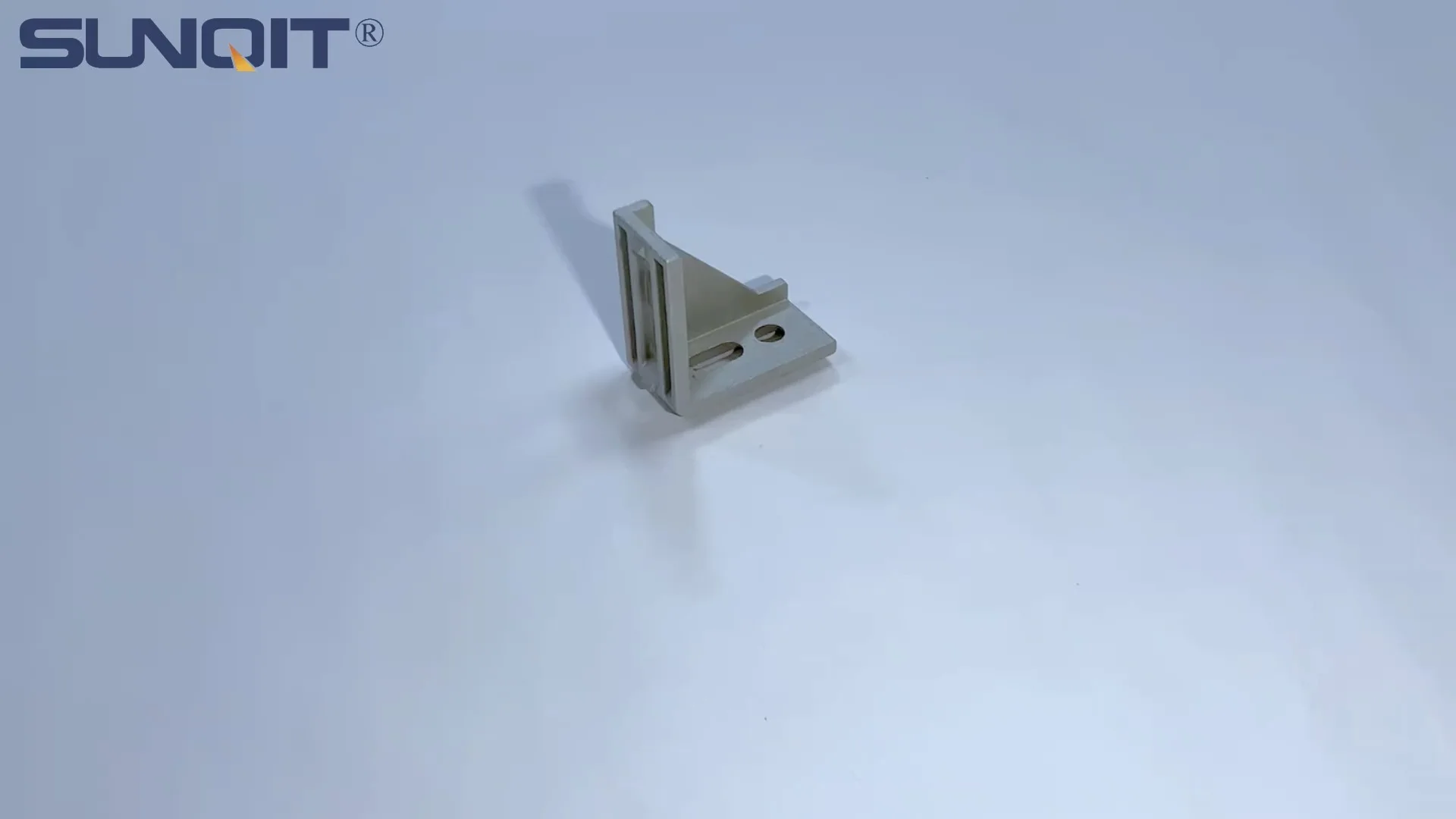
3060 Aluminum Angle Yards
It used for 90° flat connection for 20 series aluminum profile.
In the high-stakes world of medical device manufacturing, every second, every millimeter, and every detail matters. A single misalignment in assembly can compromise a life-saving tool; a cluttered workstation can slow production to a crawl; a rigid setup can derail compliance with strict regulatory standards. For decades, manufacturers in this space have grappled with these challenges, relying on traditional workbenches, fixed racks, and one-size-fits-none assembly lines that often felt more like obstacles than assets. But over the past five years, a quiet revolution has been unfolding on factory floors across the industry—one driven by a humble yet powerful component: the 3060 aluminum angle yard.
Part of the broader family of aluminum extrusion profiles, 3060 aluminum angle yards are not just pieces of metal. They're modular, adaptable, and engineered to solve the unique pain points of medical assembly. From small startups crafting specialized surgical instruments to multinational corporations producing life-sustaining devices, companies are discovering how these unassuming aluminum components are reshaping efficiency, precision, and compliance. Let's dive into their stories.
The Hidden Costs of "Good Enough" in Medical Assembly
Before we explore the transformations, it's critical to understand the baseline: what "normal" looked like for medical manufacturers just a few years ago. Walk into any medical device plant in 2018, and you'd likely encounter a patchwork of workstations: wooden benches scarred by years of use, steel racks bolted permanently to the floor, and custom-built fixtures that took weeks to design and install. These setups weren't "bad," per se—they were the best available at the time. But they came with hidden costs that added up fast.
Take precision, for example. Medical devices like pacemakers, insulin pumps, and endoscopic tools require assembly tolerances as tight as 0.001 inches. A traditional wooden workbench, however, warps over time due to humidity changes in the factory, creating uneven surfaces that throw off measurements. "We had a recurring issue with our catheter assembly line," recalls Mark, a production engineer at a mid-sized medical manufacturer in Minnesota. "The bench would bow slightly in the summer, and suddenly, our alignment jigs were off by 0.003 inches. That's three times the allowed tolerance. We'd have to shut down, sand the bench, recalibrate—hours of downtime, not to mention the scrapped parts."
Then there was flexibility. Medical device lines are rarely static. A manufacturer might produce 10,000 units of a standard syringe one quarter, then pivot to a new, smaller model for pediatric use the next. Traditional workstations, bolted and welded into place, couldn't keep up. "We'd either have to buy entirely new benches—costing $5,000 each—or spend weekends cutting and re-welding steel frames," says Lisa, operations manager at a California-based maker of diagnostic equipment. "By the time we finished, the product design might change again. It was a cycle of waste."
Compliance was another headache. The FDA and ISO 13485 demand strict controls over manufacturing environments, including surfaces that are non-porous, easy to sanitize, and resistant to chemicals (like the disinfectants used to clean work areas). Wooden benches, with their porous grain, trapped bacteria and chemicals, requiring constant re-finishing. Steel, while durable, was prone to rust if not meticulously maintained—a risk in cleanrooms where moisture levels are carefully regulated.
And let's not forget ergonomics. Assembly line workers in medical manufacturing spend 8–10 hours a day hunched over workbenches, performing repetitive tasks. Fixed-height benches forced employees to adjust their posture to the equipment, leading to chronic back pain, carpal tunnel syndrome, and high turnover. "We were losing two to three assemblers a month to injuries," says Raj, HR director at a medical device startup in Texas. "Replacing them meant training new staff, which took 6–8 weeks. It was a drain on morale and productivity."
These weren't isolated problems—they were industry-wide. And then, slowly, manufacturers began to hear whispers about a better way: aluminum extrusion profiles, and in particular, 3060 aluminum angle yards.
What Are 3060 Aluminum Angle Yards, Anyway?
At first glance, 3060 aluminum angle yards look like simple L-shaped pieces of aluminum. But their true power lies in their design. Made from high-grade aluminum alloy, they're extruded into precise, T-slot profiles—meaning they have grooves along their length that allow accessories (like brackets, shelves, and tool holders) to slide into place and lock securely with screws, no welding required. The "3060" refers to their dimensions: 30mm by 60mm, a size that strikes a perfect balance between strength and versatility for medical assembly needs.
Unlike traditional steel or wood, aluminum is naturally corrosion-resistant, non-porous, and easy to clean—ideal for sterile environments. It's also lightweight (about one-third the weight of steel), making it easy to reconfigure workstations without heavy machinery. And because it's extruded, 3060 angle yards can be cut to custom lengths on-site with basic tools, eliminating the need for expensive pre-fabrication.
But the real game-changer is their modularity. Pair 3060 aluminum angle yards with other aluminum profile accessories—like adjustable feet, swivel casters, or cross-connectors—and you can build everything from workbenches and material racks to conveyor systems and mobile trolleys. Need to raise a bench by 6 inches? Swap out the feet. Want to add a shelf for tools? Slide a bracket into the T-slot and tighten a screw. Need to move the entire workstation to a new part of the factory? Just unlock the casters and roll it.
"The first time I saw a demo, I thought, 'Why didn't we think of this sooner?'" says Maria, a plant manager at a medical device company in Illinois. "It was like building with industrial Legos—but for grown-ups who need to meet FDA standards."
By 2020, as manufacturers scrambled to adapt to pandemic-driven demand for medical equipment, 3060 aluminum angle yards stopped being a niche product and became a necessity. Let's look at how three very different companies leveraged them to transform their operations.

Success Story 1: From Startup Struggles to Scalable Growth at PrecisionMed Tools
PrecisionMed Tools, a startup based in Boston, launched in 2019 with a bold mission: to create affordable, reusable surgical retractors for small clinics and hospitals. Their first product, a lightweight retractor with interchangeable blades, showed promise—but their assembly process was holding them back.
"We started with three wooden workbenches we bought secondhand for $200 each," says founder and CEO Elena. "They were wobbly, stained, and impossible to keep clean. Our first FDA inspection in 2020 resulted in a warning letter because the benches weren't non-porous. We had to shut down production for two weeks to replace them with steel tables, which cost $3,500 apiece. But even those were a problem: they weighed 200 pounds each, so we couldn't rearrange our floor plan as we added new product lines."
By 2021, PrecisionMed had outgrown its 1,200 sq. ft. space and moved to a 5,000 sq. ft. facility. Elena knew they needed a more flexible solution. That's when she attended a manufacturing trade show and stumbled upon a boothaluminum extrusion profiles. "The sales rep showed me how you could build a workbench with 3060 aluminum angle yards in under an hour," she recalls. "He added a shelf, a light, and even a small conveyor—all without tools beyond an Allen wrench. I was sold."
PrecisionMed invested $8,000 in 3060 aluminum angle yards, aluminum profile accessories, and a few basic tools. What happened next surprised everyone on the team:
- Setup time plummeted: Building a custom workbench with 3060 angle yards took 45 minutes, down from 2 days for the steel tables. "We built six workstations in a single afternoon," Elena says. "Our old steel tables took two weeks to deliver and install."
- Compliance became a non-issue: The non-porous aluminum surface wiped clean with disinfectant, and the corrosion resistance meant no rust, even in the humid cleanroom. "Our next FDA inspection was a breeze," Elena notes. "The inspector even commented on how 'well-engineered' our workstations were."
- Scalability without the cost: As PrecisionMed added two new product lines in 2022, they reconfigured their existing workbenches instead of buying new ones. "We moved shelves, adjusted heights, and added tool rails—all in a weekend," Elena says. "We saved over $15,000 in equipment costs that year."
- Happier, healthier employees: The adjustable feet on the 3060-based workbenches let each assembler set their ideal height, reducing complaints of back pain by 80%. "Our turnover rate dropped from 30% to 5%," Elena adds. "Employees felt like we cared about their comfort, and it showed in their work."
Today, PrecisionMed is on track to hit $5 million in revenue, up from $800,000 in 2020. "Could we have grown this fast without 3060 aluminum angle yards? Maybe, but it would have cost us twice as much and taken twice as long," Elena says. "They didn't just solve our assembly problems—they gave us the flexibility to dream bigger."

Success Story 2: Streamlining Compliance and Collaboration at GlobalMed Devices
GlobalMed Devices is a Fortune 500 company with 12 manufacturing facilities worldwide, producing everything from insulin pumps to MRI machine components. By 2021, their largest U.S. plant in Ohio was struggling with a fragmented approach to assembly: each department used different workstations, leading to inconsistent quality, redundant costs, and compliance headaches.
"Our cardiac device line used custom steel workbenches, while our orthopedic division had wooden tables," explains James, operations director at the Ohio plant. "When auditors came in, they'd flag 10–15 issues per department because there was no standardization. And if we wanted to move a workstation from one line to another? Impossible—they were all built to different specs."
GlobalMed's leadership team knew they needed a unified solution, but with 200+ workstations across the plant, replacing everything at once was cost-prohibitive. Instead, they decided to pilot 3060 aluminum angle yards in their high-mix, low-volume division—a unit that produced specialized spinal implants and often changed production runs weekly.
"We started with 10 workstations," James says. "The goal was to see if aluminum extrusion profiles could handle the precision required for spinal implants, which have tolerances of 0.0005 inches. We also wanted to test if they could reduce setup time between production runs."
The results were staggering. Within three months, the pilot division saw:
- A 65% reduction in changeover time: Switching from one implant model to another used to take 4 hours (dismantling old fixtures, installing new ones). With 3060 angle yards, assemblers simply swapped out tooling plates and adjusted brackets—done in 90 minutes. "We went from running 2 production runs a day to 4," James says.
- 99% audit compliance: Standardizing on 3060-based workstations meant every surface, shelf, and tool holder met the same FDA and ISO standards. "Our last audit had zero findings in the pilot area," James notes. "The auditors called it a 'model for consistency.'"
- Better collaboration between shifts: Because the workstations were identical, night shift assemblers could easily pick up where day shift left off. "No more 'Why did they set this up this way?' conversations," James laughs. "The T-slot system made adjustments intuitive for everyone."
- Long-term cost savings: While the initial investment per workstation was 15% higher than steel ($3,800 vs. $3,300), the reusability of the 3060 angle yards meant GlobalMed avoided buying new workstations for the pilot division for three years. "We estimate we've saved $400,000 in equipment costs alone," James says.
Encouraged by the pilot, GlobalMed rolled out 3060 aluminum angle yards across all 12 facilities over the next two years. Today, James estimates the company has saved over $5 million in compliance costs, downtime, and equipment purchases. "It's not just about the workstations," he says. "It's about creating a culture of adaptability. When your tools can change as fast as your needs, you stop seeing challenges as obstacles—and start seeing them as opportunities."

Success Story 3: From Garage Startup to FDA-Approved with 3060 Aluminum Angle Yards
Not all success stories involve large corporations. Take MediFlow, a startup founded in 2020 by two former aerospace engineers, Priya and Kevin, who wanted to create a portable IV fluid warmer for rural hospitals. Working out of Kevin's garage, they faced a classic startup problem: limited space and even more limited funds.
"We had a $50,000 budget for equipment, and that had to cover everything from 3D printers to assembly tools," Priya recalls. "Traditional workbenches were out of the question—we couldn't afford them, and we didn't have room to store them. We were using folding tables from a big-box store, but they wobbled so much that assembling the delicate heating elements was nearly impossible."
While researching low-cost manufacturing solutions online, Priya stumbled upon a video of someone building a workbench with aluminum extrusion profiles. Intrigued, she ordered a small batch of 3060 aluminum angle yards and accessories—$800 total—and set to work.
"We built a corner workstation that folded up against the wall when not in use," she says. "It had a fold-down tabletop, a shelf for tools, and even a small LED light bar powered by a battery pack. When we needed to test the IV warmers, we just rolled it to the garage door for natural light."
As MediFlow grew, so did their 3060 setup. By the time they moved into a 1,000 sq. ft. warehouse in 2021, they'd expanded to three modular workstations, all built with 3060 angle yards. "We even built a mobile material rack using the same system," Kevin adds. "It had casters, so we could roll it right to the assembly line instead of walking back and forth to storage."
In 2022, MediFlow applied for FDA approval. To their surprise, their 3060-based workstations became a selling point during the inspection.
"The inspector asked how we maintained sterility in such a small space," Priya says. "We showed her how we could take apart the workbench shelves, wipe them down with alcohol, and put them back in 5 minutes. She was impressed—she said most startups her team visits have 'makeshift' setups, but ours looked professional."
Today, MediFlow's IV warmers are in over 200 rural hospitals, and the company has raised $2 million in funding. "Our investors often comment on how organized our production line is, even for a startup," Kevin says. "We tell them it's all thanks to 3060 aluminum angle yards. They let us punch above our weight—look like a big company, even when we were just two people in a garage."
Traditional vs. 3060 Aluminum Angle Yard Workstations: A Side-by-Side Comparison
| Feature | Traditional Workstations (Wood/Steel) | 3060 Aluminum Angle Yard Workstations |
|---|---|---|
| Setup Time | 2–3 days (requires welding/cutting) | 45–90 minutes (tool-free assembly with T-slots) |
| Flexibility | Low: Fixed design; difficult to reconfigure | High: Modular accessories allow quick adjustments (height, shelves, tooling) |
| Compliance | Variable: Wood warps/traps bacteria; steel prone to rust | High: Non-porous, corrosion-resistant, easy to sanitize (meets FDA/ISO 13485) |
| Durability | 5–7 years (wood rots; steel rusts/warps) | 15+ years (aluminum resists corrosion; T-slots maintain integrity over time) |
| Cost Over 5 Years* | $8,000–$12,000 (initial purchase + replacements/repairs) | $4,500–$6,000 (initial purchase + reconfiguration costs) |
| Ergonomics | Poor: Fixed height; no customization for user comfort | Excellent: Adjustable feet, height, and accessories reduce strain |
*Based on a single workstation used in a mid-sized medical manufacturing facility.
Why 3060 Aluminum Angle Yards Are More Than a Fad
Some might wonder: Are 3060 aluminum angle yards just the latest manufacturing trend, or do they offer lasting value? The answer lies in their alignment with the future of medical device manufacturing—a future defined by three key trends: personalization, agility, and sustainability.
Personalized medicine is driving demand for custom medical devices (e.g., 3D-printed implants tailored to a patient's anatomy). This requires assembly lines that can switch between designs quickly—something 3060 angle yards excel at. "We're seeing a 30% increase in custom orders annually," says Dr. Lisa Wong, a medical device industry analyst. "Manufacturers that can't adapt will get left behind. Aluminum extrusion profiles like 3060 are critical for that adaptability."
Agility is also key as supply chains become more unpredictable. "Covid taught us we need to pivot fast—whether it's shifting production to PPE or relocating lines to avoid disruptions," James from GlobalMed notes. "3060 angle yards let us be agile without sacrificing quality."
And sustainability? Aluminum is 100% recyclable, and because 3060 angle yards are modular, they rarely end up in landfills. "We've had workstations in our pilot area for 3 years, and they still look new," Elena from PrecisionMed says. "When we eventually upgrade, we'll recycle the aluminum—no waste."
Conclusion: Building the Future of Medical Assembly, One Angle Yard at a Time
Medical device manufacturing is a field where innovation can mean the difference between life and death. For too long, assembly lines have been the bottleneck—rigid, slow, and ill-suited to the industry's evolving needs. But 3060 aluminum angle yards are changing that. They're not just tools; they're enablers. Enablers of precision, compliance, and flexibility. Enablers of happier, healthier employees. Enablers of startups that dream big and corporations that need to stay ahead.
As we've seen in the stories of PrecisionMed, GlobalMed, and MediFlow, the impact of 3060 aluminum angle yards goes beyond the factory floor. It's in the reduced downtime, the lower costs, the audit approvals, and the lives improved by the devices they help build. It's in the realization that sometimes, the most powerful innovations aren't flashy—they're the ones that make the hard work of saving lives a little easier.
So the next time you walk into a medical device plant, take a closer look at the workbenches. Chances are, you'll see 3060 aluminum angle yards hard at work—quietly, reliably, transforming assembly from a chore into a competitive advantage. And that, perhaps, is their greatest success story of all.