- Company Articles
- Products and Technology
- Procurement Guidelines
- Supplier Selection Criteria for 3060 National Standard Profile A

Supplier Selection Criteria for 3060 National Standard Profile A
Related Product
3060 National Standard Profile A
Workbench, production line, logistic rack, warehouse rack Industry: Manufacturer workshop, Automobile, Electronic, Assembling, logistic
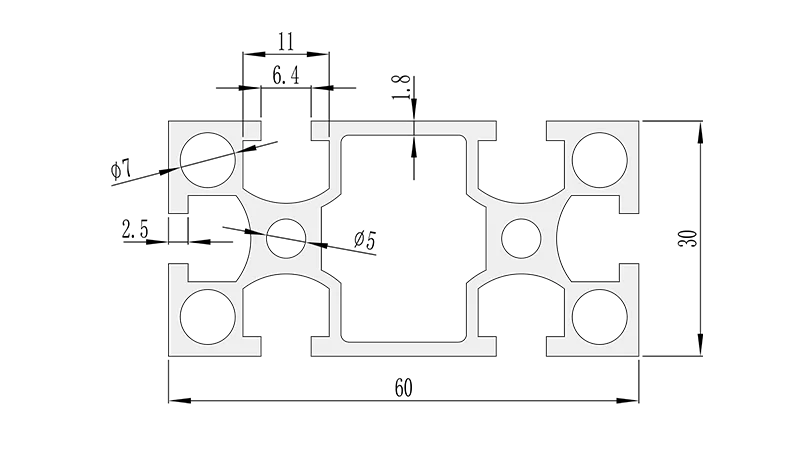
In the fast-paced world of manufacturing, where every component plays a critical role in the final product, choosing the right supplier for essential materials can make or break your production line. For companies relying on aluminum extrusions—particularly the versatile 3060 National Standard Profile A—this decision carries even more weight. This unassuming piece of metal, with its 30mm x 60mm cross-section, is the backbone of countless industrial applications: from assembly workbenches and material racks to automated conveyor systems and machine guards. Its popularity stems from a unique blend of strength, lightweight design, and adaptability, but these benefits only hold true if the profile itself meets rigorous quality standards. And that's where the supplier comes in.
Selecting a supplier for 3060 National Standard Profile A isn't just about comparing price tags. It's about finding a partner who understands your production needs, prioritizes consistency, and can deliver not just a product, but peace of mind. In this guide, we'll break down the key criteria that should shape your decision, drawing on real-world challenges and best practices to help you navigate the crowded market of aluminum profile suppliers. Whether you're a small workshop ramping up production or a large-scale manufacturer optimizing your supply chain, these insights will help you avoid costly mistakes and build a reliable foundation for your operations.
Understanding the 3060 National Standard Profile A: Why It Matters
Before diving into supplier criteria, let's clarify what makes the 3060 National Standard Profile A so indispensable. As a member of the aluminum extrusion profile family, it's produced by forcing heated aluminum alloy through a die to create a consistent, custom cross-section. The "3060" refers to its dimensions—30mm in width and 60mm in height—while "National Standard" ensures compliance with strict industry specifications for material composition, mechanical properties, and dimensional accuracy. This standardization is critical: it means you can source the profile from multiple suppliers (if needed) without worrying about compatibility issues, and it guarantees that the profile will perform as expected under load, in various environments, and over time.
The applications of 3060 National Standard Profile A are as diverse as the industries that use it. Automotive manufacturers rely on it for lightweight yet sturdy assembly line fixtures; electronics companies use it to build ESD-safe workstations; and logistics firms integrate it into modular material racks for efficient inventory management. In each case, the profile's performance directly impacts productivity: a warped section could throw off the alignment of a conveyor belt, while a weak alloy might lead to premature failure of a heavy-duty workbench. For these reasons, settling for a subpar supplier isn't an option—it's a risk that could result in production delays, increased maintenance costs, or even product recalls.
Real-World Impact: A mid-sized electronics manufacturer once opted for a low-cost supplier of 3060 profiles to cut expenses on a new line of assembly workbenches. Within six months, the profiles began to show signs of stress: joints loosened, surfaces scratched easily, and in one case, a section bent under the weight of equipment. An investigation revealed the supplier had used a lower-grade aluminum alloy (6061 instead of the specified 6063) and skipped the anodizing step to reduce costs. The result? The manufacturer spent twice the initial savings on replacements and lost two weeks of production—all because supplier selection was based solely on price.
Key Criteria for Selecting Your 3060 National Standard Profile A Supplier
1. Quality Control: From Raw Material to Finished Product
Quality is the cornerstone of any reliable supply relationship, and for 3060 National Standard Profile A, it starts with the raw materials. The best suppliers use high-purity aluminum alloys—typically 6063-T5 or 6061-T6—known for their excellent extrudability, corrosion resistance, and structural integrity. Ask potential suppliers for material certificates (such as mill test reports) to verify the alloy composition; a reputable supplier will provide these without hesitation. But alloy quality is just the beginning. The extrusion process itself must be tightly controlled to ensure dimensional accuracy. Even a deviation of 0.1mm in the profile's width or height can cause misalignment when assembling with aluminum profile accessories like connectors, brackets, or end caps—components that are designed to fit the national standard precisely.
Surface treatment is another critical quality factor. Most 3060 profiles undergo anodizing, a process that creates a protective oxide layer on the surface, enhancing corrosion resistance and durability. The thickness of this layer (measured in microns) should meet national standards—usually 8-12 microns for industrial use. Suppliers should also offer consistent color options (common choices include silver, black, or custom hues) with uniform coverage, free from streaks, pits, or discoloration. Don't be afraid to request samples: a small section of profile can reveal a lot about a supplier's attention to detail. Run your hand along the surface—does it feel smooth and consistent? Check the edges for burrs or sharpness, which could indicate poor post-extrusion finishing.
Finally, consider long-term durability. A quality 3060 profile should withstand daily wear and tear, resist chipping or fading, and maintain its structural properties even in harsh environments (e.g., high humidity or temperature fluctuations). Suppliers who conduct rigorous testing—such as salt spray tests for corrosion resistance or load tests for flexural strength—demonstrate a commitment to quality that goes beyond surface-level checks.
2. Manufacturing Capabilities and Capacity
Even the highest-quality raw materials won't save you if the supplier can't meet your production demands. When evaluating a supplier for 3060 National Standard Profile A, it's essential to assess their manufacturing capabilities and capacity. Start with extrusion equipment: modern, well-maintained presses (ideally 1,000 tons or higher for profiles of this size) ensure consistent pressure and temperature control during extrusion, leading to more uniform profiles. Suppliers with in-house tooling capabilities are also preferable—they can quickly adjust dies to fine-tune dimensions or accommodate custom requests, reducing lead times.
Capacity is equally important, especially if your business experiences seasonal fluctuations or plans for growth. Ask about the supplier's maximum monthly output for 3060 profiles and their current order backlog. A supplier operating at 90% capacity might struggle to fulfill a sudden surge in your orders, while one with excess capacity could offer flexibility in delivery schedules. It's also worth inquiring about their ability to handle large-volume orders: can they produce 10,000 meters of profile in a month? What about 50,000? The answer should align with your long-term production forecasts.
Vertical integration is another plus. Suppliers who control the entire production process—from melting raw aluminum to finishing the extruded profile—have more control over quality and lead times. In contrast, suppliers who outsource key steps (e.g., anodizing or cutting) introduce additional points of failure, as coordination between third parties can lead to delays or miscommunication.
3. Range of Aluminum Profile Accessories and Complementary Products
A profile is only as useful as the accessories that bring it to life. 3060 National Standard Profile A is designed to work with a wide range of aluminum profile accessories—connectors, end caps, hinges, T-slot nuts, and brackets—that enable quick, tool-free assembly. A supplier who offers a comprehensive lineup of these accessories not only simplifies your procurement process (one order, one delivery) but also ensures compatibility. Mismatched accessories—say, a connector that's slightly too loose or a bracket that doesn't fit the profile's T-slot—can turn a straightforward assembly into a frustrating, time-consuming task.
When evaluating a supplier's accessory offerings, look for completeness. Do they stock standard components like 3060 aluminum angle yards, which are essential for joining profiles at 90-degree angles? What about specialized parts, such as ESD-safe end caps for electronics manufacturing or heavy-duty casters for mobile workbenches? A supplier who invests in a diverse accessory catalog demonstrates an understanding of their customers' end-use cases, which can be invaluable when troubleshooting or designing custom solutions.
Consistency in accessory quality is also key. Just as with the profile itself, accessories should be made from high-grade materials (e.g., die-cast aluminum for connectors or nylon for wear-resistant nuts) and manufactured to tight tolerances. A flimsy connector could compromise the stability of an entire structure, so don't overlook this aspect in favor of lower costs.
4. Pricing Transparency and Value for Money
Cost is always a factor in supplier selection, but it should never be the sole deciding one. The goal is to find value for money—not the lowest price. A slightly higher upfront cost for a quality profile from a reliable supplier can save you thousands in the long run by reducing waste, minimizing downtime, and extending the lifespan of your equipment. That said, pricing transparency is critical: you need to understand exactly what you're paying for and why.
Start by requesting a detailed quote that breaks down costs by component: raw material, extrusion, surface treatment, cutting (if applicable), and shipping. Be wary of suppliers who provide vague estimates or refuse to itemize charges—this often hides hidden fees, such as minimum order quantities, rush delivery surcharges, or accessory markups. A transparent supplier will also explain how market fluctuations (e.g., changes in aluminum prices) might affect pricing over time and work with you to develop a flexible contract that accounts for these variables.
Volume discounts are another area to explore. Many suppliers offer tiered pricing for large orders, which can significantly reduce per-unit costs if you have steady demand for 3060 profiles. However, be cautious of minimum order requirements that exceed your short-term needs—storing excess inventory ties up capital and increases the risk of damage or obsolescence.
Pricing Pitfall to Avoid: A manufacturer once signed a contract with a supplier offering 15% lower prices on 3060 profiles than competitors. What they didn't realize was the fine print: the price excluded surface treatment, which added 20% to the final cost. Worse, the supplier required a 5,000-meter minimum order, which the manufacturer couldn't use within six months. By the time they factored in storage costs and the unexpected treatment fee, the "cheaper" option ended up costing 10% more than the original quote from a reputable supplier.
5. Technical Support and Engineering Expertise
Even the most experienced manufacturers encounter challenges when working with aluminum extrusions. Maybe you need to optimize a design to reduce weight without sacrificing strength, or perhaps you're integrating 3060 profiles into a new automated system and need help calculating load capacities. In these situations, a supplier with strong technical support can be a game-changer. Look for suppliers who employ in-house engineers with expertise in aluminum extrusion design and application engineering. These professionals can provide guidance on material selection, profile modification, and assembly best practices, helping you avoid common pitfalls and unlock the profile's full potential.
Technical support should extend beyond pre-sales. Post-purchase assistance is equally important. If you receive a batch of profiles with unexpected defects, or if an accessory fails during assembly, the supplier should respond promptly—ideally within 24 hours—to investigate, offer a solution, and prevent recurrence. Some suppliers even provide on-site support, sending technicians to your facility to troubleshoot assembly issues or conduct training sessions for your team.
Documentation is another indicator of strong technical support. Does the supplier provide detailed CAD files for 3060 National Standard Profile A and its accessories? What about installation guides, load capacity charts, or material safety data sheets? These resources not only streamline your design process but also ensure compliance with industry regulations and safety standards.
6. Compliance and Certifications
In manufacturing, compliance isn't optional—it's a legal and ethical imperative. For 3060 National Standard Profile A, this starts with adherence to the national standard itself, which outlines specifications for dimensions, mechanical properties, and material composition. But reputable suppliers go further, obtaining certifications that validate their commitment to quality and safety. Look for ISO 9001 certification, which ensures the supplier has a robust quality management system in place, and ISO 14001 for environmental responsibility, if sustainability is a priority for your business.
Material traceability is another critical compliance factor. In industries like aerospace or medical device manufacturing, you may need to trace each profile back to its batch of raw aluminum. A supplier who maintains detailed production records—including melt numbers, extrusion dates, and quality test results—can provide this traceability, which is essential for audits and recalls.
Finally, consider regional and industry-specific regulations. If you export products made with 3060 profiles, the supplier must comply with international standards, such as RoHS (Restriction of Hazardous Substances) or REACH (Registration, Evaluation, Authorization, and Restriction of Chemicals) in the EU. Failure to meet these requirements could result in customs delays or bans on your products, so it's critical to verify compliance upfront.
7. Reliability and On-Time Delivery
In manufacturing, time is money. A delayed shipment of 3060 profiles can bring your assembly line to a halt, idle workers, and derail customer deadlines. That's why reliability—specifically, on-time delivery—is non-negotiable when selecting a supplier. Start by asking for the supplier's on-time delivery rate (OTDR), ideally over the past 12 months. A rate of 95% or higher is a good benchmark, but dig deeper: what counts as "on time"? Some suppliers define it as delivery within a 3-day window, while others stick to exact dates. Clarify this to avoid misunderstandings.
To ensure reliability, inquire about the supplier's logistics network. Do they have partnerships with reputable freight carriers? Can they provide tracking information for shipments? Do they offer expedited shipping options for emergencies? A supplier with a well-established logistics system is better equipped to handle disruptions—whether a weather delay or a carrier issue—and keep your orders on track.
Communication is also key during the delivery process. A proactive supplier will notify you of potential delays as soon as they arise, along with a revised timeline and contingency plans. This transparency allows you to adjust your production schedule accordingly, minimizing the impact on your operations.
Comparing Suppliers: A Practical Evaluation Table
To put these criteria into action, we've created a handy evaluation table to help you compare potential suppliers side by side. Use this as a checklist during your selection process, assigning scores (1-5, with 5 being excellent) to each criterion based on your research, supplier interviews, and sample evaluations.
| Evaluation Criteria | What to Look For | Why It Matters | Red Flags |
|---|---|---|---|
| Material Quality | Certified 6063-T5/6061-T6 alloy; consistent extrusion; anodizing thickness ≥8 microns | Ensures strength, corrosion resistance, and compatibility with accessories | Refusal to provide material certificates; visible defects (scratches, warping) in samples |
| Accessory Range | Comprehensive lineup of 3060-compatible connectors, brackets, and end caps | Simplifies procurement and guarantees compatibility during assembly | Limited accessory options; reliance on third-party accessory suppliers |
| Technical Support | In-house engineers; 24-hour response time for inquiries; on-site troubleshooting | Helps resolve design and assembly challenges quickly | No dedicated technical team; slow or unhelpful responses to questions |
| On-Time Delivery | OTDR ≥95%; clear delivery windows; proactive delay communication | Prevents production downtime and keeps operations on schedule | OTDR <90%; vague delivery timelines; unannounced delays |
| Compliance | ISO 9001 certification; RoHS/REACH compliance; material traceability | Ensures product safety, regulatory compliance, and quality consistency | Missing certifications; inability to provide traceability records |
Conclusion: Building a Partnership for Long-Term Success
Selecting a supplier for 3060 National Standard Profile A is more than a transaction—it's the foundation of a partnership that will impact your business for years to come. By prioritizing quality, manufacturing capabilities, accessory compatibility, technical support, compliance, and reliability, you'll not only secure a steady supply of high-performance profiles but also gain a trusted advisor who can help you navigate the challenges of modern manufacturing.
Remember, the cheapest option rarely delivers the best value. Instead, focus on suppliers who align with your long-term goals, demonstrate a commitment to excellence, and view your success as their own. Take the time to request samples, visit facilities (if possible), and speak with existing customers. The effort you invest now will pay off in fewer headaches, lower costs, and a more resilient production line down the road.
In the end, the right aluminum profile supplier isn't just a vendor—they're an extension of your team. Choose wisely, and watch your operations thrive.