- Company Articles
- Products and Technology
- Product knowledge
- Sustainability of T Slot Aluminum Pipe with Board Holder: Reusability & Eco-Friendliness

Sustainability of T Slot Aluminum Pipe with Board Holder: Reusability & Eco-Friendliness
Related Product
T Slot Aluminum Pipe with Board Holder
T slot Aluminum pipe with board holder,the pipe one side connected by a joint, the other side with a slot which can hold a tray or a aluminum pannel
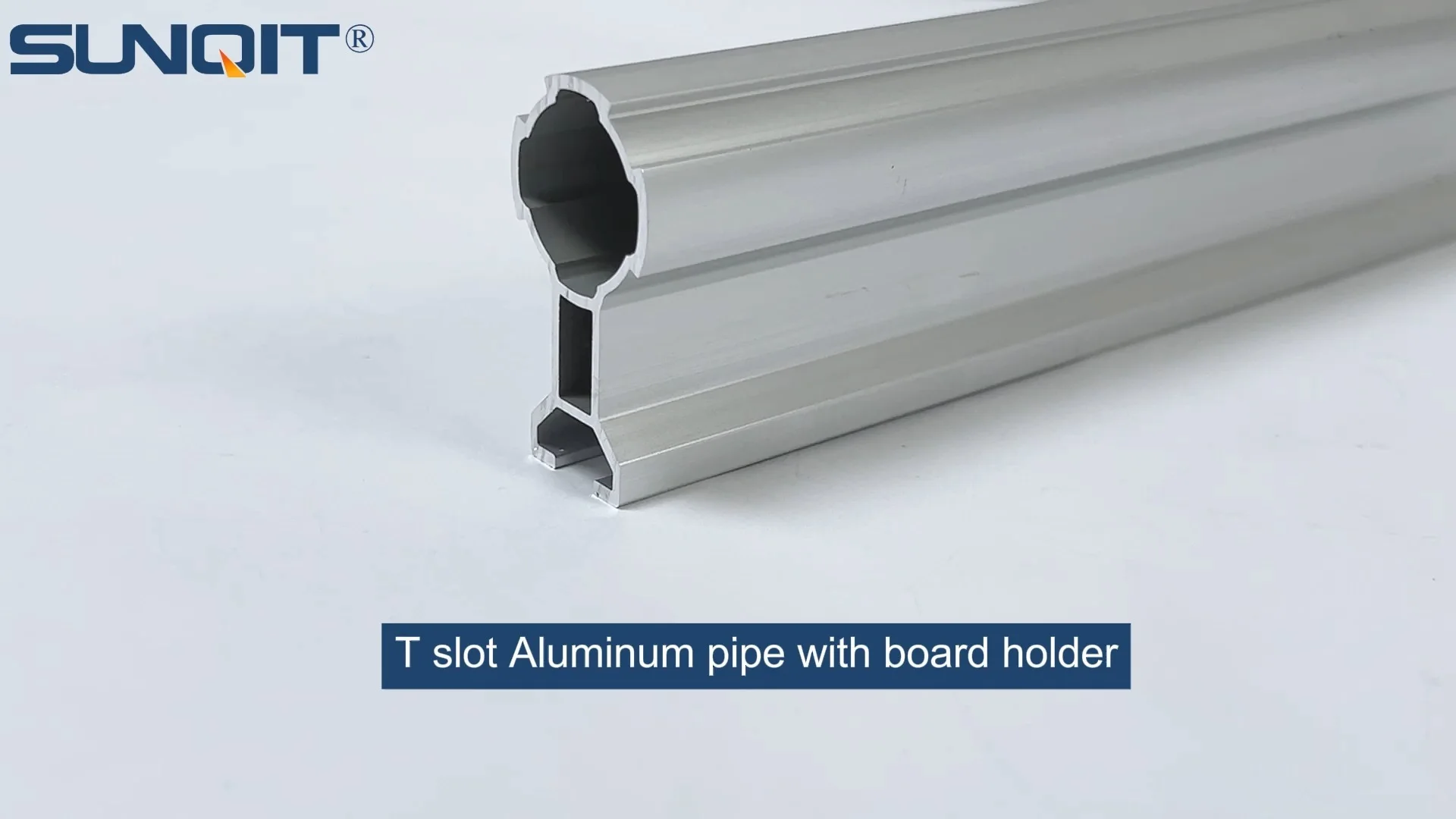
In today's manufacturing landscape, the word "sustainability" is more than just a buzzword—it's a pressing necessity. As factories, warehouses, and production facilities strive to reduce their environmental footprint, every decision—from the machinery they use to the materials they build with—carries weight. Enter T slot aluminum pipe with board holder: a humble yet revolutionary solution that's quietly transforming how we think about industrial design, waste reduction, and long-term eco-friendliness. But what makes this material so special? Let's dive in.
What Even Is T Slot Aluminum Pipe, Anyway?
If you've ever walked through a modern workshop or a lean manufacturing floor, you've probably seen T slot aluminum pipe in action—even if you didn't know its name. Picture a sleek, lightweight metal pipe with a continuous groove (the "T slot") running along its length. That slot isn't just for show: it's a built-in connection point, allowing you to attach accessories like brackets, shelves, or board holders without welding, drilling, or heavy tools. Pair it with a board holder, and suddenly you've got a customizable workbench, a material rack, or a conveyor system—all assembled in hours, not days.
But T slot aluminum pipe isn't just about convenience. Its real power lies in its adaptability. Unlike traditional steel pipes or plastic tubing, which are often fixed in shape once installed, T slot aluminum pipe bends (metaphorically, of course) to your needs. Need to reconfigure a workstation for a new product line? Swap out the accessories. Expand a storage rack? Add a few more pipes and connectors. This flexibility isn't just a time-saver—it's the cornerstone of its sustainability story.
Why Sustainability Matters in Manufacturing (Spoiler: It's Not Just About the Planet)
Before we dig into the specifics of T slot aluminum pipe, let's talk about why sustainability in manufacturing matters. The numbers are stark: according to the Environmental Protection Agency, the manufacturing sector accounts for nearly 25% of global carbon emissions. Add to that the mountains of waste generated from outdated, non-recyclable equipment—think rusted steel frames, broken plastic components—and it's clear that the status quo isn't working. But here's the good news: sustainable choices often align with smart business sense. Reducing waste means lower disposal costs. Reusing materials cuts down on purchasing new ones. And eco-friendly practices? They're increasingly a selling point for clients and customers who care about the planet.
This is where T slot aluminum pipe shines. It's not just a "green" material by accident; it's designed from the ground up to address both environmental and economic concerns. Let's break down its two biggest sustainability superpowers: reusability and eco-friendliness.

Reusability: The "Use It Again" Revolution
Let's start with reusability—because in sustainability, the best waste is the waste you never create. Traditional manufacturing setups often follow a "build once, replace later" model. A steel workbench, for example, is welded together, making it nearly impossible to modify. When your needs change—say, you need a taller bench or extra shelving—you're stuck: either you hack the existing structure (and risk weakening it) or you throw it away and buy a new one. Both options are costly, time-consuming, and wasteful.
T slot aluminum pipe flips that script. Thanks to its modular design and aluminum profile accessories—think connectors, clamps, and brackets—you can disassemble, reconfigure, and reuse the same pipes and parts over and over. Let's say you start with a simple workbench (single deck, no casters, as they say in the industry). A year later, you need a mobile trolley. Instead of buying a new trolley, you can add casters to the existing frame, swap out the top for a sturdier aluminum honeycomb panel, and voila—your "old" workbench is now a brand-new trolley. No waste, no extra cost, just adaptability.
I recently spoke with Maria, a production manager at a mid-sized electronics plant, who shared her experience. "We used to replace our assembly lines every two years because product specs changed so fast," she told me. "Steel frames, wooden shelves—they all ended up in the scrapyard. Then we switched to T slot aluminum pipe. Last year, we reconfigured three entire lines using the same pipes and aluminum pipe clamps. We saved over $15,000 in new equipment costs, and we didn't send a single piece of metal to the landfill. It was a game-changer."
The key here is the system's flexibility. Aluminum profile accessories like clamps and connectors are designed to be easily removed and reattached, meaning the pipes themselves never lose their structural integrity. Even after years of use, a T slot aluminum pipe can be repurposed into something entirely different. Compare that to plastic, which degrades over time, or steel, which rusts and weakens—reusability isn't just a feature; it's a lifecycle.

Eco-Friendliness: From Cradle to Cradle
Reusability is great, but what about the material itself? Aluminum has long been hailed as one of the most eco-friendly metals on the planet, and for good reason. Let's start with its production: while mining and refining aluminum does require energy, the real magic happens in recycling. Aluminum is 100% recyclable, and recycling it uses just 5% of the energy needed to produce new aluminum from raw ore. That's a 95% energy savings! To put that in perspective: recycling one ton of aluminum saves enough energy to power a home for 10 years.
T slot aluminum pipe takes that a step further. Unlike some aluminum products that are mixed with other materials (making recycling harder), T slot pipes are typically made from high-purity aluminum alloys. This means when they do reach the end of their long, reused life (which, let's be clear, is decades down the line), they can be melted down and turned into new pipes, accessories, or even other products—no loss in quality, no waste.
But it's not just about recycling. The production process of T slot aluminum pipe is also surprisingly green. Unlike steel, which requires high-temperature forging, aluminum extrusion (the process used to make T slot pipes) uses relatively low energy. Plus, the extrusion process itself generates minimal waste—scrap aluminum from production is immediately recycled back into the process. And because T slot pipes are lightweight, transporting them uses less fuel than hauling heavy steel, further reducing their carbon footprint.
| Material | Reusability | Recyclability | Energy Use (Production) | Typical Lifespan |
|---|---|---|---|---|
| T Slot Aluminum Pipe | High (unlimited reconfiguration with accessories) | 100% recyclable, 95% energy savings vs. new | Low (aluminum extrusion uses minimal energy) | 20+ years (with proper care) |
| Steel Pipe | Low (welded joints make modification difficult) | Recyclable, but 70% energy savings vs. new | High (requires high-temperature forging) | 10-15 years (prone to rust) |
| Plastic Pipe | Very Low (degrades over time, weakens with reuse) | Limited (often downcycled, not fully recyclable) | Moderate (petroleum-based, high carbon footprint) | 3-5 years (prone to cracking, warping) |
Aluminum Honeycomb Panels: The Perfect Eco-Friendly Partner
No discussion of T slot aluminum pipe's sustainability is complete without mentioning its frequent sidekick: the aluminum honeycomb panel. These panels, made from a lightweight aluminum core sandwiched between thin aluminum sheets, are often used as tops for workbenches or shelves in T slot setups. Why? Because they're strong, lightweight, and—you guessed it—incredibly sustainable.
Aluminum honeycomb panels are a study in efficiency. Their honeycomb structure mimics nature (think beehives), providing strength without excess weight. This means less material is used to achieve the same (or better) performance as solid wood or steel panels. And like T slot pipes, they're 100% recyclable. When paired with T slot aluminum pipe, the result is a setup that's not just modular but also materially efficient—no unnecessary bulk, no wasteful over-engineering.
John, a warehouse manager I interviewed, put it this way: "We used to use thick plywood for our workbench tops. They'd warp, splinter, and need replacing every couple of years. Now we use aluminum honeycomb panels with T slot frames. They're lighter, so the whole setup is easier to move, and they've lasted five years without a scratch. When we do eventually replace them, we'll just send them to the recycler—no guilt, no landfill."
Lean Systems: Sustainability Meets Efficiency
If you're familiar with lean manufacturing, you know its core principle: eliminate waste. T slot aluminum pipe and its accessories are practically a poster child for lean systems. Lean manufacturing focuses on streamlining processes, reducing excess inventory, and maximizing efficiency—and T slot setups support all three. Because they're modular, you can build exactly what you need, no more, no less. No over-ordering parts, no storing unused equipment, no wasted space.
Take material flow, for example. A well-designed lean system ensures materials move smoothly from one workstation to the next, minimizing delays. T slot aluminum pipe conveyors, built with roller tracks and lightweight frames, make this easy. And when your production line changes? You reconfigure the conveyor instead of replacing it. It's lean thinking applied to physical infrastructure—and it's a powerful way to reduce waste.
Sarah, a lean coordinator at an automotive parts plant, explained: "We used to have a 'just-in-case' mindset—we'd build extra workstations 'just in case' we needed them. With T slot aluminum, we build 'just-in-time.' If demand spikes, we add a few pipes and connectors. If it drops, we disassemble and store the parts. We've cut our storage costs by 30% and our waste by even more. It's lean, it's green, and it's good for the bottom line."
The Future of Sustainable Manufacturing: It's in the Pipes
As we look to the future, the role of T slot aluminum pipe in sustainable manufacturing is only going to grow. Innovations in aluminum alloys are making pipes even stronger and lighter, while new aluminum profile accessories—like quick-connect joints and tool-free clamps—are making reconfiguration easier than ever. And as more companies adopt circular economy models (where products are designed to be reused, repaired, and recycled), T slot aluminum pipe will become an essential tool in their toolkit.
But perhaps the most exciting thing about T slot aluminum pipe is how accessible it is. You don't need a massive budget or a team of engineers to start using it. Small businesses, startups, and even hobbyists can benefit from its sustainability and flexibility. It's a reminder that sustainability doesn't have to be complicated or expensive—it can be as simple as choosing materials that work with you, not against you.
Final Thoughts: Sustainability Isn't a Choice Anymore
At the end of the day, T slot aluminum pipe with board holder isn't just a material—it's a mindset. It's about choosing to build for the long term, to value adaptability over rigidity, and to see waste not as inevitable but as avoidable. In a world where every decision counts, it's a small change that can make a big difference. So the next time you're planning a new workstation, a conveyor system, or a storage rack, ask yourself: Is this built to last, or built to be replaced? With T slot aluminum pipe, the answer is clear.
Sustainability isn't about perfection; it's about progress. And T slot aluminum pipe? It's progress you can build with your own hands.