- Company Articles
- Products and Technology
- Product knowledge
- Sustainable Manufacturing Goals: Four Way Straight Lean Pipe Joint for Circular Economy

Sustainable Manufacturing Goals: Four Way Straight Lean Pipe Joint for Circular Economy
Related Product
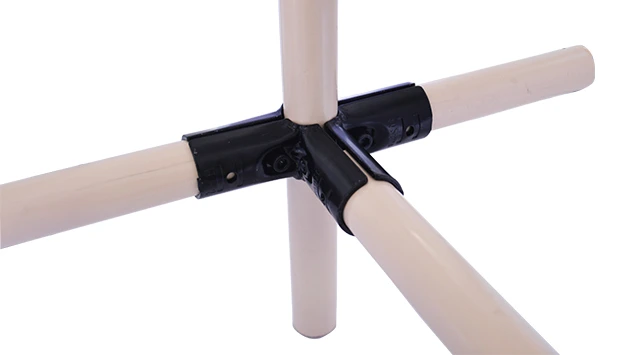
Four Way Straight Lean Pipe Joint
Four way lean pipe joint for 4 pcs 28MM lean pipe connection in straight angle, which used widely in workbench, flow rack, hand trolley frame connection.
Walk through a typical manufacturing plant a decade ago, and you might have seen piles of discarded metal frames in the corner—once part of production lines, now obsolete because the product design changed. That was the linear economy in action: make, use, discard. Today, that scene is increasingly rare, replaced by facilities where every component is designed to adapt, reuse, and recycle. As manufacturers face mounting pressure to cut carbon footprints, reduce waste, and meet strict sustainability targets, the circular economy has emerged as more than a buzzword—it's a survival strategy. And at the heart of this shift? Surprisingly small components, like the four way straight lean pipe joint, that quietly enable big changes in how we build, operate, and sustain manufacturing systems.
What is Circular Economy in Manufacturing?
To understand why components like the four way straight lean pipe joint matter, let's first clarify what circular economy means for manufacturing. Traditional manufacturing follows a linear model: extract raw materials, produce goods, distribute them, use them, then throw them away. This "take-make-waste" approach is resource-intensive, generates massive waste, and contributes to climate change. The circular economy flips this script. It's an economic system designed to eliminate waste and keep resources in use for as long as possible through four core principles: reduce, reuse, recycle, and recover. In manufacturing, this translates to designing products and production systems that are modular, repairable, and recyclable—so when a line is reconfigured or a product is retired, its components don't end up in a landfill but are instead repurposed or recycled.
For example, consider a smartphone manufacturer that uses modular components. When the camera module becomes outdated, instead of replacing the entire phone, users can swap just the camera. In manufacturing, this same logic applies to production lines. If a line needs to shift from assembling laptops to tablets, the ideal scenario is reusing existing workbenches, flow racks, and material carts—adjusting their structure rather than building new ones from scratch. This is where lean systems and modular components become critical allies of the circular economy.
Lean Systems: Aligning Efficiency with Sustainability
Lean manufacturing has long been celebrated for its focus on waste reduction—eliminating "muda" (Japanese for waste) in all forms, from excess inventory to unnecessary motion. But in recent years, lean systems have evolved beyond just operational efficiency to embrace environmental sustainability. Today's lean isn't just about cutting costs; it's about creating value with fewer resources, lower energy use, and minimal environmental impact. This alignment between lean and circular economy is no coincidence. Both prioritize efficiency, continuous improvement, and long-term resilience. A lean system that minimizes material waste in production, for instance, directly supports the circular goal of reducing resource extraction. Similarly, a circular approach that designs for reuse aligns with lean's emphasis on flexibility and adaptability.
At the core of any lean system are its physical components: workbenches, flow racks, conveyors, and the structures that hold them together. These components must be durable enough to withstand daily use, flexible enough to adapt to changing production needs, and sustainable enough to minimize environmental impact. Enter modular lean pipe systems—assemblies built from pipes, joints, and accessories that can be easily configured, reconfigured, and disassembled. Unlike welded steel structures or custom-built frames, which are fixed and often disposable, lean pipe systems are designed for change. And the unsung hero making this modularity possible? Joints. Specifically, the four way straight lean pipe joint—a small, unassuming component that plays a giant role in enabling sustainable manufacturing.

The Four Way Straight Lean Pipe Joint: A Building Block for Circularity
Let's take a closer look at the four way straight lean pipe joint. Shaped like a cross, this joint connects four lean pipes at 90-degree angles, forming sturdy, customizable structures. Think of it as the "cornerstone" of modular lean systems: it can be used to build workbenches with shelves, flow racks with multiple levels, or material carts with reinforced frames. What makes it special isn't just its functionality—it's how it's designed to support circular economy principles from the ground up.
First, tool-free assembly. Unlike traditional welded joints, which require skilled labor and heavy equipment to put together (and cut apart when no longer needed), the four way straight lean pipe joint uses a simple twist-lock mechanism. Workers can assemble a basic workbench in minutes by inserting pipes into the joint and twisting to secure them. When production needs change—say, a workbench needs to be widened or a flow rack needs an extra shelf—the joint can be untwisted, pipes rearranged, and the structure rebuilt. No cutting, no welding, no waste. This ease of reconfiguration drastically reduces the need for new materials when lines are updated, directly cutting down on resource use and waste generation.
Second, durability. Made from high-quality materials like zinc-plated steel or aluminum, these joints are built to last. A well-maintained four way joint can withstand years of heavy use in factory environments, supporting the weight of tools, materials, and products without degrading. This longevity ensures that the joint itself doesn't become a disposable item, aligning with the circular principle of extending product lifecycles. Even better, when a joint does eventually wear out (after decades of use), its metal components are fully recyclable—no toxic materials, no non-recyclable plastics, just pure metal that can be melted down and reused to make new joints or other products.
Third, compatibility. The four way straight lean pipe joint is designed to work with standard lean pipe sizes (often 28mm or 30mm in diameter), meaning it can be paired with pipes from different manufacturers and even repurposed from old systems. This interoperability is key for circularity. If a manufacturer switches suppliers or upgrades to aluminum pipes (more on that later), their existing four way joints can still be used, avoiding the need to replace entire systems. This reduces waste and lowers the total cost of ownership, making sustainability financially viable for businesses.

Material Innovation: Aluminum Profile and the Next Level of Sustainability
While steel joints and pipes have long been the backbone of lean systems, material innovation is taking sustainability a step further—particularly with the rise of aluminum profile. Aluminum is a game-changer for circular manufacturing, and when paired with four way straight lean pipe joints, it creates systems that are even more aligned with circular principles.
Aluminum profile offers several advantages over traditional steel. For starters, it's lightweight—about one-third the weight of steel—reducing energy use during transportation and installation. A worker can carry an aluminum pipe and joint assembly without heavy lifting equipment, cutting down on fuel consumption and workplace injuries. But its biggest sustainability win is recyclability. Aluminum is 100% recyclable, and recycling it uses just 5% of the energy required to produce new aluminum from bauxite ore. This means that when an aluminum lean pipe system reaches the end of its initial lifecycle, its pipes and four way joints can be melted down and turned into new components with no loss in quality. In contrast, steel recycling, while common, often results in downgraded material quality over time.
Aluminum profile also offers superior corrosion resistance, making it ideal for factories with high humidity or exposure to chemicals. This extends the lifespan of lean systems, further reducing the need for replacements. For example, a food packaging plant using aluminum lean pipe workbenches won't have to replace rusted steel components every few years—saving both money and resources. When combined with four way straight lean pipe joints made from aluminum, these systems become fully circular: designed to be reused, repaired, and recycled, with minimal environmental impact at every stage.
From Production to End-of-Life: A Lifecycle Analysis
To truly appreciate the impact of the four way straight lean pipe joint on circular economy, let's walk through its lifecycle—from raw material extraction to end-of-life. This lifecycle analysis highlights how even small components can drive big sustainability gains.
Raw Material Extraction and Production: For aluminum four way joints, the process starts with recycled aluminum (ideally). Recycled aluminum is melted in a furnace, then extruded into the joint's cross shape. This uses 95% less energy than producing aluminum from bauxite. For steel joints, recycled steel scrap is melted and cast into the joint design. In both cases, using recycled materials reduces reliance on virgin resources and cuts carbon emissions.
Assembly and Use: Once manufactured, the joints are shipped to manufacturers, who pair them with pipes to build lean systems. Tool-free assembly means minimal energy use during setup. Over the next 5–10 years (or longer), the joint supports daily production, withstanding wear and tear. If a pipe bends or a joint loosens, components can be replaced individually—no need to scrap the entire system. This "repairability" is a cornerstone of circularity.
Reconfiguration: When production needs change, the joint is untwisted, and the system is reconfigured. A workbench might become a material cart; a single-level flow rack might become a double-level one. This step is where the joint's value shines—avoiding the need for new materials and keeping existing resources in use.
End-of-Life: After 10–15 years of use, the joint may show signs of wear (e.g., a loose locking mechanism). At this point, it's disassembled from the system. The aluminum or steel is separated from any non-metallic components (e.g., rubber gaskets, which are also recyclable), then sent to a recycling facility. The metal is melted down and reused to make new joints, pipes, or other products. The cycle repeats, with the joint's material never entering a landfill.
Compare this to a traditional welded steel workbench. Its lifecycle might look like this: virgin steel mined and processed (high energy use), welded into a fixed frame (permanent, no reconfiguration), used for 3–5 years until production changes, then cut into scrap (with welding points making recycling harder), and sent to a landfill or downcycled into low-quality steel. The contrast is stark: the lean pipe system with four way joints keeps resources in use longer, uses less energy, and generates far less waste.
| Metric | Traditional Welded Steel Structure | Modular Lean Pipe System (with Four Way Joints) |
|---|---|---|
| Energy Use (Production) | High (virgin steel, welding) | Low (recycled materials, tool-free assembly) |
| Reconfiguration Ability | None (permanent welds) | High (tool-free disassembly/reassembly) |
| Material Waste (Lifecycle) | High (entire system scrapped when obsolete) | Low (components reused or recycled individually) |
| Recyclability | Low (welds degrade material quality) | High (100% recyclable materials, no degradation) |
| Lifespan | 3–5 years | 10–15+ years (with reconfiguration) |
Case Study: How a Automotive Supplier Cut Waste by 40% with Four Way Lean Pipe Joints
To see these benefits in action, let's look at a real-world example. A mid-sized automotive parts supplier in Michigan was struggling with sustainability targets. Their production lines used custom-welded steel workbenches and flow racks, which were expensive to build and impossible to reconfigure. When the company shifted to producing electric vehicle (EV) components, 70% of their existing lines became obsolete—resulting in 12 tons of steel waste and $250,000 in new equipment costs annually.
In 2022, the supplier switched to a lean system built with aluminum pipes and four way straight lean pipe joints. They replaced 15 welded workbenches with modular ones, using joints to add adjustable shelves and tool holders. When production needs changed (e.g., a new EV battery component required wider work surfaces), workers simply reconfigured the joints and pipes—no new materials needed. Within a year, the company reduced steel waste by 40%, cut new equipment costs by 30%, and extended the lifespan of their production components from 3 years to over 10. Their carbon footprint dropped by 18% due to reduced material production and transportation. "The four way joint was the key," said the plant manager. "We went from throwing away entire workbenches to reusing the same pipes and joints for years. It's not just sustainable—it's smart business."
Future Trends: Lean Pipe Systems and the Circular Economy
As manufacturing continues to evolve, the role of lean pipe systems and components like the four way straight lean pipe joint will only grow. Here are three trends shaping their future:
Smart Modularity: Emerging technologies like IoT sensors and RFID tags are being integrated into lean pipe systems. Imagine a four way joint with a built-in sensor that tracks usage—alerting maintenance teams when it's loose or nearing wear. This predictive maintenance will extend component lifespans even further. Similarly, digital twins (virtual replicas of physical systems) will allow manufacturers to test reconfigurations virtually before making physical changes, reducing trial-and-error waste.
Bio-Based Materials: While aluminum and steel dominate today, researchers are exploring bio-based composites for lean pipe joints. These materials, made from renewable resources like hemp fiber or recycled plastic, could offer similar durability with lower carbon footprints. For example, a joint made from 50% recycled plastic and 50% hemp fiber might be strong enough for light-duty applications, further reducing reliance on metals.
Circular Supply Chains: Lean pipe suppliers are embracing circular business models, such as take-back programs. When a manufacturer upgrades its system, suppliers will collect old pipes and joints, recycle them, and credit the customer for returned materials. This creates a closed-loop system where nothing is wasted, and resources are continuously reused.
Conclusion: Small Components, Big Impact
Sustainable manufacturing isn't about grand gestures alone—it's about the cumulative impact of small, intentional choices. The four way straight lean pipe joint may seem like a component, but its design—modular, durable, recyclable—embodies the circular economy principles that will define the future of manufacturing. By enabling reconfiguration, reducing waste, and supporting material recycling, this joint proves that sustainability doesn't have to come at the cost of efficiency or profitability. In fact, it's quite the opposite: circular lean systems built with four way joints save money, reduce risk, and create resilient operations that can adapt to a changing world.
As we move forward, let's not overlook the power of these small but mighty tools. The next time you walk through a manufacturing plant, take a moment to look at the workbenches and flow racks. Chances are, they're held together by four way straight lean pipe joints—quietly driving the shift from wasteful linear systems to a circular future. In the end, sustainability isn't just about big goals; it's about building them, one joint at a time.