- Company Articles
- Products and Technology
- Product knowledge
- Sustainable Manufacturing: Reusability of Aluminum Profile 3 Way Connectors

Sustainable Manufacturing: Reusability of Aluminum Profile 3 Way Connectors
Related Product
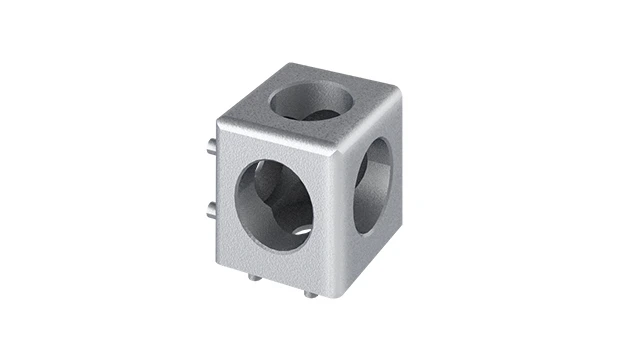
Aluminum Profile 3 Way Connector
The 3 way - squared corner connector is an external fastening method that is typically used to create a corner connection between three profiles. It is a heavy-duty connection that is simple to use and provides a polished look.
In an era where industries worldwide are grappling with the dual pressures of resource scarcity and environmental accountability, sustainable manufacturing has evolved from a buzzword to a business imperative. At the heart of this shift lies a simple yet powerful principle: creating systems that minimize waste, maximize resource efficiency, and prioritize long-term ecological balance. Among the many innovations driving this movement, aluminum profile systems—particularly their modular accessories—have emerged as unsung heroes. Today, we're diving deep into one component that embodies this ethos: the aluminum profile 3 way connector. More than just a hardware piece, this small but mighty accessory is redefining how manufacturers build, adapt, and reuse their production setups, one connection at a time.
The Rise of Sustainable Manufacturing: Why Reusability Matters
To understand the significance of aluminum profile 3 way connectors, we first need to grasp the stakes of sustainable manufacturing. Traditional production models have long operated on a linear "take-make-dispose" logic: extract raw materials, manufacture products, use them briefly, then discard them as waste. This approach, while profitable in the short term, has led to alarming consequences: overflowing landfills, depleted mineral reserves, and greenhouse gas emissions from constant production and transportation of new goods.
Consider this: the manufacturing sector accounts for approximately 28% of global energy consumption and 22% of carbon dioxide emissions, according to the International Energy Agency. A significant portion of this footprint stems from the production of new equipment and tooling—items like workbenches, material racks, and assembly lines that are often custom-built, welded, or glued together, making them nearly impossible to repurpose. When a production line needs to adapt to a new product or scale up, these structures are frequently scrapped, contributing to the 11 million tons of manufacturing waste generated annually in the U.S. alone (EPA data).
Enter the era of circular manufacturing: a model that designs out waste by prioritizing reusability, repair, and recycling. In this system, components are no longer single-use; they're meant to be disassembled, reconfigured, and reused repeatedly. This is where aluminum profile systems shine—and at their core are accessories like the 3 way connector, designed to make adaptability not just possible, but effortless.
Aluminum as a Sustainable Foundation: More Than Just a Metal
Aluminum has long been celebrated for its sustainability credentials, and for good reason. Unlike many metals, it's 100% recyclable, with no loss in quality during the recycling process. In fact, recycling aluminum uses just 5% of the energy required to produce it from raw bauxite ore—a statistic that has made it a darling of eco-conscious industries. But aluminum's sustainability story doesn't end with recyclability; its inherent properties make it ideal for modular, reusable systems.
Aluminum extrusion profiles—long, uniform shapes created by forcing molten aluminum through a die—are the backbone of these systems. Lightweight yet surprisingly strong, they're resistant to corrosion, easy to handle, and compatible with a wide range of accessories. From workbenches to conveyor systems, these profiles form the "bones" of manufacturing setups. But bones need joints to move—and that's where aluminum profile accessories, like the 3 way connector, come into play.
Aluminum profile accessories are the unsung enablers of modularity. They include everything from brackets and hinges to clamps and connectors, each designed to join profiles together securely while maintaining the system's ability to be taken apart. Among these, the 3 way connector is a standout. As its name suggests, it allows three aluminum profiles to intersect at a single point—think of it as the "cornerstone" of structures like multi-tiered material racks, L-shaped workbenches, or triangular support frames. What makes it revolutionary, however, isn't just its function, but its design for reusability.

The Star Accessory: Aluminum Profile 3 Way Connectors Explained
At first glance, an aluminum profile 3 way connector might seem unassuming—a small, often T-shaped or Y-shaped piece of metal with holes for bolts or screws. But look closer, and you'll see the engineering genius that makes it a sustainability workhorse. Let's break down its key features:
Modular Design: Most 3 way connectors are designed to fit standard aluminum extrusion profiles, which come in uniform sizes (e.g., 20x20mm, 30x30mm, 40x40mm). This standardization means a single connector can work with hundreds of profile lengths and configurations, eliminating the need for custom parts.
Tool-Free (or Minimal-Tool) Assembly: Unlike welded joints or glued connections, 3 way connectors rely on mechanical fasteners like T-slot nuts, bolts, or set screws. This means they can be tightened or loosened with basic tools (or even by hand, in some cases), making disassembly as easy as assembly. No cutting, grinding, or melting required—just a quick twist of a wrench, and the connector is free to be reused.
Durable Materials: These connectors are typically made from high-grade aluminum or reinforced plastic, both of which stand up to the wear and tear of factory environments. Even after multiple cycles of assembly and disassembly, they maintain their structural integrity, ensuring they can be reused dozens (if not hundreds) of times.
Versatility: 3 way connectors aren't limited to right angles. Many designs allow for adjustable angles, letting manufacturers create slopes, curves, or custom configurations. This flexibility means a single connector can serve multiple purposes across different projects, further reducing the need for specialized parts.
To put this in perspective, imagine a traditional manufacturing setup: a workbench built with welded steel. If the factory needs to resize the bench or repurpose it for a new task, the welded joints make modification nearly impossible. The entire bench is likely scrapped, and a new one is built from scratch. Now, compare that to a workbench built with aluminum extrusion profiles and 3 way connectors. When needs change, the connectors are loosened, the profiles are rearranged, and the same components are reused to build a new bench—no waste, no new materials, just adaptability.

Design for Reusability: Engineering Modularity into Every Connection
The reusability of aluminum profile 3 way connectors isn't an accident; it's the result of intentional engineering. Let's explore how their design supports the circular manufacturing model:
Disassembly Without Damage: Traditional fasteners like nails or rivets often damage materials when removed, rendering them useless for future use. 3 way connectors, however, use bolts or screws that apply pressure evenly, allowing profiles to be separated without warping or cracking. This means both the connector and the profiles can be reused in new configurations.
Standardized Sizing: The T-slot design of most aluminum extrusion profiles—longitudinal grooves running along their length—allows accessories like 3 way connectors to slide into place and lock securely. Because T-slots are standardized across manufacturers, a connector from one brand can often work with profiles from another, reducing reliance on proprietary parts and extending the lifespan of components.
Low Maintenance: Aluminum's natural resistance to rust and corrosion means connectors require little upkeep. Unlike steel connectors, which may need painting or lubrication to prevent degradation, aluminum connectors can sit in storage for months (or even years) and still perform like new when reused.
Scalability: As manufacturing needs grow, aluminum profile systems can scale incrementally. Adding a new shelf to a material rack, for example, doesn't require replacing existing connectors—just adding a few new profiles and extra 3 way connectors. This "build-as-you-go" approach minimizes overproduction and waste.
Economic and Environmental Benefits: A Dual Win
The reusability of aluminum profile 3 way connectors delivers benefits that extend far beyond "doing the right thing" for the planet. For manufacturers, it's a financial game-changer—a way to cut costs while reducing environmental impact. Let's break down the dual wins:
Cost Savings Over Time: While the upfront cost of aluminum profile systems may be higher than traditional welded steel or wooden setups, the long-term savings are undeniable. By reusing connectors and profiles, manufacturers eliminate the need to purchase new materials for every reconfiguration. A single 3 way connector, reused 10 times over a decade, costs a fraction of 10 disposable connectors or custom-built joints. Additionally, disassembly and reassembly are faster than building new structures, reducing labor costs and downtime.
Reduced Waste Management Costs: Manufacturing waste isn't just bad for the environment—it's expensive. Hauling, disposing of, or recycling scrap metal and wood adds up. By reusing components, factories slash the volume of waste they generate, lowering disposal fees and even qualifying for tax incentives or sustainability grants in some regions.
Lower Carbon Footprint: Every time a 3 way connector is reused, it avoids the carbon emissions associated with producing a new one. Since aluminum production is energy-intensive, even small reductions in new aluminum manufacturing can have a significant environmental impact. For example, a factory that reuses 500 connectors annually could save thousands of kilowatt-hours of energy and prevent hundreds of kilograms of CO2 emissions.
Enhanced Agility: In today's fast-paced manufacturing landscape, agility is key. Consumer demands shift, product lines evolve, and factories need to adapt quickly. Aluminum profile systems with reusable connectors allow for rapid reconfiguration—whether it's rearranging workbenches for a new product or scaling up a material rack to meet increased demand. This agility not only improves productivity but also reduces the risk of investing in rigid, soon-to-be-obsolete infrastructure.
| Feature | Traditional Welded Steel Connectors | Aluminum Profile 3 Way Connectors |
|---|---|---|
| Reusability | Low—welded joints damage materials when disassembled; rarely reusable | High—can be disassembled and reused 50+ times without damage |
| Energy Use (Production) | High—steel production and welding require significant energy | Low—aluminum recycling uses 5% of primary production energy; no welding needed |
| Cost Over 10 Years | High—requires frequent replacement of entire structures | Low—one-time purchase with minimal replacement costs |
| Waste Generation | High—scrapped structures end up in landfills or require energy-intensive recycling | Low—minimal waste from disassembly; components are reused |
| Adaptability | Low—fixed configurations; difficult to modify | High—easily reconfigured for new layouts or tasks |
Real-World Impact: Lean Systems in Action
To see the reusability of aluminum profile 3 way connectors in action, look no further than a mid-sized electronics manufacturer in Michigan, U.S., which adopted lean manufacturing principles in 2022. Prior to the shift, the factory relied on custom-built wooden workbenches and steel material racks—structures that were heavy, difficult to move, and impossible to repurpose. When the company introduced a new smartphone model, the assembly line needed to be completely redesigned, and the old workbenches were sent to the scrapyard.
Today, the factory's production floor tells a different story. It's filled with aluminum extrusion profile workbenches, material racks, and conveyor systems—all held together by aluminum profile accessories like 3 way connectors. When the company launched a new tablet line earlier this year, instead of building new workbenches, they simply disassembled the existing ones, reconfigured the profiles, and reused the 3 way connectors to create larger, L-shaped benches better suited for tablet assembly. The process took two days instead of two weeks, saved $45,000 in new materials, and kept over 2 tons of waste out of landfills.
"We used to dread product launches because we knew we'd be stuck with a mountain of scrap and a huge bill for new equipment," says Maria Gonzalez, the factory's operations manager. "Now, with the aluminum system, we just rearrange what we have. The 3 way connectors are the secret—they make everything click, literally. We've reused the same ones for three different product lines, and they still work like new."
Overcoming Challenges and Looking Ahead
While aluminum profile 3 way connectors offer clear benefits, adopting them isn't without challenges. For one, the initial investment can be a barrier for small manufacturers accustomed to cheap, disposable materials. However, as more suppliers enter the market and economies of scale drive down costs, this gap is narrowing. Additionally, some workers may need training to assemble and disassemble the systems properly—though many manufacturers find that the simplicity of the T-slot design makes training quick and intuitive.
Looking to the future, the role of aluminum profile 3 way connectors in sustainable manufacturing is only set to grow. Innovations like smart connectors with built-in sensors (to track usage and maintenance needs) and even biodegradable plastic variants (for lighter-duty applications) are on the horizon. Meanwhile, as circular economy policies become stricter globally—with regulations like the EU's Circular Economy Action Plan mandating higher recycling rates and waste reduction—manufacturers will increasingly turn to modular, reusable systems to stay compliant.
Perhaps most exciting is the potential for these connectors to support the "factory of the future"—a hyper-flexible, eco-friendly space where production lines adapt in real time to demand, and waste is all but eliminated. In this vision, aluminum extrusion profiles and their accessories aren't just tools; they're the building blocks of a more sustainable, efficient, and resilient manufacturing sector.
Conclusion: Small Connectors, Big Impact
In the grand scheme of manufacturing, aluminum profile 3 way connectors may seem small. But as we've explored, their impact is anything but. By enabling the reuse of aluminum extrusion profiles and accessories, they're helping to shift the industry from a linear "take-make-dispose" model to a circular one—where waste is minimized, resources are cherished, and adaptability is built into every connection.
Sustainable manufacturing isn't about grand gestures alone; it's about the cumulative effect of thousands of small, intentional choices. Choosing a reusable connector over a disposable one. Prioritizing modularity over rigidity. Valuing long-term resilience over short-term savings. In these choices, aluminum profile 3 way connectors stand out as a testament to what's possible when sustainability is engineered into the very fabric of how we build.
So the next time you walk through a factory, take a closer look at the workbenches, the material racks, the assembly lines. Chances are, you'll spot the unassuming 3 way connector—quietly holding things together, and quietly changing the world, one reusable connection at a time.