- Company Articles
- Products and Technology
- Installation And Maintenance
- Swivel Stem Caster Wheel Installation Height: Impact on Equipment Stability

Swivel Stem Caster Wheel Installation Height: Impact on Equipment Stability
Related Product
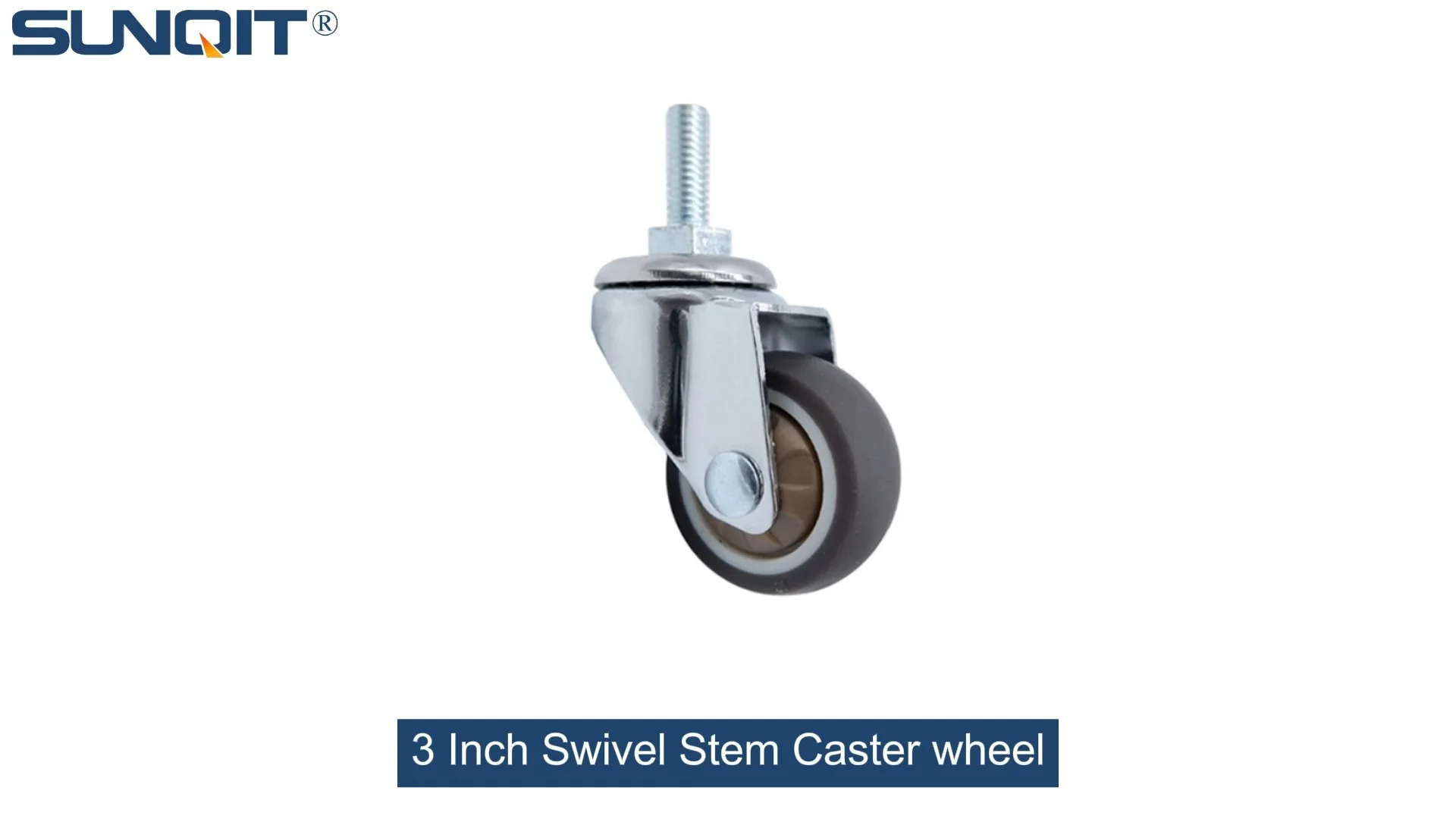
Swivel Stem Caster wheel
360 Degree Swivel Stem Caster. Threaded-post mount design, castors diameter 3 inch.Each swivel caster wheels loading 70KGS. Heavy enough and widely suit for carts, chairs, cabinet, flow rack, workbench, turnover rolley.
Introduction: The Unsung Hero of Industrial Mobility
In the bustling world of manufacturing, warehousing, and logistics, every piece of equipment—from the humblest workbench to the sturdiest turnover trolley—relies on one small but mighty component to keep operations moving: caster wheels. Among the various types of casters, swivel stem caster wheels stand out for their versatility, allowing equipment to rotate 360 degrees and navigate tight spaces with ease. But here's the thing: not all caster setups are created equal. One critical factor that often flies under the radar, yet can make or break equipment performance, is installation height .
Imagine a factory floor where a workbench, fitted with swivel stem casters, glides smoothly during morning shifts but becomes wobbly and unstable by afternoon. Or a warehouse trolley that handles light loads perfectly but tips over when fully stocked. Chances are, the culprit isn't the caster itself, but how high (or low) it's installed. Installation height—the distance from the floor to the point where the caster attaches to the equipment—plays a pivotal role in determining stability, load capacity, and maneuverability. In this article, we'll dive deep into why installation height matters, how it impacts equipment stability, and how to choose the right height for your needs, with a focus on swivel stem caster wheels and the essential caster accessories that support them.
Understanding Swivel Stem Caster Wheels: More Than Just Rollers
Anatomy of a Swivel Stem Caster
Before we tackle installation height, let's get to know the star of the show: the swivel stem caster wheel. At first glance, it might seem simple, but it's a blend of components working in harmony. The main parts include:
- The Wheel: The part that touches the floor, made from materials like rubber, polyurethane, or steel, depending on load and floor type.
- The Stem: The metal rod that connects the caster to the equipment (hence "stem" caster). Stems can be threaded, friction-fit, or welded.
- The Swivel Mechanism: A raceway or bearing that allows the wheel to rotate horizontally, enabling 360-degree movement.
- Caster Accessories: Optional add-ons like brakes, swivel locks, or stem extensions that enhance functionality and safety.
Common Applications
Swivel stem casters are everywhere, from medical carts in hospitals to tool cabinets in garages. In industrial settings, they're indispensable for equipment that needs frequent repositioning, such as:
- Workbenches: Mobile workstations used for assembly, packaging, or repairs.
- Turnover Trolleys and Racks: Used to transport materials, parts, or finished goods across warehouses.
- Material Handling Equipment: Light-duty carts for moving tools, supplies, or small components.
Each of these applications demands a unique balance of mobility and stability—balance that hinges, in part, on installation height.

What Exactly Is "Installation Height"?
Installation height sounds straightforward, but let's clarify: it's the vertical distance from the floor to the mounting surface of the equipment. For swivel stem casters, this is measured from the bottom of the wheel (where it touches the floor) up to the top of the stem's mounting point (e.g., the bottom of the workbench or trolley frame). Think of it as the "leg length" of your equipment—too short, and you might scrape floors or struggle with obstacles; too long, and you risk instability.
Most swivel stem casters come with standard installation heights (e.g., 2 inches, 4 inches, 6 inches), but custom heights are available for specialized needs. The key is to match this height to the equipment's design and the demands of its environment.

Key Factors That Influence Installation Height
Choosing the right installation height isn't a one-size-fits-all decision. Several factors come into play, each affecting how the caster performs. Let's break them down:
1. Equipment Weight and Load Capacity
Heavier equipment demands casters with higher load capacities, but did you know installation height affects this too? A taller stem may flex under heavy loads, reducing the caster's ability to bear weight. Conversely, a shorter stem distributes weight more evenly, increasing load capacity. For example, a workbench loaded with power tools (500 lbs) will need a lower installation height than a lightweight trolley (100 lbs) to maintain stability.
2. Floor Conditions
Smooth, polished factory floors allow for lower installation heights, while rough or uneven surfaces (like concrete with cracks or warehouse floors with pallet jack tracks) require more ground clearance. A higher installation height prevents the equipment base from scraping the floor or getting caught on obstacles. In such cases, caster accessories like larger wheels or stem extensions can help bridge the gap.
3. Center of Gravity (CoG)
The CoG is the point where an object's weight is evenly distributed. For equipment, this is typically near its midpoint. Installation height directly impacts CoG: higher installation heights raise the CoG, making the equipment more prone to tipping. A workbench with a high CoG (e.g., tall shelves stacked with heavy parts) will feel unstable on casters with excessive height, even if the total weight is within the caster's load rating.
4. Mobility Requirements
How often does the equipment move? And how quickly? Equipment that's constantly on the go (e.g., a warehouse trolley making hourly rounds) needs casters that balance stability with maneuverability. Lower installation heights generally improve stability but may reduce maneuverability on tight turns, while higher heights can make steering easier but risk wobbling at speed.

The Critical Link: Installation Height and Equipment Stability
Now, let's connect the dots: why does installation height have such a big impact on stability? It all boils down to physics—specifically, the relationship between installation height, center of gravity, and the forces acting on the equipment.
Center of Gravity: The Tipping Point
Imagine a pyramid vs. a rectangle. The pyramid, with its low CoG, is stable; the rectangle, if tall and narrow, tips over easily. Equipment on casters works the same way. A higher installation height raises the CoG, making the equipment more top-heavy. For example, a workbench with a 6-inch installation height has a CoG 2 inches higher than one with a 4-inch height. When pushed or pulled, the taller workbench is more likely to tip if the force exceeds its stability threshold.
Load Distribution and Stress on Components
Installation height also affects how stress is distributed across the caster's components. A taller stem acts like a lever: when the equipment turns or hits an obstacle, the stem bends slightly, putting extra pressure on the swivel joint and wheel bearings. Over time, this can lead to premature wear, loosening, or even failure. Caster accessories like reinforced stems or heavy-duty swivel joints can mitigate this, but they're no substitute for proper height selection.
Maneuverability vs. Stability: Striking the Balance
Swivel stem casters are prized for their mobility, but there's a trade-off: more maneuverability can mean less stability. A higher installation height allows the swivel mechanism to rotate more freely, making tight turns easier. However, this freedom comes at the cost of stability—especially when the equipment is moving quickly or carrying uneven loads. Lower installation heights restrict swivel movement slightly, improving stability but requiring more force to steer. The sweet spot depends on how often the equipment moves and the complexity of its path.
Practical Guidelines: How to Choose the Right Installation Height
Now that we understand the "why," let's get to the "how." Here's a step-by-step guide to determining the optimal installation height for your swivel stem casters:
Step 1: Calculate Your Equipment's Weight and CoG
Start by weighing your equipment (empty and fully loaded) and identifying its CoG. You can do this by tilting the equipment gently and noting the point where it balances. For a workbench, the CoG is usually near the center of the top surface; for a trolley with shelves, it's where the heaviest items are stored. Write down these numbers—they'll guide your height choice.
Step 2: Evaluate Your Floor and Environment
Measure the maximum obstacle height on your floor (e.g., cracks, thresholds, pallet jack rails). Add 0.5–1 inch to this height to ensure clearance. For example, if your floor has 1-inch cracks, aim for an installation height of at least 1.5 inches. Smooth floors may only need 0.25–0.5 inches of clearance.
Step 3: select Caster Size and Type
Wheel size and installation height go hand in hand. Larger wheels (e.g., 5-inch diameter) naturally have higher installation heights than smaller wheels (e.g., 2-inch). Match wheel size to your load and environment: polyurethane wheels for smooth floors, rubber wheels for noise reduction, and steel wheels for heavy loads. Don't forget to check the caster's load rating—always choose one rated for 1.5x your maximum load to account for dynamic forces (like pushing or stopping suddenly).
Step 4: Test with Adjustable Solutions
If you're unsure, start with adjustable options. Caster accessories like adjustable leveling feet can help fine-tune height after installation. For example, if a workbench feels wobbly, you can lower the leveling feet slightly to redistribute weight and stabilize it. Adjustable stems or shims (thin metal/washers) are also useful for tweaking height without replacing the entire caster.
Step 5: Document and Iterate
Once you've installed the casters, test the equipment under real-world conditions: load it to capacity, push it around obstacles, and observe for wobbling or tipping. If issues arise, adjust the height or switch to a different caster size. Keep records of what works—this will save time when outfitting similar equipment in the future.
Common Installation Height Issues and How to Fix Them
Even with careful planning, problems can arise. Let's troubleshoot the most common issues and their solutions:
Issue 1: Equipment Wobbles or Tips Over
Cause:
Installation height is too high, raising the CoG.
Solution:
Lower the installation height by switching to shorter stems or smaller wheels. If lowering isn't possible, add caster accessories like outriggers (extensions that widen the equipment's base) or swivel locks to prevent sudden turns. For workbenches, attaching adjustable leveling feet to the corners can also add stability by creating a wider support base.
Issue 2: Floor Scraping or Obstacle Jams
Cause:
Installation height is too low for the floor conditions.
Solution:
Increase height with taller stems, larger wheels, or stem extensions (a common caster accessory). For example, swapping a 2-inch stem for a 4-inch stem adds 2 inches of clearance. If the equipment base is too low, use a caster installation base—a metal plate that raises the mounting point without replacing the stem.
Issue 3: Uneven Height Across Casters
Cause:
Inconsistent installation or uneven floors.
Solution:
Use a level to check each caster's height. Adjust with shims under the mounting plate or switch to casters with adjustable stems. For uneven floors, adjustable leveling feet are a game-changer—they let you fine-tune each caster's height individually, ensuring the equipment sits flat and stable.
Case Study: How Installation Height Fixed a Factory Workbench Crisis
Let's put theory into practice with a real-world example. A mid-sized electronics manufacturer recently upgraded their assembly line with new workbenches, each fitted with 4-inch swivel stem casters (installation height: 6 inches). The goal was to make the workbenches mobile, allowing workers to reconfigure the line quickly for different products.
At first, things went smoothly. But when the workbenches were loaded with tools, circuit boards, and testing equipment (total weight: 600 lbs), problems emerged. Workers reported that the benches wobbled when pushed, and one even tipped over slightly when a technician leaned on the edge. An investigation revealed the issue: the 6-inch installation height had raised the workbench's CoG too high, making it unstable under load.
The solution? The manufacturer switched to 3-inch swivel stem casters (installation height: 4 inches) and added adjustable leveling feet to the bench corners. The lower height reduced the CoG, and the leveling feet compensated for minor floor unevenness. Result: No more wobbling, no more near-tips, and workers could still move the benches with ease. Lesson learned: installation height must align with both load and mobility needs.
Installation Height Comparison Table
| Installation Height Range | Stability Level | Load Capacity | Maneuverability | Best For |
|---|---|---|---|---|
| Low (2–4 inches) | High (low CoG, minimal tipping risk) | High (weight distributed evenly) | Low (less swivel freedom, harder to turn) | Heavy equipment (e.g., loaded workbenches, tool cabinets) |
| Medium (4–6 inches) | Medium (balanced CoG) | Medium (suitable for most general loads) | High (excellent swivel movement) | General-purpose equipment (e.g., warehouse trolleys, mobile shelves) |
| High (6–8+ inches) | Low (high CoG, higher tipping risk) | Low (taller stems may flex under load) | Very High (easy to navigate tight spaces) | Lightweight, frequently moved equipment (e.g., medical carts, small parts trolleys) |
Conclusion: Height Matters—Don't Overlook It
Swivel stem caster wheels are the unsung heroes of industrial mobility, but their performance hinges on a detail many overlook: installation height. Too high, and you risk instability and tipping; too low, and you face floor damage and reduced mobility. By considering factors like equipment weight, floor conditions, and center of gravity, and by following practical guidelines for selection and testing, you can ensure your casters—whether on a workbench, trolley, or other equipment—strike the perfect balance of mobility and stability.
Remember, caster accessories like adjustable leveling feet, stem extensions, and reinforced stems can help fine-tune height and performance, but they're not replacements for proper initial selection. So next time you're outfitting equipment with swivel stem casters, take a moment to think about height. Your equipment (and your workers) will thank you.