- Company Articles
- Products and Technology
- Solution
- Swivel Stem Caster Wheel with Brake: Aligning with Lean Manufacturing Principles

Swivel Stem Caster Wheel with Brake: Aligning with Lean Manufacturing Principles
Related Product
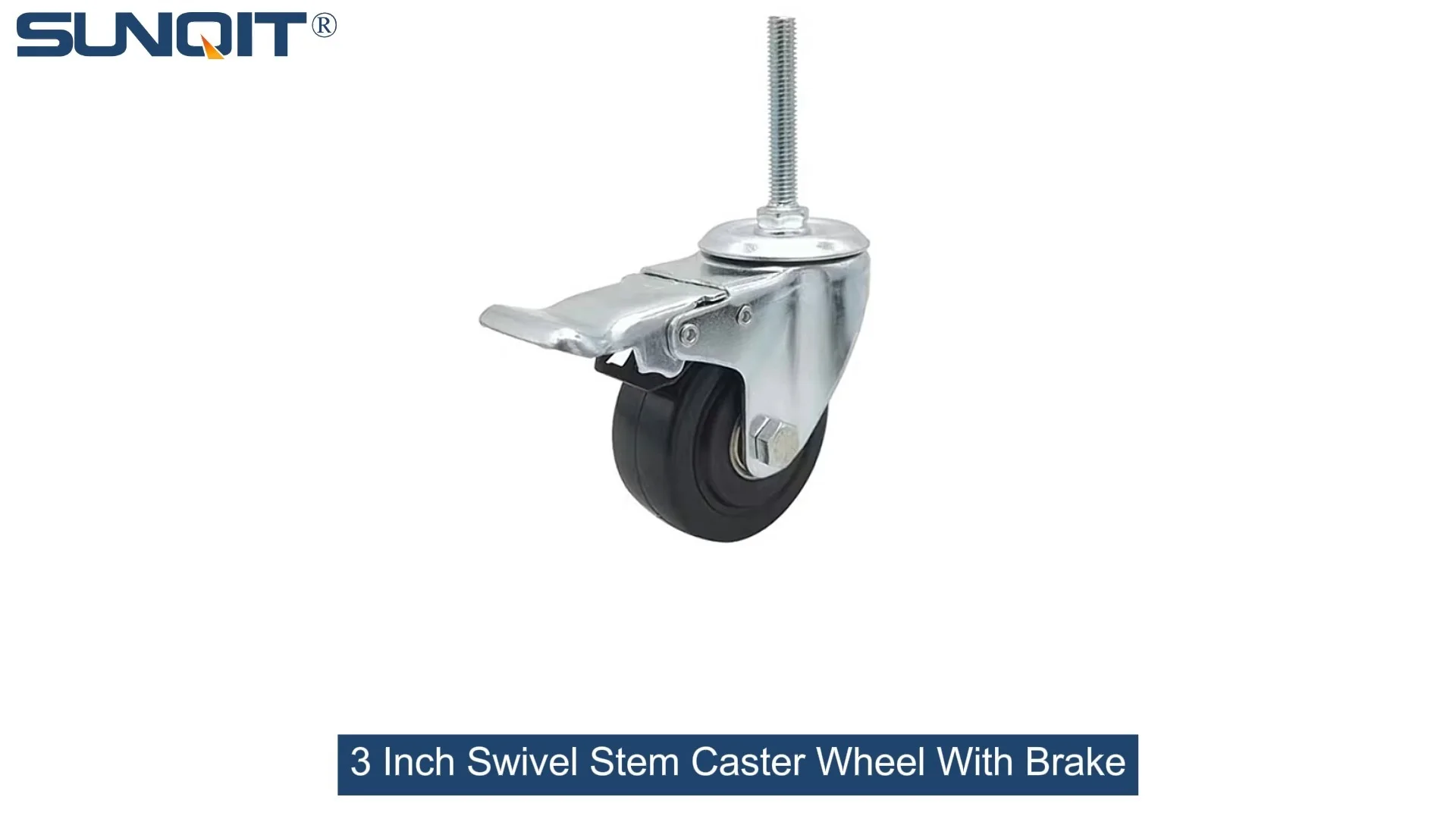
Swivel Stem Caster Wheel with Brake
360 Degree Swivel Stem Caster with brake. Threaded-post mount design, castors diameter 3 inch.Each swivel caster wheels loading 70KGS. Heavy enough and widely suit for carts, chairs, cabinet, flow rack, workbench, turnover rolley.
Walk into any manufacturing facility that's embraced lean principles, and you'll notice something subtle but powerful: everything has a purpose. The tools are within arm's reach, the workflow flows like water, and even the smallest components—like the wheels on a trolley or the joints on a workbench—feel intentional. Lean manufacturing isn't just about big-picture strategies; it's about sweating the details. And today, we're diving into one of those details that's easy to overlook but impossible to ignore once you see its impact: the swivel stem caster wheel with brake. This unassuming component might seem trivial, but it's a quiet hero in the quest to eliminate waste, boost efficiency, and create a workplace that works with people, not against them.
The Heart of Lean: It's All About the Little Things
Lean manufacturing, at its core, is a philosophy of value creation . It asks: How do we deliver more value to customers while using fewer resources? The answer often lies in stripping away waste—those activities that drain time, energy, and money without contributing to the final product. Think about the last time you had to move a heavy box across a room. If the box had wheels that stuck, or if you had to stop every few feet to readjust it, you were experiencing "motion waste" and "waiting waste"—two of the eight types of waste lean aims to eliminate. Now, multiply that frustration by a hundred workers on a factory floor, and you start to see why even small tools like casters matter.
Material handling is a prime culprit for waste. Every time a worker pushes a trolley that's hard to maneuver, or a workbench that drifts out of place, or a rack that can't be repositioned quickly, value is leaking. That's where the swivel stem caster wheel with brake steps in. It's not just a wheel; it's a tool that turns clunky, wasteful movement into smooth, purposeful action. Let's break down why it's such a critical part of any lean system.
Lean Manufacturing Principles: A Quick Refresher
Before we dive into the caster itself, let's ground ourselves in the principles that make lean tick. At its foundation, lean is built on concepts like 5S (Sort, Set in Order, Shine, Standardize, Sustain), Kaizen (continuous improvement), and the elimination of the "Eight Wastes": Transport, Inventory, Motion, Waiting, Overproduction, Overprocessing, Defects, and Unused Talent. For our conversation, we'll zero in on motion waste (unnecessary movement of people or equipment), waiting waste (delays caused by inefficient tools or processes), and transport waste (unoptimized movement of materials). These three are where the swivel stem caster wheel with brake shines brightest.

Material Handling: The Unsung Battlefield of Lean
Imagine a typical day on a factory floor. Workers move raw materials from storage to assembly lines. Finished parts are transported to packaging stations. Tools and equipment are shifted to accommodate changing production runs. None of this is "value-added" work in the strictest sense—customers don't pay for materials to be moved around—but it's necessary. The goal of lean is to make this necessary work as efficient as possible, so it doesn't eat into time that could be spent building, testing, or improving products.
Enter the workhorses of material handling: turnover trolleys , mobile workbenches, and adjustable racks. These tools are the backbone of a flexible production system. But here's the catch: their effectiveness lives or dies by their mobility. A turnover trolley loaded with 50 pounds of components is only useful if it can be moved easily, precisely, and safely. A workbench that's supposed to "follow the work" (a key lean idea) is useless if it drifts across the floor when someone leans on it. That's where casters come in. And not just any casters—swivel stem casters with brakes.

What Is a Swivel Stem Caster Wheel with Brake, Anyway?
Let's start with the basics. A caster is essentially a wheel mounted on a frame, designed to make objects mobile. But the "swivel stem caster wheel with brake" is a specific type built for precision and control. Let's break down its parts:
- Stem Mounting: Unlike plate-mounted casters (which bolt onto the bottom of equipment), stem casters have a metal rod (the "stem") that inserts into a hole or socket on the equipment. This makes them quick to install and ideal for lightweight to medium-weight tools like workbenches or small turnover trolleys.
- Swivel Mechanism: The wheel and frame can rotate 360 degrees, allowing the equipment to move in any direction without needing to be lifted or pivoted. Think of it like the wheels on a shopping cart—graceful, not clunky.
- Brake System: A built-in brake (usually a foot pedal) locks either the wheel (preventing rotation) or the swivel mechanism (preventing turning), keeping the equipment stationary when needed.
Now, why does this design matter for lean? Let's connect the dots.

4 Ways Swivel Stem Casters with Brakes Align with Lean Principles
1. Slashing Motion Waste: Less Effort, More Action
Motion waste is the enemy of productivity. It's the extra step, the awkward reach, the struggle to push a trolley around a corner. Swivel stem casters eliminate this by letting equipment move with the worker, not against them. Imagine a worker pushing a turnover trolley loaded with circuit boards. With fixed casters (which only roll forward/backward), they'd have to walk all the way around the trolley to turn it—a full 180-degree loop just to change direction. With swivel casters? A gentle nudge, and the trolley glides left or right, following the worker's path. That's seconds saved per turn, hours saved per day, and less fatigue for the team.
And when the worker reaches their destination? The brake locks the trolley in place, so they don't have to it while unloading. No more chasing a drifting trolley across the floor. No more repositioning it three times to line up with the assembly line. Just set, lock, work—simple, efficient, and lean .
2. Crushing Waiting Waste: Keep the Line Moving
Waiting waste happens when work stops because tools or materials aren't ready. A common scenario: A workbench is needed at Station A, but it's stuck at Station B because no one can move it quickly. Or a turnover trolley breaks down because its casters failed, leaving materials stranded. Swivel stem casters with brakes prevent this in two ways: durability and reliability.
High-quality swivel casters are built to last, with sealed bearings that resist dust and debris (no more jamming), and sturdy stems that don't bend under load. This means fewer breakdowns, so equipment stays in action. And when equipment is moving, the swivel mechanism ensures it gets where it needs to go fast—no detours, no delays. In lean terms, that's a steady flow of materials, and a production line that never has to hit "pause" because a trolley is stuck.
3. Boosting Flexibility: Adapt Like a Lean Champion
Lean systems thrive on flexibility. Production runs change, new products are introduced, and workflows need to pivot—fast. A fixed workbench bolted to the floor can't keep up. But a workbench on swivel stem casters? It becomes a chameleon. Need to reconfigure the assembly line for a new order? Unlock the brakes, roll the workbench to its new spot, lock it down, and you're ready. No tools, no downtime, no hassle.
This adaptability is especially critical for small-batch production or custom manufacturing, where change is constant. A single workbench can serve as a testing station in the morning and a packaging station in the afternoon—all because its casters let it "follow the work." That's the beauty of lean: using what you have in smarter ways, instead of buying new equipment for every task.
4. Enhancing Safety: No Waste in Accidents
Defects and injuries are two of the costliest forms of waste in manufacturing. A dropped box of parts (defects) or a worker straining their back (injuries) can derail a day's production. Swivel stem casters with brakes mitigate both risks. The smooth swivel action reduces the force needed to move equipment, cutting down on back strain. The brake ensures that trolleys and workbenches stay put during use, so parts don't slide off and get damaged. Even better, many models have "total lock" brakes that lock both the wheel and swivel, preventing tipping or rolling on uneven floors—a small feature that prevents big headaches.
| Caster Type | Maneuverability | Safety (with Brake) | Waste Reduction Focus | Best For |
|---|---|---|---|---|
| Swivel Stem with Brake | Excellent (360° rotation) | High (locks wheel/swivel) | Motion, Waiting, Defects | Workbenches, Turnover Trolleys, Mobile Racks |
| Fixed Caster | Poor (only forward/backward) | Low (no brake option) | None (increases motion waste) | Heavy, Straight-Line Transport (e.g., large machinery) |
| Swivel Without Brake | Excellent | Low (drifts when stopped) | Motion (but risks waiting/defects) | Temporary, Unloaded Movement (e.g., tool carts) |
Real-World Impact: How One Factory Cut Waste with Casters
Let's take a look at a real example to bring this to life. A mid-sized electronics manufacturer was struggling with motion and waiting waste on their assembly line. Workers spent 20% of their shift moving materials between stations, and turnover trolleys often broke down or got stuck, causing delays. The team decided to upgrade to swivel stem casters with brakes on all their workbenches and trolleys. Here's what happened:
- Motion waste dropped by 35%: Workers no longer walked extra steps to maneuver trolleys. The 360° swivel let them navigate tight spaces with ease.
- Waiting waste decreased by 28%: Trolleys and workbenches moved faster and broke down less often, so materials arrived at stations on time.
- Worker fatigue scores improved by 40%: Pushing and pulling required less effort, leading to fewer breaks and higher morale.
The best part? The upgrade cost was minimal compared to the savings. Over six months, the factory recouped their investment through increased productivity and reduced downtime. That's the power of aligning small tools with lean principles—it's not about spending more; it's about spending smarter.
Choosing the Right Swivel Stem Caster for Your Lean System
Not all swivel stem casters are created equal. To maximize lean benefits, you need to pick the right one for your needs. Here are key factors to consider:
Load Capacity: Don't Overlook the Basics
Every caster has a maximum load rating. Exceeding it leads to breakdowns (waiting waste) and safety risks. For a workbench, you might need a 200-pound capacity per caster. For a turnover trolley hauling heavy parts? 500 pounds or more. Always calculate the total weight of the equipment plus its typical load, then divide by the number of casters (usually 4) to get the per-caster requirement. Add a 20% buffer to be safe—lean is about prevention, not reaction.
Wheel Material: Match the Floor
The wheel material affects both maneuverability and floor protection. Polyurethane wheels are a lean favorite—they're soft enough to glide over concrete without marking it, yet tough enough to handle daily use. Rubber wheels are better for uneven floors, while steel wheels work for extremely heavy loads (though they're noisier and harder on floors). Choose based on your environment—scratching floors leads to repair waste, and noisy wheels add to worker fatigue (another form of waste!).
Brake Type: Lock It Down
Not all brakes are the same. "Wheel lock" brakes stop the wheel from rotating but let the caster swivel—good for keeping a trolley from rolling but still allowing it to be repositioned slightly. "Total lock" brakes lock both the wheel and swivel, making the equipment completely stationary—ideal for workbenches where precision is key. For most lean applications, total lock brakes are worth the extra cost—they eliminate more motion waste by keeping equipment perfectly still during use.
Final Thoughts: Lean Isn't Just a System—It's a Mindset
At the end of the day, the swivel stem caster wheel with brake is more than a tool—it's a symbol of the lean mindset. It reminds us that value isn't created by grand gestures but by thousands of small, intentional choices: a wheel that turns smoothly, a brake that locks firmly, a design that adapts to change. These choices add up to a workplace where waste fades, efficiency thrives, and workers feel empowered to do their best.
So the next time you walk through your facility, take a closer look at the casters on your workbenches, trolleys, and racks. Are they fighting against your lean goals, or supporting them? If it's the former, maybe it's time for an upgrade. After all, lean manufacturing isn't about being perfect—it's about being better. And sometimes, better starts with something as simple as a wheel that works with you.
In the world of lean, the smallest details often make the biggest difference. And the swivel stem caster wheel with brake? It's proof that even the humblest component can be a lean champion.