- Company Articles
- Products and Technology
- Solution
- Swivel Stem Caster Wheel with Brake: Custom Solutions for Unique Production Needs

Swivel Stem Caster Wheel with Brake: Custom Solutions for Unique Production Needs
Related Product
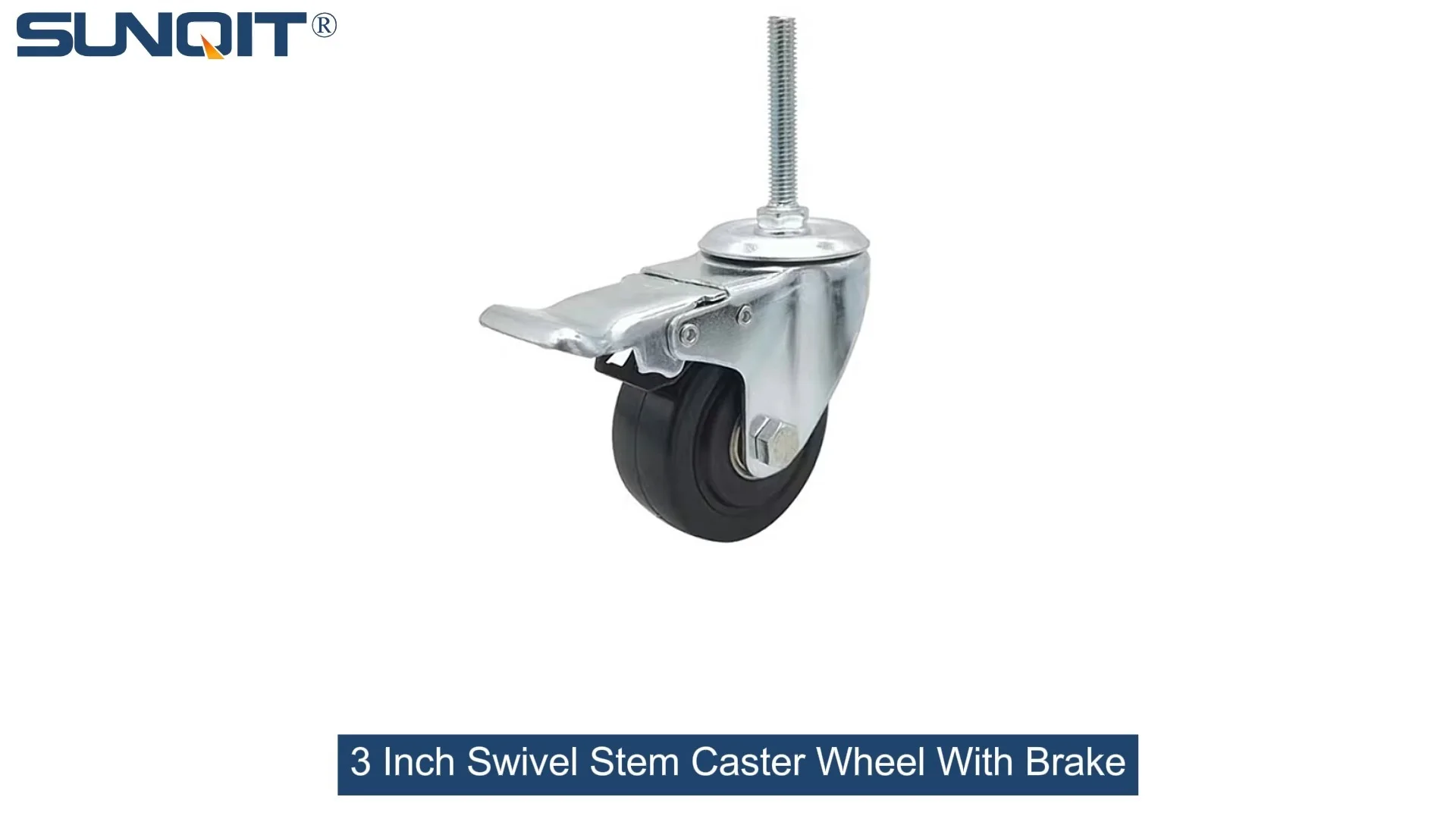
Swivel Stem Caster Wheel with Brake
360 Degree Swivel Stem Caster with brake. Threaded-post mount design, castors diameter 3 inch.Each swivel caster wheels loading 70KGS. Heavy enough and widely suit for carts, chairs, cabinet, flow rack, workbench, turnover rolley.
Walk into any production facility, and you'll quickly notice a silent but critical player in the daily chaos: the caster wheel. From moving heavy workbenches across the floor to positioning turnover trolleys exactly where they're needed, casters are the unsung heroes that keep operations flowing. But not all casters are created equal—especially when your production line has unique demands. That's where the swivel stem caster wheel with brake comes in. More than just a "wheel on a stick," these specialized components blend mobility, stability, and adaptability to solve the kind of challenges that generic casters can't handle. Let's dive into how they work, why customization matters, and how they can transform your production assemble process—whether you're running a small workshop or a large-scale manufacturing plant.
What Makes Swivel Stem Caster Wheels with Brake Stand Out?
First, let's break down the basics. A swivel stem caster wheel is exactly what it sounds like: a wheel mounted on a swivel joint, attached to a stem (a rod or bolt) that inserts into the equipment it's moving. The "with brake" part is the game-changer here. Unlike fixed casters that only roll forward and backward, or swivel casters without brakes that spin freely, these wheels let you move equipment in any direction (thanks to the swivel) and lock it securely in place (thanks to the brake) when you need stability. Imagine trying to assemble a delicate electronic component on a workbench that won't stay still—that's where a reliable brake turns frustration into focus.
The stem itself is another key feature. Stems come in different lengths and diameters, designed to fit into pre-drilled holes or mounting brackets on everything from aluminum profile workbenches to steel tool cabinets. This versatility means they can be retrofitted onto existing equipment, saving you from buying entirely new workstations. And because the stem is rigidly attached, the caster can handle more weight than plate-mounted alternatives, which rely on screws that might loosen over time.
But what really sets these casters apart is their ability to balance two opposing needs: movement and stability. In busy production environments, you might need to reposition a workstation five times a day to accommodate different tasks. A swivel stem caster makes that quick and easy—no need to lift or drag heavy equipment. Then, when it's time to work, a simple tap on the brake pedal locks the wheel (and sometimes the swivel joint itself) to keep the equipment steady. It's like having a portable workstation that transforms into a fixed one in seconds.
The Case for Customization: Why One-Size-Fits-All Casters Fall Short
Here's the truth: most production lines aren't "one-size-fits-all," so your casters shouldn't be either. Let's say you run a lean system focused on minimizing waste and maximizing efficiency. Your workbenches need to be lightweight enough to move quickly but sturdy enough to support heavy tools. A generic caster might either be too flimsy (leading to wobbly workstations) or too heavy (slowing down reconfigurations). Or maybe you work in electronics manufacturing, where static electricity can ruin sensitive components—so you need ESD-safe casters that dissipate static charge. Generic rubber wheels? They'll just build up static and put your products at risk.
Even floor type matters. If your facility has polished concrete floors, a hard plastic wheel might scratch or scuff the surface; a soft rubber wheel would be better. If you're rolling over uneven concrete or factory grates, a larger wheel with a shock-absorbing tread can prevent equipment from jostling (and potentially damaging parts). And let's not forget load capacity. A caster rated for 200 lbs will fail miserably if you're trying to move a 500 lbs workbench loaded with machinery—leading to broken wheels, damaged equipment, or even workplace injuries.
This is where customization becomes essential. A good supplier won't just sell you a "swivel stem caster with brake"—they'll ask questions: What's the maximum weight you need to move? What kind of floors do you have? Do you need the brake to lock just the wheel, or the swivel too? Do you work in a wet or corrosive environment (hello, stainless steel options!)? By tailoring the wheel material, stem length, brake type, and even bearing quality to your specific needs, you get a caster that doesn't just "work"—it works for you .

Materials Matter: Choosing the Right Wheel for Your Environment
When it comes to swivel stem caster wheels with brake, the wheel material is more than just a cosmetic choice—it's about performance and longevity. Let's break down the most common options and when to use them:
Rubber: Soft and non-marking, rubber wheels are ideal for indoor spaces with delicate floors, like offices or labs. They absorb shocks well, making them great for transporting fragile items. However, they're not the best for heavy loads or rough surfaces—they can wear down quickly if used outdoors or on concrete.
Polyurethane: The workhorse of caster materials. Polyurethane wheels combine the best of rubber and plastic: they're durable, non-marking, and handle moderate to heavy loads (up to 500 lbs or more). They also roll smoothly on most surfaces, from tile to concrete, and resist oil and chemicals—perfect for factory floors where spills happen.
Cast Iron: For heavy-duty jobs, cast iron wheels are the way to go. They can handle loads over 1000 lbs and stand up to extreme temperatures and rough terrain. The downside? They're noisy, mark floors, and can rust if not treated—so save them for outdoor use or industrial settings where durability trumps finesse.
Conductive Polyurethane: A must for ESD workstations or electronics production. These wheels are infused with conductive materials that dissipate static electricity, preventing it from building up and damaging sensitive components like circuit boards. They're a small investment that avoids costly defects.
But the wheel isn't the only material to consider. The stem and swivel joint need to be tough too. Many manufacturers use steel stems for strength, but if you're in a corrosive environment (like a food processing plant or marine facility), stainless steel is worth the upgrade. And for lightweight applications, aluminum stems (paired with aluminum pipe accessories) can reduce overall equipment weight without sacrificing durability.

Integrating with Lean Systems: How Casters Streamline Workflow
Lean manufacturing is all about eliminating waste—whether that's wasted time, space, or effort. Swivel stem caster wheels with brake align perfectly with this philosophy by making your workspace adaptable . Think about it: traditional fixed workstations lock you into a single layout. If you need to reconfigure your production line for a new product, you're looking at hours (or days) of dismantling and rebuilding. With casters, you can rearrange workbenches, material racks, and trolleys in minutes.
Take a typical lean system scenario: you're running a small-batch production line for custom machinery parts. One day, you're assembling part A, which requires a workbench near the 3D printer. The next day, you switch to part B, which needs to be close to the welding station. With a workbench on swivel stem casters with brake, you simply unlock the brakes, roll it to the new spot, lock the brakes, and start working. No downtime, no heavy lifting, no wasted space. It's why lean experts often call casters "the easiest way to create a flexible factory."
Brakes are especially critical here. In lean environments, "5S" (Sort, Set in Order, Shine, Standardize, Sustain) emphasizes keeping tools and equipment in their "standardized" positions to reduce search time. A caster with a reliable brake ensures that once you've positioned a workstation or trolley, it stays there—no more hunting for a misplaced tool because the trolley rolled away. It also prevents accidents: imagine a caster without a brake on a slight incline—one bump, and your equipment could go rolling into a machine or a coworker.

Case Study: Solving Unique Production Challenges with Custom Casters
Let's put this into context with a real-world example (names changed for privacy). A mid-sized electronics manufacturer we worked with recently was struggling with their ESD workstation setup. They produced sensitive circuit boards, so all work surfaces needed to be ESD-safe to prevent static damage. Their existing workbenches were fixed to the floor, which made it hard to reconfigure the line for different board sizes. They wanted to make the workbenches mobile but needed to ensure two things: the casters wouldn't conduct static, and the workbenches wouldn't move during assembly.
The solution? Custom swivel stem caster wheels with brake. We started by selecting conductive polyurethane wheels to dissipate static charge, paired with stainless steel stems to avoid corrosion (important in their climate-controlled facility). The stems were sized to fit the existing holes in the workbench legs, so no drilling or modifications were needed. For the brakes, we chose a "total lock" design that locks both the wheel and the swivel joint—critical for stability when technicians were soldering or testing boards. We also added caster accessories like anti-slip adjustable leveling feet to the workbenches, which could be lowered to provide extra stability on uneven floors (a common issue in older industrial buildings).
The result? The manufacturer could now reconfigure their production line in under an hour instead of a full day. The ESD-safe casters eliminated static-related defects, and the brakes gave technicians the confidence to work without worrying about the workbench moving. Best of all, by retrofitting existing workbenches instead of buying new ones, they saved over 40% on costs—a win for both their budget and their lean system goals.
Comparing Your Options: A Guide to Swivel Stem Caster Features
Not sure which swivel stem caster wheel with brake is right for you? Let's compare some common configurations to help you decide. The table below breaks down key features, from load capacity to brake type, so you can match the caster to your needs:
| Load Capacity | Wheel Material | Brake Type | Stem Length (Inches) | Best For |
|---|---|---|---|---|
| Up to 200 lbs | Rubber | Wheel lock only | 2" | Light workbenches, office equipment, or small tool carts |
| 200-500 lbs | Polyurethane | Total lock (wheel + swivel) | 3" | Medium-duty assembly stations, ESD workstations, or turnover trolleys |
| 500-1000 lbs | Cast Iron | Heavy-duty wheel lock | 4" | Industrial machinery, large material racks, or welding tables |
| Up to 300 lbs | Conductive Polyurethane | Total lock | 2.5" | Electronics production, ESD-sensitive workbenches, or lab equipment |
| 1000+ lbs | Steel | Dual-wheel lock (two brakes per caster) | 5"+ | Heavy machinery, automotive assembly lines, or metalworking stations |
Remember, these are just starting points. A good supplier can tweak these specs—adjusting stem diameter, adding bearings for smoother swiveling, or even custom-coloring wheels to match your facility's aesthetic (yes, that's a thing!). The key is to communicate your needs clearly: How often will you move the equipment? What's the maximum weight? What's the floor like? The more details you provide, the better the customization.
Beyond the Caster: The Role of Accessories and Support
A swivel stem caster wheel with brake is only as good as the accessories that support it. Think of it like a car: the wheels matter, but you also need good tires, brakes, and suspension to make it run smoothly. Here are some caster accessories that can take your setup to the next level:
Caster Installation Base: If your equipment doesn't have pre-drilled holes for the stem, an installation base (a metal plate with a stem hole) can be bolted or welded on, turning any surface into a caster-ready platform.
Bush Adapter: These small sleeves fit over the stem to adjust its diameter, letting you use the same caster on equipment with different hole sizes. Great for facilities with mixed equipment brands.
Anti-Slip Adjustable Leveling Feet: For uneven floors, these feet can be screwed into the bottom of your equipment (alongside casters) to provide extra stability. Lower them when the equipment is stationary, raise them when you need to move it.
Stem Extensions: If your stem is too short to reach the mounting hole, an extension can add length without compromising strength. Useful for thick workbench legs or custom-built equipment.
Working with a supplier who offers these accessories is crucial. They can help you troubleshoot issues like "my caster stem is too short" or "the brake pedal is hard to reach" without forcing you to buy a whole new caster. It's this kind of support that turns a transaction into a partnership—and partnerships are key when you're trying to optimize a unique production line.
Why Your Lean System Deserves Custom Casters
At the end of the day, a lean system is about more than just cutting costs—it's about creating a workplace that adapts to change. Swivel stem caster wheels with brake embody that adaptability. They let you respond to new orders, new products, and new challenges without overhauling your entire setup. They reduce physical strain on your team (no more lifting heavy equipment!), cut down on downtime, and ensure that every square foot of your facility is used efficiently.
But don't just take our word for it. Think about your own production line: What's one task that feels unnecessarily hard? Is it moving materials from the storage rack to the assembly station? Is it repositioning workbenches for different jobs? Chances are, the right caster could make that task faster, safer, or easier. And when tasks are easier, your team stays focused, morale stays high, and productivity soars.
Conclusion: Your Production, Your Caster—The Custom Solution Awaits
Swivel stem caster wheels with brake are more than just components—they're tools for transformation. Whether you're upgrading an existing lean system, building a new ESD workstation, or simply trying to make your production assemble process less of a hassle, customization is the key. By choosing the right wheel material, brake type, and stem length, you can turn a generic caster into a solution that fits your unique needs like a glove.
So, what's next? Start by assessing your challenges: What's heavy? What moves often? What needs to stay put? Then, partner with a supplier who asks the right questions and offers more than just off-the-shelf products. With the right swivel stem caster wheel with brake, you're not just buying a wheel—you're investing in a more efficient, flexible, and productive future for your business. And in manufacturing, that's the best kind of investment you can make.