- Company Articles
- Products and Technology
- Product knowledge
- Swivel Stem Caster Wheel with Brake: Enhancing Flexibility in Custom Production Lines

Swivel Stem Caster Wheel with Brake: Enhancing Flexibility in Custom Production Lines
Related Product
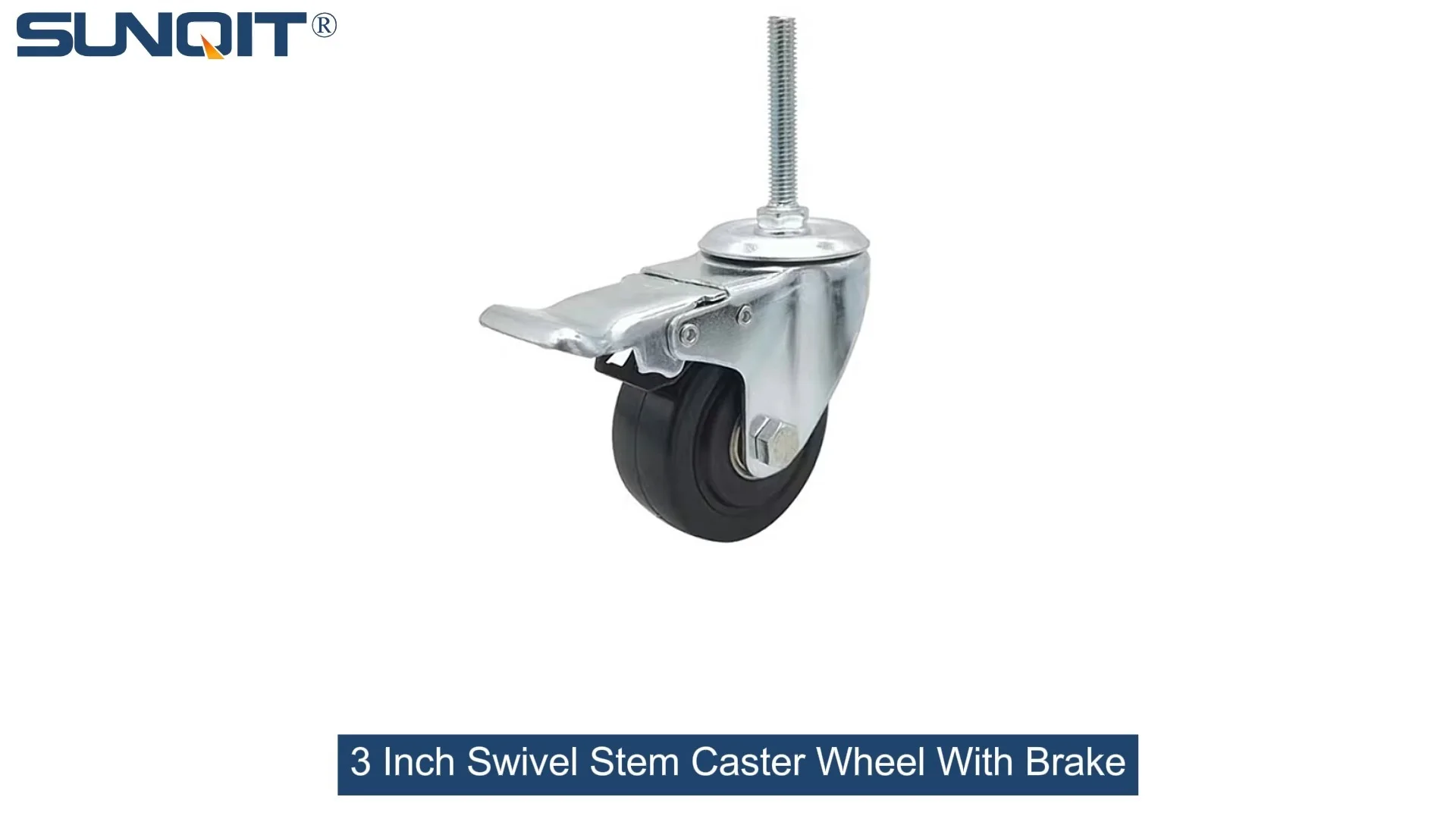
Swivel Stem Caster Wheel with Brake
360 Degree Swivel Stem Caster with brake. Threaded-post mount design, castors diameter 3 inch.Each swivel caster wheels loading 70KGS. Heavy enough and widely suit for carts, chairs, cabinet, flow rack, workbench, turnover rolley.
The Heartbeat of Modern Manufacturing: Flexibility
Walk into any thriving manufacturing facility today, and you'll notice a common theme: adaptability. Gone are the days of rigid, fixed production lines that take weeks to reconfigure. In their place are dynamic workspaces where stations shift, workflows evolve, and teams respond quickly to changing customer demands. At the center of this transformation lies a seemingly small but mighty component: the caster wheel. More specifically, the Swivel Stem Caster Wheel with Brake has emerged as a unsung hero, enabling the kind of flexibility that defines lean, efficient, and customer-centric production environments.
Imagine a scenario where a sudden rush order requires reallocating a workbench from one corner of the factory to another. Or a situation where a team needs to rearrange a material handling area to accommodate a new machine. Without the right mobility tools, these tasks would involve heavy lifting, downtime, and even potential safety risks. But with a reliable swivel stem caster wheel with brake, what once took hours can now happen in minutes. It's not just about saving time—it's about empowering teams to work smarter, reduce waste, and stay ahead in an increasingly competitive market.
In this article, we'll dive deep into the world of swivel stem caster wheels with brakes, exploring their design, functionality, and the critical role they play in modern production lines. We'll also examine how they integrate with other key components like workbenches, roller tracks, and aluminum profiles to create cohesive, efficient systems. Whether you're a production manager looking to optimize your workflow, a facility designer crafting the next generation of manufacturing spaces, or simply curious about the mechanics behind smooth operations, this guide will shed light on why these casters are more than just "wheels"—they're enablers of innovation.
Beyond Basic Wheels: What Makes the Swivel Stem Caster with Brake Stand Out?
Not all casters are created equal. While standard fixed casters or non-braked swivel models have their uses, the Swivel Stem Caster Wheel with Brake is engineered for precision, control, and versatility. Let's break down its key features and why they matter in a production setting.
1. 360° Swivel: Maneuverability Without Limits
The "swivel" in the name says it all. Unlike fixed casters that only roll forward and backward, these casters can rotate a full 360 degrees, allowing the equipment they're attached to—whether a workbench, trolley, or material rack—to glide smoothly in any direction. This is game-changing in tight spaces. For example, a workbench mounted on swivel casters can be easily pivoted to align with a conveyor belt or repositioned to form a U-shape with other stations during a team assembly project. The stem design, which typically features a threaded or press-fit stem, ensures a secure connection to the equipment base, while the swivel mechanism (often a ball bearing raceway) ensures smooth rotation even under heavy loads.
2. The Brake: Safety and Stability When You Need It Most
Mobility is only useful if you can stop when you need to. The brake mechanism is where these casters truly shine. Most models feature a foot-operated brake that, when engaged, locks both the wheel and the swivel motion, preventing accidental movement. This is crucial for two reasons: safety and precision. In a production line, a workbench that drifts mid-assembly could lead to errors or injuries. With the brake engaged, operators can work with confidence, knowing their workspace is stable. Additionally, during maintenance or when loading/unloading materials, the brake ensures the equipment stays put, reducing the risk of tip-overs or collisions with nearby machinery.
3. Durable Materials for Heavy-Duty Use
Manufacturing environments are tough. Floors are often concrete, debris is common, and loads can be substantial. That's why quality swivel stem caster wheels with brakes are built to last. The wheels themselves are typically made from high-density rubber, polyurethane, or nylon. Rubber wheels, for instance, offer excellent shock absorption and floor protection, making them ideal for facilities with sensitive flooring or where noise reduction is a priority. Polyurethane wheels, on the other hand, combine the durability of plastic with the grip of rubber, handling heavier loads (often up to 500 lbs per caster) without scuffing floors. The stem and brake components are usually constructed from steel or reinforced aluminum, ensuring they can withstand the wear and tear of daily use.
4. Easy Installation: Minimal Downtime, Maximum Impact
In fast-paced production settings, downtime is the enemy. The best swivel stem caster wheels with brakes are designed for quick, hassle-free installation. The stem—whether threaded, hollow, or square—fits into pre-drilled holes or mounting plates on equipment like workbenches or trolleys. Many suppliers offer stems in standard sizes (e.g., 3/8-inch or 1/2-inch diameters) to ensure compatibility with common industrial furniture. This means a maintenance team can replace or upgrade casters in minutes, not hours, keeping production on track.

Integration with Key Production Components: Building a Cohesive System
A single component, no matter how well-designed, can't transform a production line on its own. The true power of the Swivel Stem Caster Wheel with Brake lies in how seamlessly it works with other essential elements of modern manufacturing. Let's explore how it pairs with three critical components: workbenches, roller tracks, and aluminum profiles.
Workbenches: From Fixed to Fluid
The workbench is the cornerstone of any production line—a space where operators assemble, inspect, or package products. Traditionally, workbenches were bolted to the floor, limiting their utility. Today, however, the majority of modern workbenches come equipped with casters, and for good reason. A workbench fitted with Swivel Stem Caster Wheels with Brakes becomes a mobile command center. Need to move it closer to a material rack for faster access? Unlock the brakes, glide it over, and lock again. Want to reconfigure a team of workbenches into a collaborative circle for a brainstorming session? No problem. This mobility also simplifies cleaning—simply roll the workbench aside to sweep or sanitize the floor underneath, a key advantage in industries like food processing or pharmaceuticals where hygiene is paramount.
Take, for example, the Workbench E (Single Deck-without Caster) —a popular model among manufacturers. While it comes "without caster" by default, many facilities choose to retrofit it with swivel stem casters with brakes. This customization turns a static table into a dynamic tool that adapts to shifting needs. The result? A workspace that grows with the team, rather than restricting it.
Roller Tracks: Smooth Material Flow, Powered by Mobility
Roller tracks are the arteries of a production line, transporting materials, components, and finished goods from one station to the next. But even the most efficient roller track system can hit a snag if the stations feeding into it aren't positioned correctly. Here's where casters come in. Trolleys or carts mounted on Swivel Stem Caster Wheels with Brakes can easily align with roller tracks, allowing operators to load materials onto the track with minimal effort. For instance, a turnover trolley filled with parts can be rolled up to a roller track, braked into place, and then the parts can be slid onto the track for transport to the next workstation. This eliminates the need for manual lifting or awkward reaching, reducing strain and speeding up material handling.
Consider the Plastic Roller Track Guide Rail Yellow , a common component in lean systems. Its smooth, low-friction surface ensures materials glide easily, but its effectiveness depends on how well it's integrated with the surrounding equipment. A mobile cart with swivel casters can bridge the gap between storage and the roller track, ensuring a continuous flow of materials without bottlenecks. It's a small adjustment, but one that adds up to significant time savings over a shift.
Aluminum Profiles: Strength and Flexibility in One
Aluminum profiles have revolutionized the way production lines are built. Lightweight yet strong, these extruded aluminum beams can be assembled into frames, racks, workstations, and more, using simple connectors. When paired with Swivel Stem Caster Wheels with Brakes , aluminum profiles become the backbone of truly modular systems. For example, a material rack constructed from Aluminum Profile 4040 (a popular size for industrial use) can be fitted with casters, turning it into a mobile storage unit. This is especially valuable in lean systems, where the goal is to eliminate waste—including wasted space. A mobile aluminum profile rack can be moved to where it's needed most, whether that's near a production line during peak hours or to a storage area during lulls.
The key here is compatibility. Aluminum profiles often feature T-slots, which allow for easy mounting of casters. Many caster manufacturers offer stem adapters or mounting plates designed specifically for aluminum profiles, ensuring a secure fit that can handle the weight of loaded racks or workstations. This combination of aluminum's versatility and casters' mobility creates a system that's not just flexible, but also durable enough to withstand the rigors of daily use.

Real-World Impact: How Casters Transform Production Lines
To truly understand the value of Swivel Stem Caster Wheels with Brakes , let's look at a real-world example. Consider a mid-sized electronics manufacturer that produces custom circuit boards. Their production line involves several steps: component sorting, soldering, testing, and packaging. Initially, their workbenches and material racks were fixed in place, which meant operators often had to walk long distances to retrieve parts or move boards between stations. This led to fatigue, delays, and occasional errors.
The solution? Retrofitting all workbenches and material racks with swivel stem casters with brakes. Almost immediately, the team noticed a difference. The soldering workbench could now be positioned directly next to the component sorting rack, cutting down on walking time. The testing station, which was previously tucked in a corner, could be rolled out into the open during peak hours to accommodate more testers. Even the packaging area benefited—trolleys with casters could be loaded with finished products and easily moved to shipping, rather than being carried by hand.
After three months, the manufacturer reported a 15% increase in production output and a 20% reduction in operator fatigue (measured through employee surveys). Perhaps most notably, they were able to take on smaller, custom orders that would have been too time-consuming with their old setup, opening up a new revenue stream. It's a testament to how small changes—like upgrading casters—can lead to big results.

Choosing the Right Swivel Stem Caster: Key Considerations
Not all swivel stem caster wheels with brakes are suited for every application. To get the most out of your investment, it's important to consider a few key factors before making a purchase:
Load Capacity: Know Your Weight Limits
Every caster has a maximum load capacity, and exceeding it can lead to premature wear, brake failure, or even accidents. When calculating the load, remember to include the weight of the equipment itself plus the maximum weight of materials it will carry. For example, a workbench that weighs 100 lbs and holds 300 lbs of parts needs casters with a combined capacity of at least 400 lbs (and ideally more, to account for uneven loading). Most manufacturers list both individual caster capacity and total capacity for sets of four, so be sure to check both.
Floor Type: Protect Your Surfaces
The type of wheel material matters just as much as the caster design. Hard wheels (like steel) are durable but can scratch or damage delicate floors (e.g., polished concrete or vinyl). Soft wheels (like rubber or polyurethane) are gentler on floors and provide better traction, making them ideal for indoor use. If your facility has uneven floors or debris, consider wheels with a larger diameter—they'll roll more smoothly over obstacles. For example, a 5-inch wheel will handle cracks or small bolts better than a 3-inch wheel.
Brake Type: Foot-Operated vs. Other Options
While foot-operated brakes are standard, there are variations. Some models lock only the wheel, while others lock both the wheel and the swivel. For most production line applications, the latter is preferable, as it prevents the equipment from swiveling unexpectedly. Additionally, look for brakes that are easy to engage and disengage—operators shouldn't have to bend down or use excessive force, as this can lead to fatigue or skipped brake usage.
| Caster Type | Key Feature | Best For | Load Capacity (per caster) |
|---|---|---|---|
| Swivel Stem Caster with Brake (Rubber Wheel) | 360° swivel, wheel + swivel lock, floor-friendly | Workbenches, trolleys on polished floors | 200–400 lbs |
| Swivel Stem Caster with Brake (Polyurethane Wheel) | High load capacity, chemical resistance | Heavy-duty racks, industrial trolleys | 400–800 lbs |
| Fixed Stem Caster (No Brake) | Only rolls forward/backward, no swivel | Equipment that rarely moves | 300–600 lbs |
| Swivel Caster Without Brake | 360° swivel but no locking mechanism | Light-duty carts, temporary use | 150–300 lbs |
Durability and Maintenance: Keeping Your Casters Rolling Strong
A quality Swivel Stem Caster Wheel with Brake is built to last, but like any piece of equipment, it requires regular maintenance to perform at its best. Here are some tips to ensure your casters stay in top shape:
- Clean Regularly: Dust, debris, and grease can build up in the swivel mechanism or around the brake, causing it to stick. Wipe the wheels and swivel head with a damp cloth weekly, and use a brush to remove debris from hard-to-reach areas.
- Lubricate Moving Parts: The swivel raceway and wheel bearings benefit from occasional lubrication. Use a light machine oil or silicone spray (avoid heavy greases, which can attract dirt) and apply a small amount to the swivel joint and wheel axles every 3–6 months, depending on usage.
- Inspect Brakes: Check the brake pads for wear and ensure the brake lever moves freely. If the brake feels "soft" or doesn't lock securely, replace the brake mechanism immediately—don't wait for a failure.
- Tighten Loose Stems: Over time, the stem may loosen in the mounting hole. Periodically check and tighten any mounting nuts or bolts to prevent wobbling, which can damage the caster or the equipment it's attached to.
By following these simple steps, you can extend the life of your casters and ensure they continue to provide reliable mobility and safety for years to come.
The Future of Production Line Mobility
As manufacturing continues to evolve—driven by trends like Industry 4.0, automation, and customization—the demand for flexible, mobile solutions will only grow. What does this mean for the humble swivel stem caster wheel with brake? We're already seeing innovations like smart casters equipped with sensors that monitor load, temperature, or wear, sending alerts when maintenance is needed. Others are integrating with IoT systems, allowing operators to track the location of mobile equipment in real time.
Additionally, as sustainability becomes a priority, we can expect to see casters made from recycled materials or designed for easier recycling at the end of their life. Lightweight yet strong materials, like carbon fiber-reinforced plastics, may also enter the market, reducing the overall weight of mobile equipment and improving energy efficiency.
But even with these advancements, the core purpose of the swivel stem caster with brake will remain the same: to give production lines the freedom to adapt. In a world where change is the only constant, that freedom is invaluable.
Conclusion: Small Wheels, Big Impact
It's easy to overlook the role of casters in manufacturing. They're small, often hidden under workbenches or trolleys, and rarely get the attention of flashy new machines or high-tech software. But as we've explored, the Swivel Stem Caster Wheel with Brake is a foundational component of modern production lines. It's the difference between a workspace that frustrates and one that empowers, between downtime and efficiency, between rigidity and innovation.
Whether you're building a new lean system from scratch, retrofitting an existing line, or simply looking to improve your team's daily workflow, don't underestimate the power of a quality caster. Pair it with sturdy workbenches, smooth roller tracks, and versatile aluminum profiles, and you'll create a production environment that's not just efficient—but ready to thrive in whatever the future brings.
So the next time you see a workbench gliding across the factory floor or a trolley stopping perfectly in line with a roller track, take a moment to appreciate the small but mighty component making it all possible. The swivel stem caster wheel with brake may not be the star of the show, but it's certainly the unsung hero keeping the production line moving—forward, flexibly, and fearlessly.