- Company Articles
- Products and Technology
- Product knowledge
- Swivel Stem Caster Wheel with Brake: Essential for 3C Product Testing Stations

Swivel Stem Caster Wheel with Brake: Essential for 3C Product Testing Stations
Related Product
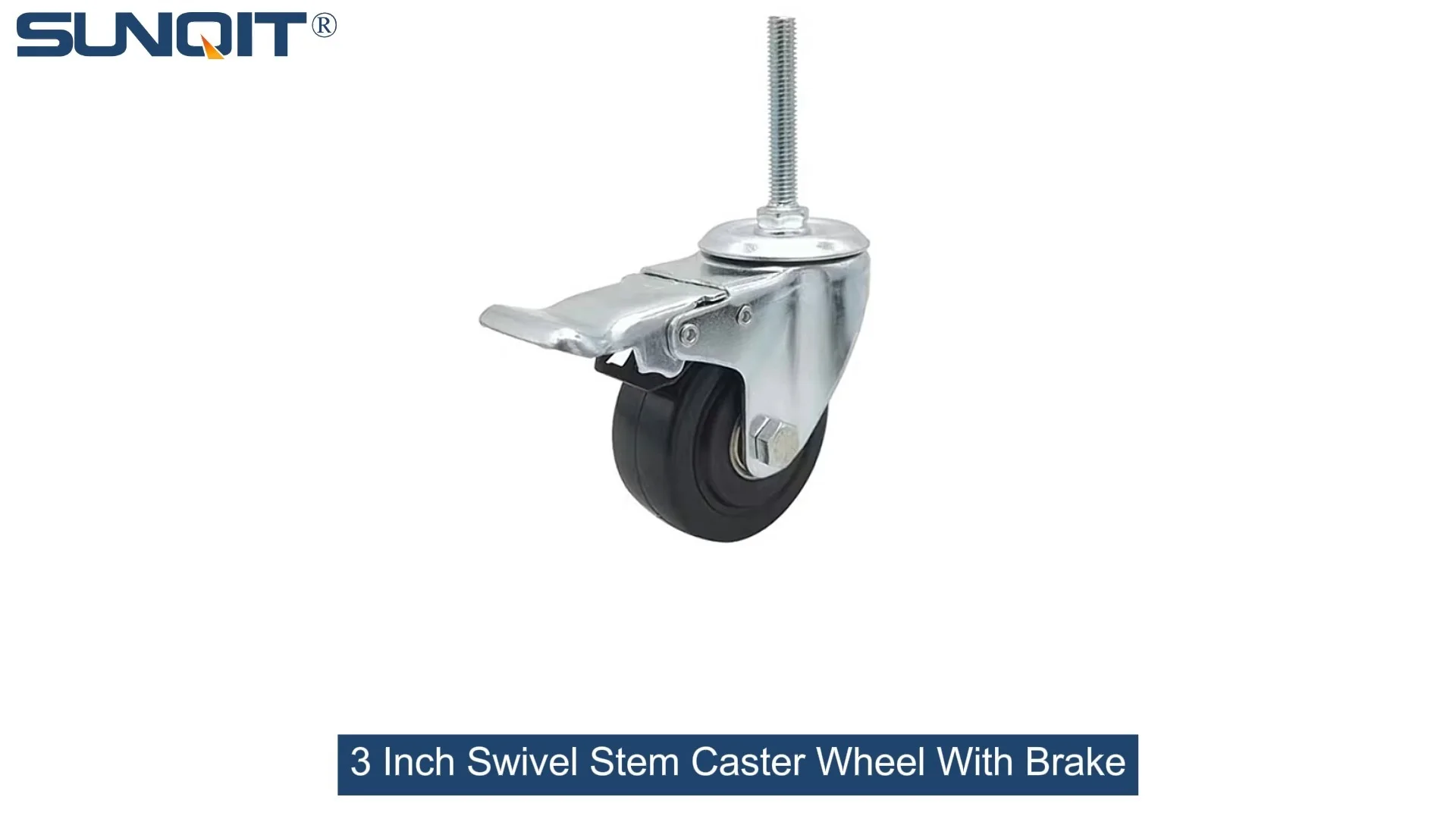
Swivel Stem Caster Wheel with Brake
360 Degree Swivel Stem Caster with brake. Threaded-post mount design, castors diameter 3 inch.Each swivel caster wheels loading 70KGS. Heavy enough and widely suit for carts, chairs, cabinet, flow rack, workbench, turnover rolley.
The Unsung Hero of 3C Testing: Why Mobility Matters More Than You Think
Let's start with a scenario we've all seen (or maybe even experienced): Walk into any 3C product testing lab—whether it's for smartphones, laptops, or smartwatches—and you'll likely find rows of workstations lined up like soldiers. Each one is bolted to the floor, cluttered with testing gear, and surrounded by cables snaking across the floor. Technicians shuffle back and forth, carrying devices from one station to the next, bending over fixed tables to reach equipment, and pausing to adjust setups when a new model comes in. It's busy, but is it efficient? Here's the hard truth: In an industry where product cycles last months (not years) and precision is measured in millimeters, fixed workstations are holding labs back. And that's where the swivel stem caster wheel with brake steps in—not as a "nice-to-have" accessory, but as a critical tool that transforms how 3C testing gets done.
3C products—computers, communications, and consumer electronics—are delicate beasts. A single static discharge can fry a circuit board. A misaligned sensor can throw off camera calibration. And with new models launching every few months, labs need to reconfigure testing lines on the fly. Fixed workstations? They're the opposite of flexible. They lock you into a layout, force unnecessary movement (wasting time and energy), and make it harder to adapt when priorities shift. But what if your testing station could move with you? What if you could roll it to the component storage area, lock it in place for precise calibration, then reposition it next to the roller track for seamless device handoff? That's the promise of the swivel stem caster wheel with brake—and it's why forward-thinking labs are swapping out fixed legs for these but powerful tools.
The Problem with "Set It and Forget It" Workstations
To understand why swivel stem casters are game-changers, let's break down the pain points of traditional fixed workstations in 3C testing. First, there's the issue of static control . Most 3C labs use esd workstations to prevent electrostatic discharge from damaging sensitive components. These workstations are grounded, with conductive surfaces and mats that channel static away from devices. But here's the catch: If your workstation is fixed, you can't move it closer to the assembly line when a new batch of devices arrives. Instead, you're stuck carrying those devices across the lab—exposing them to static risks (even with anti-static bags) and wasting time that could be spent testing.
Then there's ergonomics . Technicians spend hours bent over workbenches, adjusting test probes or aligning screens. A fixed workstation forces them to adapt to the table's height and position, leading to strained backs, neck pain, and even repetitive motion injuries over time. And let's not forget workflow waste —a cardinal sin in lean system principles. Lean manufacturing (and testing) is all about eliminating non-value-added activities, and moving devices between fixed stations is pure waste. Every step a technician takes to fetch a tool or transport a device is time that could be spent on actual testing.
Finally, there's flexibility . 3C testing isn't one-size-fits-all. A station testing smartphone cameras needs different lighting and alignment tools than one testing laptop batteries. With fixed workstations, reconfiguring for a new test means disassembling, moving heavy equipment, and re-calibrating—sometimes taking hours. In a lab where a single day of delay can cost thousands in missed deadlines, that's not just inefficient; it's costly.

Swivel Stem Caster Wheel with Brake: What It Is and How It Solves These Problems
At first glance, a swivel stem caster wheel with brake might seem simple: a wheel attached to a stem that swivels 360 degrees, with a brake lever to lock it in place. But looks are deceiving. These casters are engineered for precision—specifically for environments where mobility, stability, and static control can't be compromised. Let's break down their key features and how they address the challenges we just discussed.
360-Degree Swivel: Maneuverability in Tight Spaces
Labs are rarely spacious. Equipment, cables, and storage racks leave little room to maneuver. A swivel stem caster's ability to rotate 360 degrees means you can pivot the workstation in place, squeeze through narrow aisles, and position it exactly where you need it—even in corners. Compare that to fixed workstations, which require you to plan layouts around their immobility, often wasting valuable floor space.
Locking Brake: Stability When You Need It Most
Mobility is great, but precision testing demands stability. That's where the brake comes in. A high-quality swivel stem caster with brake locks two things: the wheel (so the workstation doesn't roll) and the swivel (so it doesn't pivot). This dual locking mechanism ensures the station stays rock-solid during delicate tasks—like aligning a micrometer to measure a phone's bezel or calibrating a touchscreen sensor. No more "shimmying" tables or accidental movements that throw off measurements.
ESD Compatibility: Keeping Static at Bay, Even on the Move
Remember those esd workstations we talked about earlier? Swivel stem casters can be designed with conductive materials (like brass or aluminum) or ESD-safe coatings that maintain the workstation's grounding path. The stem itself is often made of metal, which connects to the workstation frame, ensuring static is channeled away from devices—even when the station is rolled across the lab. This is critical because a mobile workstation that isn't grounded is just a static-generating hazard waiting to happen.
Load Capacity: Built for Heavy Testing Gear
3C testing stations aren't light. They're loaded with oscilloscopes, thermal cameras, power supplies, and heavy fixtures. A cheap caster might buckle under the weight, leading to wobbly workstations or even equipment damage. High-quality swivel stem casters are rated for loads of 100–300 kg per wheel, meaning a four-caster workstation can easily support 400–1200 kg—plenty for even the most gear-heavy setups.

From Chaos to Order: How Casters Fit Into Lean System Principles
Lean system thinking is all about creating value by eliminating waste—and in 3C testing, mobility is a powerful waste-buster. Let's map out how swivel stem casters align with core lean principles:
- Eliminating Transportation Waste: Instead of moving devices to the workstation, move the workstation to the devices. This cuts down on the "transport" step in the testing process, saving time and reducing the risk of device damage during transit.
- Reducing Motion Waste: Technicians no longer need to walk back and forth between storage, testing stations, and roller tracks. The workstation comes to them, minimizing unnecessary movement and fatigue.
- Flexibility for "Just-in-Time" Testing: 3C labs often handle small batches of prototype devices. With casters, you can quickly reconfigure stations to test a new model without disassembling the entire line—supporting "just-in-time" testing that aligns with production schedules.
- Maximizing Space Utilization: Fixed workstations take up permanent floor space. Mobile stations can be rolled into storage when not in use, freeing up room for other tasks (like training or equipment maintenance).
One lab manager I spoke with (let's call him Mike) shared a telling example: His team used to spend 2 hours reconfiguring fixed workstations whenever a new smartphone prototype arrived. They'd unbolt tables, move heavy equipment, and rewire grounding systems—all while the clock ticked on tight deadlines. After switching to esd workstations with swivel stem casters, that reconfiguration time dropped to 20 minutes. "We just roll the stations into place, lock the brakes, and we're ready," Mike said. "It's not just about saving time—it's about reducing stress. When you're up against a launch date, every minute counts."

Fixed vs. Mobile: A Side-by-Side Comparison
Still on the fence? Let's put fixed workstations and mobile esd workstations with swivel stem casters head-to-head. The table below breaks down key factors like flexibility, static control, and cost over time:
| Factor | Fixed Workstation | Mobile ESD Workstation (with Swivel Stem Casters) |
|---|---|---|
| Setup/Reconfiguration Time | 2–4 hours (requires tools, disassembly) | 15–30 minutes (roll, lock, and test) |
| Static Control | Strong (grounded, but limited to fixed position) | Equally strong (grounded via conductive casters; mobile grounding) |
| Technician Ergonomics | Poor (fixed height/position forces awkward postures) | Excellent (station can be positioned at optimal height/angle) |
| Workflow Efficiency | Low (high transportation/motion waste) | High (station moves to materials; reduces non-value steps) |
| Initial Cost | Lower (no caster investment) | Higher (caster + workstation cost) |
| Long-Term ROI | Low (high labor costs from inefficiency) | High (time savings, reduced errors, lower injury risk) |
The takeaway? Fixed workstations might seem cheaper upfront, but they cost more in the long run—especially in fast-paced 3C environments. Mobile stations with swivel stem casters aren't just an upgrade; they're an investment in efficiency, precision, and technician well-being.
Choosing the Right Swivel Stem Caster: Key Features to Prioritize
Not all swivel stem casters are created equal. To get the most out of your investment, look for these critical features—especially if you're pairing them with an esd workstation or integrating them into a lean system:
- Dual-Locking Brakes: As mentioned earlier, the best casters lock both the wheel and the swivel plate. This prevents "drifting" during testing and ensures the workstation stays grounded.
- ESD-Safe Materials: Look for casters with conductive rubber wheels or metal stems that maintain grounding continuity. Ask suppliers for ESD test reports to verify compliance (most labs require resistance between 10^6 and 10^9 ohms).
- Load Rating: Calculate the total weight of your workstation (including equipment, tools, and operators) and choose casters with a rating that exceeds this by 20% (to account for uneven loads).
- Non-Marking Wheels: Lab floors are often polished concrete or vinyl. Rubber or polyurethane wheels won't leave scuffs, keeping your workspace looking professional.
- Smooth Swivel Action: A stiff swivel joint makes maneuvering frustrating. Test casters before buying—they should rotate effortlessly, even under load.
- Corrosion Resistance: Labs can be humid (especially during environmental testing). Stainless steel stems or zinc-plated joints prevent rust, extending caster life.
Pro tip: Don't skimp on brake quality. A cheap brake might work for a few months, but under daily use, the lever can bend or the locking mechanism can wear out—putting your workstation at risk of unexpected movement. Invest in casters with heavy-duty brake levers and replaceable brake pads (they'll save you from buying new casters down the line).
Beyond the Caster: Building a Mobile Testing Ecosystem
Swivel stem casters are powerful on their own, but they're even better when paired with other lab tools. For example, many labs use roller tracks to move devices between testing stages. A mobile workstation can roll right up to the roller track, aligning perfectly for seamless handoff (no more reaching across gaps or dropping devices). Similarly, integrating your mobile esd workstation with a lean system—like kanban boards or digital workflow tools—creates a "test cell" that adapts to changing priorities.
Another trend? Modular workbenches with interchangeable tops. Pair a modular esd workbench with swivel stem casters, and you can swap out a wooden top for a conductive mat in minutes—perfect for switching between "general assembly" and "static-sensitive testing" tasks. It's this kind of flexibility that makes mobile stations indispensable in modern 3C labs.
Final Thoughts: Small Tool, Big Impact
In the world of 3C testing, where success hinges on precision, speed, and adaptability, the swivel stem caster wheel with brake is more than a tool—it's a catalyst for change. It transforms rigid, wasteful workflows into agile, lean operations. It turns static-prone workstations into mobile, grounded hubs of efficiency. And it gives technicians the flexibility to focus on what matters: ensuring every device meets the high standards consumers demand.
So the next time you walk into a 3C testing lab, take a look at the workstations. If they're bolted to the floor, imagine the possibilities (oops, almost said "imagine"—let's say "picture the difference") a few well-placed casters could make. Faster testing. Happier technicians. Fewer delays. In an industry that never stands still, mobility isn't optional—it's essential. And the swivel stem caster wheel with brake? It's the key to unlocking that mobility.