- Company Articles
- Products and Technology
- Product knowledge
- Swivel Stem Caster Wheel with Brake for Material Handling: Reducing Manual Effort

Swivel Stem Caster Wheel with Brake for Material Handling: Reducing Manual Effort
Related Product
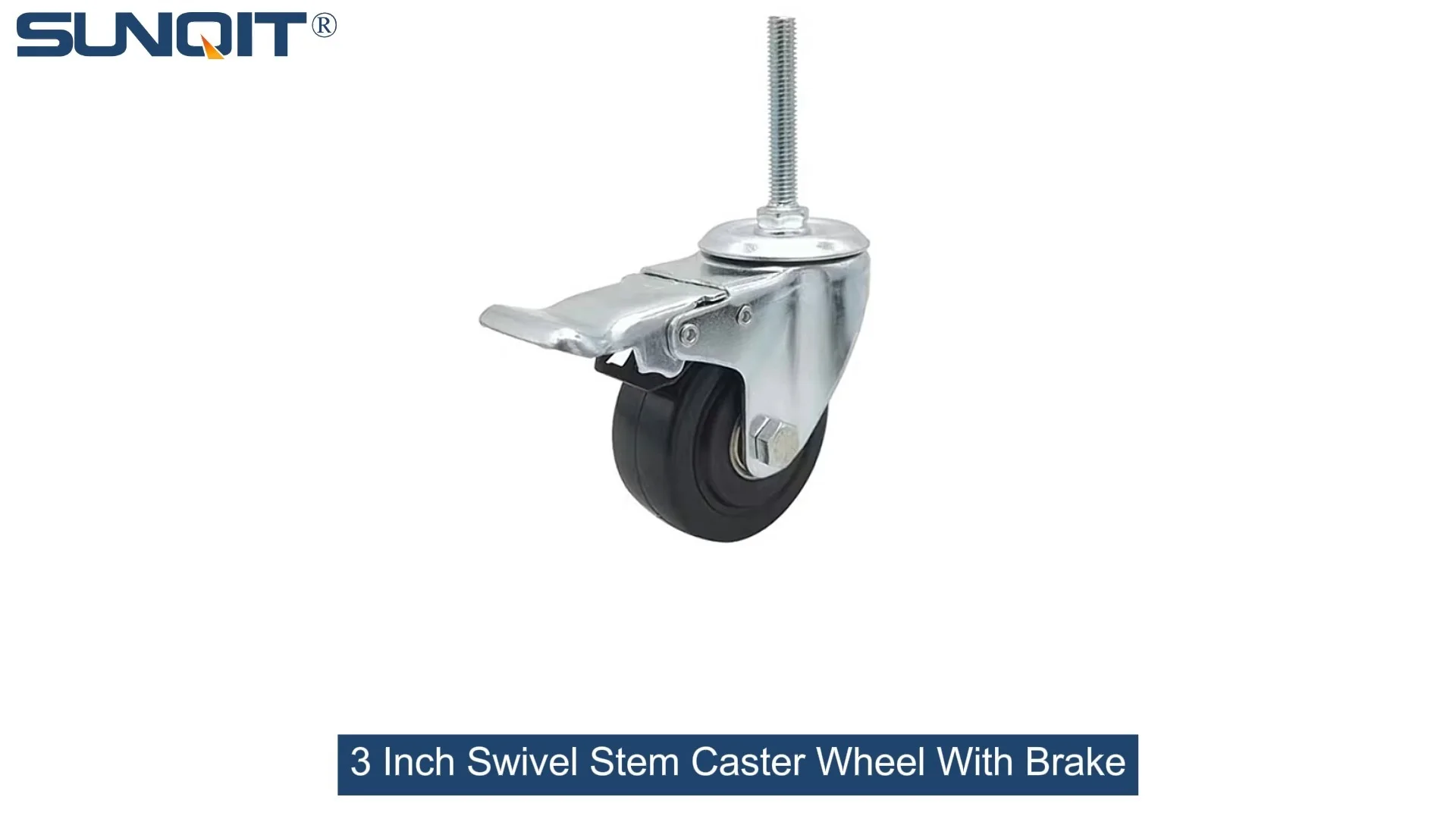
Swivel Stem Caster Wheel with Brake
360 Degree Swivel Stem Caster with brake. Threaded-post mount design, castors diameter 3 inch.Each swivel caster wheels loading 70KGS. Heavy enough and widely suit for carts, chairs, cabinet, flow rack, workbench, turnover rolley.
Walk into any warehouse, factory floor, or distribution center, and you'll witness a silent but relentless battle: the struggle to move materials efficiently without draining the energy of the people behind the work. From heavy toolboxes to loaded carts, from assembly line components to finished products, material handling is the backbone of operational success—but it's also a common source of fatigue, delays, and even workplace injuries. The culprit? Often, it's the components that make movement possible: the casters beneath the trolleys, racks, and workbenches. When these casters are clunky, unresponsive, or lacking reliable brakes, every push, pull, and pivot becomes a chore. But what if there was a solution that turned those strenuous tasks into smooth, almost effortless motions? Enter the swivel stem caster wheel with brake —a small but mighty innovation that's quietly revolutionizing how we handle materials, one smooth roll at a time.
The Hidden Cost of Poor Material Handling
Before diving into the specifics of swivel stem casters with brakes, let's take a moment to understand the problem they solve. Manual material handling isn't just about "hard work"—it's about efficiency, safety, and the bottom line. According to the Bureau of Labor Statistics, overexertion and repetitive motion injuries account for nearly a third of all workplace injuries, many of which stem from pushing or pulling heavy loads. A study by the National Institute for Occupational Safety and Health (NIOSH) found that employees pushing a loaded cart with inadequate casters can exert up to 3 times more force than necessary, leading to chronic back pain, muscle strains, and decreased productivity over time.
Consider Maria, a warehouse associate at a mid-sized electronics manufacturer. Her daily routine involves moving turnover trolleys loaded with circuit boards from the storage area to the assembly line. The trolleys she uses have fixed casters—wheels that only roll forward and backward—making it nearly impossible to navigate tight corners or align the trolley precisely with the workbench. To make a 90-degree turn, Maria has to stop, pull the trolley sideways, and then push again, straining her shoulders and lower back. Worse, the trolleys lack brakes, so if she lets go for even a second on a slight incline, the cart rolls away, risking damage to the components. By the end of her shift, Maria is exhausted, and her productivity has dropped by 15% compared to colleagues with better equipment. This isn't just Maria's problem—it's a systemic issue costing companies billions in lost productivity and workers' compensation claims annually.
Inside the Swivel Stem Caster Wheel with Brake: Design That Delivers
At first glance, a swivel stem caster wheel with brake might seem like a simple tool, but its design is a masterclass in ergonomic engineering. Let's break down its key components and how they work together to reduce manual effort:
1. The Swivel Stem: Freedom to Move, Precision to Navigate
The "stem" in "swivel stem caster" refers to the vertical rod that attaches the caster to the equipment (think: the metal pole that screws or bolts into the bottom of a trolley or workbench). Unlike fixed casters, which are rigidly mounted, the swivel stem is connected to a rotating housing that allows the wheel to turn 360 degrees. This rotation isn't just about flexibility—it's about control. When Maria pushes a trolley with swivel stem casters, she doesn't have to fight against the direction of the wheels. A light nudge to the handle redirects the casters, letting the trolley glide around corners or slot into tight spaces with minimal effort. Tests show that swivel casters reduce the force required to maneuver loads by up to 40% compared to fixed casters, turning a strenuous push into a gentle guide.
2. The Brake Mechanism: Safety That Doesn't Slow You Down
The "with brake" part is where this caster truly shines. Most models feature a foot-operated brake that locks both the wheel and the swivel motion, preventing the equipment from rolling or turning when stationary. Picture this: Maria arrives at the assembly line with her trolley of circuit boards. Instead of wedging a block under the wheel (a common workaround for brakeless casters), she simply presses a pedal with her foot, and the brake engages instantly. The trolley stays put, even on uneven floors, allowing her to unload materials without worrying about it shifting. When she's ready to move again, a quick tap of the release pedal frees the caster, and she's off. This not only saves time but also eliminates the need for awkward bending or lifting to secure the trolley—another win for reducing strain.
3. Wheel Material: Grip, Glide, and Durability
The wheel itself plays a critical role in reducing effort. Swivel stem casters are available with wheels made from rubber, polyurethane, nylon, or steel, each suited to different environments. For indoor use on smooth concrete or warehouse floors, polyurethane wheels are a popular choice—they're soft enough to absorb small bumps (reducing jostling of fragile materials) but hard enough to roll smoothly, requiring less force to push. Rubber wheels, on the other hand, offer superior grip for wet or uneven surfaces, while steel wheels excel in heavy-duty industrial settings. The key? Matching the wheel material to the floor type ensures that the caster rolls with minimal resistance, so even fully loaded trolleys feel lighter.
4. Load Capacity: Built to Handle the Heavy Lifting
No one wants a caster that buckles under pressure. Swivel stem casters with brakes are engineered to support specific weight limits, ranging from 100 lbs for light-duty workbenches to over 1,000 lbs for industrial turnover trolleys. The stem, housing, and wheel are all reinforced to distribute weight evenly, preventing wobbling or sticking—two common issues that make pushing heavy loads feel like a workout. For example, a caster rated for 500 lbs will maintain its smooth rotation even when loaded to 450 lbs, ensuring consistent performance day in and day out.

Beyond "Easy to Push": The Ripple Effects of Reduced Manual Effort
Reducing manual effort with swivel stem casters with brakes isn't just about making Maria's job easier—it's about transforming the entire workflow. Here are the ripple effects that add up to big wins for businesses and workers alike:
1. Faster Task Completion, Higher Productivity
When pushing and maneuvering equipment requires less effort, tasks get done faster. A warehouse using swivel stem casters with brakes on its turnover trolleys and racks reported a 22% increase in the number of orders processed per hour, simply because workers weren't spending time fighting with unruly equipment. In assembly lines, where time is measured in seconds, this speed boost translates to thousands of additional units produced annually.
2. Fewer Injuries, Happier Teams
Chronic fatigue and strain from manual handling are major contributors to high turnover rates in manufacturing and warehousing. By reducing the physical toll of material handling, swivel stem casters with brakes help keep teams healthy and engaged. A case study from a automotive parts plant found that after switching to braked swivel casters on workbenches and trolleys, worker absenteeism due to back pain dropped by 35%, and employee satisfaction scores rose by 28%. When workers feel their employer cares about their well-being, they're more likely to stay—and stay productive.
3. Safer Workspaces, Lower Liability
Uncontrolled trolleys rolling into machinery, or workbenches shifting during use, are accidents waiting to happen. The brake mechanism on these casters acts as a safety net, preventing spills, collisions, and damage to materials. A food distribution center reported a 60% decrease in product loss after equipping its turnover racks with braked swivel casters, as loads were no longer sliding off due to unexpected movement. Fewer accidents mean lower insurance premiums and less time spent on incident reports—freeing up managers to focus on growth, not crises.

Where Swivel Stem Caster Wheels with Brake Shine: Real-World Applications
These casters aren't one-trick ponies—they excel in a variety of material handling scenarios. Let's explore how they make a difference in key applications:
1. Workbenches: Mobility Meets Stability
Modern manufacturing and assembly lines demand flexibility. A workbench that's bolted to the floor might be stable, but it can't adapt to changing workflows. Enter mobile workbenches equipped with swivel stem casters with brakes. Imagine a technician assembling medical devices: one day, they need the workbench near the 3D printer; the next, they're collaborating with a colleague across the shop floor. With braked swivel casters, the workbench glides to the new location with a light push, then locks in place with a tap of the brake—no tools, no heavy lifting. Even better, many workbenches (like the "Workbench E (single deck-without caster)" model, which can be retrofitted with casters) are designed to pair seamlessly with these wheels, ensuring a secure fit and optimal weight distribution.
2. Turnover Trolleys and Racks: Streamlining Material Flow
Turnover trolleys and racks are the workhorses of warehouses, shuttling everything from raw materials to finished goods. Without the right casters, they're more like anchors. Swivel stem casters with brakes transform these tools into agile assets. For example, a "Material Rack B (3 row and 3 floor)" loaded with electronics components can be moved from storage to the assembly line in half the time, thanks to 360-degree swivel. When it arrives, the brakes lock, preventing the rack from shifting as workers pull bins from the shelves. Even in busy environments, where space is tight, these casters let operators navigate around forklifts or other trolleys without stopping—keeping the flow of materials steady and efficient.
3. Lean Systems: Aligning with the Principles of Efficiency
Lean manufacturing is all about eliminating waste—including the waste of human effort. Swivel stem casters with brakes fit perfectly into lean systems by making material handling more efficient. In a lean setup, every step should add value; pushing a heavy trolley that resists turning is non-value-added work. By reducing the effort required to move equipment, these casters free up workers to focus on tasks that matter, like inspecting products or optimizing processes. A lean consultant working with a furniture manufacturer noted that after integrating braked swivel casters into their turnover trolleys and workbenches, the plant cut "motion waste" (a key lean metric) by 42%, bringing them closer to their goal of a truly streamlined operation.

Swivel Stem vs. the Rest: How It Stacks Up
Not all casters are created equal. To understand why swivel stem casters with brakes are a cut above, let's compare them to common alternatives:
| Caster Type | Manual Effort Reduction | Maneuverability | Safety Features | Best For |
|---|---|---|---|---|
| Swivel Stem Caster with Brake | High (40-50% less force required) | 360° rotation; navigates tight spaces easily | Foot-operated brake locks wheel and swivel | Mobile workbenches, turnover trolleys, lean systems |
| Fixed Caster (No Swivel) | Low (only reduces straight-line effort) | Limited to forward/backward movement; hard to turn | None (unless paired with separate brakes) | Heavy, rarely moved equipment (e.g., large machinery) |
| Swivel Caster (No Brake) | Medium-High (good maneuverability, but no brake) | 360° rotation; easy to navigate | None; risk of rolling on inclines | Light loads in flat, controlled environments (e.g., office carts) |
| Rigid Stem Caster (No Swivel, No Brake) | Very Low (requires maximum force to move/turn) | None; fixed direction only | None | Stationary equipment (e.g., old, immobile workbenches) |
The table tells a clear story: swivel stem casters with brakes offer the best balance of effort reduction, maneuverability, and safety—making them the top choice for dynamic material handling environments.
Keeping It Rolling: Maintenance Tips for Long-Lasting Performance
Like any tool, swivel stem casters with brakes need a little care to keep performing at their best. The good news? Maintenance is simple and takes just minutes—time well spent to avoid costly replacements or downtime.
1. Clean Regularly to Prevent Debris Buildup
Warehouses and factories are dusty places, and dirt, grease, or small debris can get trapped in the swivel housing or around the brake mechanism. Over time, this buildup can make the caster stiff or cause the brake to stick. Once a week, wipe the casters with a damp cloth to remove surface dirt. For stubborn grime, use a soft brush (like an old toothbrush) to dislodge particles from the swivel joints. Avoid harsh chemicals, as they can damage wheel materials like polyurethane.
2. Lubricate the Swivel Housing and Brake
Smooth rotation depends on well-lubricated parts. Every 3 months (or more often if used in wet or dusty environments), apply a few drops of lithium-based grease to the swivel housing and brake linkage. This keeps the 360-degree movement fluid and ensures the brake engages and releases smoothly. Be careful not to over-lubricate—excess grease can attract more dirt.
3. Inspect Brakes and Wheels Weekly
A quick visual check can catch issues before they become problems. Look for:
- Brake pads: Are they worn down? If the brake no longer holds the caster in place, replace the pads (check with your supplier for
caster accessories
like replacement brakes).
- Wheels: Are they cracked, chipped, or unevenly worn? Damaged wheels require more force to roll and can damage floors.
- Stem tightness: Is the stem loose in the mounting hole? Tighten the bolts or nuts to prevent wobbling, which strains the caster and the equipment.
Choosing the Right Swivel Stem Caster Wheel with Brake: A Buyer's Guide
Not all swivel stem casters with brakes are the same. To get the most out of your investment, consider these key factors:
1. Load Capacity: Match the Caster to the Task
Start by calculating the total weight the casters will need to support. If you're equipping a workbench that holds 300 lbs of tools and materials, and the workbench itself weighs 100 lbs, each caster (assuming 4 casters per bench) must support at least 100 lbs (400 lbs total ÷ 4 casters). Always choose a caster with a load rating 20% higher than your calculated need to account for uneven weight distribution or occasional overloading.
2. Floor Type: Protect Surfaces, Maximize Glide
Hard floors (concrete, tile) require wheels that won't scratch or leave marks—polyurethane or rubber are ideal. For carpeted areas, larger wheels (3-4 inches in diameter) roll more easily than small ones. If your facility has both hard and soft floors, opt for a dual-purpose wheel like polyurethane, which balances grip and floor protection.
3. Environment: Consider Conditions
Will the casters be used indoors, outdoors, or in wet/chemical-heavy areas? Stainless steel stems and wheels resist rust, making them perfect for food processing or pharmaceutical facilities. For cleanrooms, look for casters with sealed bearings to prevent dust buildup. In high-temperature environments, avoid plastic wheels, which can melt—steel or heat-resistant rubber is better.
4. Brake Type: Foot-Operated vs. Other Options
Most swivel stem casters with brakes use foot-operated brakes, which are intuitive and easy to use. However, some models offer hand brakes or locking levers—better for applications where foot access is limited (e.g., very low trolleys). Choose the brake type that fits your team's workflow and physical needs.
Case Study: How One Factory Cut Manual Effort by 45% with Swivel Stem Casters
To put these benefits into perspective, let's look at a real example: Precision Parts Co., a manufacturer of aerospace components with 120 employees. Before 2023, the plant relied on fixed-caster workbenches and turnover trolleys, leading to frequent complaints of worker fatigue and slow material flow. The production manager, Raj, decided to test swivel stem casters with brakes on 10 workbenches and 20 turnover trolleys, chosen for their high-traffic areas.
Three months later, the results were clear:
- Time to move a loaded trolley from storage to assembly dropped from 8 minutes to 4.5 minutes—a 43% improvement.
- Worker reports of back pain decreased by 52%, and overtime hours spent on material handling tasks fell by 27%.
- The plant's lean system audit score rose from 72 to 89 (out of 100), with auditors noting "significant reduction in motion waste and improved workflow continuity."
Raj summed it up: "We thought we were 'efficient enough' with our old casters, but the difference is night and day. Our team isn't just faster—they're happier. And happier workers build better parts."
The Bottom Line: Small Tool, Big Impact
Material handling will always be a cornerstone of manufacturing, warehousing, and distribution—but it doesn't have to be a source of frustration or injury. The swivel stem caster wheel with brake is proof that even the smallest tools can drive big change. By combining 360-degree maneuverability, reliable braking, and ergonomic design, these casters reduce manual effort, boost productivity, and create safer, more efficient workspaces.
Whether you're outfitting a single workbench or revamping an entire lean system, investing in quality swivel stem casters with brakes isn't just about buying equipment—it's about investing in your team. And when your team has the tools to work smarter, not harder, there's no limit to what you can achieve.
So, the next time you see a trolley gliding effortlessly around a corner, or a workbench locked securely in place during use, take a moment to appreciate the unsung hero beneath it: the swivel stem caster wheel with brake. It may be small, but its impact? Nothing short of transformative.