- Company Articles
- Products and Technology
- Product knowledge
- Swivel Stem Caster Wheel with Brake for Mobile Material Racks: Warehouse Efficiency

Swivel Stem Caster Wheel with Brake for Mobile Material Racks: Warehouse Efficiency
Related Product
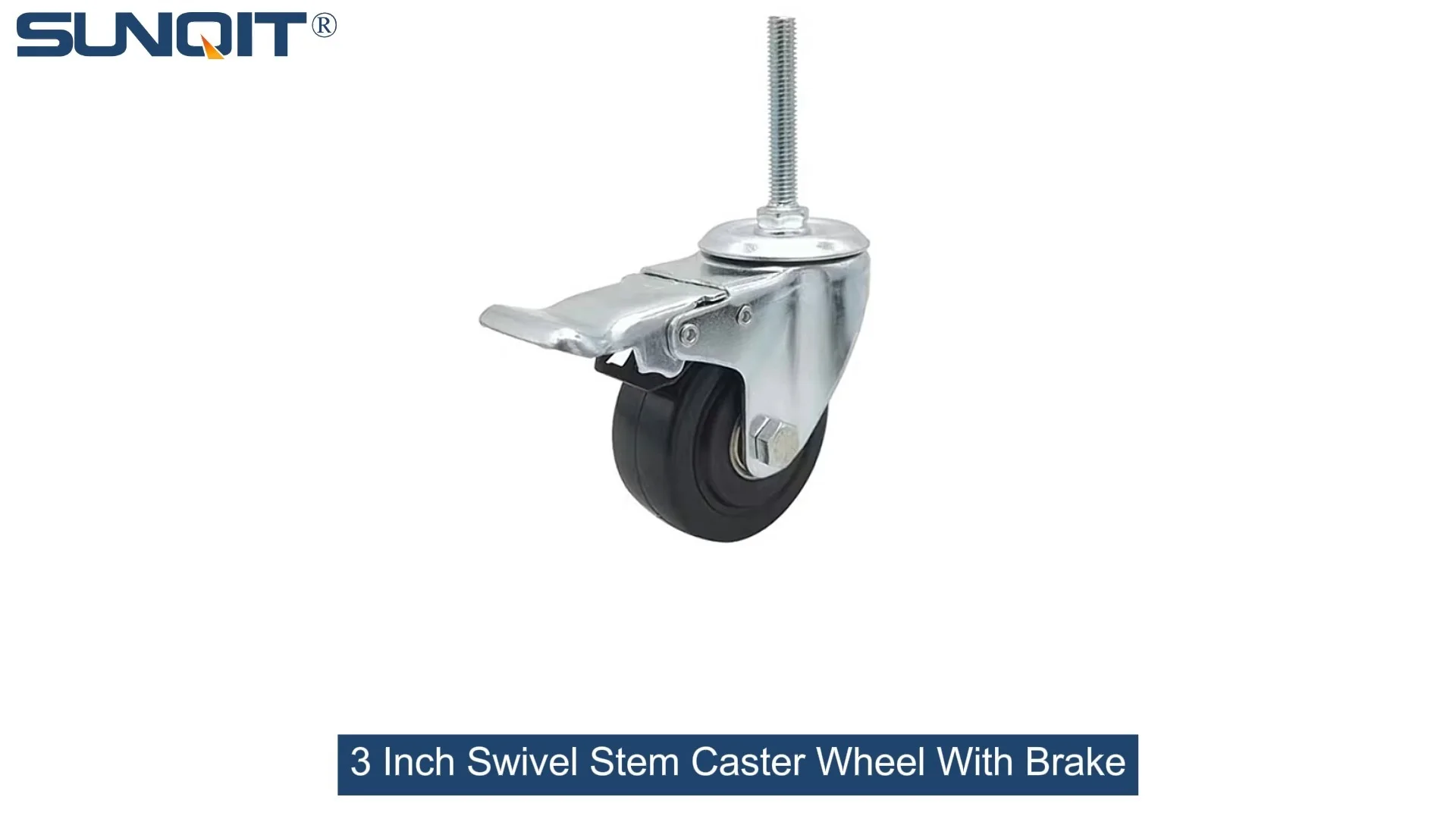
Swivel Stem Caster Wheel with Brake
360 Degree Swivel Stem Caster with brake. Threaded-post mount design, castors diameter 3 inch.Each swivel caster wheels loading 70KGS. Heavy enough and widely suit for carts, chairs, cabinet, flow rack, workbench, turnover rolley.
Walk into any busy warehouse, and you'll quickly spot the unsung heroes of daily operations: material racks. They hold everything from raw components to finished products, acting as the backbone of inventory management. But here's the catch—far too many of these racks are stuck in one place, bolted to the floor like permanent fixtures. When a sudden rush hits, or a new production line needs space, or a team member simply needs to grab a part from the back row, those fixed racks become more of a roadblock than a helper. That's where mobility enters the picture. And at the heart of that mobility? The swivel stem caster wheel with brake —a small component with a huge impact on how warehouses run.
In this article, we'll dive into why these caster wheels matter, how they transform workhorses like the material rack b (3 row and 3 floor) from static storage units into dynamic tools, and how pairing them with elements like roller track and workbench setups creates a leaner, more responsive workflow. We'll also touch on why partnering with a reliable lean system supplier ensures these components work together seamlessly, turning everyday operations into a well-oiled machine.
The Problem with "Stuck" Storage: Why Mobility Matters in Modern Warehouses
Let's start with the obvious: warehouses aren't static places. Customer demands shift, production schedules change, and seasonal peaks turn once-quiet corners into bustling hubs. Yet, many facilities still rely on fixed material racks. I've talked to warehouse managers who describe the frustration: "Last month, we had to rearrange our assembly line to meet a big order, but the racks holding our parts were bolted down. We spent two days unbolting, moving, and rebolting them—time we could've used to ship products."
Fixed racks also limit flexibility in space use. A rack that's perfect for storing bulky items in January might become a wasted footprint in July when smaller components are needed. And let's not forget the physical toll on workers. Hauling heavy boxes from a distant fixed rack to a workbench isn't just tiring—it's a recipe for slowdowns and even injuries. When every second counts, forcing teams to take extra steps or use forklifts for small moves eats into productivity.
This is where mobile material racks shine. But not just any mobility—controlled, reliable mobility. A rack on cheap casters might roll too easily, causing accidents, or get stuck on uneven floors, defeating the purpose. That's why the swivel stem caster wheel with brake is a game-changer. It lets you move racks when you need to, lock them in place when you don't, and do it all without breaking a sweat.
Meet the Star: What Makes the Swivel Stem Caster Wheel with Brake So Effective?
At first glance, a caster wheel might seem simple—just a wheel on a stem, right? But the swivel stem caster wheel with brake is engineered with precision to solve specific warehouse challenges. Let's break down its key features and why they matter.
1. 360-Degree Swivel: Maneuverability in Tight Spaces
Unlike rigid casters that only roll forward and backward, swivel stem casters pivot 360 degrees. Picture this: You're navigating a material rack b (3 row and 3 floor) —a sturdy, multi-level rack loaded with parts—through a narrow aisle between two workbenches. With fixed casters, you'd have to shuffle back and forth, inching the rack into place. With swivel casters, a gentle push lets the rack glide around corners and squeeze into tight spots, even when fully loaded. It's like turning a bulky shopping cart into a nimble hand truck.
2. The Brake: Safety and Stability When You Need It
Mobility is great, but a rack that rolls away mid-use is a disaster. That's why the brake is non-negotiable. Most quality swivel stem casters come with a foot-operated brake that locks both the wheel and the swivel motion. Step on the brake, and the rack stays put—even on sloped floors or when someone bumps into it. I visited a electronics warehouse last year where they'd switched to braked casters after a near-miss: a loaded rack rolled into a roller track , spilling components onto the floor. "Now, we lock the brakes every time we load or unload," the supervisor told me. "No more close calls."
3. Durable Materials: Built to Handle Heavy Loads
Warehouse racks don't carry feathers—they hold steel parts, toolboxes, and cases of products. A cheap caster might crack or bend under heavy weight, but the best swivel stem caster wheel with brake options use robust materials: steel stems, reinforced nylon or polyurethane wheels, and corrosion-resistant coatings. Take the material rack b (3 row and 3 floor) , for example. With three rows and three floors, it's designed to hold up to 500kg of materials. Pairing it with casters rated for 150kg each (four casters per rack) ensures it can handle the load without wobbling or failing.
4. Smooth Rolling: Even on Less-Than-Perfect Floors
Not every warehouse has perfectly smooth concrete. Cracks, uneven joints, or even small debris can trip up low-quality casters. But many swivel stem casters feature shock-absorbing wheels (often made of polyurethane) that glide over bumps, reducing noise and making pushes easier on workers. One warehouse I worked with had a section of floor that had settled slightly—before upgrading casters, moving racks over that spot required two people. Now, one person can do it with one hand.

From Storage to Workflow: How the Material Rack B (3 Row and 3 Floor) Benefits from Mobile Casters
Let's zoom in on a specific example: the material rack b (3 row and 3 floor) . This rack is a popular choice for warehouses because of its versatility—three rows of shelves mean it can organize small parts, boxes, or tools, while three floors maximize vertical space without towering too high. But when it's fixed, it's just… a rack. Add swivel stem caster wheels with brake , and it becomes a mobile command center.
1. Bring the Rack to the Workbench (Instead of the Other Way Around)
Imagine an assembly line where workers need parts from the material rack b to build products at their workbench . With a fixed rack, they'd have to walk back and forth, grabbing one part at a time. With a mobile rack, they can roll the entire rack right next to their workbench. Suddenly, everything they need is arm's reach away. A manufacturing plant in Ohio reported a 22% increase in assembly speed after equipping their material rack b units with casters—simply because workers spent less time walking and more time building.
2. Adapt to Shifting Workflows in Minutes
Seasonal rushes, new product launches, or equipment maintenance can turn a warehouse layout upside down. A mobile material rack b can be rearranged in minutes, not days. For example, during the holiday season, a toy manufacturer might need to group all packaging materials near the shipping area. With fixed racks, that's a logistical nightmare. With casters? Roll the racks into place, lock the brakes, and you're done. No tools, no downtime, no stress.
3. Multi-Use Flexibility: From Storage to Transport
The material rack b isn't just for storage. With casters, it doubles as a transport trolley. Need to move a batch of parts from the receiving dock to the assembly line? Load them onto the rack, unlock the brakes, and roll. No need for a separate cart—one piece of equipment does two jobs. This reduces clutter (fewer carts lying around) and cuts down on the number of tools workers need to learn to use.
"We used to have separate storage racks and transport carts. Now, with the material rack b on casters, we've cut our equipment count by 30%. And since the racks lock in place, we don't have to worry about parts shifting during transport." — Maria, Warehouse Supervisor, Automotive Parts Supplier

Beyond the Rack: Integrating with Roller Track and Workbenches for a Leaner Flow
A mobile material rack is powerful on its own, but it truly shines when part of a larger system. Let's talk about how it pairs with roller track and workbench setups to create a seamless workflow—exactly the kind of lean efficiency that modern warehouses strive for.
Roller Track: Bridging the Gap Between Rack and Workbench
Roller track is like a highway for materials. These tracks, with their smooth-rolling wheels, let boxes and parts glide from one point to another with minimal effort. Now, imagine your mobile material rack b parked next to a roller track that leads straight to a workbench. Instead of lifting heavy boxes off the rack and carrying them, you simply slide them onto the roller track—and gravity does the rest. It's a small change, but it adds up. Workers strain less, moves happen faster, and the risk of dropping items drops dramatically.
For example, a electronics warehouse might use roller track to connect their material rack b (storing circuit boards) to a soldering workbench. When a technician needs a board, they unlock the rack, roll it to the track, slide the board onto the track, and it glides right to their bench. No lifting, no carrying—just smooth, continuous flow.
Workbench: The Final Piece of the Productivity Puzzle
Workbenches are where the real work happens—assembly, packaging, quality checks. But a workbench is only as good as the materials around it. When your material rack b is mobile, you can customize the space around the workbench to fit the task. Need extra room for a large project? Roll the rack a few feet away. Switching to a different product? Swap out the rack for another mobile unit holding the new parts. It's like having a workspace that adapts to you, not the other way around.
Some workbenches even come with their own casters, but pairing a mobile workbench with a mobile material rack takes flexibility to the next level. One furniture manufacturer I know uses this setup: during morning shifts, they line up racks and workbenches for assembling chairs; in the afternoon, they rearrange everything to pack and ship those chairs. The entire floor plan changes in under an hour—something that would've been impossible with fixed furniture.

Choosing Quality: Why a Lean System Supplier Matters for Your Caster and Rack Setup
By now, you're probably thinking, "I need to add these casters to my racks!" But here's a word of caution: not all casters, racks, or roller track systems are created equal. A cheap caster might save you money upfront, but if it breaks after a month, you're back to square one—plus the cost of replacements and downtime.
That's where partnering with a reputable lean system supplier makes a difference. These suppliers specialize in components that work together—casters that fit perfectly with material racks, roller track that aligns with workbench heights, and parts that are tested for durability. They don't just sell you a caster; they help you design a system that meets your specific needs.
For example, a good lean system supplier will ask questions like: What's the maximum weight your racks will hold? Do you need ESD (anti-static) components for sensitive electronics? What's the condition of your warehouse floor? Based on that, they'll recommend the right swivel stem caster wheel with brake (maybe one with a higher load rating or shock-absorbing wheels), the best material rack (like the 3-row, 3-floor model), and even accessories like brake locks or floor protectors.
I once worked with a small warehouse that tried to "DIY" their mobile racks by buying generic casters online. The casters didn't fit the rack legs properly, so they used washers to make them work. Within a week, a washer slipped, the rack tipped, and products were damaged. A lean system supplier would've avoided that by ensuring compatibility from the start.
The Bottom Line: How These Small Changes Add Up to Big Results
Let's wrap this up with the impact that matters most: results. What do warehouses actually gain when they equip their material rack b (3 row and 3 floor) with swivel stem caster wheels with brake , pair it with roller track , and integrate it with workbench setups via a trusted lean system supplier ?
1. Time Savings: More Work, Less Effort
Every minute spent moving a fixed rack, carrying parts, or rearranging a workspace is a minute not spent on value-adding tasks. Mobile racks with good casters cut those minutes down to seconds. One study by the Material Handling Institute found that facilities with mobile storage solutions saved an average of 15-20 hours per week in labor time—time that can be redirected to shipping orders, improving quality, or training teams.
2. Reduced Injuries: Happier, Healthier Teams
Warehouse work is physical, but unnecessary lifting and pushing are major causes of strains and sprains. Mobile racks and roller track reduce the need for heavy manual handling, lowering injury rates. And when teams feel safer and less fatigued, morale goes up—along with retention and productivity.
3. Better Adaptability: Ready for Whatever Comes Next
In today's fast-paced market, the ability to pivot quickly is a competitive advantage. A warehouse with mobile racks can adjust to new orders, seasonal spikes, or even unexpected delays without missing a beat. As one manager put it: "We used to say 'no' to rush orders because we couldn't rearrange fast enough. Now, we say 'yes'—and our customers notice."
Final Thoughts: Small Components, Big Impact
The swivel stem caster wheel with brake might not be the flashiest piece of warehouse equipment, but it's a quiet revolution. When paired with a versatile rack like the material rack b (3 row and 3 floor) , integrated with roller track , and supported by a lean system supplier , it transforms how warehouses operate—making them more flexible, efficient, and worker-friendly.
So, the next time you walk through your warehouse, look at those fixed racks. Imagine how much easier life could be if they could move. Then take the first step: talk to a lean system supplier , explore your options, and start building a workspace that moves at the speed of your business. Your team, your customers, and your bottom line will thank you.
| Component | Key Benefit | Real-World Impact |
|---|---|---|
| Swivel Stem Caster Wheel with Brake | Controlled mobility; easy to maneuver and lock | One-person rack moves; 50% reduction in time spent rearranging |
| Material Rack B (3 Row and 3 Floor) | Vertical storage + mobility = space efficiency | 30% more parts stored in the same footprint |
| Roller Track | Smooth material flow between rack and workbench | 25% fewer manual lifts; reduced product damage |
| Workbench | Adaptive workspace paired with mobile racks | 15% faster assembly times; customizable for tasks |
| Lean System Supplier | Integrated, tested components | 90% fewer compatibility issues; longer-lasting equipment |