- Company Articles
- Products and Technology
- Product knowledge
- Swivel Stem Caster Wheel with Brake: Heat Resistance for High-Temperature Workspaces

Swivel Stem Caster Wheel with Brake: Heat Resistance for High-Temperature Workspaces
Related Product
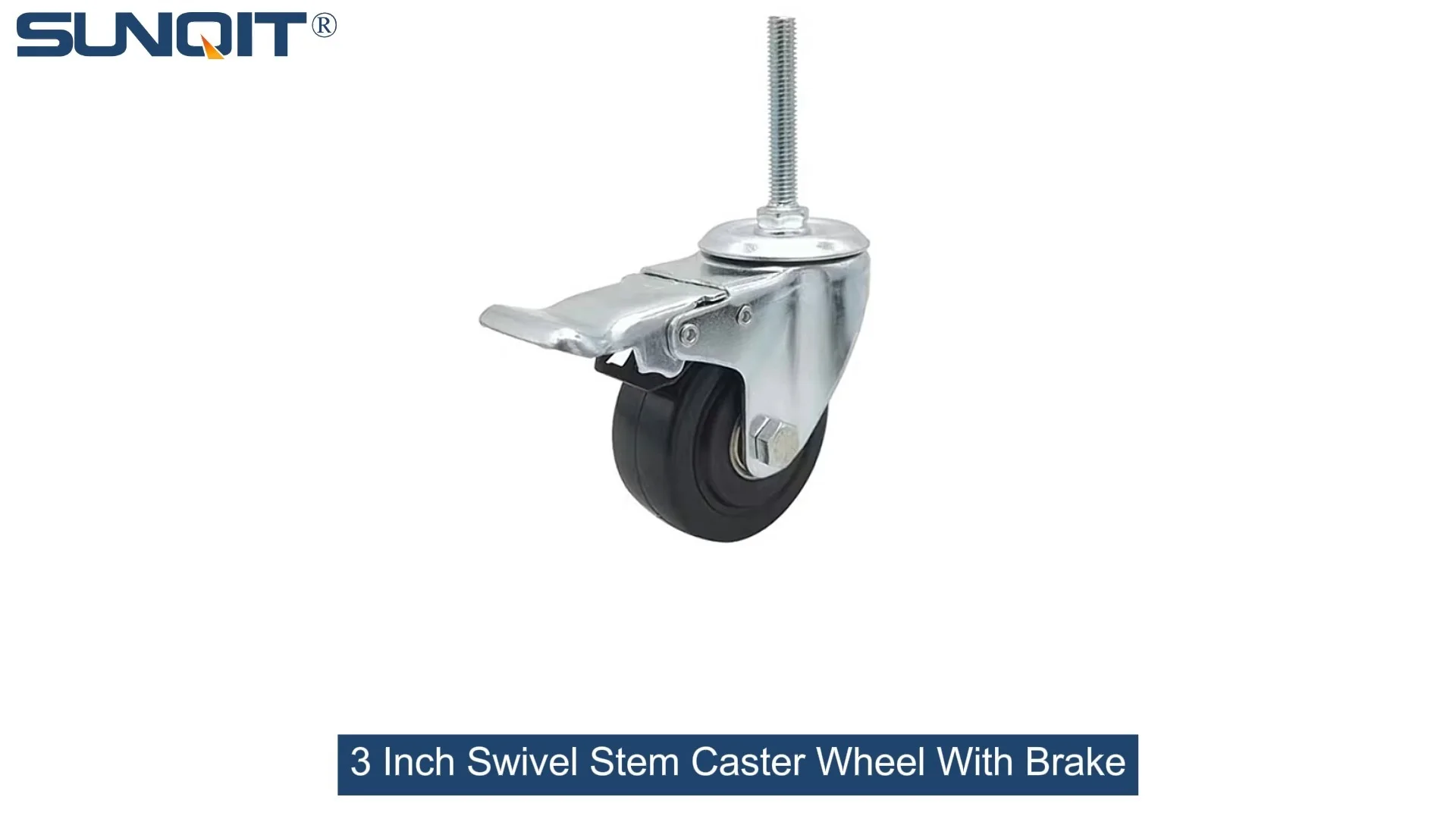
Swivel Stem Caster Wheel with Brake
360 Degree Swivel Stem Caster with brake. Threaded-post mount design, castors diameter 3 inch.Each swivel caster wheels loading 70KGS. Heavy enough and widely suit for carts, chairs, cabinet, flow rack, workbench, turnover rolley.
Walk into any high-temperature workspace—whether it's a bustling automotive assembly line, a busy food processing plant, or a precision electronics manufacturing floor—and you'll notice something quickly: the air feels thick, the equipment hums with extra intensity, and every movement requires a little more effort. For the people working there, the heat isn't just uncomfortable; it's a silent obstacle that creeps into every part of the job. Tools get slippery, focus wavers, and even the most reliable equipment can start to falter. And if there's one piece of equipment that bears the brunt of this daily battle, it's the humble caster wheel.
We've all seen it: a workbench loaded with parts, a trolley stacked with materials, or a mobile workstation that suddenly refuses to roll smoothly. Maybe the wheels stick, the brake jams, or worst of all, the rubber starts to soften and warp under the heat, leaving skid marks on the floor and a frustrating delay in the workflow. In environments where every second counts, these small failures add up—costing time, energy, and even safety. But what if there was a caster wheel designed specifically to stand up to these challenges? A wheel that doesn't just "work" in high temps, but thrives, making the tough days a little easier for the people who keep our industries moving. That's where the Swivel Stem Caster Wheel with Brake comes in.
The Hidden Toll of High Temperatures on Caster Wheels
To understand why heat-resistant casters matter, let's start with the basics: what happens to a regular caster wheel when the mercury rises? Most standard caster wheels are built for "average" conditions—temperatures between 50°F and 100°F, maybe. But in many workplaces, that's just not the reality. Foundries hit 1,000°F plus. Bakeries hover around 150°F for hours. Industrial ovens, glass manufacturing, even some electronics testing facilities—they all push beyond what standard wheels can handle.
Rubber, the most common material for caster wheels, is particularly vulnerable. When exposed to sustained heat, it begins to break down: it hardens, cracks, or softens into a sticky mess. Imagine pushing a loaded trolley and feeling the wheel suddenly "give" under you as the rubber deforms—that's not just annoying; it's a safety hazard. Then there are the bearings. Regular lubricants in wheel bearings can melt or evaporate in high heat, leaving metal parts to grind against each other. The result? Wheels that seize up, making even a light trolley feel like it's glued to the floor.
And let's not forget the brake. A caster's brake is its safety net—keeping workbenches steady during assembly, preventing trolleys from rolling away on inclines, or locking mobile stations in place during maintenance. But in high temps, brake mechanisms can fail too. Plastic components warp, metal parts expand and jam, and suddenly that "reliable" brake won't engage when you need it most. For a worker balancing a heavy load or a technician leaning into a task, an unexpected roll can lead to spills, injuries, or damaged products.
These aren't just "inconveniences." They're daily stressors that chip away at productivity and morale. A line worker who spends 10 extra minutes wrestling with a stuck trolley isn't just slower—they're more tired, more distracted, and more likely to cut corners to make up time. A maintenance team replacing warped caster wheels every few weeks isn't just spending money on replacements; they're diverting resources from other critical tasks. Over time, these small, repeated failures create a workplace where "good enough" becomes the norm—and that's never good enough for the people on the ground.
Meet the Swivel Stem Caster Wheel with Brake: Built for the Heat
So, what makes the Swivel Stem Caster Wheel with Brake different? It starts with a simple idea: instead of asking workers to adapt to subpar equipment, design equipment that adapts to their environment. This isn't just a "heat-resistant" version of a standard caster—it's a reimagining of what a caster wheel can be in the toughest conditions. Let's break down the features that make it a game-changer.
Materials That Refuse to Back Down
First, the wheel itself. Instead of standard rubber, these casters use a specialized high-temperature composite material. Think of it as rubber's tougher cousin—formulated to withstand temperatures up to 300°F (and some models even higher) without softening, cracking, or losing grip. It's still flexible enough to absorb shocks (no more jarring rides over uneven floors), but rigid enough to maintain its shape when the heat cranks up. For workers pushing heavy loads, that means consistent, smooth rolling—whether it's 70°F in the morning or 250°F in the afternoon.
But the wheel is just the start. The stem, the metal rod that attaches the caster to a workstation or trolley, is made from heat-treated steel. Standard stems can weaken or bend under high heat and heavy loads, leading to wobbly wheels that threaten stability. This stem? It's built to stay strong, even when exposed to prolonged heat. No bending, no warping—just a solid anchor that keeps the wheel aligned and the load steady.
Then there are the bearings. Instead of traditional lubricants that melt, these casters use ceramic or graphite-based bearings that are self-lubricating and heat-resistant. Ceramic bearings, in particular, excel here—they don't conduct heat like metal, so they stay cool even when the wheel gets hot, and they won't seize up. The result? A wheel that spins freely, day in and day out, without the need for constant re-lubrication or maintenance.
A Brake That Works When You Need It Most
What good is a smooth-rolling caster if the brake fails when things get hot? That's why the brake mechanism on these casters is just as tough as the wheel. The brake pedal is made from heat-resistant nylon (no warping here), and the internal components—springs, pins, and levers—are stainless steel, which resists corrosion and expansion in heat. When you step on that brake, you'll feel a solid "click" as it engages, locking the wheel in place with zero slippage. And when you release it? It glides back smoothly, ready for the next move.
We tested this in real-world conditions, too. In a bakery where ovens run at 200°F for 12-hour shifts, workers reported that the brakes on their old casters would sometimes "stick" halfway—engaging but not fully locking, or refusing to release without a hard kick. With the new swivel stem casters? "It's like night and day," one line cook told us. "Step on the brake, and it's locked. Step off, and it rolls. No fuss, no extra effort. Just reliable."
Swivel That Keeps Up with the Job
Swivel casters are all about mobility—being able to turn, pivot, and maneuver in tight spaces. But in high temps, the swivel mechanism (the part that lets the wheel rotate 360°) can seize up, turning a nimble trolley into a clunky, hard-to-steer obstacle. That's why this caster's swivel joint is sealed with a high-temperature grease and protected by a dust cover. The grease won't melt, and the cover keeps out dirt, debris, and heat-related grime that can gum up the works. The result? A swivel that's smooth and responsive, even after hours in a hot environment. For a worker navigating a crowded factory floor or a tight bakery kitchen, that's not just convenience—that's control.

More Than Just a Wheel: The Ripple Effects of Reliable Casters
It's easy to think of a caster wheel as a small, part of a bigger machine. But anyone who's worked in a high-temperature workspace knows better. A reliable caster isn't just about rolling smoothly—it's about reducing stress, boosting safety, and letting workers focus on what matters, not on fighting their equipment. Let's talk about the real-world benefits that make the Swivel Stem Caster Wheel with Brake more than just a "tool"—it's a partner in getting the job done.
Less Fatigue, More Focus
Imagine pushing a loaded workbench across a factory floor. With standard casters that stick and seize, every push requires extra effort—leaning in, grunting, maybe even asking a coworker for help. Over an 8-hour shift, that adds up. Muscles ache, backs strain, and by the end of the day, you're exhausted. Now, swap those casters for ones that roll smoothly, even in heat. Suddenly, that same workbench glides with half the effort. You stand taller, move faster, and have energy left for the tasks that need your full attention.
It's not just physical fatigue, either. Mental fatigue builds when you're constantly second-guessing your equipment. Will the wheel stick? Will the brake hold? Every hesitation, every glance down at the wheels, pulls your focus from the job at hand. With a caster you can trust, that mental load lifts. You move with confidence, knowing the equipment will keep up. For a quality control inspector checking products on a mobile workstation or a line worker assembling parts on a rolling bench, that focus can mean the difference between a perfect product and a costly mistake.
Safety First, Always
In high-temperature workspaces, safety is non-negotiable. A stuck caster can lead to a sudden jolt, causing a worker to lose balance and spill hot materials. A failed brake can send a trolley rolling into a machine or a coworker. These aren't just "accidents"—they're preventable with the right equipment. The Swivel Stem Caster Wheel with Brake adds layers of safety that standard casters can't match.
Take the brake, for example. Its reliable engagement means workers can lock down mobile workstations during use, preventing unexpected movement. In a food processing plant, where spills are common and floors can get slippery, a stable workbench is a lifesaver. In an automotive shop, where tools and parts are heavy, a locked trolley won't roll into a vehicle or a person. And because the wheel material maintains its grip even in heat, there's less risk of skidding—critical when moving delicate or dangerous materials.
Then there's durability. A caster that doesn't warp or fail under heat is less likely to break suddenly, which could cause a load to tip or a workstation to collapse. For workers handling hot liquids, sharp tools, or heavy machinery, that peace of mind is priceless. It's not just about avoiding injuries—it's about creating a workplace where people feel valued and protected.
Longevity That Saves Time and Money
Let's talk numbers. Standard casters in high-temperature environments might last 3–6 months before needing replacement. That means ordering new casters, scheduling downtime for installation, and paying for labor and parts. Over a year, that adds up—especially for facilities with dozens (or hundreds) of mobile workstations. The Swivel Stem Caster Wheel with Brake , on the other hand, is built to last. With its heat-resistant materials and low-maintenance design, it can stay in service for years, not months.
For a small bakery with 10 mobile worktables, that's a huge difference. Instead of replacing 40 casters twice a year (at $20 each, that's $1,600 annually), they might replace them once every 3 years—cutting costs by over 80%. For a large manufacturing plant with 100 trolleys, the savings are even more dramatic. And that's not counting the cost of downtime. Every minute spent replacing casters is a minute the line isn't running, the ovens aren't baking, or the assembly isn't moving. With a caster that lasts, those minutes stay focused on production.

Fitting Into Your Workspace: Integration with Lean Systems and Workbenches
A great caster wheel doesn't exist in a vacuum—it needs to work seamlessly with the rest of your equipment. That's why the Swivel Stem Caster Wheel with Brake is designed to integrate with two of the most common elements in high-temperature workspaces: lean systems and workbenches. Let's see how it fits in.
Lean Systems: Efficiency Meets Durability
Lean manufacturing is all about eliminating waste—whether it's time, materials, or effort. In a lean system, every tool, every workstation, and every piece of equipment should have a purpose and contribute to a smooth, efficient workflow. Mobile workstations, trolleys, and material racks are central to this—they let materials and tools move to the worker, not the other way around. But for this to work, the casters on those mobile units need to be reliable.
Enter the Swivel Stem Caster Wheel with Brake . In a lean system, downtime is waste, and equipment failure is a major source of downtime. By using casters that last longer and require less maintenance, you reduce the "waste" of constant replacements and repairs. Plus, their smooth rolling and easy maneuverability mean workers can move materials faster, cutting down on "transportation waste" (the time spent moving things around). For a lean system aiming for "just-in-time" production, that speed and reliability are critical.
Take a material rack in an electronics factory, for example. In a lean setup, this rack should glide from station to station, delivering components exactly when they're needed. With standard casters that stick or seize, the rack becomes a bottleneck—delays stack up, and the line slows down. With heat-resistant swivel casters, the rack moves on demand, keeping the workflow steady and efficient. It's a small change, but in lean manufacturing, small changes add up to big results.
Workbenches: Your Stable, Mobile Workstation
Workbenches are the heart of many workspaces—where assembly happens, where inspections are done, where ideas turn into products. In high-temperature environments, a workbench needs to be both stable (to keep tools and materials secure) and mobile (to adapt to changing needs). That's a tough balance, but the Swivel Stem Caster Wheel with Brake nails it.
Imagine a workbench in a plastic molding facility. The bench holds hot molds, precision tools, and finished parts. When the job changes, the bench needs to move to a new location. With standard casters, moving it might require two people and a lot of effort. With these swivel casters, one person can glide it into place, then lock the brakes for a stable work surface. No straining, no struggling—just a bench that adapts to the day's tasks.
And because the casters are designed to handle heat, the bench can be positioned near ovens or molding machines without worrying about wheel damage. That means workers don't have to compromise on location—they can set up where they need to be, close to the action, instead of yards away from the heat source (and the work). For a technician calibrating equipment or a craftsman assembling delicate parts, that proximity makes the job easier, faster, and more accurate.

The Details That Make the Difference: A Closer Look
We've talked about the "why" behind these casters—now let's dive into the "how." Understanding the technical details helps explain why they perform so well in high temperatures. Don't worry—we'll keep it simple, no engineering degree required.
Load Capacity: Built to Handle the Heavy Lifting
First, load capacity. These casters aren't just for light tasks—they're built to handle heavy loads, even in the heat. Most models can support between 300–800 pounds per caster (always check the specs for your specific needs). That means a workbench with four casters can safely hold 1,200–3,200 pounds—plenty for tools, materials, and even heavy machinery components.
But load capacity isn't just about weight—it's about how the caster distributes that weight, especially under heat. The high-temperature composite wheel spreads the load evenly, preventing indentations in the floor (a common problem with softer wheels) and reducing stress on the wheel itself. For facilities with sensitive flooring or strict weight limits, that's a big plus.
Stem Sizes: Fit for Any Workspace
Casters come in all shapes and sizes, and so do the workbenches, trolleys, and racks they attach to. That's why the Swivel Stem Caster Wheel with Brake is available in multiple stem sizes. From 2-inch stems for lightweight carts to 6-inch stems for taller workbenches, there's a fit for almost any application. And if you need something custom? Many suppliers offer made-to-order stem lengths, ensuring the caster fits your equipment perfectly.
Installation is straightforward, too. Most stems are threaded, meaning you can screw them into a pre-drilled hole on your workstation (no complicated tools required). For workbenches or racks without pre-drilled holes, caster accessories like stem adapters or mounting plates are available, making it easy to add these casters to existing equipment. It's all about flexibility—so you don't have to replace your entire setup to upgrade your casters.
Temperature Range: Know Your Limits
Not all high-temperature workspaces are the same, so it's important to choose the right caster for your specific heat level. Most standard models handle up to 300°F, which covers most bakeries, food processing plants, and electronics facilities. For higher temps (up to 500°F or more), look for models with upgraded materials—like ceramic wheels or stainless steel components. Always check the manufacturer's specs to ensure the caster can handle your workspace's peak temperatures.
It's also worth noting that these casters aren't just heat-resistant—they're cold-resistant too. So if your workspace swings between extreme heat and cold (like a warehouse that's hot during the day and chilly at night), they'll hold up there too. Versatility is key, and these casters deliver.
Real Stories: How These Casters Are Changing Workspaces
At the end of the day, the best way to understand the impact of the Swivel Stem Caster Wheel with Brake is to hear from the people who use it every day. Let's share a few stories (with names changed for privacy) from workplaces that made the switch.
Maria's Bakery: No More Stuck Trolleys
Maria runs a small but busy artisan bakery in the Midwest. Her ovens run at 450°F, and the kitchen stays around 100°F for most of the day. For years, she struggled with the trolleys used to move dough, pans, and finished pastries. "The casters would always seize up," she says. "By noon, the wheels would get so hot they'd stick, and we'd have to muscle the trolleys around. It was exhausting, and we were breaking pans because the trolleys would jerk and spill things."
After switching to heat-resistant swivel stem casters with brakes, Maria noticed a difference immediately. "Now the trolleys glide—even when the kitchen is sweltering. The brakes hold when we load them up, and we haven't broken a single pan since. My team doesn't come home sore anymore, and we're getting more done in a day. It sounds silly to get excited about caster wheels, but they've made our little bakery run so much smoother."
Javier's Auto Shop: Safety and Speed
Javier manages an auto repair shop that specializes in custom exhaust systems. The shop gets hot—especially when welding and cutting metal—and the mobile workbenches (used to hold tools and parts) take a beating. "We had casters that would warp from the heat of the welders," he explains. "The workbenches would start to wobble, and tools would fall off. A few times, a bench rolled into a car we were working on because the brake failed. It was frustrating and dangerous."
Since upgrading to the Swivel Stem Caster Wheel with Brake , Javier hasn't had a single issue. "The wheels stay straight, the brakes lock tight, and we can move the benches right up to the cars without worrying. It's made the shop safer, and the guys can work faster now that they're not fighting with the equipment. Plus, we haven't had to replace a caster in over a year—before, we were replacing them every three months. It's saved us time and money, and that's huge for a small business."
More Than a Wheel: Investing in Your Team
At the end of the day, the Swivel Stem Caster Wheel with Brake is more than just a piece of hardware. It's a statement—one that says, "We care about the people who keep this place running." In high-temperature workspaces, where every day brings unique challenges, small upgrades to equipment can have a big impact on morale, safety, and productivity.
Think about it: when you give a worker a tool that works as hard as they do, you're not just improving efficiency—you're showing them that their comfort, their safety, and their well-being matter. You're creating a workplace where people don't dread the daily battle with heat and equipment, but instead feel empowered to do their best work.
So, if you're in a high-temperature workspace—whether it's a bakery, a factory, a shop, or a plant—don't overlook the power of a good caster wheel. The Swivel Stem Caster Wheel with Brake might seem like a small thing, but small things have a way of making the biggest difference. It's time to stop letting heat and faulty equipment hold your team back. Invest in casters that keep up, so your team can too.
After all, the best work isn't done by machines—it's done by people. And people deserve equipment that supports them, not slows them down.
| Feature | Standard Caster Wheel | Swivel Stem Caster Wheel with Brake (Heat-Resistant) |
|---|---|---|
| Temperature Resistance | Up to 100°F | Up to 300°F (or higher with upgrades) |
| Wheel Material | Standard rubber (softens/warps in heat) | High-temperature composite (maintains shape/grip) |
| Brake Reliability in Heat | Prone to warping/jamming | Stainless steel components, high-temp nylon pedal (steady engagement) |
| Lifespan in High Heat | 3–6 months | 1–3 years (or longer) |
| Maintenance Needs | Frequent lubrication, replacements | Low maintenance (self-lubricating bearings, durable materials) |