- Company Articles
- Products and Technology
- Product knowledge
- Swivel Stem Caster Wheel with Brake: How Stem Diameter Affects Installation

Swivel Stem Caster Wheel with Brake: How Stem Diameter Affects Installation
Related Product
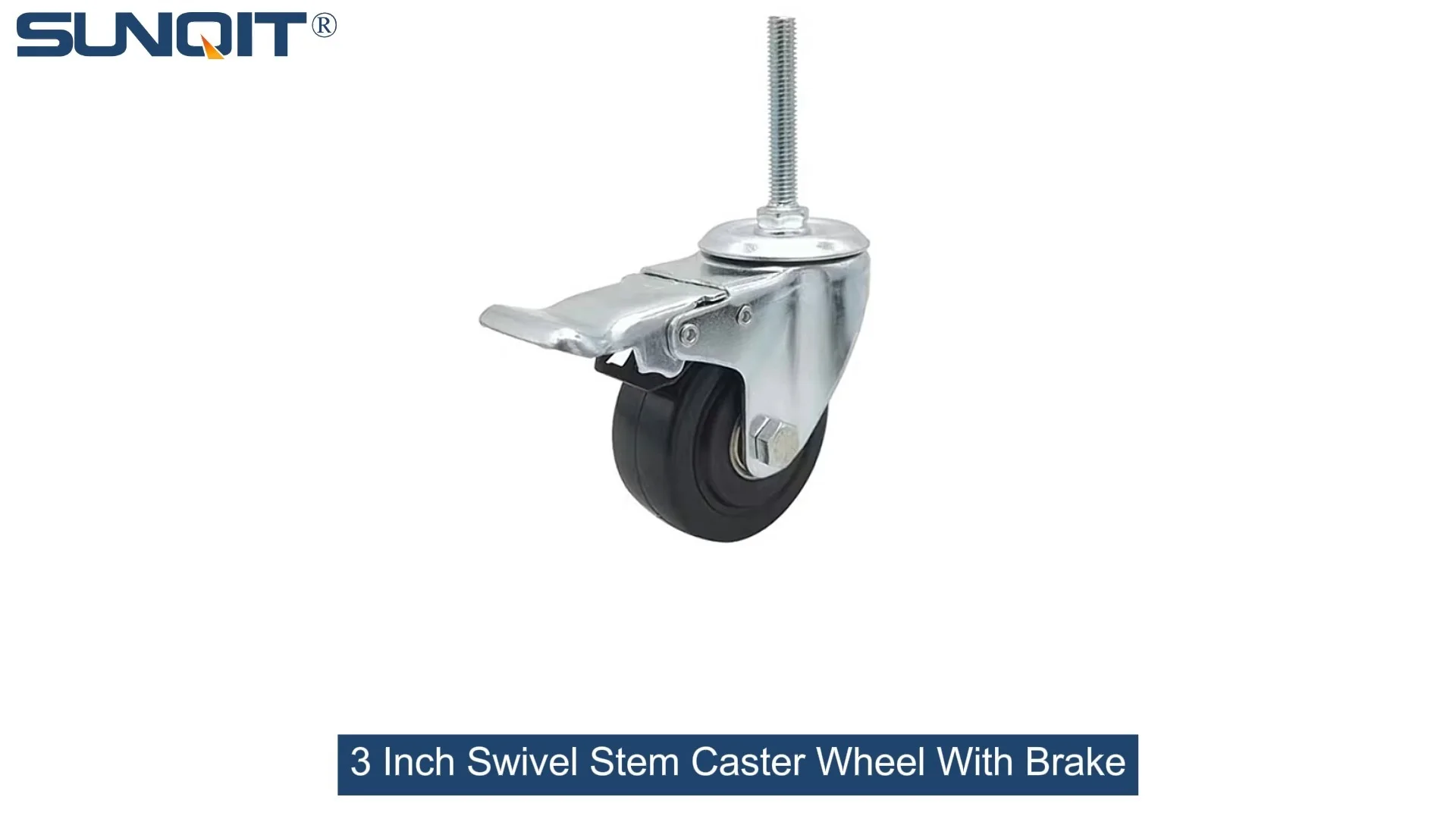
Swivel Stem Caster Wheel with Brake
360 Degree Swivel Stem Caster with brake. Threaded-post mount design, castors diameter 3 inch.Each swivel caster wheels loading 70KGS. Heavy enough and widely suit for carts, chairs, cabinet, flow rack, workbench, turnover rolley.
Picture this: It's 9 a.m. on a bustling manufacturing floor. A line worker eases a loaded turnover trolley toward the assembly station, the swivel stem casters gliding silently over the concrete. With a quick tap of the brake lever, the trolley locks into place—no wobbling, no slipping, just precise control. Across the floor, another team adjusts a mobile workbench, its casters swiveling 360 degrees to reposition seamlessly around a new production layout. This is the rhythm of a well-oiled operation, where every component, down to the smallest part, works in harmony. But what if that harmony is disrupted by something as seemingly minor as the diameter of a caster stem?
In the world of material handling, swivel stem caster wheels with brakes are the unsung heroes of efficiency and mobility. They turn static workbenches into dynamic tools, make heavy trolleys maneuverable, and ensure that every piece of equipment can be positioned exactly where it's needed—when it's needed. Yet, for all their utility, these casters rely on a critical detail that's often overlooked: stem diameter. Get that diameter wrong, and suddenly, those smooth-rolling wheels become a source of frustration: wobbling workbenches, stuck brakes, even safety hazards that grind productivity to a halt.
In this article, we'll dive into the often-underestimated role of stem diameter in installing swivel stem caster wheels with brakes. We'll explore why size matters, how it impacts everything from stability to compatibility with caster accessories, and why getting it right is a cornerstone of building reliable lean systems. Whether you're setting up a new workspace or troubleshooting existing equipment, understanding stem diameter will transform how you approach mobility on the factory floor.
Understanding Swivel Stem Caster Wheels with Brake: More Than Just Wheels
Before we get to stem diameter, let's break down what makes a swivel stem caster wheel with brake tick. At first glance, it's a simple assembly: a wheel, a fork (the frame holding the wheel), a swivel mechanism, a brake, and a stem. But each part plays a vital role. The wheel, often made of rubber, polyurethane, or steel, determines load capacity and floor protection. The swivel mechanism—a raceway of ball bearings—lets the wheel rotate freely, making tight turns possible. The brake, usually a foot-operated lever, locks the wheel (or swivel) to prevent movement. And then there's the stem: the unassuming metal rod that connects the entire assembly to your equipment.
Think of the stem as the bridge between the caster and your workbench, trolley, or rack. It's not just a "stick" holding the wheel on—it's the structural link that transfers weight, absorbs shock, and ensures stability. Stems come in different styles: threaded (screwed into a nut), grip ring (compressed to fit into a hole), or plain (secured with bolts through a flange). But regardless of style, one feature unites them all: diameter. This measurement—the width of the stem—dictates how well the caster integrates with your equipment and its accessories.
Why Stem Diameter Isn't Just a Number: The Science of Fit
Imagine buying a pair of shoes two sizes too big. You'd trip, slip, and struggle to walk—hardly ideal for a day's work. The same logic applies to caster stems. A stem that's too small for its mounting hole will wobble, creating instability that can damage equipment or injure workers. One that's too large? You'll either struggle to install it (risking damage to the caster or your equipment) or find it impossible to fit at all. In short, stem diameter is the foundation of a secure, functional caster installation.
Let's take a real-world example. A mid-sized electronics manufacturer recently upgraded their production line with new ESD workstations, each fitted with swivel stem casters for easy reconfiguration. The team chose casters with a 5/8-inch stem, assuming it would fit their existing workbench frames. But when they tried to install them, the stems were loose in the 3/4-inch holes of the workbench legs. To "fix" the problem, they wrapped tape around the stems to make them thicker. At first, it worked. But within weeks, the tape wore down, casters wobbled, and workers reported back pain from leaning on unstable workbenches. Worse, during a routine inspection, an ESD audit flagged the wobbly casters as a static discharge risk—threatening product quality. All because of a 1/8-inch mismatch in stem diameter.
This story highlights a key point: stem diameter isn't just about "fitting." It's about load distribution. When a caster is properly mounted, the stem bears the weight of the equipment and its load evenly, transferring force from the wheel to the frame. A loose stem creates uneven pressure points, leading to premature wear on the swivel mechanism, bent stems, or even cracked equipment frames. Over time, this not only shortens caster lifespan but also increases maintenance costs and downtime—exactly the opposite of what lean systems aim to achieve.

Common Stem Diameters and Their Real-World Applications
Stem diameters aren't arbitrary. They're engineered to match common equipment designs and load requirements. Let's look at the most widely used sizes and where you'll find them in industrial settings:
| Stem Diameter (Inches) | Stem Diameter (Metric) | Typical Load Capacity | Common Applications |
|---|---|---|---|
| 1/2" | M12 | 100–300 lbs per caster | Light-duty workbenches, tool carts, small turnover trolleys |
| 5/8" | M16 | 300–600 lbs per caster | Medium-duty assembly workstations, parts racks, ESD workbenches |
| 3/4" | M20 | 600–1,000 lbs per caster | Heavy-duty material racks, large turnover trolleys, industrial shelving |
| 1" | M25 | 1,000+ lbs per caster | Pallet jacks, heavy machinery bases, warehouse storage racks |
Take 5/8-inch (M16) stems, for example. They're the workhorses of lean systems, commonly found on ESD workstations and material rack B (3 row and 3 floor) setups. Why? Because they strike a balance: strong enough to support tools, components, and workers (up to 600 lbs per caster) without adding unnecessary bulk. On the flip side, 1/2-inch stems are perfect for lightweight tool carts or mobile whiteboards in office-factory hybrids—places where mobility matters more than heavy lifting.

Installation 101: How Stem Diameter Shapes the Process
Installing a swivel stem caster with brake might seem straightforward: drill a hole, stick the stem in, secure it, done. But anyone who's wrestled with a mis sized stem knows better. Let's walk through a typical installation and see where diameter comes into play.
Step 1: Prep the equipment. You'll need a mounting point—usually a caster installation base (a metal plate or bracket welded/bolted to the equipment frame). The base has a pre-drilled hole for the stem. Here's where diameter first matters: the hole must match the stem size exactly. A 5/8-inch stem needs a 5/8-inch hole. If the hole is 1/64-inch too big, the stem will rattle. Too small, and you'll either snap the stem (bad) or strip the threads (worse).
Step 2: insert the stem. For threaded stems, this means screwing it into a nut embedded in the base. For grip-ring stems, it's compressing the ring (a spring-loaded collar) to fit into the hole, where it expands to lock in place. Either way, a snug fit is non-negotiable. A stem that's too loose won't just wobble—it can rotate inside the base, making the brake lever hard to reach or causing the wheel to swivel unexpectedly.
Step 3: Secure and test. Once the stem is in, you'll add a washer and nut (for threaded stems) or verify the grip ring is fully engaged. Then comes the test: wiggle the caster. If it moves side-to-side, the diameter is wrong. If it feels solid, you're good. But here's the kicker: even a "close enough" fit can fail over time. Vibration from moving loads will loosen a slightly undersized stem, turning a minor annoyance into a major issue down the line.

Caster Accessories: The Forgotten Piece of the Diameter Puzzle
Casters don't work alone. They rely on caster accessories to function—things like brake extension levers, dust covers, and even replacement wheels. And guess what? These accessories are designed with specific stem diameters in mind.
Take brake levers, for example. A lever that fits a 3/4-inch stem might be too long for a 1/2-inch stem, making it hard to reach. Or consider washers: a washer for a 5/8-inch stem will slide right off a 1/2-inch stem, leaving the caster loose. Even the caster installation base itself is an accessory—manufacturers make bases with holes sized for standard stem diameters, so mixing and matching is a recipe for frustration.
Here's a pro tip: When ordering casters, always check the accessory specs. If you need replacement brakes or want to add a swivel lock, confirm they're compatible with your stem diameter. It's a small step that saves hours of headache later.
Stem Diameter in Lean Systems: Efficiency Through Precision
Lean systems thrive on precision. Every tool, every process, every component is designed to eliminate waste—whether that's time, effort, or materials. Swivel stem casters with brakes are a lean staple: they let you reconfigure workspaces quickly (reducing setup waste), move materials efficiently (cutting transport waste), and adapt to changing demand (minimizing overproduction). But none of that works if the casters themselves are a source of waste.
Consider a lean manufacturing cell where workbenches on casters are rearranged daily to match production schedules. If the casters have undersized stems, workers spend extra time wrestling with wobbly benches, adjusting brakes that don't align, or stopping to tighten loose stems. That's "motion waste"—a cardinal sin in lean. Multiply that by 10 workbenches and 20 reconfigurations a month, and suddenly you're losing hours of productive time.
On the flip side, a facility that nails stem diameter sees smoother workflows. Workers move equipment with confidence, knowing brakes will engage reliably and casters won't fail mid-shift. Maintenance teams spend less time fixing casters and more time on value-adding tasks. And because the casters last longer (no premature wear from wobbling), replacement costs drop—another win for lean's "reduce waste" mantra.
Troubleshooting: Signs Your Stem Diameter Is Off
How do you know if your stem diameter is wrong? Watch for these red flags:
- Wobbling or shaking: The most obvious sign. If the caster moves side-to-side when stationary, the stem is too small for the mounting hole.
- Stem rotation: The caster swivels even when the brake is locked, or the stem spins inside the base. This means the stem isn't secured properly—often due to a loose fit.
- Premature brake failure: Brakes wear out faster if the stem wobbles, as the lever doesn't align correctly with the wheel.
- Cracks in the mounting base: A stem that's too large can stress the base, leading to cracks or deformation over time.
If you spot any of these, don't ignore them. Start by measuring the stem diameter (use a caliper for accuracy) and comparing it to the mounting hole size. Chances are, you'll find a mismatch. Fixing it might mean swapping out casters for the correct diameter, or replacing the caster installation base with one that fits. Either way, the investment in time will pay off in smoother operations.
Final Thoughts: Small Diameter, Big Impact
Swivel stem caster wheels with brakes are quiet contributors to a productive workspace. They make heavy loads feel light, static setups feel dynamic, and chaotic floors feel organized. But their magic hinges on a detail as small as stem diameter. It's not glamorous, but it's critical—like the foundation of a building or the spark plug in an engine.
So, the next time you're spec'ing out casters for a workbench, trolley, or rack, remember: stem diameter isn't just a number on a spec sheet. It's the difference between a workspace that flows and one that fights you every step of the way. Measure twice, install once, and let your casters do what they do best—keep your operation moving forward, smoothly and safely.
After all, in the world of lean systems and efficient manufacturing, the smallest details often make the biggest difference. And when it comes to swivel stem casters with brakes, that detail is stem diameter.