- Company Articles
- Products and Technology
- Product knowledge
- Swivel Stem Caster Wheel with Brake: Hygienic Design for Medical Device Assembly

Swivel Stem Caster Wheel with Brake: Hygienic Design for Medical Device Assembly
Related Product
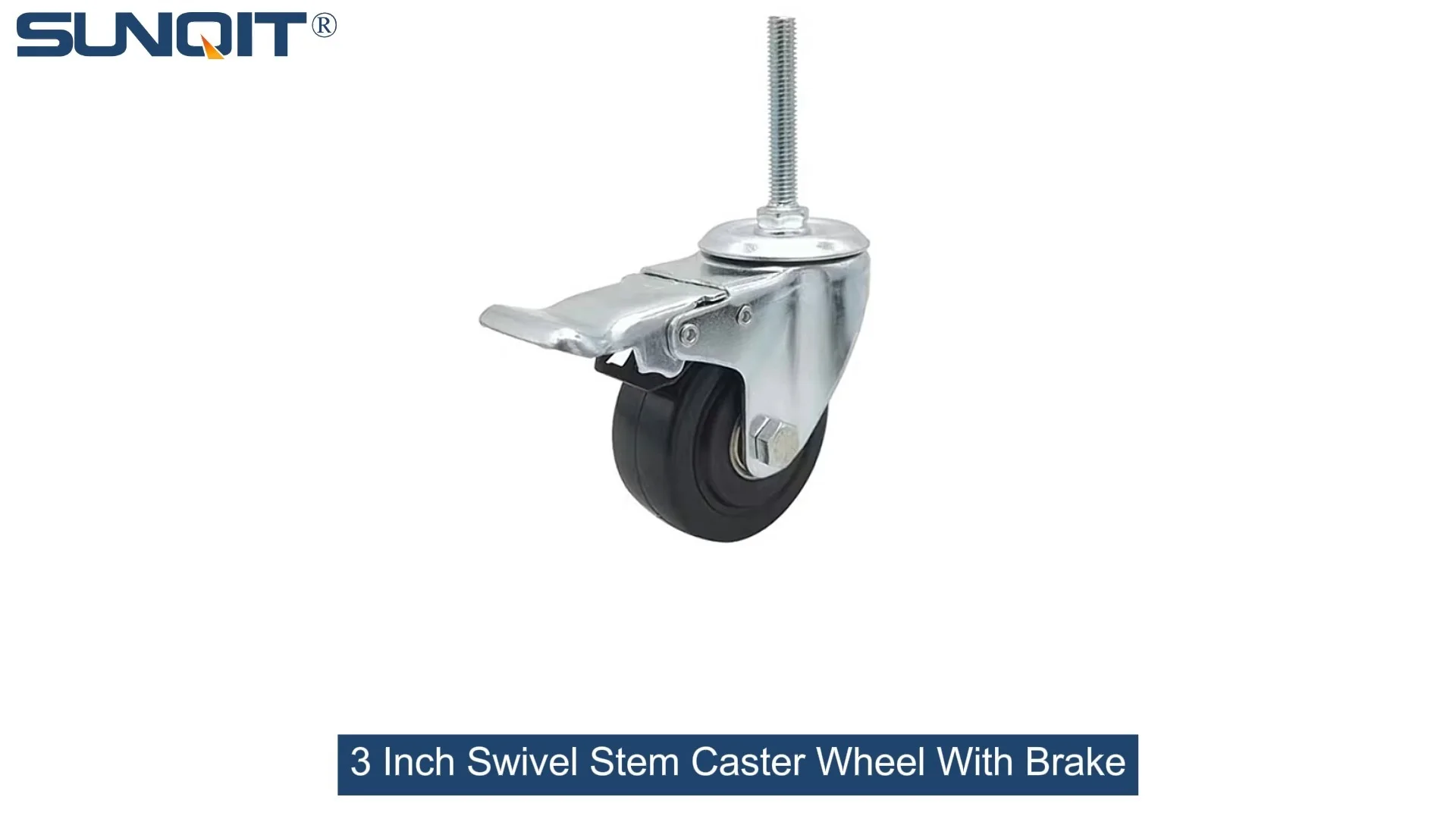
Swivel Stem Caster Wheel with Brake
360 Degree Swivel Stem Caster with brake. Threaded-post mount design, castors diameter 3 inch.Each swivel caster wheels loading 70KGS. Heavy enough and widely suit for carts, chairs, cabinet, flow rack, workbench, turnover rolley.
In the world of medical device manufacturing, precision isn't just a goal—it's a lifeline. Every component, from the tiniest screw in a pacemaker to the casing of a surgical laser, must meet uncompromising standards for safety, sterility, and reliability. But behind these intricate devices lies another layer of critical infrastructure: the workstations, racks, and mobility solutions that keep assembly lines moving smoothly. Among these, one unsung hero often makes the difference between seamless efficiency and costly disruptions: the swivel stem caster wheel with brake .
Imagine a technician carefully aligning a circuit board for a patient monitor, only to have the workstation shift slightly, misaligning the components. Or a team needing to reconfigure an assembly line to accommodate a new device model, but struggling to move heavy workstations without damaging floors or compromising sterility. These scenarios highlight why mobility and stability are not afterthoughts in medical manufacturing—they're foundational. In this article, we'll explore how the swivel stem caster wheel with brake, paired with ESD workstations and aluminum profiles , forms the backbone of a lean system designed to meet the unique demands of medical device assembly.
The Medical Assembly Challenge: Balancing Mobility and Stability
Medical device assembly floors are dynamic environments. Technicians rotate between tasks, tools are shared across stations, and regulatory audits demand constant adaptability. Yet, this flexibility must coexist with strict requirements for stability. A workstation that drifts mid-assembly can lead to misaligned parts, rework, or even product defects—risks no manufacturer can afford, especially when lives depend on the final product.
Consider the assembly of an insulin pump, where tiny fluid channels must be perfectly sealed to prevent leaks. A workstation that shifts by just a millimeter during bonding could create a hairline crack, rendering the device unsafe for patients. Similarly, in cleanroom settings, even minor movement can disrupt air filtration systems or stir up particles, violating sterility protocols. For these reasons, mobility solutions in medical manufacturing can't just "move"—they must move intentionally .
This is where the swivel stem caster wheel with brake enters the picture. Unlike rigid casters that limit movement to straight lines or basic swivel casters lacking reliable brakes, these specialized wheels offer 360-degree maneuverability paired with instant stability. When locked, they anchor workstations firmly in place; when unlocked, they glide smoothly, even over uneven floors, reducing strain on technicians and minimizing the risk of accidental shifts.
Anatomy of a Medical-Grade Caster: What Sets Swivel Stem Casters with Brake Apart
Not all casters are created equal, and in medical settings, the difference between "good enough" and "medical-grade" can have far-reaching consequences. Let's break down the key features that make swivel stem caster wheels with brake indispensable in this field:
1. 360-Degree Swivel for Unmatched Maneuverability
Medical assembly lines are rarely straight, static paths. Technicians often need to navigate workstations around equipment, access tight corners, or reposition stations to align with material flow. The swivel stem design allows the caster to rotate freely, making even heavy workstations easy to pivot and maneuver. This agility reduces the time spent reconfiguring lines, a critical factor in lean system implementation, where minimizing waste (including time waste) is a core principle.
2. Fail-Safe Brake Mechanism
The brake is the heart of these casters. Unlike flimsy, spring-loaded brakes that can wear out or slip, medical-grade swivel stem casters feature robust, foot-operated brakes that engage with a firm, audible "click." This tactile feedback reassures technicians that the workstation is secure. Many models also include a "total lock" function, which locks both the wheel rotation and the swivel motion, preventing any movement—even if bumped. For tasks requiring absolute precision, like microsoldering or laser alignment, this dual locking feature is non-negotiable.
3. Hygienic Materials and Design
Sterility is paramount in medical manufacturing, and casters are no exception. Traditional casters with crevices or porous materials can harbor bacteria or debris, violating cleanroom standards (e.g., ISO 14644). Medical-grade swivel stem casters address this with smooth, non-porous surfaces—often made of stainless steel or non-marking polyurethane—and sealed bearings to prevent lubricant leakage. Some models even feature antimicrobial coatings to inhibit microbial growth, an extra layer of protection in environments where contamination risks are high.
4. Load Capacity Tailored to Medical Gear
Medical workstations aren't light. They often hold heavy tools, ESD mats, material bins, and even integrated computers. A typical swivel stem caster with brake for medical use can support 200–500 pounds per wheel, with four-wheel configurations easily handling 800–2000 pounds total. This load capacity ensures that even fully equipped ESD workstations —which may include metal frames, (ESD workbench tops), and storage racks—remain stable and mobile without compromising structural integrity.

Beyond Mobility: Integrating with ESD Workstations
Mobility is only part of the equation. Medical devices, particularly those with electronic components like MRI machines or patient monitors, are highly sensitive to electrostatic discharge (ESD). A single static spark—generated by friction between a technician's shoe and the floor, or even between components on a workstation—can damage microchips, corrupt data, or render a device inoperable. That's why ESD workstations are mandatory in medical assembly, and their compatibility with mobility solutions like swivel stem casters is critical.
How ESD Workstations and Casters Work in Tandem
An ESD workstation typically includes a conductive work surface, grounding straps, and a frame designed to dissipate static charges safely to the floor. To maintain this protection, every component in the system—including casters—must be conductive. Swivel stem casters for ESD environments are engineered with conductive materials (e.g., carbon-infused polyurethane wheels or metal stems) that create a continuous grounding path from the workstation to the floor. This ensures that any static buildup is channeled away, rather than accumulating on the workstation or its contents.
Consider a scenario where a technician rolls an ESD workstation across a non-conductive floor. Without conductive casters, the movement could generate static, which would remain trapped in the workstation. But with conductive swivel stem casters, the charge is immediately grounded, protecting sensitive components like heart rate monitors or defibrillator circuits. This integration isn't just about compliance with standards like ANSI/ESD S20.20—it's about building trust in the devices that healthcare professionals rely on.

Aluminum Profiles: The Durable, Flexible Backbone
While casters and ESD features handle mobility and static protection, the structural foundation of medical workstations often comes down to one material: aluminum profile . Aluminum's unique blend of strength, lightness, and versatility makes it ideal for medical manufacturing, where durability must coexist with adaptability.
Why Aluminum Profiles Outshine Traditional Materials
Traditional workstation materials like steel or wood fall short in medical settings. Steel is heavy, making it hard to move even with high-quality casters, and prone to rust if exposed to cleaning chemicals. Wood, while lightweight, is porous and difficult to sanitize, violating sterility requirements. Aluminum profiles, by contrast, offer:
- Lightweight Strength: Aluminum has a high strength-to-weight ratio, meaning workstations can support heavy loads without being cumbersome to move—even with multiple swivel stem casters.
- Corrosion Resistance: Aluminum naturally forms a protective oxide layer, making it resistant to harsh cleaning agents (like alcohol or hydrogen peroxide) used in medical cleanrooms.
- Modularity: Aluminum profiles feature T-slot designs that allow for easy attachment of accessories—shelves, tool holders, ESD mats—without welding or drilling. This modularity aligns with lean system principles, enabling quick reconfigurations as production needs change.
- Hygienic Design: Smooth, non-porous surfaces leave no room for bacteria to hide, and profiles can be anodized for extra durability and easy cleaning.
| Feature | Aluminum Profile | Steel | Wood |
|---|---|---|---|
| Weight (per linear foot) | 1–3 lbs | 5–10 lbs | 2–4 lbs |
| Corrosion Resistance | Excellent | Poor (without coating) | Poor (absorbs moisture) |
| Modularity | High (T-slot design) | Low (requires welding) | Low (prone to damage when modified) |
| Cleanability | Easy (non-porous) | Moderate (requires coating) | Difficult (porous) |
When paired with swivel stem casters with brake, aluminum profiles create a workstation that's both sturdy and agile. For example, a medical device manufacturer producing ventilators might use aluminum profiles to build a modular ESD workstation, then add swivel casters to allow technicians to move it between testing and assembly zones. When the line switches to producing oxygen concentrators, the T-slot design lets them reattach shelves and tool holders in minutes—no downtime, no wasted resources.

Lean Systems in Action: Reducing Waste, Boosting Compliance
At its core, medical device manufacturing is a study in efficiency. Every second of downtime, every unnecessary movement, and every reworked component eats into profit margins and delays life-saving devices from reaching patients. This is where lean system methodology shines—and where swivel stem casters, ESD workstations, and aluminum profiles become more than tools: they're enablers of lean principles.
Eliminating Waste with Mobility and Modularity
Lean systems focus on eliminating eight types of waste (or "muda"), including transportation, motion, and waiting. Swivel stem casters directly address transportation waste by making it easy to move materials and workstations to where they're needed, rather than forcing technicians to walk long distances. For example, a flow rack (a common lean tool for organizing materials) mounted on swivel casters can be rolled to the assembly line, reducing the time spent fetching parts.
Modular aluminum profiles tackle motion waste by allowing workstations to be customized to each technician's ergonomic needs. Tools, bins, and monitors can be positioned at eye level or arm's length, reducing bending, reaching, and fatigue. And when production needs change—say, a new device model requires additional storage—the T-slot design lets teams add shelves or racks in minutes, avoiding the "waiting" waste of traditional workstation modifications.
Compliance Through Consistency
Regulatory compliance (e.g., FDA 21 CFR Part 820) demands consistency in manufacturing processes. Swivel stem casters with brake ensure that workstations are positioned identically every time, reducing variability in assembly steps. ESD workstations with conductive casters provide consistent static protection, with built-in grounding verification tools that simplify audit preparation. Aluminum profiles, with their durable, easy-to-clean surfaces, help maintain sterility standards day in and day out—no more worrying about chipped paint or warped wood compromising cleanroom protocols.
Real-World Impact: A Case Study in Medical Device Manufacturing
To understand the practical benefits of these components, let's look at a hypothetical (but realistic) case study: a mid-sized medical device manufacturer producing surgical power tools. Before upgrading their infrastructure, the company faced several challenges:
- Workstations were heavy steel frames with rigid casters, making reconfiguration time-consuming and labor-intensive.
- Static damage to circuit boards was causing a 5% defect rate, leading to costly rework.
- Cleanroom audits frequently flagged hard-to-clean surfaces on wooden shelves and rust spots on steel frames.
The solution? A complete overhaul using swivel stem caster wheels with brake , ESD workstations , and aluminum profiles . Within six months, the results were clear:
- Defect Rate drop: ESD-compliant workstations with conductive casters reduced static-related defects to 0.5%.
- Reconfiguration Time: Modular aluminum workstations on swivel casters cut line reconfiguration time from 8 hours to 2 hours, supporting faster product launches.
- Audit Success: Smooth aluminum surfaces and corrosion-resistant casters passed FDA audits with zero findings related to workstation cleanliness.
- Technician Satisfaction: Ergonomic, mobile workstations reduced reported fatigue by 30%, boosting productivity and morale.
Conclusion: The Foundation of Reliable Medical Manufacturing
In the high-stakes world of medical device assembly, every component matters—including the ones that keep workstations moving, stable, and sterile. The swivel stem caster wheel with brake isn't just a mobility solution; it's a guardian of precision, ensuring that delicate assemblies stay aligned and secure. When paired with ESD workstations that protect sensitive electronics and aluminum profiles that offer durable, modular flexibility, these casters form the backbone of a lean system designed to meet the industry's toughest challenges.
As medical technology continues to advance—with smaller, more complex devices and stricter regulatory demands—the need for reliable, adaptable infrastructure will only grow. By investing in these foundational components, manufacturers don't just improve efficiency; they reaffirm their commitment to the patients who depend on their products. After all, in medical manufacturing, the difference between a good device and a life-saving one often starts with the wheels beneath the workstation.