- Company Articles
- Products and Technology
- Product knowledge
- Swivel Stem Caster Wheel with Brake: Impact Resistance for Busy Production Floors

Swivel Stem Caster Wheel with Brake: Impact Resistance for Busy Production Floors
Related Product
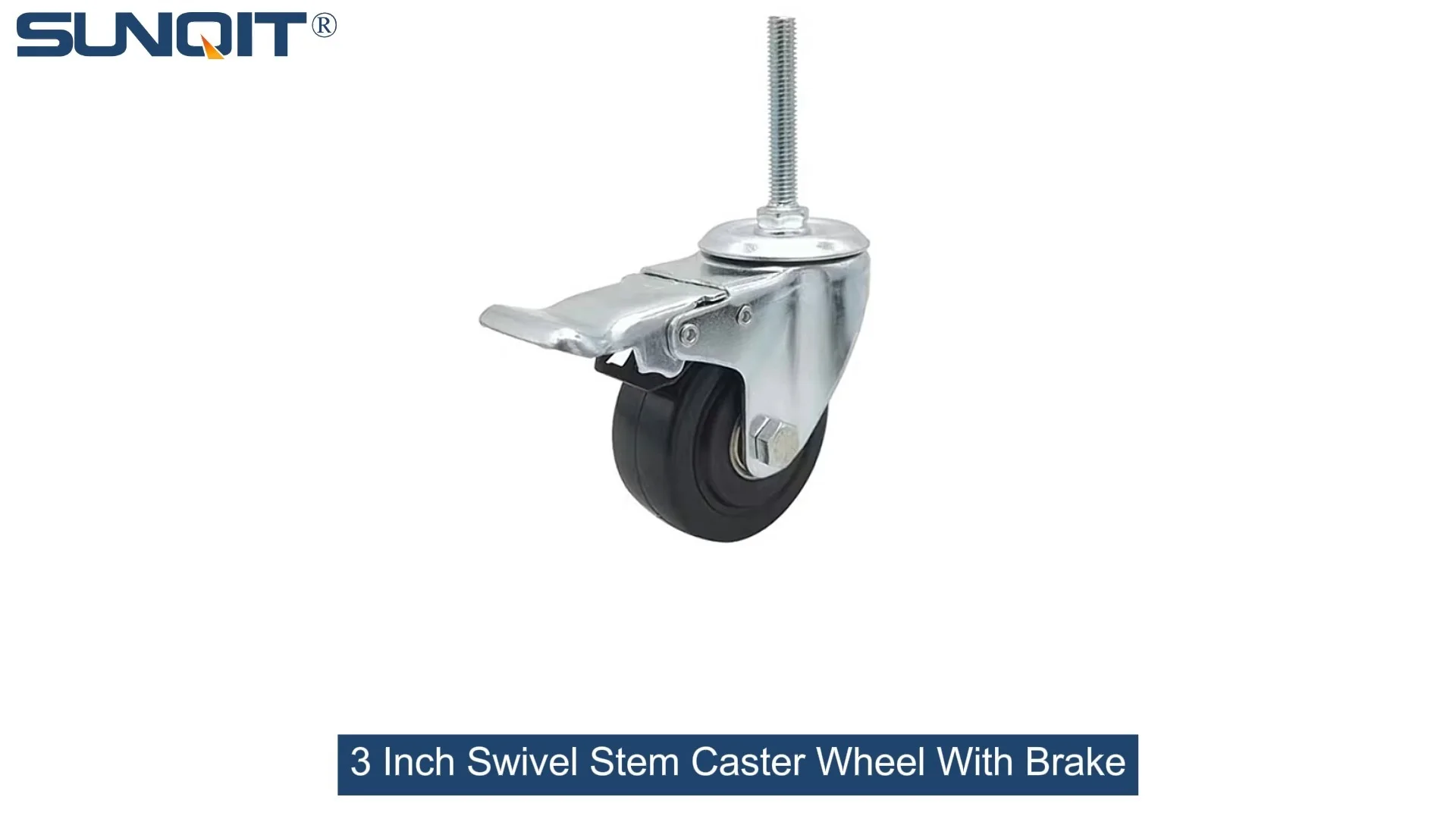
Swivel Stem Caster Wheel with Brake
360 Degree Swivel Stem Caster with brake. Threaded-post mount design, castors diameter 3 inch.Each swivel caster wheels loading 70KGS. Heavy enough and widely suit for carts, chairs, cabinet, flow rack, workbench, turnover rolley.
Let's paint a picture: It's 9 AM on a Monday at a mid-sized electronics assembly plant. The floor hums with the whir of machinery, the clink of metal parts, and the steady shuffle of workers pushing trolleys loaded with circuit boards. Maria, a line supervisor, is already juggling three urgent requests—"The material rack by Station 5 is jammed," "Trolley 7's wheel just locked up again," and "We need to reposition the workbench for the new prototype run by noon." Sound familiar? For anyone managing a production floor, chaos is the norm. But here's the thing: the difference between a smooth day and a disaster often comes down to the smallest tools—like the casters that keep everything moving. Today, we're diving into one unsung hero that's quietly revolutionizing how production floors handle movement, safety, and durability: the swivel stem caster wheel with brake. This isn't just any caster. It's a workhorse built for the grind, designed to take a beating and keep going—because when your floor is busy, the last thing you need is a caster failure throwing a wrench in your day.
What Even Is a Swivel Stem Caster Wheel with Brake, Anyway?
Let's start with the basics. If you've ever pushed a shopping cart, a office chair, or a tool trolley, you've used a caster. But not all casters are created equal. A swivel stem caster wheel with brake is a specialized version built for industrial environments—think factories, warehouses, and assembly lines. The "stem" part means it mounts to equipment via a metal rod (the stem) that inserts into a hole or bracket, making installation straightforward. The "swivel" lets it rotate 360 degrees, so you can maneuver tight corners or pivot trolleys with ease. And the "brake"? That's the game-changer: a foot-operated lever that locks the wheel in place, keeping your equipment stable when you need it to stay put.
But why does this matter on a busy production floor? Imagine trying to load parts onto a lean pipe workbench that won't stay still. Or pushing a heavy turnover trolley down a narrow aisle, only to have it veer off course because the casters don't swivel smoothly. Or worse—having a trolley roll away unexpectedly because the brake gave out, risking damage to parts or injury to workers. These aren't just minor inconveniences; they're productivity killers. The swivel stem caster with brake solves all three problems: it mounts securely, movesly, and locks reliably.
The Need for Impact Resistance: Why "Tough" Isn't Enough
Production floors are brutal places for equipment. Trolleys get slammed into walls. Workbenches are dragged over uneven concrete. Casters take hits from dropped tools, rolling pallets, and the constant vibration of machinery. A flimsy caster might work for a week, maybe a month—but eventually, the wheels crack, the swivel joint seizes, or the brake pedal snaps. That's where "impact resistance" comes in. It's not just about being "tough"; it's about surviving repeated, sudden shocks without losing functionality.
Let's break down the forces at play. When a loaded trolley hits a door frame (we've all been there), the caster wheel absorbs the brunt of that impact. If the wheel is made of cheap plastic, it might chip or split. If the swivel joint isn't reinforced, the stem could bend, making the caster wobble. Over time, these small impacts add up, turning a functional trolley into a liability. The swivel stem caster with brake is engineered to handle this. Manufacturers use materials like polyurethane or reinforced rubber for the wheels, which flex on impact and bounce back, rather than cracking. The swivel housing is often made of cast iron or heavy-gauge steel, so it won't bend under pressure. Even the brake mechanism is built with durable springs and metal levers, so slamming on the brake (literally) won't snap it off.
Pro Tip: Not all "impact-resistant" casters are the same. Look for ones tested to withstand drop impacts (e.g., "tested to 500 lbs dropped from 12 inches") or repeated shock loading. This data tells you it's not just marketing hype—it's actually built to last.

Anatomy of a Workhorse: Key Features That Make It Stand Out
Let's get up close and personal with the swivel stem caster with brake. What exactly makes it different from the generic casters you might find at a hardware store? Let's break down its core components:
1. The Wheel: More Than Just Rubber
The wheel is the first line of defense against impacts. Most industrial casters use either rubber, polyurethane, or nylon. Rubber is great for shock absorption but can wear down quickly on rough floors. Nylon is super durable but doesn't absorb impacts well, making trolleys noisy and prone to skidding. Polyurethane? It's the sweet spot. It's tough enough to resist cuts and abrasions, flexible enough to absorb shocks, and provides good traction on both smooth concrete and uneven warehouse floors. Many swivel stem casters with brake use polyurethane wheels with a steel or aluminum core—adding rigidity without sacrificing impact resistance.
2. The Swivel Joint: Smooth Rotation, Even Under Load
Ever tried pushing a loaded trolley that "fights" you when you turn? That's a swivel joint that's not up to the task. A high-quality swivel stem caster uses precision ball bearings in the joint, allowing it to rotate freely even when carrying heavy loads (we're talking 500+ lbs per caster). The stem itself is usually made of cold-rolled steel, which is stronger than regular steel and less likely to bend under stress. Some models even have a "raceway" (the part the bearings sit in) sealed with grease to keep out dust and debris—critical for production floors where metal shavings or sawdust can gum up moving parts.
3. The Brake: Lock It and Forget It
The brake is where safety meets convenience. There are two common types: wheel brakes (which lock the wheel itself) and swivel locks (which lock the entire caster from swiveling). The best swivel stem casters with brake have both, but for most production needs, a reliable wheel brake is essential. Look for a brake that's easy to engage with a quick tap of the foot—no bending over required. The brake lever should be made of thick steel, not plastic, to avoid snapping. And when engaged, it should hold firm: even if someone bumps the trolley, it shouldn't budge. Some advanced models even have a "soft brake" feature, where the wheel slows gradually before locking, reducing stress on the caster and the floor.
4. The Stem: A Secure Connection
The stem is what attaches the caster to your equipment—whether it's a turnover trolley and rack , a workbench, or a material cart. Stems come in different lengths and diameters (common sizes are 1/2-inch, 5/8-inch, or 3/4-inch), so you'll need to match it to your equipment's mounting holes. But size isn't everything: the stem should have a smooth finish to avoid damaging the mounting bracket, and some models include a locking nut to prevent it from loosening over time. For extra security, look for stems with a "threaded" end, which screws into the equipment for a tighter fit than a plain stem.

How It Integrates with Your Existing Setup: Lean Pipe Workbenches, Trolleys, and More
The beauty of the swivel stem caster with brake is how seamlessly it fits into existing production setups. Let's take a lean pipe workbench as an example. Lean pipe (or "flexible pipe") workbenches are popular because they're modular—you can add shelves, bins, or tool holders as needed. But what good is a modular workbench if you can't move it? Adding swivel stem casters with brakes turns a static workbench into a mobile workstation. Need to reconfigure the line for a new product? Unlock the brakes, push it into place, lock the brakes, and you're done. No heavy lifting, no disassembly, no wasted time.
Then there are turnover trolley and rack systems—those rolling carts used to transport parts between stations. A typical turnover trolley might carry 300-500 lbs of components. With cheap casters, that's a recipe for trouble: wheels get stuck, the trolley veers off course, or the brakes fail when you stop to unload. Swap in swivel stem casters with brake, and suddenly the trolley glides smoothly, turns on a dime, and stays put when you hit the brake. Workers like it because it's less tiring to push; managers like it because it reduces the risk of parts getting damaged in transit.
Even material racks benefit. Imagine a material rack b (3 row and 3 floor) loaded with heavy tooling. Moving it manually would require a team of workers. With four swivel stem casters (two with brakes for stability), one person can reposition it in minutes. And because the brakes lock securely, you don't have to worry about the rack shifting while someone is loading or unloading parts.

Real-World Impact: Stories from the Floor
Numbers and specs are great, but let's hear from people who actually use these casters. Take Dave, a production manager at a automotive parts plant in Michigan. "We used to replace casters on our trolleys every 3-4 months," he told me. "The old ones would either wear out from the concrete floors or break when someone hit a corner too hard. We switched to swivel stem casters with brake last year, and I haven't ordered a replacement since. The polyurethane wheels don't mark the floors, the brakes hold even when the trolley is loaded with 600 lbs of steel parts, and the swivel is so smooth, the workers actually fight over who gets to push the 'good trolley.'"
Then there's Priya, who runs a small electronics assembly shop in California. "Space is tight here, so we're always moving workbenches around," she said. "Before, moving a workbench meant taking everything off it, then two people grunting to drag it. Now, with the swivel casters, I can unlock them, push the bench myself, lock it, and have the line back up in 5 minutes. And the brakes? Total peace of mind. We had a near-miss once when a bench rolled into a worker—never again."
These stories aren't outliers. When you replace flimsy casters with ones built for impact resistance and reliability, you're not just fixing a tool—you're streamlining workflows, reducing downtime, and making the floor safer for everyone.
Caster Showdown: How It Stacks Up Against the Competition
Not sure if a swivel stem caster with brake is right for you? Let's compare it to other common caster types you might find on the market:
| Caster Type | Impact Resistance | Brake Functionality | Swivel Range | Max Load (lbs) | Best For |
|---|---|---|---|---|---|
| Swivel Stem with Brake | High (polyurethane/steel construction) | Wheel lock (foot-operated, reliable) | 360° smooth rotation | 300-800+ | Production floors, lean pipe workbenches, heavy trolleys |
| Rigid Caster (no swivel) | Medium (simple design, but no swivel to absorb impacts) | None (fixed direction) | 0° (only moves forward/backward) | 500-1000+ | Straight-line movement (e.g., conveyor systems) |
| Swivel Without Brake | Medium-High (similar to stem caster, but no brake) | None (will roll if not chocked) | 360° rotation | 300-800+ | Light-duty use (e.g., office carts, non-critical tools) |
| Heavy-Duty Industrial Caster | Very High (steel wheels, reinforced joints) | Dual lock (wheel + swivel lock) | 360° (but heavier, slower rotation) | 1000-5000+ | Mining, construction, extreme loads |
As you can see, the swivel stem caster with brake hits the sweet spot for most production floors. It's more maneuverable than rigid casters, safer than swivel casters without brakes, and more practical for daily use than heavy-duty industrial casters (which are overkill for most factory tasks and harder to push).
Maintenance 101: Keeping Your Casters Rolling (and Braking) for Years
Even the toughest caster needs a little TLC. Here's how to make sure your swivel stem casters with brake last for years:
1. Clean Them Regularly
Production floors are dusty, greasy places. Over time, dirt and debris can build up in the swivel joint or around the brake mechanism, causing it to stick. Once a week, wipe the wheels and swivel housing with a damp cloth. For caked-on grime, use a small brush (like an old toothbrush) to dislodge dirt from crevices.
2. Lubricate the Swivel Joint
Every 3-6 months, apply a few drops of lubricating oil (like 3-in-1 oil) to the swivel joint. This keeps the ball bearings moving smoothly and prevents rust. Avoid using heavy greases, which can attract more dirt.
3. Check the Brake Tension
Brakes can loosen over time, making them less effective. Test the brake weekly by engaging it and trying to push the trolley—if it moves, the brake needs adjustment. Most models have a small nut near the brake lever that you can tighten with a wrench to increase tension.
4. Inspect Wheels for Wear
Look for cracks, flat spots, or uneven wear on the wheels. If a wheel is damaged, replace it immediately—driving on a worn wheel can damage the swivel joint or cause the trolley to wobble.
Pro Maintenance Hack: Keep a small "caster care kit" near your tool bench: a brush, lubricating oil, a wrench, and a spare wheel. That way, you can fix minor issues before they become big problems.
Choosing the Right Supplier: It's About More Than Price
So, you're sold on the swivel stem caster with brake. Now, where do you buy it? Not all suppliers are created equal. Here's what to look for:
Material Quality: Ask what the wheels are made of (polyurethane is best), what grade steel the stem and swivel housing use, and if the bearings are sealed. A reputable supplier will have no problem sharing specs.
Testing and Certifications: Look for casters tested to industry standards (e.g., ISO for impact resistance, OSHA for safety). Certifications mean the product has been put through rigorous trials.
Customer Support: What if you need help choosing the right stem length or replacing a wheel? A good supplier offers technical support and fast shipping on replacement parts.
Customization: Maybe you need a longer stem, a larger wheel, or a brake lever positioned differently. Some suppliers offer custom options to fit your specific needs.
Remember, the cheapest caster might save you money upfront, but it'll cost you more in replacements and downtime. Investing in quality pays off in the long run.
Final Thoughts: Small Tool, Big Impact
At the end of the day, the swivel stem caster wheel with brake is more than just a wheel. It's a tool that empowers workers to move freely, keeps equipment safe, and turns chaotic production floors into well-oiled machines. It's the difference between Maria, the line supervisor, spending her morning putting out fires and spending it focusing on improving workflows. It's the reason Dave's trolley casters haven't broken in a year. It's the quiet confidence that comes from knowing your equipment can handle whatever the day throws at it.
So, the next time you're on the production floor, take a look at the casters under your trolleys and workbenches. Are they holding you back? Or are they helping you move forward? If it's the former, maybe it's time to upgrade. Your team, your productivity, and your peace of mind will thank you.