- Company Articles
- Products and Technology
- Solution
- Swivel Stem Caster Wheel with Brake in Automotive Assembly: Worker Mobility Solutions

Swivel Stem Caster Wheel with Brake in Automotive Assembly: Worker Mobility Solutions
Related Product
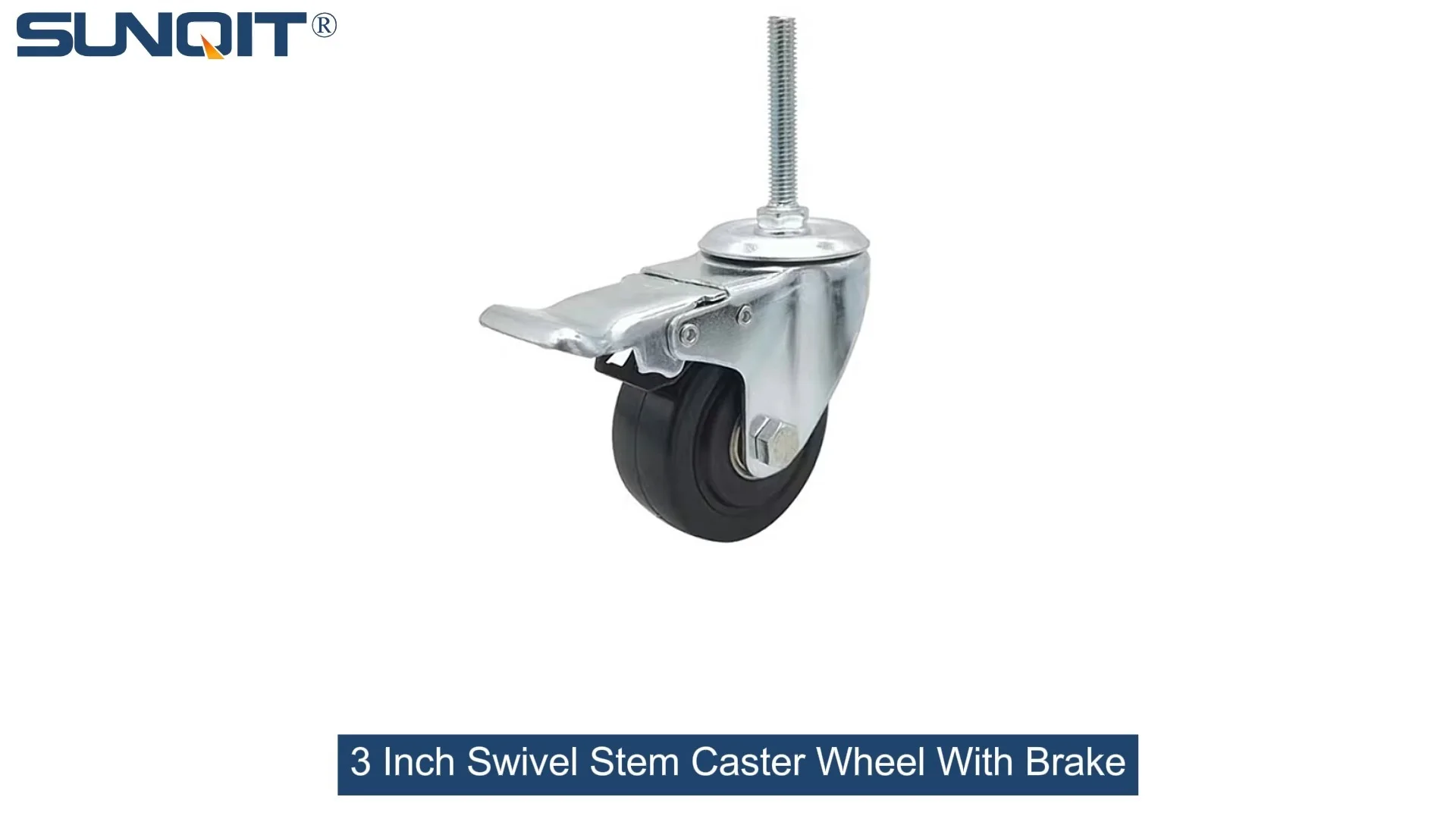
Swivel Stem Caster Wheel with Brake
360 Degree Swivel Stem Caster with brake. Threaded-post mount design, castors diameter 3 inch.Each swivel caster wheels loading 70KGS. Heavy enough and widely suit for carts, chairs, cabinet, flow rack, workbench, turnover rolley.
In the thunderous rhythm of an automotive assembly plant, where every second counts and precision is non-negotiable, the ability to move freely isn't just a convenience—it's the lifeblood of productivity. Picture this: a worker navigating a cart loaded with torque wrenches, wiring harnesses, and plastic trim pieces, weaving between stationary assembly lines and moving conveyor belts. Or a team repositioning a heavy workbench to align with a new vehicle model's production requirements. In these moments, the difference between a smooth workflow and a bottleneck often comes down to one yet critical component: the caster wheel. And among the various caster types, the swivel stem caster wheel with brake stands out as a silent champion, blending mobility, stability, and safety into a single, unassuming package.
Automotive assembly lines are a symphony of moving parts—both the vehicles being built and the tools, materials, and workstations that support their creation. Workers don't just stand in one spot; they pivot, reach, and transport. According to industry reports, the average automotive plant worker walks 5-7 miles per shift, much of that spent pushing, pulling, or guiding carts and equipment. In such an environment, mobility solutions that reduce fatigue, prevent accidents, and keep pace with tight production schedules aren't just nice to have—they're essential. This is where the swivel stem caster wheel with brake steps in, addressing three core challenges: maneuverability in tight spaces, stability during critical tasks, and safety when precision work is underway.
The Unsung Heroes: Casters in the Automotive Workflow
Casters are the unsung heroes of industrial mobility, quietly bearing the weight of the tools, parts, and workbenches that keep assembly lines humming. From small tool carts to heavy-duty material racks, these wheeled components come in countless designs, each tailored to specific needs. Fixed casters, for example, offer straight-line stability but lack flexibility; they're ideal for moving items along predictable paths like roller tracks. Swivel casters, on the other hand, allow 360-degree rotation, making them perfect for navigating tight corners or repositioning equipment with minimal effort. But when you add a brake to a swivel stem caster, you unlock a new level of control—one that's particularly vital in automotive settings, where the margin for error is razor-thin.
Why "stem" caster? Unlike plate-mounted casters, which attach to equipment via a flat metal plate, stem casters feature a cylindrical stem (often threaded or friction-fit) that inserts directly into a hole or socket on the cart, workbench, or trolley. This design offers a lower profile, lighter weight, and easier installation—key advantages in automotive applications where space is limited and equipment must be lightweight enough for workers to handle. Combine that stem with a swivel mechanism and a reliable brake, and you get a caster that can pivot on a dime, lock securely in place, and withstand the daily grind of a plant floor.
Anatomy of a Swivel Stem Caster Wheel with Brake: What Makes It Tick?
To appreciate why these casters excel in automotive assembly, let's break down their components. At first glance, a swivel stem caster wheel with brake looks simple: a wheel, a swivel head, a stem, and a brake pedal. But beneath that simplicity lies engineering designed to tackle the unique demands of industrial environments.
1. The Stem: The Backbone of Attachment
The "stem" is the caster's connection point to the equipment. In automotive settings, stems are typically 2-4 inches long and made of hardened steel, ensuring they can support loads up to 500 pounds per caster (or more, depending on the model). Threaded stems are common, screwing into pre-tapped holes on carts or workbenches, while friction-fit stems (held in place by pressure) offer quick swaps during maintenance. This versatility makes them compatible with everything from lightweight tool carts to heavy-duty workbench frames—critical in a plant where equipment varies widely in size and function.
2. The Swivel Mechanism: Freedom to Pivot
At the heart of the swivel caster is its ability to rotate 360 degrees. This is made possible by a raceway—a ring of ball bearings or roller bearings that allows the caster's upper housing (connected to the stem) to spin freely around the lower housing (connected to the wheel). In automotive plants, where carts must often make sharp turns to avoid obstacles, this swivel action reduces the force needed to maneuver by up to 40% compared to fixed casters. Imagine pushing a cart with fixed casters: you'd have to stop, reorient, and push again to change direction. With a swivel caster, a gentle nudge is enough to pivot, saving time and energy over a full shift.
3. The Wheel: Grip, Durability, and Floor Protection
The wheel itself is a study in material science. Automotive plant floors are tough—concrete, epoxy, or painted surfaces that take a beating from heavy traffic. Caster wheels must balance grip (to prevent slipping), durability (to resist wear), and floor protection (to avoid scuffs or cracks). Polyurethane is the go-to material here: it's elastic enough to absorb shocks (reducing noise and vibration), has high friction for stable movement, and won't mark floors—unlike harder materials like steel. Some models even use rubber-polyurethane blends for extra cushioning, ideal for carts carrying fragile parts like glass windshields or electronic control units.
4. The Brake: Safety in a Foot Tap
Perhaps the most critical feature for automotive environments is the brake. Most swivel stem casters with brakes use a foot-operated pedal that, when pressed, engages a brake pad against the wheel or locks the swivel mechanism (or both). This dual-action braking—wheel lock and swivel lock—is a game-changer. When a worker needs to stabilize a cart during use (say, while retrieving a part from a shelf), a quick tap of the brake pedal prevents the cart from rolling or pivoting. Release the pedal, and the caster is free to move again. This simplicity is intentional: in high-stress, fast-paced settings, workers can't afford to fumble with complex braking systems. The brake must be intuitive, reliable, and operable even with gloves on—a standard met by most industrial-grade models.

Why Brake Matters: Safety and Stability in Every Move
In an industry where OSHA safety standards are strict and accident prevention is paramount, the brake on a swivel stem caster isn't just a feature—it's a lifeline. Consider the risks of an unbraked caster in an automotive plant:
- A cart loaded with 300 pounds of steel brackets rolls unchecked down a slight incline, colliding with a worker or a stationary machine.
- A mobile workbench shifts during use, causing a worker to overreach and strain their back.
- During maintenance, an unsecured tool cart drifts into a roller track , jamming the material flow system and halting production.
These scenarios aren't hypothetical. The Bureau of Labor Statistics reports that "struck by moving objects" is one of the top causes of non-fatal injuries in manufacturing, with carts and dollies accounting for a significant portion of these incidents. The brake on a swivel stem caster directly mitigates these risks by turning a mobile asset into a stable one in seconds.
But the brake's benefits go beyond safety. In precision tasks—like assembling an engine block or aligning a door panel—stability is critical. A workbench or cart that shifts even an inch can throw off measurements, leading to rework or quality defects. With the brake engaged, workers can focus on their task without worrying about the equipment moving beneath them. This peace of mind translates to faster, more accurate work—a win for both productivity and quality control.

Swivel Stem Casters vs. the Competition: A Comparative Look
Not all casters are created equal. To understand why swivel stem casters with brakes are preferred in automotive assembly, let's compare them to other common types:
| Caster Type | Swivel Capability | Brake Feature | Best For | Load Capacity (Per Caster) | Automotive Assembly Fit |
|---|---|---|---|---|---|
| Swivel Stem with Brake | 360° rotation | Foot-operated wheel/swivel lock | Mobile workbenches, tool carts, parts dollies | 200-1,500 lbs | High (versatile, safe, maneuverable) |
| Fixed Stem Caster | None (only moves forward/backward) | Rarely included | Straight-line transport (e.g., along roller tracks) | 500-2,000 lbs | Low (limited maneuverability) |
| Swivel Plate-Mounted Caster | 360° rotation | Available, but bulkier | Heavy machinery, large storage racks | 1,000-5,000 lbs | Medium (overkill for most worker-driven equipment) |
| Locking Rigid Caster | None | Wheel lock only | Stationary equipment needing occasional movement | 300-800 lbs | Low (no swivel for tight spaces) |
As the table shows, swivel stem casters with brakes strike a balance that's hard to beat for worker-driven equipment. They offer the maneuverability of swivel casters, the stability of brakes, and the lightweight, space-saving design of stem mounting—all tailored to the dynamic, space-constrained world of automotive assembly.

Real-World Impact: How Swivel Stem Casters with Brakes Transform Workflows
To put these benefits into context, let's look at a hypothetical but realistic scenario: a mid-sized automotive plant producing 300 vehicles per day. The plant recently switched from fixed casters to swivel stem casters with brakes on all worker-driven tool carts and mobile workbenches. Here's what changed:
1. Reduced Fatigue, Increased Productivity
Workers reported a noticeable decrease in physical strain, particularly in their shoulders and lower backs. Pushing a swivel caster cart requires less force than a fixed caster cart, especially when turning. Over a full shift, this translates to less fatigue and more energy for core tasks. The plant saw a 12% increase in cart-related tasks completed per hour, from 15 to 17 tasks—adding up to hundreds of extra tasks per day across the workforce.
2. Fewer Accidents, Lower Downtime
Prior to the switch, the plant averaged 2-3 cart-related incidents per month (e.g., collisions, tipped carts, or strained workers). In the six months after adopting braked swivel casters, that number dropped to zero. Fewer accidents meant less downtime for investigations, worker compensation claims, and equipment repairs—saving an estimated $50,000 annually in indirect costs alone.
3. Flexibility for Model Changes
Automotive plants frequently reconfigure assembly lines to accommodate new vehicle models. With swivel stem casters, workers could reposition workbenches and tool carts in minutes, rather than hours (as was the case with fixed or heavy plate-mounted casters). During a recent model launch, the plant cut line reconfiguration time by 40%, ensuring production targets were met without delays.
Maintaining Swivel Stem Casters with Brakes: Tips for Longevity
Like any industrial equipment, swivel stem casters with brakes require regular maintenance to perform at their best. In automotive plants—where dirt, grease, and debris are constant companions—this upkeep is especially important. Here are key maintenance tips:
1. Keep Them Clean
Debris like metal shavings, oil, or rubber dust can clog the swivel raceway or jam the brake mechanism. A weekly wipe-down with a dry cloth or a blast of compressed air (for hard-to-reach areas) prevents buildup. For greasy casters, use a mild degreaser, then dry thoroughly to avoid rust.
2. Lubricate Regularly
The swivel raceway and brake pivot points need lubrication to stay smooth. Use a lithium-based grease or dry lubricant (to avoid attracting dirt) every 2-4 weeks, depending on usage. A quick spray or application with a grease gun ensures the caster swivels freely and the brake engages/disengages without sticking.
3. Inspect Brakes and Wheels
Check brake pads for wear—if they're thin or cracked, replace them immediately (many manufacturers offer caster accessories like replacement brake kits for this purpose). Also, inspect wheels for flat spots, cracks, or embedded debris (like nails or screws), which can cause uneven rolling or damage floors. replace wheels at the first sign of significant wear.
4. Tighten Loose Stems
Threaded stems can loosen over time, especially on carts that see heavy use. A monthly check with a wrench ensures the stem remains securely attached to the equipment, preventing wobbling or detachment.
Conclusion: The Caster That Drives the Line
In the grand scheme of automotive manufacturing, with its robots, conveyor belts, and high-tech machinery, the swivel stem caster wheel with brake may seem. But as we've explored, its impact is anything but small. It's the difference between a worker dreading the next cart push and moving with ease. Between a near-miss and a safe shift. Between a production line that stalls and one that hums along, meeting every deadline.
Automotive assembly is a world of precision, speed, and safety—and the tools that support it must embody all three. The swivel stem caster wheel with brake does just that, proving that sometimes the most powerful solutions come in the simplest packages. So the next time you see a worker glide a cart into place, tap a brake pedal, and focus intently on their task, remember: behind that moment of efficiency and safety is a caster wheel doing what it does best—keeping the industry moving forward, one roll (and brake) at a time.