- Company Articles
- Products and Technology
- Product knowledge
- Swivel Stem Caster Wheel with Brake in Home Appliance Production: Stability & Safety

Swivel Stem Caster Wheel with Brake in Home Appliance Production: Stability & Safety
Related Product
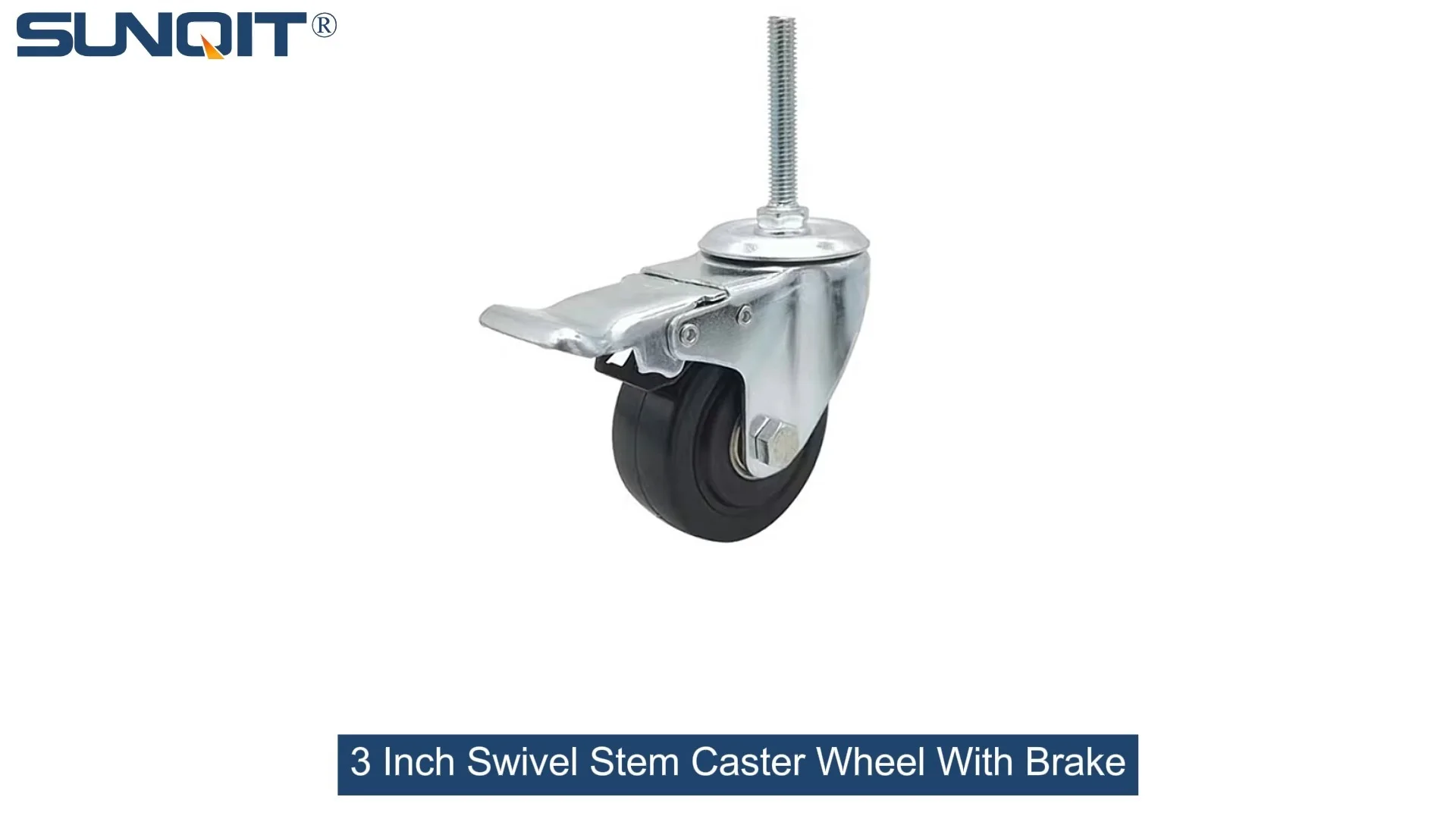
Swivel Stem Caster Wheel with Brake
360 Degree Swivel Stem Caster with brake. Threaded-post mount design, castors diameter 3 inch.Each swivel caster wheels loading 70KGS. Heavy enough and widely suit for carts, chairs, cabinet, flow rack, workbench, turnover rolley.
How a Small Component Elevates Efficiency and Protects Workers in the Fast-Paced World of Appliance Manufacturing
Walk into any home appliance factory—whether it's a plant churning out sleek refrigerators, robust washing machines, or compact microwaves—and you'll be met with a symphony of motion. Workers hustle between stations, conveyor belts hum with components, and carts glide across the floor, ferrying everything from heavy steel frames to delicate electronic panels. In this high-stakes environment, where every second counts and precision is non-negotiable, the difference between a smooth workflow and a costly delay often comes down to the smallest details. One such detail? The wheels beneath those carts, workbenches, and trolleys. Specifically, the swivel stem caster wheel with brake —a humble component that plays an outsized role in keeping production lines moving safely and efficiently.
Home appliance production is a balancing act. Factories must handle bulky, often heavy items (a single refrigerator compressor can weigh 30 pounds or more) while maintaining the agility to adapt to shifting demand or design changes. Lean system principles, which prioritize minimizing waste and maximizing flow, have become the backbone of modern manufacturing here. But lean systems rely on seamless material movement—parts need to arrive at the right station, at the right time, without getting stuck, tipping, or causing accidents. This is where the choice of casters becomes critical. A poorly designed caster can turn a "lean" process into a sluggish, error-prone one: a cart that drifts when loaded, a workbench that wobbles during assembly, or a trolley that slips unexpectedly, risking damage to parts or injury to workers. The swivel stem caster wheel with brake isn't just a wheel with a brake; it's a tool that bridges mobility and stability, ensuring that motion serves the process—not disrupts it.
The Hidden Risks of Unreliable Mobility in Home Appliance Production
To appreciate why the swivel stem caster wheel with brake matters, let's first unpack the unique challenges of moving materials in home appliance manufacturing. Unlike, say, electronics assembly—where components are small and lightweight—appliance production involves a mix of heavy metal parts, fragile glass (think oven doors or refrigerator shelves), and sensitive wiring. This diversity demands casters that can handle variable loads without compromising on control.
Consider a typical scenario: A worker loads a cart with three washing machine drums, each weighing 45 pounds, and pushes it to the assembly line. Without a reliable swivel mechanism, the cart might resist turning, forcing the worker to exert extra effort—a recipe for fatigue and potential musculoskeletal injuries. If the wheels lack grip, the cart could skid on a slightly oily floor, endangering nearby workers or damaging the drums. Worst of all, if there's no brake, or if the brake is hard to engage, the cart might roll away when the worker steps away to grab a tool, crashing into a conveyor or spilling its contents. In a factory producing 500 appliances per day, even a 10-minute delay from such an incident can cost thousands of dollars in lost output.
Then there are the mobile workbenches, a staple in lean system setups. These workstations, often used for tasks like wiring or quality checks, need to be both movable (to follow the flow of production) and stable (to keep tools and parts secure during assembly). A workbench without a dependable brake might shift mid-task, causing a worker to misalign a part or drop a tool. For delicate tasks—like installing a microwave's control panel—even a tiny wobble can lead to defects that require rework, eating into profits and deadlines.
Safety, too, is a constant concern. The U.S. Bureau of Labor Statistics reports that over 20% of manufacturing injuries involve material handling, with "overexertion" and "struck by object" being top causes. Many of these incidents trace back to unstable or poorly controlled mobile equipment. In home appliance factories, where metal parts and heavy machinery are omnipresent, a runaway cart isn't just a productivity issue—it's a hazard. OSHA standards mandate that mobile equipment must be "stable and secure" during use, but compliance starts with choosing the right components. Here, the swivel stem caster wheel with brake isn't just a convenience; it's a critical line of defense against accidents.
Anatomy of a Hero: What Makes the Swivel Stem Caster Wheel with Brake Unique?
At first glance, a swivel stem caster wheel with brake might look like any other wheeled component. But its design is the result of decades of engineering focused on solving the specific challenges of industrial mobility. Let's break down its key features and why they matter in home appliance production:
1. The Swivel Mechanism: Agility Without Sacrifice
Unlike fixed casters (which only roll forward and backward) or rigid stem casters (which limit movement to a single direction), swivel stem casters pivot 360 degrees. This maneuverability is a game-changer in tight factory spaces. Imagine navigating a cart loaded with dishwasher tubs around a corner where two conveyor lines meet—without swivel casters, the worker would need to make multiple awkward turns, wasting time and increasing the risk of collision. The swivel design lets the cart glide smoothly, following the worker's lead with minimal effort.
But mobility alone isn't enough. The "stem" in "swivel stem caster" refers to how the caster attaches to the equipment—via a metal stem that inserts into a socket or bracket on the cart or workbench. This stem mount is stronger and more stable than plate-mounted casters (which bolt onto the surface) for certain applications, especially when space is limited. In home appliance production, where carts and workbenches are often custom-built to fit specific parts, the stem mount's compact design allows for lower profiles, keeping the center of gravity low and reducing the risk of tipping.
2. The Brake: Control When It Counts
The brake is what elevates this caster from "useful" to "indispensable." Most swivel stem casters with brakes offer two types of locking: total lock and directional lock. Total lock brakes engage both the wheel (preventing rolling) and the swivel (preventing pivoting), effectively anchoring the equipment in place. Directional lock, by contrast, only locks the swivel, keeping the wheel aligned straight while still allowing limited rolling—useful for moving in a straight line without veering.
In home appliance production, total lock brakes are particularly valuable. When a worker loads a turnover trolley and rack with oven doors, they need to ensure the trolley stays put while they secure the load. A quick tap on the brake pedal (usually located near the wheel for easy access) locks both movement and swivel, turning a mobile cart into a stable platform. Later, when moving the trolley to the next station, releasing the brake is just as simple—no bending, no fumbling, and no delay.
Brake durability is also key. In a factory setting, casters are exposed to dust, oil, and occasional impacts. A cheap brake might jam after weeks of use, rendering it useless. High-quality swivel stem caster wheels with brakes use sealed brake mechanisms and robust materials (like reinforced plastic or steel) to withstand harsh conditions. Some even feature "no-touch" designs, where the brake pedal is elevated to avoid getting caught on debris—a small detail that prevents big headaches.
3. Wheel Design: Grip, Load, and Floor Protection
The wheel itself is just as critical as the swivel and brake. Home appliance factories use a variety of floor surfaces—concrete, epoxy, even polished tile—and the caster wheel must adapt. Rubber wheels, for example, offer excellent grip and shock absorption, making them ideal for uneven concrete floors where heavy loads might bounce. Polyurethane wheels, on the other hand, are prized for their durability and resistance to oil and chemicals, a must in areas where lubricants or cleaning agents might spill.
Load capacity is another consideration. A standard swivel stem caster wheel with brake might handle 200-300 pounds per wheel, but heavy-duty models can support 500 pounds or more. In appliance production, where a single cart might carry four refrigerator doors (each 70 pounds), choosing casters with a load rating well above the expected weight is a safety imperative. Overloading a caster can cause the wheel to crack, the stem to bend, or the brake to fail—all disasters waiting to happen.
Floor protection is a subtle but important benefit, too. Scratched or damaged floors can create tripping hazards or trap debris, which in turn can jam casters or damage components. Soft rubber or polyurethane wheels minimize floor wear, extending the life of the factory's infrastructure and reducing maintenance costs.

From Workbench to Trolley: How Swivel Stem Casters Integrate into Production
In home appliance manufacturing, the swivel stem caster wheel with brake isn't a standalone component—it's part of a larger ecosystem of tools and equipment. Let's explore how it integrates with two staples of the factory floor: the workbench and the turnover trolley and rack .
Mobile Workbenches: Stability Meets Flexibility
Modern home appliance assembly lines aren't static. They're dynamic, with stations that shift based on production runs—one day assembling top-loading washers, the next front-loaders. Mobile workbenches are the backbone of this flexibility. Equipped with tools, bins, and power outlets, these workstations follow the flow of production, allowing workers to stay close to the action.
But a workbench is only useful if it stays put when needed. Imagine a technician wiring a dryer control panel: they need both hands free, and the bench can't shift mid-connection. Here, swivel stem casters with brakes shine. Most mobile workbenches use four casters—two with total lock brakes and two swivel-only (or two with directional lock). When the bench needs to move, all brakes are released, and the swivel casters allow easy navigation around obstacles. Once in place, engaging the brakes on the two locking casters anchors the bench, preventing even the slightest wobble.
Ergonomics play a role, too. A workbench that's easy to move reduces strain on workers, who no longer have to carry tools or walk long distances between stations. And because the stem mount casters are low-profile, the workbench sits at a comfortable height (typically 36-40 inches), reducing bending and back pain during assembly tasks.
Turnover Trolleys and Racks: Hauling Heavy Loads Safely
Turnover trolleys and racks are the workhorses of material transport, designed to carry stacks of parts—think pallets of microwave doors, bins of screws, or racks of control panels—between storage, assembly, and packaging areas. These trolleys often weigh hundreds of pounds when loaded, making stability and control non-negotiable.
A well-designed turnover trolley will use at least four swivel stem caster wheels with brakes, with the brakes positioned on opposite corners for balanced locking. When loading the trolley, workers engage the brakes to prevent movement, ensuring they can stack parts evenly without the trolley shifting. During transport, the swivel casters allow the trolley to navigate tight aisles, while the stem mount ensures the wheels stay securely attached even over bumps. When unloading at the assembly line, a quick brake engagement keeps the trolley steady, so workers can safely remove parts without wrestling with a moving target.
One factory in Ohio, which produces commercial refrigerators, recently upgraded its fleet of turnover trolleys to use heavy-duty swivel stem casters with total lock brakes. The result? A 35% reduction in incidents involving tipped loads and a 15% increase in trolley throughput, as workers no longer wasted time struggling with hard-to-maneuver equipment.
| Equipment Type | Caster Role | Key Benefit |
|---|---|---|
| Mobile Workbench | Swivel for maneuverability, brakes for stability during assembly | Workers stay productive without sacrificing precision |
| Turnover Trolley and Rack | Heavy-duty swivel and total lock brakes for load control | Safe transport of heavy, bulky appliance parts |
| Tool Carts | Lightweight swivel for easy movement, brakes for secure tool access | Tools are always within reach, no more wasted steps |

Lean Systems and Safety: A Perfect Pair with Quality Casters
Lean system principles are all about eliminating waste—whether it's time, materials, or effort. In home appliance production, where margins are tight and competition is fierce, lean isn't just a buzzword; it's survival. The swivel stem caster wheel with brake aligns perfectly with lean goals by reducing two major sources of waste: delays and injuries.
Consider time waste. A cart with stiff, non-swiveling casters takes longer to move, requiring workers to exert more effort and slowing down material flow. A cart without a reliable brake might roll away, forcing someone to chase it down or, worse, clean up a spill. These small delays add up: over a shift, they can cost hours of productive time. Swivel stem casters with brakes minimize this waste by making movement effortless and secure—carts glide, brakes lock instantly, and workers stay focused on their tasks, not on wrestling with equipment.
Injuries, too, are a form of waste—wasting worker time, medical costs, and morale. By preventing tip-overs, skids, and strain, swivel stem casters with brakes reduce the risk of accidents, keeping lean teams intact and productive. OSHA estimates that employers save $4-$6 for every $1 invested in ergonomic improvements; reliable casters are a low-cost, high-impact example of this.
Safety compliance is another lean benefit. Lean systems thrive on standardization, and safety standards (like OSHA's requirements for stable mobile equipment) are non-negotiable. Using certified swivel stem casters with brakes ensures factories meet these standards without adding complexity to workflows. It's a "set it and forget it" solution: once the casters are installed and workers trained to use the brakes, compliance becomes second nature.

Keeping Casters Rolling: Maintenance Tips for Longevity
Like any piece of equipment, swivel stem caster wheel with brake performance depends on proper maintenance. In a factory environment, where dust, oil, and debris are constant companions, neglecting casters can lead to sticky swivels, weak brakes, or worn wheels—all of which undermine stability and safety. Here are simple steps to keep casters in top shape:
- Daily Inspections: Have workers do a quick check before using a cart or workbench. Look for debris stuck in the wheels (like screws or metal shavings), which can cause uneven rolling. Test the brake: does it engage smoothly? Does the wheel lock completely?
- Weekly Cleaning: Use a brush or compressed air to remove dirt from swivel joints and brake mechanisms. For oil or grease buildup, wipe wheels with a rag dampened with mild detergent—avoid harsh chemicals that can degrade rubber or polyurethane.
- Monthly Lubrication: Apply a light machine oil or silicone spray to swivel joints and brake pivots. This prevents rust and keeps the swivel action smooth. Be careful not to over-lubricate, as excess oil can attract dust.
- Quarterly Load Checks: Ensure casters aren't being overloaded. If a cart feels sluggish or the wheels start to deform, verify that the load doesn't exceed the caster's rated capacity. Overloading is a leading cause of premature caster failure.
- replace Worn Parts Promptly: Caster accessories like brake pads or wheel bearings wear out over time. Keep spares on hand, and replace them at the first sign of damage (e.g., a brake that slips or a wheel that wobbles).
Many factories assign a "caster champion"—a maintenance worker or team lead responsible for overseeing caster care. This simple step ensures maintenance doesn't fall through the cracks, extending the life of casters and reducing replacement costs.
The Unsung Hero of Home Appliance Production
In the grand scheme of home appliance manufacturing—with its robots, conveyor systems, and high-tech machinery—the swivel stem caster wheel with brake may seem. But as we've explored, it's far from it. It's the component that turns a static workbench into a mobile workstation, a heavy cart into a nimble tool, and a chaotic floor into a streamlined, safe space.
For factory managers, investing in quality swivel stem casters isn't just about buying wheels—it's about investing in efficiency, safety, and lean system success. It's about ensuring that the next time a worker pushes a cart loaded with refrigerator parts, they do so with confidence, knowing the casters will glide smoothly, brake firmly, and keep the line moving forward. In a world where home appliances are getting smarter, lighter, and more complex, the humble caster remains a steady, reliable partner in production.
So the next time you open your refrigerator or start a load of laundry, take a moment to appreciate the journey those appliances took to reach your home. Behind every sleek design and reliable performance is a factory floor full of motion—and beneath that motion, a set of wheels working tirelessly to keep things stable, safe, and moving forward. That's the power of the swivel stem caster wheel with brake: small in size, but enormous in impact.