- Company Articles
- Products and Technology
- Installation And Maintenance
- Swivel Stem Caster Wheel with Brake in Warehousing: Fastening & Security Tips

Swivel Stem Caster Wheel with Brake in Warehousing: Fastening & Security Tips
Related Product
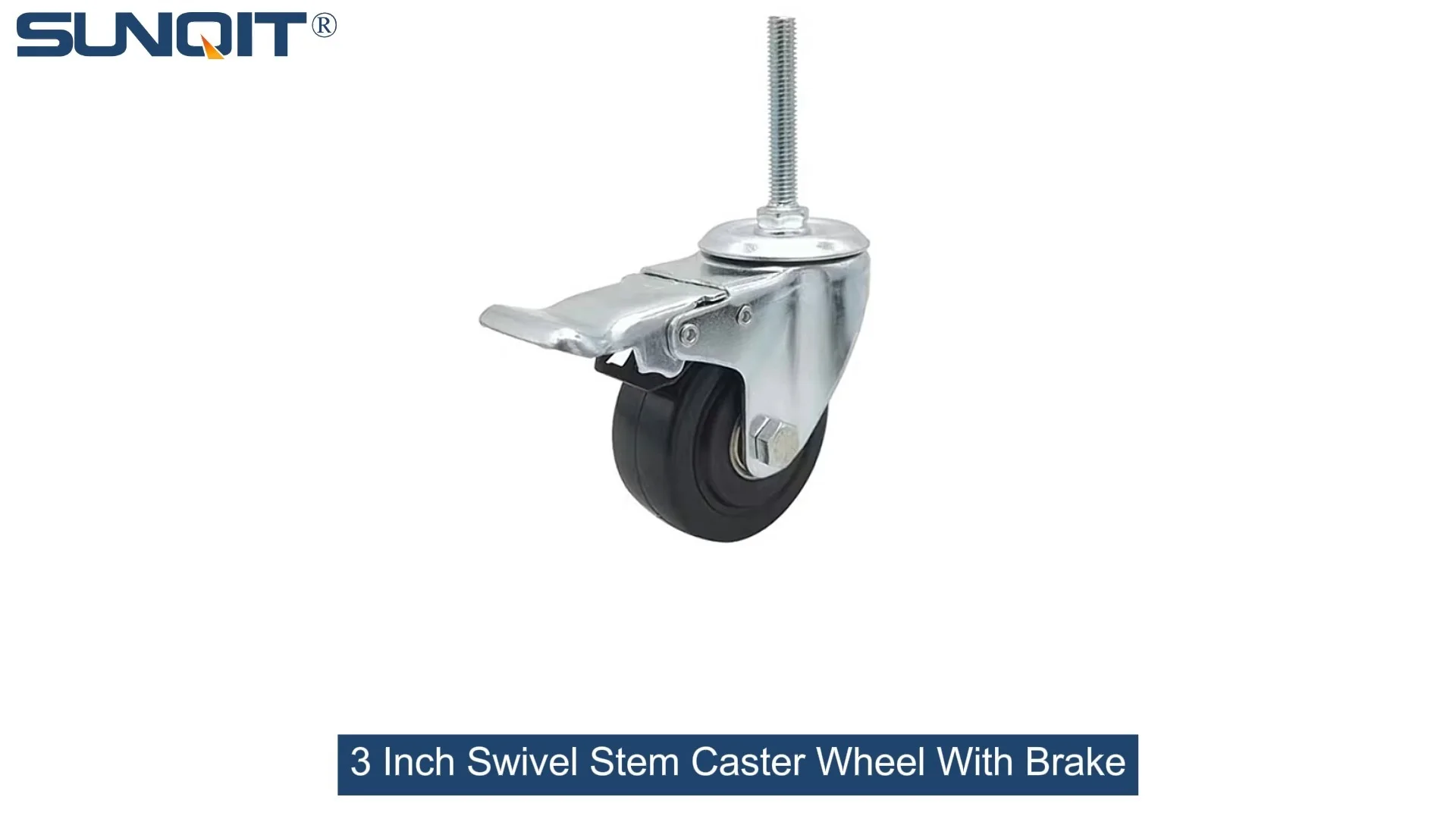
Swivel Stem Caster Wheel with Brake
360 Degree Swivel Stem Caster with brake. Threaded-post mount design, castors diameter 3 inch.Each swivel caster wheels loading 70KGS. Heavy enough and widely suit for carts, chairs, cabinet, flow rack, workbench, turnover rolley.
It's a busy Monday morning in a 50,000 sq ft warehouse. Forklifts hum in the distance, pickers rush to fill orders, and somewhere near the packing station, Maria pauses, frustrated. The turnover trolley she's pushing feels wobbly again—last week, it veered off course and nearly knocked over a pallet of fragile electronics. "Not again," she mutters, kicking the wheel. If only the casters were secured properly. Sound familiar? In warehouses, where every second counts and safety is non-negotiable, the humble swivel stem caster wheel with brake plays a bigger role than you might think. It's not just a wheel; it's the difference between a smooth workflow and a costly accident, between meeting deadlines and falling behind. Today, we're diving deep into how to fasten and secure these critical components, ensuring your equipment moves when you need it to—and stays put when you don't.
What Are Swivel Stem Caster Wheels with Brake, Anyway?
Let's start with the basics. A swivel stem caster wheel is exactly what it sounds like: a wheel mounted on a swivel head, attached to a stem that screws or bolts into equipment. The "stem" is the metal rod that connects the caster to the trolley, workbench, or rack—think of it as the caster's backbone. The "swivel" part lets the wheel rotate 360 degrees, making it easy to maneuver tight corners or pivot loads. And the "brake"? That's the hero feature here. It's a mechanism—usually a foot pedal or lever—that locks the wheel (or the swivel head) in place, preventing unwanted movement when loading, unloading, or parked.
These casters come in all shapes and sizes, from tiny 2-inch wheels for light workbenches to beefy 8-inch ones for heavy-duty turnover trolleys. They're made with different wheel materials too: rubber for quiet operation on concrete, polyurethane for durability, or steel for rough surfaces. But no matter the size or material, their job is simple: keep your equipment mobile yet stable. And in a warehouse, where you're moving everything from small parts bins to 500-pound pallets, that stability is everything.
Why They Matter in Warehousing: More Than Just Wheels
You might be thinking, "It's just a caster—how important can it be?" Let's break it down. In a typical warehouse, you've got workbenches that need to shift for deep cleaning, turnover trolleys shuttling between assembly lines and storage, and material racks that double as picking stations. Without reliable casters, these tasks become a hassle. A loose caster slows down Maria as she pushes her trolley; a stuck brake means Joe, the maintenance guy, has to wrestle a workbench into place. Worse, a failed caster can lead to spills, injuries, or damaged inventory. According to the Occupational Safety and Health Administration (OSHA), over 20% of warehouse injuries involve manual handling of equipment—many of which trace back to unstable or poorly secured casters.
Then there's the lean system angle. Warehouses today thrive on lean principles: minimizing waste, maximizing efficiency, and keeping workflows flexible. A good swivel stem caster with brake supports all three. Need to reconfigure your packing station for a rush order? Unlock the brakes, move the workbench, lock it down—done. No wasted time, no heavy lifting, no disruption. It's the kind of flexibility that turns a static warehouse into a dynamic, adaptable space.

Key Components: What Makes a Caster Tick?
Before we get into fastening and security, let's meet the team that makes your caster work. Understanding these parts will help you spot issues and fasten them correctly:
- The Stem: As we mentioned, this is the caster's anchor. It can be threaded (like a bolt) or smooth (for press-fit mounting). Threaded stems are the most common in warehouses—they screw into a nut or threaded hole in your equipment, creating a tight bond.
- The Swivel Head: A housing with bearings that lets the wheel rotate. If this is loose, your caster will wobble, making the equipment hard to steer.
- The Wheel: The part that touches the ground. It has a hub, spokes (or a solid core), and a tread. Worn treads or cracked hubs are red flags.
- The Brake Mechanism: This can be a "total lock" (locks both wheel rotation and swivel) or "wheel lock" (only stops the wheel from rolling). Most warehouse casters use foot brakes—step on the pedal to lock, step again to release.
- Caster Accessories: These are the unsung helpers. Think lock washers to prevent loosening, stem extenders for deeper mounting holes, or dust caps to keep debris out of the swivel head. Don't overlook these—they're often the difference between a caster that lasts 6 months and one that lasts 6 years.
Pro Tip: Always check the caster's load rating! A caster rated for 300 pounds won't cut it if you're putting 500 pounds on the trolley. Overloading is the number one cause of stem bending or brake failure. The load rating is usually stamped on the caster's housing—never guess!

Fastening 101: How to Secure Your Caster (So It Stays Put)
Fastening a swivel stem caster might seem like a "screw it in and go" job, but there's a science to it. Do it wrong, and you'll be dealing with wobbly wheels, stripped threads, or even a caster that pops out mid-use. Do it right, and your caster will stay secure for years. Let's walk through the steps.
Step 1: Choose the Right Stem and Mounting Hole
First, make sure the stem matches the mounting hole on your equipment. Threaded stems come in standard sizes (like 3/8"-16 or 1/2"-13 threads per inch). If the hole is too big, the stem will wobble; too small, and you'll strip the threads when tightening. Use a thread gauge to check the hole size, or ask your caster supplier for a compatibility chart. Pro tip: If you're replacing an old caster, take it with you to the supplier—they'll help you find an exact match.
Step 2: Prep the Mounting Surface
Before installing, clean the mounting hole and the area around it. Dust, grease, or rust can prevent the stem from seating properly. Use a wire brush to clean out the hole, then wipe it with a rag and some isopropyl alcohol. If the hole has been stripped before, you might need a thread repair kit (like a helicoil) to restore the threads. Don't skip this—rust or debris is like sandpaper; it'll wear down the stem over time, leading to loosening.
Step 3: Apply Thread Locker (Yes, It Matters)
Thread locker is your best friend here. It's a liquid adhesive that keeps the stem from unscrewing due to vibration—common in warehouses where equipment is always moving. Use a medium-strength locker (like Loctite Blue) for most applications. Avoid high-strength (red) unless you're sure you'll never need to remove the caster—it's permanent! Apply a drop or two to the threads, then screw the stem into the hole. Let it cure for 24 hours before putting weight on the caster.
Step 4: Torque It to Spec (No Guessing!)
"Tighten until it's snug" is the worst advice here. Under-tighten, and the stem will loosen; over-tighten, and you'll snap the stem or crack the mounting plate. Every caster has a recommended torque spec (measured in foot-pounds or Newton-meters), provided by the manufacturer. Use a torque wrench to get it right. Not sure what the spec is? Check the caster's manual or ask the supplier. To give you a rough idea, here's a table of common stem sizes and torque ranges:
| Stem Diameter | Thread Type | Torque Range (ft-lbs) | Torque Range (Nm) |
|---|---|---|---|
| 3/8" | Coarse (16 TPI) | 8-12 | 11-16 |
| 1/2" | Coarse (13 TPI) | 15-20 | 20-27 |
| 5/8" | Coarse (11 TPI) | 25-30 | 34-41 |
| 3/4" | Coarse (10 TPI) | 40-45 | 54-61 |
Remember, these are general guidelines—always follow the manufacturer's specs. And never use a pipe wrench or pliers to tighten the stem; they'll damage the threads. Use a socket wrench or a caster wrench (a special tool with a square drive that fits over the stem's top).
Step 5: Check for Wobble
After tightening, give the caster a good shake. It should move smoothly but not wobble side-to-side. If it wobbles, the stem might be misaligned, or the mounting hole is damaged. Remove the caster, inspect the stem and hole, and try again. A wobbly caster isn't just annoying—it puts extra stress on the swivel head and brake mechanism, leading to premature wear.

Security Tips: Making Sure the Brake Actually Works (When You Need It)
A caster that's fastened well is half the battle. The other half? Ensuring the brake works reliably. There's nothing scarier than stepping on the brake pedal and feeling it sink with no resistance—especially when you're on a slight incline with a heavy load. Here's how to keep your brakes secure and effective.
Test the Brake Under Load (Not Just When Empty)
Brakes can feel strong when the trolley is empty, but add 300 pounds of inventory, and they might slip. Always test the brake with a representative load. Park the trolley on a slight incline (if you have one), load it to capacity, then engage the brake. Give the trolley a gentle push—if it moves, the brake isn't strong enough. You might need a heavier-duty brake (like a dual-lock brake that locks both the wheel and swivel) or an adjustment. Most brakes have a tension screw that lets you tighten the pedal—check the manual for how to adjust it.
Keep Brakes Clean and Lubricated
Warehouses are dusty, greasy places, and that grime loves to build up in brake mechanisms. Over time, dirt can jam the pedal or prevent the brake pad from gripping the wheel. Every month, spray the brake with a degreaser (like WD-40 Specialist Degreaser), then wipe it clean with a rag. After cleaning, apply a light lubricant (like silicone spray) to the pivot points of the pedal—this keeps it moving smoothly. Avoid heavy oils, which attract more dirt.
replace Worn Brake Pads (Don't Wait for Them to Fail)
Brake pads are the part that presses against the wheel to stop it. They wear down over time, especially if you're braking heavily or on rough surfaces. Check the pads every few weeks: if they're thin, cracked, or glazed (shiny from heat), replace them. Most caster suppliers sell replacement pads—they're cheap, and swapping them takes 5 minutes with a screwdriver. Waiting until the pad is completely worn means the metal brake arm will grind against the wheel, ruining both the wheel and the brake mechanism. Trust us, replacing a $5 pad is better than replacing a $50 caster.
Train Your Team to Use Brakes Properly
Even the best brake won't work if your team doesn't use it. How many times have you seen someone park a trolley and walk away without locking the brake? It takes 2 seconds to step on the pedal—make it a habit. Hold a quick training session: show everyone how the brake works (some have a "soft lock" for swiveling and a "hard lock" for wheels), demonstrate how to test it, and explain the risks of not using it. Post reminders near workstations: "Lock It Before You Leave It!"
Real-World Applications: Workbenches, Trolleys, and Lean Systems
Let's put this all into context with some real-world examples. These aren't just "tips"—they're solutions to problems warehouse teams face every day.
Example 1: The Mobile Workbench
Imagine a workbench in your assembly area that needs to move to the packing station during peak hours. It's loaded with tools, a laptop, and a bin of parts—about 200 pounds total. The workbench has four swivel stem casters with brakes, but lately, it's been drifting when parked. The fix? First, check the stem torque: the maintenance team had tightened them "by feel" and under-tightened the 1/2" stems (only 10 ft-lbs instead of 15-20). Retorquing to 18 ft-lbs with thread locker solved the wobble. Then, inspect the brakes: one pad was worn down to metal. Replacing the pads and adjusting the tension screw made the brake engage firmly. Now, the workbench stays put when locked, and moves smoothly when unlocked—perfect for lean workflows that require flexibility.
Example 2: The Turnover Trolley and Rack
Your warehouse uses turnover trolleys to move inventory from the stockroom to the picking area. These trolleys have two fixed casters and two swivel stem casters with brakes (for steering). Last month, a trolley rolled into a forklift because the brake failed. The root cause? The caster stems were the wrong size—someone had replaced them with 3/8" stems instead of 1/2", and they stripped under load. Solution: Order the correct 1/2" stems, prep the mounting holes (they were rusty), apply thread locker, and torque to 18 ft-lbs. Also, switch to dual-lock brakes (lock wheel and swivel) for extra security. Now, even on the warehouse's slight slope, the trolley stays locked until the pedal is released. Maria, who uses this trolley daily, says, "It's like night and day—I don't even think about it now; it just works."
Example 3: Lean System Integration
Your warehouse is implementing a lean system, focusing on 5S (Sort, Set in Order, Shine, Standardize, Sustain). Part of this is reducing waste by making workstations mobile. You've got racks that need to reconfigure for seasonal inventory spikes. The problem? The old casters were flimsy, and the brakes kept failing, making reconfiguration more hassle than it was worth. The fix? Upgrade to heavy-duty swivel stem casters with total-lock brakes, properly fastened with the right torque and thread locker. Now, the racks move easily when needed, lock securely when in place, and require minimal maintenance. The team spends less time wrestling with equipment and more time on value-adding tasks—exactly what lean is all about.
Common Mistakes to Avoid (So You Don't Learn the Hard Way)
Even seasoned warehouse managers make caster mistakes. Let's highlight the most common ones—and how to steer clear.
- Over-tightening the stem: "If a little torque is good, more must be better!" Wrong. Over-tightening can snap the stem, strip the threads, or crack the mounting plate. Always stick to the manufacturer's torque spec.
- Ignoring caster accessories: Skipping lock washers or thread locker might save 2 minutes now, but it'll cost hours later when the caster loosens. Caster accessories are cheap insurance—use them.
- Mixing caster types: Putting a swivel caster where a fixed one should go, or mixing sizes on the same trolley. This causes uneven wear, makes steering harder, and stresses the brakes.
- Forgetting to inspect brakes: "If it locks, it's fine!" Not necessarily. Brake pads wear slowly—check them monthly, not just when they fail.
- Using the wrong wheel material: Rubber wheels on rough concrete wear out fast; steel wheels on polished floors scratch them. Match the wheel to the surface for longer life.
Final Thoughts: Your Casters Deserve Attention
At the end of the day, swivel stem caster wheels with brake are the unsung heroes of the warehouse. They don't get the glory, but they keep your operation moving—literally. Fastening them properly and keeping their brakes secure isn't just a "maintenance task"; it's an investment in safety, efficiency, and peace of mind. So take 10 minutes today: walk around your warehouse, check a few casters. Are they tight? Do the brakes engage firmly? If not, grab a torque wrench and some thread locker—your team (and your bottom line) will thank you.
And Maria? She's pushing her turnover trolley now, no wobbles, no stress. As she locks the brake at the packing station, she smiles. "Who knew a wheel could make such a difference?" Exactly. Now go make it happen in your warehouse.