- Company Articles
- Products and Technology
- Installation And Maintenance
- Swivel Stem Caster Wheel with Brake: Installation Height & Stem Length Guide

Swivel Stem Caster Wheel with Brake: Installation Height & Stem Length Guide
Related Product
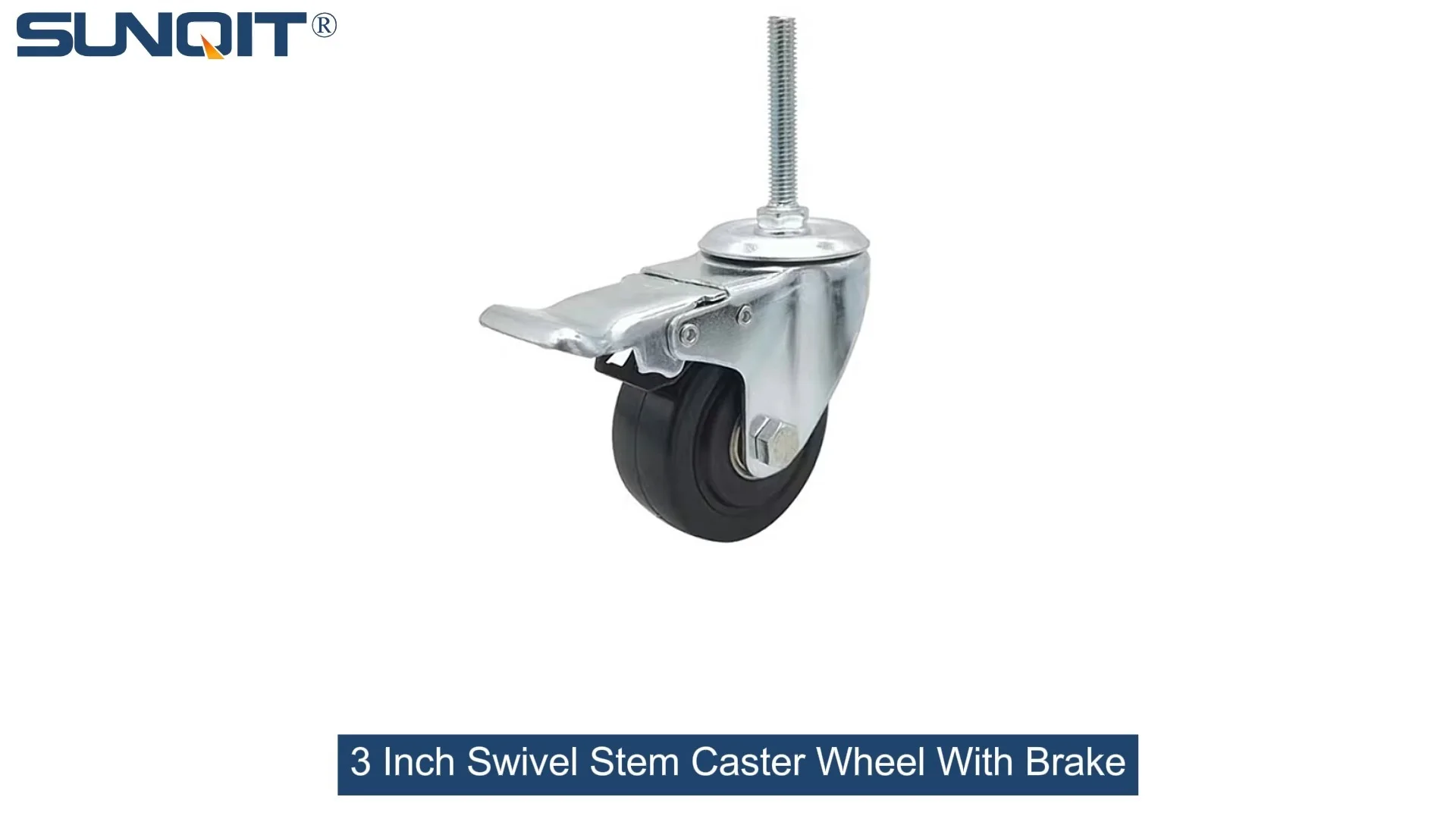
Swivel Stem Caster Wheel with Brake
360 Degree Swivel Stem Caster with brake. Threaded-post mount design, castors diameter 3 inch.Each swivel caster wheels loading 70KGS. Heavy enough and widely suit for carts, chairs, cabinet, flow rack, workbench, turnover rolley.
If you've ever pushed a heavy workbench across a workshop floor, only to have it veer off course, or struggled to keep a mobile cart from rolling away while loading it, you know how critical the right casters are. Among the most versatile and widely used options in industrial, commercial, and even home settings are swivel stem caster wheels with brakes. These small but mighty components combine mobility, maneuverability, and stability—allowing equipment to move freely when needed and stay firmly in place when it matters most.
But here's the thing: not all swivel stem casters with brakes are created equal. Two of the most overlooked yet essential factors that determine their performance are installation height and stem length . Get these wrong, and you could end up with wobbly equipment, premature wear, or even safety hazards. Whether you're outfitting a new aluminum workbench, upgrading a turnover trolley, or replacing old casters on a material rack, understanding how installation height and stem length work together is key to getting the job done right.
In this guide, we'll break down everything you need to know about swivel stem caster wheels with brakes—from what installation height and stem length actually mean, to how to measure them accurately, common mistakes to avoid, and real-world applications where these details make all the difference. By the end, you'll be equipped to choose, install, and maintain casters that keep your equipment moving smoothly and safely for years to come.
What Are Swivel Stem Caster Wheels with Brake, Anyway?
Before diving into the technical details, let's start with the basics. A swivel stem caster wheel with brake is a caster assembly consisting of three main parts: the wheel, the swivel head, the stem, and the brake mechanism. The wheel is the part that makes contact with the floor, made from materials like rubber, polyurethane, or nylon, depending on the load and floor type. The swivel head allows the wheel to rotate 360 degrees, making the equipment easy to maneuver around corners or tight spaces. The stem is the metal rod that attaches the caster to the equipment (think of it as the "leg" that connects the wheel assembly to your workbench or cart). Finally, the brake —usually a lever or pedal—locks the wheel in place, preventing movement when engaged.
These casters are everywhere: on medical carts in hospitals, food service trolleys in restaurants, tool chests in garages, and yes, aluminum workbenches in manufacturing facilities. Their popularity stems from their balance of functionality and simplicity—no complicated mounting plates, no heavy hardware, just a stem that fits into a pre-drilled hole or socket, making installation relatively straightforward. But as we'll explore, "straightforward" doesn't mean "one-size-fits-all."
Installation Height: The Unsung Hero of Caster Performance
What Is Installation Height, Exactly?
Installation height (sometimes called "overall height" or "mounting height") refers to the vertical distance from the top of the caster's mounting surface (where it attaches to your equipment) to the bottom of the wheel when the caster is fully loaded. In simpler terms, it's how "tall" the caster makes your equipment. For example, if a caster has an installation height of 100mm, attaching it to a workbench will raise the workbench 100mm off the ground (plus the thickness of the mounting surface, but we'll get to that later).
Why does this matter? Imagine (oops, scratch that—think about) a workshop with uneven concrete floors. If your caster's installation height is too low, the bottom of your equipment might scrape against bumps or debris, making it hard to push. Too high, and the equipment becomes top-heavy, increasing the risk of tipping. Installation height also affects ergonomics: a workbench that's raised too high can strain workers' backs; too low, and it forces them to hunch over. It's a Goldilocks scenario—you need it just right.
Factors That Influence Installation Height
Several factors determine the ideal installation height for your swivel stem caster with brake. Let's break them down:
- Load Capacity: Heavier loads require larger, sturdier wheels, which often have a taller installation height. A caster designed for 500kg will have a different height than one rated for 100kg, even if the stem length is the same.
- Floor Conditions: Smooth, even floors (like polished concrete or vinyl) can tolerate lower installation heights, as there's less risk of catching on debris. Rough or uneven surfaces (cracked concrete, gravel) need more clearance—aim for at least 10-15mm of extra height to avoid snags.
- Equipment Design: The structure of your equipment matters. A low-profile aluminum workbench with a thin frame might require a shorter installation height to maintain stability, while a tall material rack with multiple shelves may need taller casters to balance its center of gravity.
- Wheel Material: Softer wheels (like rubber) compress slightly under load, reducing installation height by a few millimeters. Harder wheels (like polyurethane) maintain their shape better, so their installation height is more consistent.
How to Measure Installation Height (The Right Way)
Measuring installation height isn't as simple as grabbing a ruler and measuring from the top of the stem to the bottom of the wheel. To get an accurate measurement, follow these steps:
- Identify the Mounting Surface: The "top" of the installation height is the surface where the caster attaches to your equipment. For stem casters, this is usually the bottom of the equipment's frame or leg (where the stem is inserted).
- Account for the Stem Housing: The stem is attached to a housing that holds the swivel head and wheel. The mounting surface rests on top of this housing, so you'll need to measure from the bottom of the housing (where it meets the equipment) to the bottom of the wheel.
- Measure Under Load (If Possible): Since some wheels compress under weight, measure installation height with the caster under a typical load. If you can't do this, check the manufacturer's specs—most list "loaded height" and "unloaded height" separately.
Pro tip: Always measure in millimeters (mm) for precision. Even a 2-3mm difference can affect performance, especially on equipment with four casters (the total height difference across all four could make the equipment rock).

Stem Length: The "Glue" That Holds It All Together
Why Stem Length Is Non-Negotiable
If installation height is about how tall your caster is, stem length is about how securely it attaches to your equipment. The stem is the metal rod that extends from the caster's housing into a hole or socket in your equipment's frame. Too short, and the caster might pull out under stress; too long, and it could protrude inside the equipment, damaging contents or reducing usable space. In extreme cases, an incorrectly sized stem can even cause the caster to wobble, leading to uneven wear on the wheel or swivel head.
Stem length is especially critical for swivel stem casters because the swivel action creates lateral forces (side-to-side movement) that put extra stress on the stem. A stem that's not properly secured can bend or break, turning a mobile workbench into a dangerous projectile.
Types of Stems (And How They Affect Length)
Swivel stem casters come with different stem types, each with its own length requirements. The most common include:
| Stem Type | Description | Stem Length Considerations |
|---|---|---|
| Threaded Stem | A stem with external threads (like a bolt) that screws into a threaded hole in the equipment. | Must be long enough to pass through the equipment frame and have at least 5-8 threads remaining to secure with a nut. Too short = loose fit; too long = threads protrude inside. |
| Expanding Stem | A smooth stem with a built-in expansion mechanism (e.g., 360° swivel expanding stem casters). When inserted into an unthreaded hole, a tool tightens the stem, causing it to expand and grip the hole. | Stem length must match the hole depth exactly. Too short = expansion mechanism doesn't engage; too long = stem sticks out the other side. |
| Grip Ring Stem | A smooth stem with a groove near the top that holds a metal "grip ring." The stem is pushed into a hole, and the ring snaps into a recess, locking it in place. | Stem length must be slightly longer than the hole depth to allow the grip ring to seat properly. Too short = ring doesn't lock; too long = stem wobbles. |
For most workshop equipment, like aluminum workbenches or turnover trolleys, threaded stems are the go-to choice because they're easy to install and adjust. Expanding stems are popular for equipment with thick frames, where threading a hole might be difficult, while grip ring stems are common in lighter-duty applications (think office chairs or small carts).
How to Measure Stem Length for Your Equipment
Measuring stem length is a two-step process: first, determine the thickness of your equipment's mounting surface (the frame or leg where the caster will be attached), then choose a stem length that matches or slightly exceeds this thickness (depending on the stem type).
Step 1: Measure the mounting surface thickness. Use a caliper or ruler to measure how thick the material is where the caster will be installed. For example, if you're attaching a caster to an aluminum workbench leg that's 20mm thick, that's your baseline.
Step 2: Add clearance for the stem type.
- Threaded stems: Add 10-15mm to the mounting thickness to ensure enough threads for a nut. For a 20mm thick leg, a 30-35mm threaded stem would work (20mm for the leg + 10-15mm for the nut).
- Expanding stems: Match the stem length exactly to the mounting thickness. A 20mm thick leg needs a 20mm expanding stem.
- Grip ring stems: Add 5-8mm to the mounting thickness. A 20mm leg would need a 25-28mm grip ring stem (the extra length allows the grip ring to sit in the recess).
Pro tip: If you're unsure about the stem type, check the equipment's manual or look at the existing casters (if replacing). Most casters have the stem length printed on the housing (e.g., "M12x30mm" for a 12mm diameter, 30mm long threaded stem).

Key Considerations for Swivel Stem Casters with Brakes
Load Capacity: Don't Overlook the "Weight" of the Matter
Installation height and stem length are critical, but they work hand-in-hand with load capacity. Every caster has a maximum weight it can support, and this includes both the equipment's weight and the load it carries. A caster rated for 200kg per wheel might seem sufficient for a 50kg workbench, but if you regularly load the workbench with 300kg of tools, you'll need casters rated for at least 100kg each (since the weight is distributed across four casters: 350kg total ÷ 4 casters = 87.5kg per caster—round up to 100kg for safety).
Why does this tie into installation height and stem length? Heavier loads require larger wheels (higher installation height) and thicker, stronger stems (longer or wider stems). A caster with a short, thin stem might save space, but it won't hold up under heavy use—leading to bent stems, broken brakes, or wheels that wear out quickly.
Brake Type and Placement
Swivel stem casters with brakes come with different brake styles: wheel brakes (which lock the wheel from rotating), swivel locks (which lock the swivel head, preventing the wheel from turning), or combination brakes (which lock both). For most applications, wheel brakes are sufficient—they prevent the equipment from rolling but still allow the swivel head to turn slightly, making it easier to position.
Brake placement also matters. Some brakes are on the side of the caster, others on top. For equipment that's close to the ground (low installation height), top-mounted brakes might be hard to reach; side-mounted brakes are easier to engage with your foot. When choosing, consider who will be using the equipment: a tall worker might prefer top-mounted brakes, while someone shorter might find side-mounted ones more accessible.
Compatibility with Equipment
Not all equipment is designed to accept stem casters. For example, some aluminum workbenches come with pre-drilled holes for threaded stems, while others have flat bases that require plate-mounted casters (which attach with screws, not stems). Before buying, check your equipment's specs or look for existing caster holes. If you're building a custom workbench, drill holes that match your stem diameter and length—common stem diameters are 10mm, 12mm, and 16mm, so use a drill bit that's slightly larger than the stem (e.g., 10.5mm for a 10mm threaded stem to allow for easy insertion).

Real-World Applications: When Installation Height and Stem Length Matter Most
Aluminum Workbenches: Balancing Mobility and Stability
Aluminum workbenches are a staple in workshops, labs, and manufacturing facilities because they're lightweight, corrosion-resistant, and easy to customize. Adding swivel stem casters with brakes turns a fixed workbench into a mobile workstation—perfect for rearranging layouts, cleaning, or moving tools between stations. But aluminum is also softer than steel, so stem length is critical to avoid stripping threads or cracking the frame.
For a typical aluminum workbench with 25mm thick legs, a threaded stem length of 35-40mm works well (25mm for the leg + 10-15mm for the nut). Installation height should be around 75-100mm, depending on the wheel size. Smaller wheels (50-75mm diameter) lower the workbench for better ergonomics, while larger wheels (100-125mm) handle rough floors better but raise the height.
Turnover Trolleys and Material Racks: Maneuvering Heavy Loads
Turnover trolleys and material racks often carry heavy, bulky items—think boxes of parts, raw materials, or finished products. For these, swivel stem casters with brakes need to prioritize load capacity and stability. A stem length of 40-50mm is common for steel or aluminum frames (thicker than workbench legs), with installation heights of 100-150mm to accommodate larger wheels (80-125mm diameter) that roll over cracks and debris easily.
Here's a pro move: mix swivel and rigid casters. Put two swivel stem casters with brakes on one end and two rigid casters (non-swiveling) on the other. This reduces the risk of the trolley "crabbing" (moving sideways) when pushed, while still allowing it to turn. Just make sure the rigid casters have the same installation height as the swivel ones to keep the trolley level.
Common Mistakes to Avoid
Even seasoned professionals make mistakes when choosing casters. Here are the most frequent ones—and how to steer clear:
- Ignoring frame thickness: Assuming a "standard" stem length will work for any equipment. Always measure the frame thickness first!
- Underestimating load capacity: "It's just a workbench" can lead to casters that fail under stress. Always calculate total weight (equipment + load) and divide by the number of casters.
- Overlooking floor conditions: Using low-profile casters on rough floors leads to scraping and premature wear. Invest in larger wheels with higher installation height if your floors are uneven.
- Mixing caster types: Using casters with different installation heights on the same equipment causes it to rock. All four casters must have the same height.
- Forgetting caster accessories: A stem that's slightly too long can be fixed with a washer, but it's better to get the right length. Avoid relying on accessories to compensate for poor sizing.
Maintenance Tips to Keep Your Casters Rolling Smoothly
Even the best swivel stem casters with brakes need a little TLC to last. Here's how to maintain them:
- Clean wheels regularly: Debris like dirt, hair, or metal shavings can get stuck in the wheel bearings, causing squeaking or uneven rolling. Wipe wheels with a cloth and use a brush to clean out the bearings.
- Lubricate swivel heads and brakes: Apply a few drops of lubricating oil (like 3-in-1 oil) to the swivel joint and brake mechanism every 3-6 months to keep them moving smoothly.
- Check brakes monthly: Ensure the brake engages fully and releases completely. If it's loose or sticks, tighten the brake adjustment nut (on threaded stems) or replace worn brake pads.
- Inspect stems for damage: Bent or stripped stems are a safety hazard. replace them immediately if you notice cracks, rust, or threads that won't tighten.
FAQs: Your Swivel Stem Caster Questions Answered
Q: Can I use a swivel stem caster with brake on a wooden workbench?
A: Absolutely! Just make sure the stem length is appropriate for the wood thickness. For softwoods (like pine), use a grip ring stem or add a metal insert to prevent the wood from splitting. For hardwoods (like oak), threaded stems work well—just pre-drill a pilot hole slightly smaller than the stem diameter to tap threads.
Q: My casters keep getting stuck—could installation height be the issue?
A: It's possible! If the installation height is too low, the bottom of your equipment might be dragging on the floor. Check for debris under the wheels first, then measure the installation height to ensure there's enough clearance (at least 5-10mm) between the equipment and the floor.
Q: How do I know if I need a left-hand or right-hand brake?
A: Most swivel stem casters with brakes are "universal"—the brake can be engaged from either side. If you're buying a specialty caster, check the product specs, but for most workshop equipment, universal brakes are fine.
Q: Can I replace just the wheel on my caster, or do I need to buy a whole new assembly?
A: In many cases, you can replace just the wheel—look for "wheel replacement kits" from caster suppliers. This is cheaper than buying a new caster, especially if the stem and brake are still in good shape. Just make sure the new wheel has the same diameter and axle size as the old one to maintain installation height.
Final Thoughts: Invest in the Details
Swivel stem caster wheels with brakes might seem like small components, but they play a huge role in the functionality, safety, and efficiency of your equipment. By taking the time to measure installation height and stem length correctly, you'll ensure your aluminum workbench, turnover trolley, or material rack moves smoothly, stays stable, and lasts for years. Remember: it's not just about buying a caster—it's about buying the right caster for your needs.
So the next time you're shopping for casters, skip the "one-size-fits-all" approach. Grab a ruler, measure your frame, check your load capacity, and choose a swivel stem caster with brake that's tailored to your workspace. Your back (and your equipment) will thank you.