- Company Articles
- Products and Technology
- Product knowledge
- Swivel Stem Caster Wheel with Brake vs Fixed Caster: Which Suits Your Workflow?

Swivel Stem Caster Wheel with Brake vs Fixed Caster: Which Suits Your Workflow?
Related Product
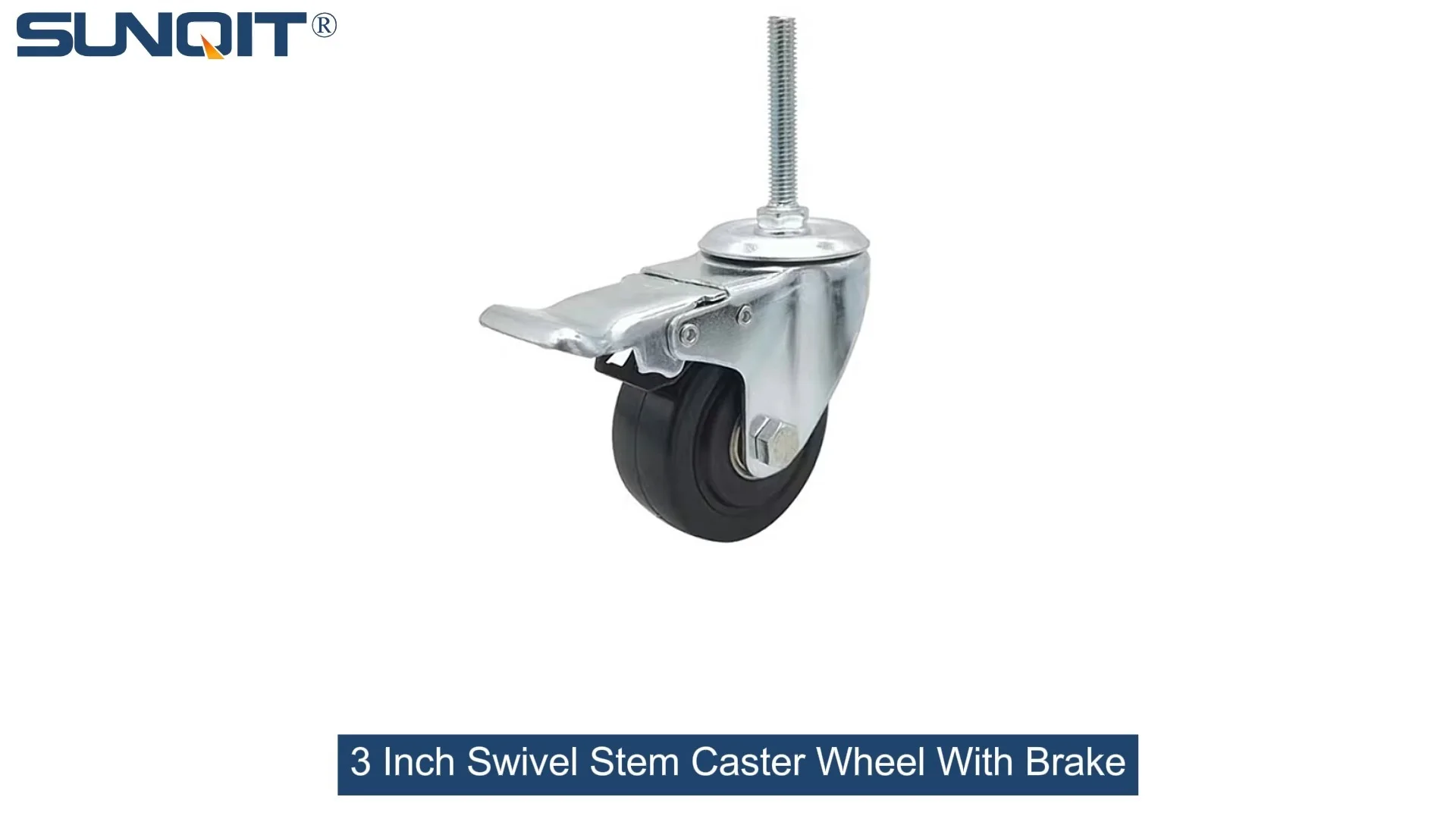
Swivel Stem Caster Wheel with Brake
360 Degree Swivel Stem Caster with brake. Threaded-post mount design, castors diameter 3 inch.Each swivel caster wheels loading 70KGS. Heavy enough and widely suit for carts, chairs, cabinet, flow rack, workbench, turnover rolley.
In the bustling world of workshops, warehouses, and production lines, the difference between a smooth, efficient day and a frustrating one often comes down to the small, often overlooked components that keep things moving. Casters—those humble wheels attached to the bottom of workbenches, trolleys, and racks—are exactly those unsung heroes. But not all casters are created equal. Today, we're diving into two of the most common types: the swivel stem caster wheel with brake and the fixed caster. By the end, you'll have a clear picture of which one aligns with your workflow, whether you're managing a lean system, assembling products on a workbench, or moving goods with a turnover trolley and rack.
First Things First: What Even Are Casters, and Why Do They Matter?
Before we compare, let's get back to basics. Casters are wheeled devices mounted to the bottom of equipment to make it mobile. They come in all shapes and sizes, but their core job is simple: reduce friction so you can move heavy or bulky items with less effort. But their impact goes beyond just "ease of movement." The right caster can boost productivity, reduce workplace injuries (no more straining to push a stuck trolley!), and even extend the life of your equipment by minimizing wear and tear on floors and frames.
Now, within the vast world of casters, two designs stand out for their distinct roles: the swivel stem caster with brake and the fixed caster. Let's break down each, starting with the more versatile of the two.
Swivel Stem Caster Wheel with Brake: The Flexible Workhorse
Picture this: You're in a busy electronics assembly plant. A workbench loaded with sensitive components needs to be moved from the soldering station to the testing area. The path isn't straight—there are other workbenches, pallets, and even a few coworkers in the way. You need to pivot, turn, and then lock the bench in place once it's where it needs to be. That's where the swivel stem caster wheel with brake shines.
Let's break down its key features:
The "Swivel" in Swivel Stem
Unlike fixed casters, which only roll forward and backward, swivel casters have a 360-degree rotating mount (called a "swivel head") that allows the wheel to turn independently of the equipment it's attached to. This means you can maneuver the item in any direction—sideways, diagonally, in tight circles—with minimal force. Think of it like the wheels on a shopping cart: you don't have to face the cart directly to move it; a gentle push from the side sends it gliding where you need it.
The "Stem" Connection
The "stem" refers to how the caster attaches to your equipment. A stem caster has a metal rod (the stem) that inserts into a pre-drilled hole or socket on the bottom of the item—think workbenches, toolboxes, or small trolleys. This makes installation straightforward: no need for complex mounting plates, just a hole that matches the stem's diameter. It's a popular choice for lighter to medium-duty applications, though heavy-duty stem casters (with thicker stems) exist for larger loads.
The "Brake" Functionality
Ah, the brake—the feature that turns a "good" caster into a "great" one for many workflows. Most swivel stem casters with brakes offer two types of braking: total lock and directional lock . Total lock brakes lock both the wheel (preventing it from rolling) and the swivel head (preventing it from turning), keeping the equipment completely stationary. Directional lock brakes only lock the swivel head, turning the caster into a temporary fixed caster—useful when you need to move in a straight line without the wheel swiveling. This flexibility is a game-changer for tasks where you need both mobility and stability.

Fixed Caster: The Reliable Straight Shooter
Now, let's meet the fixed caster. As the name suggests, fixed casters don't swivel. Their wheels are mounted on a rigid axle that's fixed in one direction—usually parallel to the length of the equipment. This means they only roll forward and backward, like the wheels on a shopping cart that's been "locked" to go straight (though fixed casters don't have a swivel head to lock in the first place).
At first glance, fixed casters might seem limiting. After all, why would you want a wheel that can't turn? But that rigidity is exactly their strength. Fixed casters excel in scenarios where movement is predictable, straight-line, and heavy-duty. Let's unpack why they're still a staple in many industries.
Stability in Simplicity
Because fixed casters don't swivel, they offer superior stability when moving in a straight line. There's no "wobble" from a swivel head, which makes them ideal for transporting heavy loads over long distances—think a turnover trolley and rack loaded with boxes moving from the warehouse dock to a storage area. The fixed direction ensures the trolley stays on course, even over uneven floors, reducing the risk of tipping or shifting cargo.
Durability for Heavy Loads
Fixed casters are often built with thicker axles and sturdier frames than their swivel counterparts. Without the moving parts of a swivel head, there are fewer points of failure, making them better suited for constant, heavy use. If your workflow involves moving 500+ pounds of materials day in and day out along a set path, fixed casters are likely the more durable choice.
Cost-Effectiveness
Simplicity often translates to lower cost. Fixed casters have fewer components (no swivel bearings, no brake mechanisms), so they're generally cheaper to manufacture and purchase. If your needs are straightforward—say, a rack that only moves back and forth between two points—fixed casters can save you money without sacrificing functionality.

Swivel Stem with Brake vs Fixed Caster: A Head-to-Head Comparison
To make the choice clearer, let's put these two caster types side by side. The table below breaks down their key features, ideal uses, and trade-offs.
| Feature | Swivel Stem Caster Wheel with Brake | Fixed Caster |
|---|---|---|
| Movement Range | 360-degree swivel + rolling; can move in any direction | Fixed direction (forward/backward only); no swivel |
| Brake Functionality | Yes (total lock or directional lock); can immobilize completely or lock direction | No built-in brake (some may have external locks, but rare) |
| Load Capacity (General Range) | 100–1,500 lbs per caster (varies by size/material) | 200–2,000+ lbs per caster (heavier-duty options available) |
| Maneuverability | High; ideal for tight spaces, frequent direction changes | Low; best for straight, predictable paths |
| Ideal Surfaces | Smooth to moderately uneven floors (warehouse concrete, workshop tiles) | Smooth to rough surfaces (including gravel, uneven concrete) |
| Maintenance Needs | Higher; swivel bearings need lubrication, brakes need adjustment | Lower; minimal parts—mostly wheel lubrication and axle checks |
| Cost Range | Higher ($15–$50+ per caster, depending on load capacity and brake type) | Lower ($8–$30+ per caster, simpler designs cost less) |
| Best For | Workbenches, mobile tool carts, small trolleys, equipment needing frequent repositioning | Heavy-duty trolleys, long-distance transport racks, equipment with fixed paths |

Real-World Workflows: Where Each Caster Shines
Numbers and features tell part of the story, but let's look at how these casters perform in actual work environments. We'll focus on three common scenarios: a workbench in a manufacturing plant, a turnover trolley and rack in a warehouse, and a lean system setup in a production line.
Scenario 1: The Mobile Workbench
Imagine a workbench used for assembling small electronics. Throughout the day, it needs to move from the component storage area to the soldering station, then to quality control, and finally back to the cleaning area. The path is rarely straight—there are other workbenches, bins of parts, and workers in between. When in use, the workbench needs to stay rock-solid so assemblers can focus on precision tasks.
Here, the swivel stem caster wheel with brake is the clear winner. Its 360-degree swivel makes navigating tight spaces a breeze, and the brake ensures the bench stays put during assembly. A fixed caster would turn this simple task into a headache: you'd have to constantly reposition the bench by pushing it backward or forward, wasting time and risking collisions.
Scenario 2: The Turnover Trolley and Rack
Now, consider a large turnover trolley and rack used to transport pallets of raw materials from the warehouse dock to the production floor. The route is a straight, 200-foot stretch of concrete, and the trolley often carries 1,200 lbs of goods. The goal is to move the load quickly and safely with minimal effort.
In this case, fixed casters are the better fit. Their fixed direction ensures the trolley rolls straight, reducing the risk of tipping under heavy load. Swivel casters, even with brakes, would be overkill here—their swivel heads might wobble under the weight, making the trolley harder to control over long distances. Plus, since the path never changes, the lack of swivel isn't a drawback.
Scenario 3: The Lean System Setup
A lean system is all about minimizing waste and maximizing efficiency, which often means flexible, adaptable workspaces. For example, a production line that switches between assembling two different products might need to reconfigure workstations, material racks, and transport paths weekly. In this environment, equipment needs to be mobile but also stable when in use.
Here, a mix of both casters might work best. Use swivel stem casters with brakes on workstations and small material racks that need frequent repositioning. Pair them with fixed casters on larger, heavy-duty transport trolleys that move along fixed routes between stations. This hybrid approach balances flexibility and stability, aligning perfectly with lean principles of adaptability and waste reduction.
How to Choose: Key Questions to Ask Yourself
Still on the fence? Ask yourself these questions to narrow it down:
- How often do I need to change direction? If you're moving equipment in tight spaces or changing direction multiple times a day, go with swivel stem casters with brakes. If it's a straight shot 90% of the time, fixed casters will do.
- Does the equipment need to stay stationary during use? If yes, the brake on a swivel stem caster is non-negotiable. Fixed casters without brakes can roll unexpectedly, which is a safety hazard.
- What's the maximum load? For loads over 1,500 lbs, fixed casters (or heavy-duty swivel casters) are safer. For lighter loads (under 1,000 lbs), swivel casters offer more flexibility.
- What's my budget? If cost is a primary concern and your needs are simple, fixed casters save money. If maneuverability and safety are worth the extra investment, swivel stem casters with brakes are worth it.
- What's the floor like? Swivel casters work best on smooth floors; their swivel heads can get stuck on rough or uneven surfaces. Fixed casters, with their rigid design, handle rough floors better.
Caster and Accessories: Don't Forget the Extras
No caster discussion is complete without mentioning caster and accessories —the small parts that can enhance performance or extend lifespan. For swivel stem casters with brakes, consider replacement brake pads (they wear out over time) or stem extenders if you need extra height. For fixed casters, axle caps can prevent dirt from getting into the bearings, and heavy-duty wheels (rubber for smooth floors, polyurethane for rough) can improve durability.
Investing in quality accessories is just as important as choosing the right caster. A worn brake pad on a swivel caster can turn a stable workbench into a rolling hazard, while a rusted axle on a fixed caster can grind movement to a halt. Regularly checking and replacing accessories is part of keeping your workflow running smoothly.
Maintenance Tips to Keep Casters Rolling
Whether you choose swivel stem casters with brakes or fixed casters, proper maintenance is key to longevity. Here's how to care for each:
Swivel Stem Caster with Brake Maintenance
- Lubricate the swivel head: Every 3–6 months (more often in dusty environments), apply a few drops of lubricating oil to the swivel bearing to keep it turning smoothly.
- Check the brake: Test the brake regularly to ensure it locks the wheel and swivel head securely. Tighten loose brake levers or replace worn brake pads as needed.
- Clean the wheels: Wipe away dirt, debris, or hair that can get caught in the wheel bearings. For sticky wheels, use a mild detergent and a brush.
Fixed Caster Maintenance
- Lubricate the axle: Apply oil to the axle bearings every 6–12 months to prevent rust and reduce friction.
- Inspect the wheel: Check for cracks, flat spots, or worn tread. replace wheels that show signs of damage—they can cause uneven rolling or damage floors.
- Tighten mounting hardware: Over time, bolts or stems can loosen. Periodically check and tighten them to prevent the caster from wobbling or detaching.
Final Thoughts: It's All About Your Workflow
At the end of the day, the choice between a swivel stem caster wheel with brake and a fixed caster boils down to your unique workflow. If you need flexibility, maneuverability, and the ability to lock equipment in place, the swivel stem caster with brake is your go-to. If you prioritize stability, heavy load capacity, and cost-effectiveness for straight-line movement, fixed casters are the way to go.
And remember: there's no rule that says you have to choose one or the other. Many workflows benefit from a mix—swivel casters on the front of a trolley for steering and fixed casters on the back for stability, for example. The key is to assess your needs, test both types if possible, and invest in quality casters and accessories that will grow with your operation.
So, whether you're outfitting a new workbench, upgrading a turnover trolley and rack, or optimizing a lean system, take a moment to appreciate the humble caster. It may be small, but it's the difference between a workflow that drags and one that glides.