- Company Articles
- Products and Technology
- Product knowledge
- Swivel Stem Caster Wheel with Brake vs Rigid Stem: Maneuverability Comparison

Swivel Stem Caster Wheel with Brake vs Rigid Stem: Maneuverability Comparison
Related Product
Swivel Stem Caster Wheel with Brake
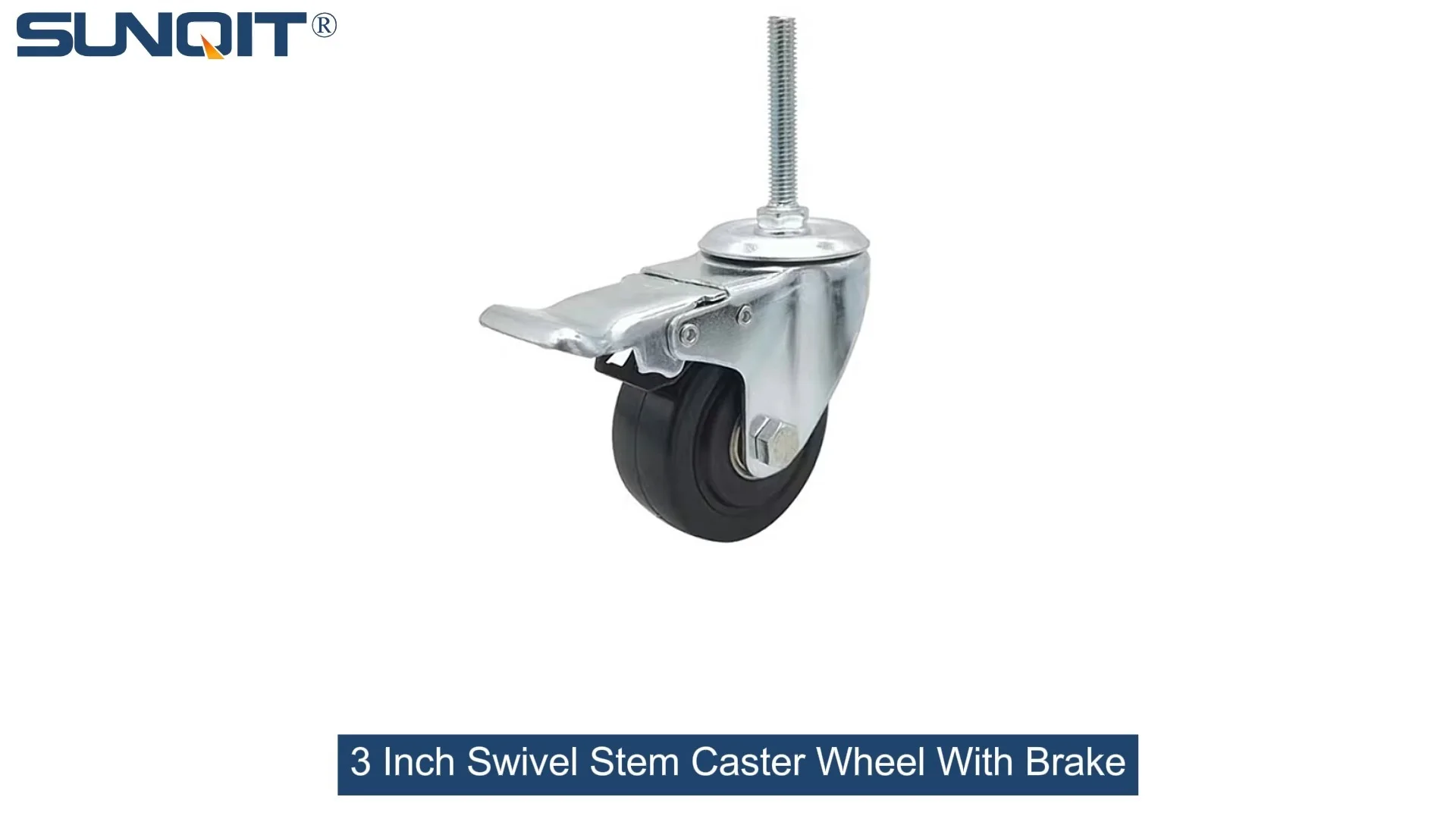
360 Degree Swivel Stem Caster with brake. Threaded-post mount design, castors diameter 3 inch.Each swivel caster wheels loading 70KGS. Heavy enough and widely suit for carts, chairs, cabinet, flow rack, workbench, turnover rolley.
In the bustling world of workshops, warehouses, and manufacturing floors, the unsung heroes of efficiency often lie beneath the equipment we rely on daily. From the workbench where precision assembly happens to the turnover trolley shuttling materials across the factory, the caster wheels that glide these tools and structures determine how smoothly operations run. Maneuverability—how easily something moves, turns, and adapts to space—isn't just a convenience; it's a cornerstone of productivity, safety, and workflow optimization. Today, we're diving into two of the most common caster types that shape this maneuverability: the swivel stem caster wheel with brake and the rigid stem caster wheel. By the end, you'll understand which one deserves a spot under your equipment, and why.
Understanding Swivel Stem Caster Wheels with Brake: The Flexible Workhorse
Let's start with the more dynamic of the two: the swivel stem caster wheel with brake. Picture this: a nurse navigating a medication cart through a crowded hospital corridor, a warehouse worker pivoting a loaded trolley around a tight corner, or a mechanic rolling a tool chest under a car with pinpoint accuracy. Chances are, they're relying on swivel stem casters. These wheels are designed for movement that feels almost intuitive—like an extension of the user's intent.
Anatomy of a Swivel Stem Caster with Brake
At its core, a swivel stem caster wheel with brake has three key components: the stem, the swivel mechanism, and the brake. The stem is the metal rod that attaches the caster to the equipment (think of it as the "leg" connecting the wheel to the workbench or trolley). The swivel mechanism sits between the stem and the wheel, allowing the wheel to rotate 360 degrees independently of the equipment. This is what gives swivel casters their signature agility. Finally, the brake —usually a foot-operated lever—locks the wheel in place, preventing movement when stability is needed (like when loading a workbench or stopping a trolley on an incline).
The magic of the swivel mechanism lies in its ball bearings or raceways, which reduce friction as the wheel turns. This design lets the caster pivot smoothly, even under heavy loads, making it easy to change direction with minimal force. For example, a material rack loaded with parts might weigh several hundred pounds, but with swivel casters, a single worker can guide it through a maze of assembly lines without breaking a sweat.
Maneuverability in Action
What truly sets swivel stem casters apart is their ability to handle tight spaces and frequent direction changes. Imagine a workshop where workbenches are rearranged daily to accommodate different projects. A workbench fitted with swivel stem casters with brakes can be spun, tilted, and positioned exactly where needed—then locked down to stay put during use. In contrast, a fixed setup would require disassembly or heavy lifting, wasting precious time.
The brake adds another layer of control. In busy environments, accidental movement is a hazard. A sudden jostle to an unsecured trolley could send materials crashing, or a workbench sliding into a colleague. The brake eliminates this risk by engaging with the wheel (or sometimes the swivel mechanism itself) to create friction, holding the caster firmly in place. Many models even have a "total lock" feature that stops both wheel rotation and swivel, ensuring maximum stability when precision work is underway.
Pros and Cons
Pros:
Unmatched flexibility for tight spaces and dynamic workflows; 360-degree rotation reduces strain on users; brakes enhance safety and stability; compatible with light to medium-heavy loads (depending on build quality).
Cons:
Less stable at high speeds or on uneven surfaces compared to rigid casters; the swivel mechanism has more moving parts, which may require occasional maintenance (like lubrication of bearings); not ideal for long, straight-line hauling where constant direction changes aren't needed.
Understanding Rigid Stem Caster Wheels: The Steady Performer
Now, let's shift to the rigid stem caster wheel— the reliable, no-nonsense counterpart to the swivel caster. If swivel casters are the dancers of the caster world, rigid casters are the marathon runners: built for consistency, straight-line efficiency, and endurance. You'll find them on equipment that moves in predictable paths, like conveyor systems, loading docks, or heavy-duty material racks that rarely need repositioning.
Anatomy of a Rigid Stem Caster
Rigid stem casters are refreshingly simple: a stem, a wheel, and a fixed yoke that connects them. Unlike swivel casters, there's no rotating mechanism— the wheel is locked into a straight-ahead position relative to the stem. This design prioritizes stability over flexibility. The stem is often thicker and more robust than those on swivel casters, and the yoke is welded or bolted to prevent movement, making the entire unit sturdier under heavy loads.
Because there are fewer moving parts, rigid casters are inherently durable. They're built to withstand constant use in high-traffic areas, like a warehouse where a turnover trolley shuttles between the same two points 50 times a day. The lack of a swivel mechanism also means less wear and tear—no ball bearings to gum up, no raceways to corrode, just a wheel that rolls forward and backward, reliably, for years.
Maneuverability in Action
Rigid stem casters excel in environments where movement is linear and predictable. Think of a production line where a conveyor system carries products from one station to the next in a straight path—rigid casters keep the conveyor stable, preventing lateral drift that could misalign items. Or a loading dock where pallets are moved back and forth between a truck and a storage area: rigid casters ensure the trolley stays on track, even when loaded to capacity.
That said, "maneuverability" for rigid casters isn't about tight turns—it's about control in straight lines. A rigid caster trolley is easier to push over long distances because there's no swivel to "fight against." The wheels stay aligned, reducing the effort needed to keep the trolley moving forward. This makes them ideal for tasks like transporting heavy materials across a large warehouse floor, where frequent direction changes aren't required.
Pros and Cons
Pros:
Superior stability for straight-line movement; higher weight capacity than most swivel casters; fewer moving parts mean lower maintenance and longer lifespan; better suited for rough or uneven surfaces (less likely to get stuck or wobble).
Cons:
Limited flexibility—can't turn without moving the entire equipment; difficult to navigate tight spaces; no built-in brake (though some models may include a separate locking mechanism, it's less common).

Maneuverability Face-Off: Swivel vs. Rigid
To truly grasp how these two caster types stack up, let's break down their maneuverability side by side. The table below compares key factors like rotation, turning radius, and ideal use cases—so you can see which one aligns with your needs.
| Feature | Swivel Stem Caster Wheel with Brake | Rigid Stem Caster Wheel |
|---|---|---|
| Rotation Range | 360 degrees (full swivel) | 0 degrees (fixed straight) |
| Turning Radius | Small (can pivot in place) | Large (requires space to turn the entire equipment) |
| Brake Function | Built-in (locks wheel/swivel for stability) | Usually none (may require external locks) |
| Best For | Tight spaces, frequent direction changes, mobile workstations (e.g., workbenches, tool carts) | Straight-line movement, heavy loads, fixed paths (e.g., conveyor systems, loading trolleys) |
| Weight Capacity | Medium (typically 200–800 lbs per caster) | High (often 800–2,000+ lbs per caster) |
| Maintenance Needs | Higher (swivel mechanism requires lubrication, brake adjustments) | Lower (only wheel bearings need occasional lubrication) |
Key Takeaways from the Table
If your workflow involves a lot of "stop-and-go" movement—like a workbench that needs to be repositioned for different tasks, or a trolley that weaves through narrow aisles—swivel stem casters with brakes are the clear choice. Their 360-degree rotation and small turning radius make them agile, while the brake adds safety when you need to lock things down.
On the other hand, if your equipment moves in a straight line 90% of the time—think of a material rack that's wheeled from storage to the assembly line and back—rigid casters will serve you better. They're built to handle heavy loads without wobbling, and their simplicity means less downtime for repairs.

Real-World Scenarios: When to Choose Which
The best way to decide between swivel and rigid casters is to look at real-world examples. Let's walk through three common scenarios and see which caster type shines.
Scenario 1: A Busy Workshop with Changing Layouts
Imagine a small electronics workshop where teams assemble different products each week. The workbenches need to be rearranged to fit the project—sometimes in a U-shape for collaborative work, sometimes in a line for assembly lines. Here, swivel stem casters with brakes are indispensable. Workers can easily spin the workbenches into place, lock the brakes to keep them steady during assembly, and unlock them when it's time to reconfigure. Rigid casters would make this process a nightmare: moving a workbench even a few feet to the left would require lifting or angling the entire bench, wasting time and risking injury.
Scenario 2: A Large Warehouse with Fixed Routes
Now, picture a warehouse that stores bulk goods, with wide aisles and fixed paths marked on the floor. Trolleys here move from the storage racks to the shipping dock in straight lines, carrying pallets of inventory. Rigid casters are the better fit. They keep the trolleys stable, even when loaded with 1,000+ pounds of goods, and their straight-line efficiency reduces the effort needed to push them across the warehouse. Swivel casters would be overkill here—their swivel mechanism might cause the trolley to drift off course, slowing down transport and increasing the risk of collisions.
Scenario 3: A Hospital Supply Cart
Hospitals demand both agility and safety. A supply cart needs to navigate narrow corridors,,.:,.——,.

Maintenance Matters: Keeping Your Casters Rolling
,.,.(),.——,.
,.:,.,().,.
——,(),.,.,.
Choosing Your Caster: It's All About Maneuverability Needs
,.,,.,.
,,,,.,,.
,:""——.,,.,,——.