- Company Articles
- Products and Technology
- Product knowledge
- Swivel Stem Caster Wheels: Common Myths vs Facts in Industrial Applications

Swivel Stem Caster Wheels: Common Myths vs Facts in Industrial Applications
Related Product
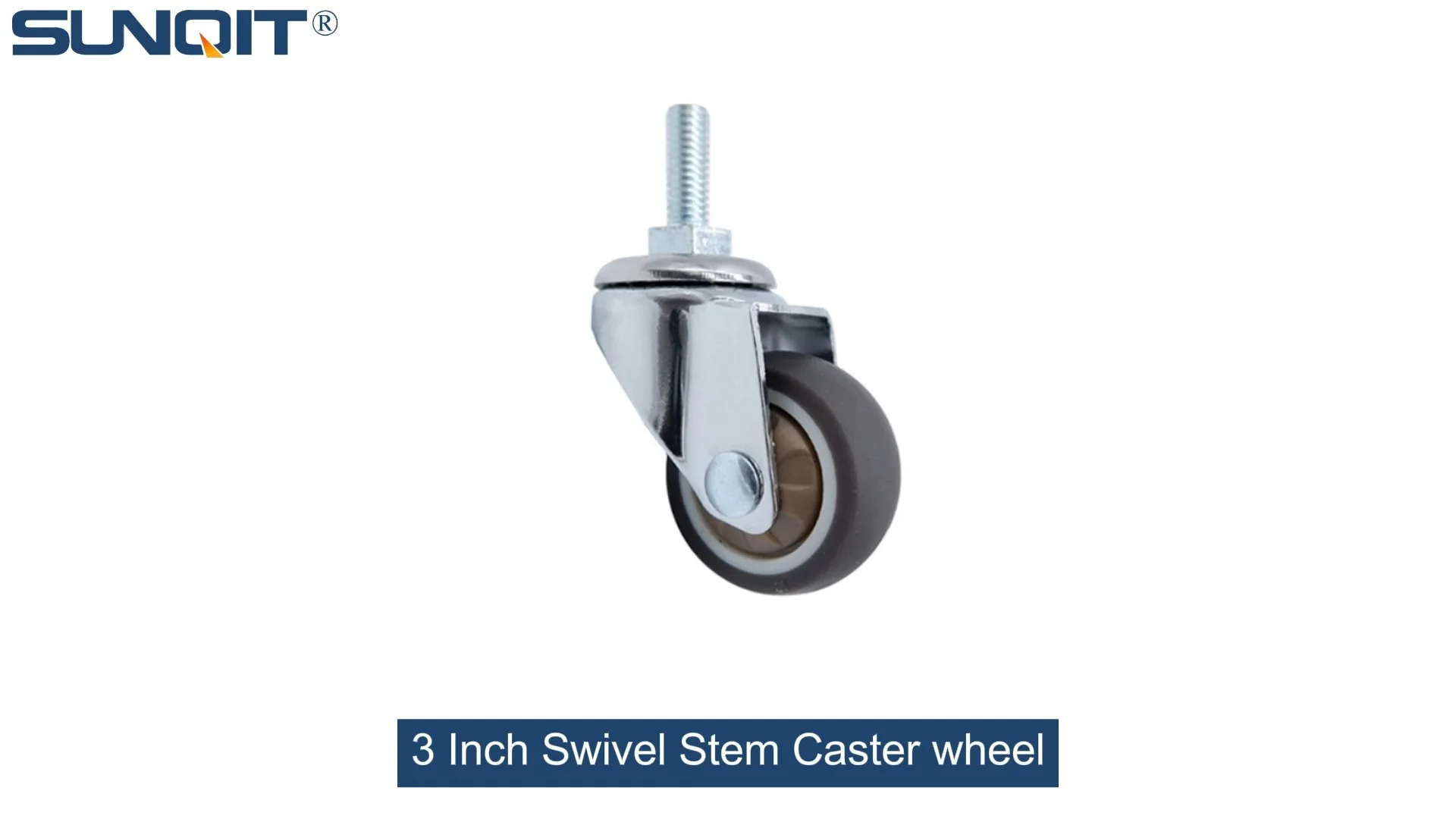
Swivel Stem Caster wheel
360 Degree Swivel Stem Caster. Threaded-post mount design, castors diameter 3 inch.Each swivel caster wheels loading 70KGS. Heavy enough and widely suit for carts, chairs, cabinet, flow rack, workbench, turnover rolley.
In the bustling world of manufacturing, warehouses, and assembly lines, there's a humble component that often goes unnoticed—until it fails. Swivel stem caster wheels, those small but mighty devices that let workbenches glide, flow racks shift, and material carts maneuver, are the unsung heroes of industrial efficiency. Yet, despite their ubiquity, misconceptions about their design, functionality, and importance run rampant. Today, we're diving deep into the world of swivel stem caster wheels, separating fact from fiction to help you make smarter choices for your lean system, aluminum profile setups, and beyond.
Why Swivel Stem Caster Wheels Matter More Than You Think
Before we tackle the myths, let's ground ourselves in why these caster wheels are critical. In industrial settings, every second counts. A workbench that locks securely in place during precision assembly, a flow rack that glides smoothly to reduce worker strain, or a material cart that stops instantly when needed—these scenarios rely on swivel stem caster wheels performing flawlessly. They're not just "wheels on a stick"; they're engineered components that bridge mobility and stability, directly impacting productivity, safety, and the bottom line of your lean system.
Now, let's debunk the most persistent myths surrounding these essential tools.
Myth vs Fact: Setting the Record Straight
| Myth | Fact |
|---|---|
| Myth 1: All swivel stem caster wheels are interchangeable—just pick the cheapest option. | Fact: Load capacity, brake type, and material compatibility vary drastically. A lightweight caster for a small tool cart won't withstand the weight of a heavy-duty workbench loaded with machinery. Always match the caster to the application. |
| Myth 2: The brake on a swivel stem caster wheel is just for parking—no need to use it during work. | Fact: A swivel stem caster wheel with brake isn't just for stopping movement; it stabilizes the equipment during use. Loose casters can cause wobbling, leading to errors in assembly or even accidents. Always engage the brake when the equipment is stationary. |
| Myth 3: Aluminum profile compatibility doesn't affect caster performance—any caster fits any frame. | Fact: Aluminum profile systems have specific slot sizes and mounting points. Using a caster with a stem that's too short or a mounting plate that doesn't align with the profile's T-slots can lead to instability or damage to the frame over time. |
| Myth 4: Flow racks don't need specialized casters—regular wheels work just fine. | Fact: Flow racks rely on smooth, consistent movement to keep materials flowing to workers. Swivel stem casters with precision bearings reduce friction, ensuring materials glide evenly, while brakes prevent unintended shifts during loading/unloading. |
| Myth 5: Lean systems only care about speed—caster wheels are an afterthought. | Fact: A lean system thrives on eliminating waste, including time wasted on struggling with stuck casters or repairing damaged equipment. High-quality swivel stem casters reduce downtime and improve workflow, making them a cornerstone of lean efficiency. |
Diving Deeper: The Truth About Swivel Stem Caster Wheels with Brake
Let's zoom in on one of the most misunderstood features: the brake. A swivel stem caster wheel with brake isn't a "nice-to-have"—it's a safety and precision tool. Imagine a worker assembling delicate electronics on a workbench. If the bench shifts even slightly mid-task, a component could be ruined, costing time and money. The brake locks both the wheel and the swivel mechanism, ensuring the bench stays put. In high-vibration environments, like near heavy machinery, brakes prevent "walkaway" movement that could lead to collisions.
Not all brakes are created equal, either. Some models lock only the wheel, while others lock the swivel joint too. For workbenches that need to stay aligned with assembly lines, a dual-lock brake is essential. On the flip side, for flow racks that need occasional repositioning, a wheel-only brake might suffice. The key is understanding your workflow: Do you need quick, one-touch braking? Or heavy-duty locking for extreme loads? Answering these questions ensures you choose the right brake type.
Aluminum Profile: The Unsung Partner of Swivel Casters
Industrial setups today often rely on aluminum profile systems for their flexibility and strength. These modular frames are used in workbenches, flow racks, and material carts, making them a backbone of modern manufacturing. But here's the catch: aluminum profiles have unique geometries, from 2020 to 4080 series, each with different slot widths and load capacities. A swivel stem caster that fits a 2020 profile might not secure properly to a 4040 profile, leading to a wobbly structure.
For example, a 4040 aluminum profile (40mm x 40mm) has a T-slot width of 8mm, while a 3030 profile has a 6mm slot. Using a caster with a mounting bolt that's too thick for the slot will strip the aluminum, weakening the frame. Conversely, a bolt that's too thin will rattle loose, causing the caster to shift. The solution? Always check the profile's specifications and choose casters with compatible mounting hardware—many suppliers offer caster stems or plates designed specifically for common aluminum profile series.
Flow Racks and Lean Systems: How Casters Keep the Line Moving
In a lean system , the goal is to minimize waste—whether it's time, materials, or effort. Flow racks are a classic lean tool, using gravity or manual pushing to move materials from storage to the assembly line. But without the right casters, even the best flow rack design can become a bottleneck.
Consider a scenario: A flow rack loaded with heavy components needs to be shifted 3 feet to align with a new assembly station. If the casters are stiff or uneven, two workers might struggle to move it, wasting time and energy. A swivel stem caster with precision ball bearings, however, glides smoothly with minimal force, letting one worker reposition the rack in seconds. Add a brake to lock it in place, and you've eliminated the risk of the rack drifting mid-shift—keeping the lean flow uninterrupted.
Even the direction of the caster matters. For flow racks that need to move in tight spaces, a 360-degree swivel caster with a tight turning radius is essential. For straight-line movement along an assembly line, rigid casters (non-swivel) on one end and swivel casters on the other provide stability while allowing controlled steering. The key is to map your workflow first: How often does the equipment move? What's the turning radius? Answering these will guide your caster selection.

Real-World Impact: A Case Study in Caster Optimization
To illustrate the difference between myth and fact, let's look at a mid-sized electronics manufacturer we worked with last year. They were struggling with two issues: their assembly workbenches kept shifting during soldering tasks, leading to defective circuit boards, and their flow racks were difficult to reposition, causing delays when production lines reconfigured.
Their initial setup? Generic swivel casters without brakes, mounted on 4040 aluminum profile workbenches. The casters were cheap, but their stems were too short for the profile's thickness, so they'd been secured with makeshift washers. Unsurprisingly, the workbenches wobbled, and the flow racks—loaded with 50kg component bins—required two workers to move.
The solution was twofold: First, replace the workbench casters with swivel stem caster wheels with brake designed for 4040 aluminum profiles. These casters had longer stems that fit the profile's depth, and dual-lock brakes that secured both the wheel and swivel joint. Second, upgrade the flow rack casters to heavy-duty swivel stems with precision bearings, rated for 150kg per caster. Within a month, defective circuit boards dropped by 32%, and line reconfigurations took half the time—all because of better casters.

Choosing the Right Swivel Stem Caster: Key Questions to Ask
Now that we've busted the myths, how do you select the right swivel stem caster for your needs? Start with these questions:
- What's the total load? Calculate the weight of the equipment plus the maximum load it will carry. Casters are rated per wheel, so divide the total load by the number of casters (e.g., 200kg total ÷ 4 casters = 50kg per caster; choose a caster rated for at least 75kg to be safe).
- What surface will the caster roll on? Smooth concrete needs different wheels than gravel or uneven factory floors. Rubber wheels absorb shock but wear on rough surfaces; polyurethane wheels are durable for concrete.
- Do you need brakes? If the equipment stays in one place during use, a swivel stem caster wheel with brake is non-negotiable. For mobile equipment, consider foot-operated brakes for easy access.
- What's the mounting surface? For aluminum profile frames, check the profile series (2020, 3030, etc.) and T-slot dimensions. For steel frames, consider plate-mount casters with bolt holes.
- How often will it move? Frequent repositioning calls for casters with sealed bearings to reduce maintenance. Rare movement might allow for simpler, cost-effective options.

The Bottom Line: Casters Are a Lean Investment, Not an Expense
It's easy to view swivel stem caster wheels as a trivial purchase—after all, they're small compared to the machinery they support. But as we've seen, the right casters reduce waste, improve safety, and boost productivity. A lean system depends on every component working in harmony, and casters are no exception.
So, the next time you're setting up a workbench, flow rack, or material cart, remember: Don't fall for the myths. Invest in casters that match your load, your aluminum profile, and your workflow. Your workers will thank you for the stability, your bottom line will thank you for the efficiency, and your lean system will run smoother than ever.
Because in the world of industrial efficiency, even the smallest wheel can turn the biggest profit.