- Company Articles
- Products and Technology
- Product knowledge
- Swivel Stem Caster Wheels for Automated Guided Vehicles (AGVs): Compatibility Guide

Swivel Stem Caster Wheels for Automated Guided Vehicles (AGVs): Compatibility Guide
Related Product
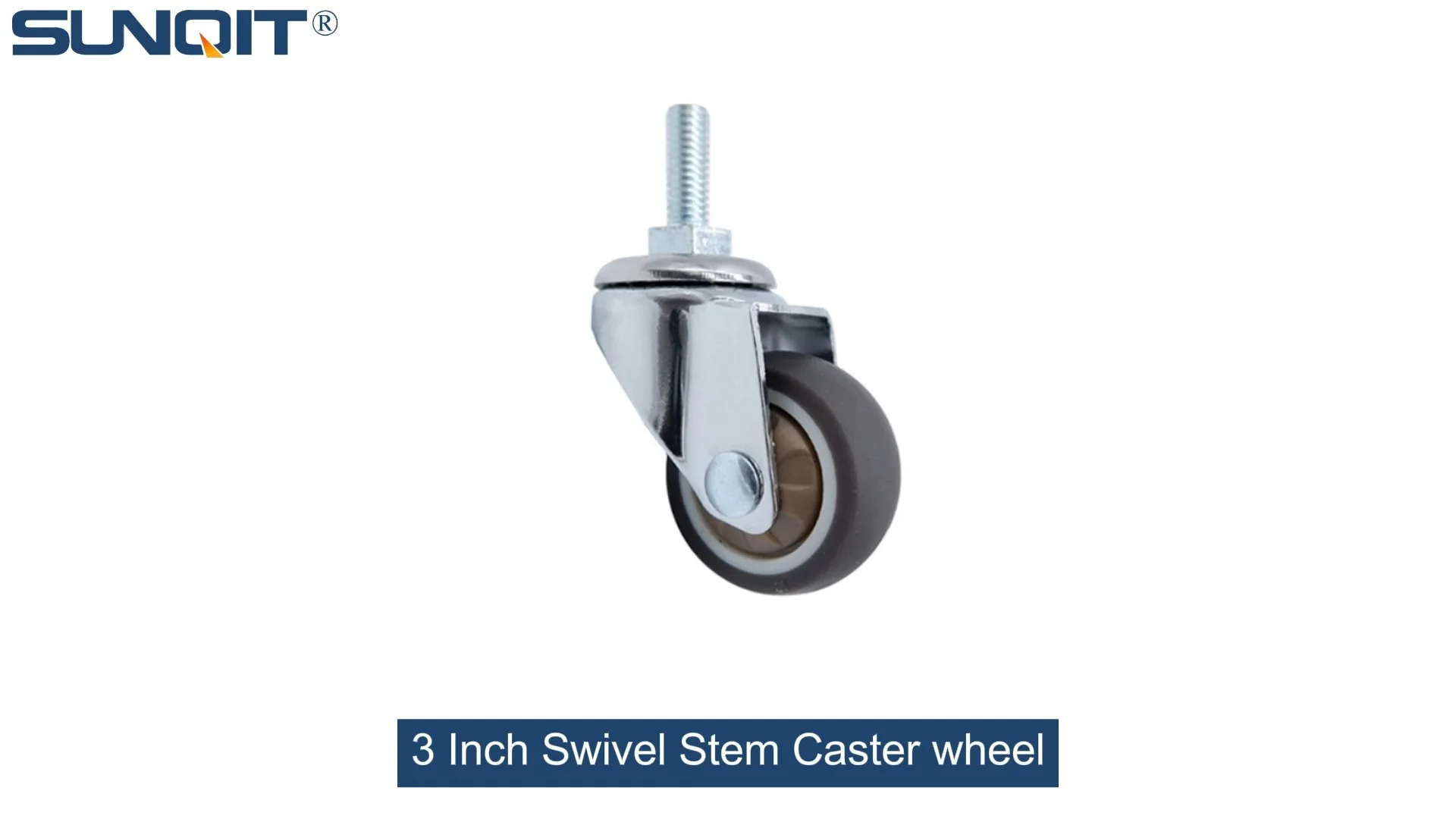
Swivel Stem Caster wheel
360 Degree Swivel Stem Caster. Threaded-post mount design, castors diameter 3 inch.Each swivel caster wheels loading 70KGS. Heavy enough and widely suit for carts, chairs, cabinet, flow rack, workbench, turnover rolley.
Introduction: The Unsung Heroes of AGV Mobility
Walk into any modern manufacturing facility, warehouse, or distribution center these days, and you'll likely spot them: sleek, boxy machines gliding silently across the floor, ferrying materials from one station to another with pinpoint precision. These are Automated Guided Vehicles (AGVs), the workhorses of Industry 4.0 that keep production lines moving, reduce human error, and cut down on operational costs. But here's the thing: for all their advanced sensors, programming, and high-tech navigation systems, AGVs rely on a surprisingly simple component to do their job—caster wheels. And not just any caster wheels, but swivel stem caster wheels, the unsung heroes that give AGVs their agility, stability, and ability to navigate tight corners and complex layouts.
If you've ever struggled with a shopping cart that wobbles, sticks, or refuses to turn smoothly, you know how frustrating poor caster performance can be. Now imagine that cart is a 2,000-pound AGV carrying sensitive electronics or heavy automotive parts. A faulty or incompatible swivel stem caster wheel isn't just an annoyance—it's a recipe for downtime, damaged goods, and even safety hazards. That's why choosing the right swivel stem caster wheel for your AGV isn't just a purchasing decision; it's a critical part of maintaining efficiency, reliability, and ultimately, the success of your operations.
In this guide, we're going to dive deep into the world of swivel stem caster wheels for AGVs. We'll break down what makes these casters unique, the key factors that determine compatibility with different AGV models and environments, and how to select, maintain, and troubleshoot them to keep your AGVs—and your production line—running like clockwork. Whether you're a plant manager, a maintenance technician, or someone just starting to explore AGV integration, this guide will give you the insights you need to make informed decisions about one of the most important (yet often overlooked) components of your automated system.
What Are Swivel Stem Caster Wheels, Anyway?
Before we get into compatibility, let's make sure we're all on the same page about what swivel stem caster wheels are and why they're the go-to choice for AGVs. A caster wheel is essentially a wheel mounted on a frame (called a yoke or fork) that allows 360-degree rotation, enabling the object it's attached to (like a cart or AGV) to move in any direction. The "stem" part refers to the vertical rod or shaft that connects the caster to the AGV's frame. Unlike plate-mount casters, which are bolted directly to the bottom of the equipment, stem-mount casters use this stem to secure into a socket or bracket on the AGV, making installation and replacement quicker and more straightforward.
Swivel stem casters are designed to rotate freely around the stem axis, which is what gives AGVs their ability to turn, pivot, and maneuver in tight spaces. This swivel action is controlled by a raceway—a precision-machined ring of ball bearings or roller bearings—that allows smooth rotation with minimal friction. The stem itself can be threaded, unthreaded, or have a grip ring, depending on how it's meant to attach to the AGV. For AGVs, which often require quick adjustments and maintenance, stem-mount designs are preferred because they can be swapped out without disassembling large parts of the vehicle.
But not all swivel stem caster wheels are created equal. They come in a variety of sizes, materials, and configurations, each tailored to specific applications. For example, a small AGV used in a electronics assembly plant might use lightweight, non-marking caster wheels with soft rubber treads to protect delicate floors and prevent static buildup. Meanwhile, a heavy-duty AGV in a automotive factory might need steel wheels with reinforced stems to handle loads of several thousand pounds. The key is to match the caster's design to the AGV's weight, speed, environment, and intended use—a process we'll explore in detail throughout this guide.

Key Compatibility Factors: What to Consider Before You Buy
Choosing a swivel stem caster wheel for your AGV isn't as simple as picking the first one you see in a catalog. Compatibility depends on a handful of critical factors, each of which can make or break the performance of your AGV. Let's walk through each one step by step.
1. Load Capacity: Don't Skimp on Strength
First and foremost, you need to ensure the swivel stem caster wheel can handle the weight of your AGV—including its payload. This might seem obvious, but it's how often this step is rushed or miscalculated. Let's break it down: the total load per caster is the AGV's empty weight plus the maximum payload it will carry, divided by the number of casters on the vehicle. For example, if your AGV weighs 1,000 pounds and carries a 500-pound payload, that's 1,500 pounds total. If it has four casters, each caster needs to support at least 375 pounds. But here's the catch: you should always add a safety margin—typically 25% to 50%—to account for uneven loads, sudden stops, or rough floor conditions. So in this case, a caster with a 500-pound capacity would be a safer bet than one rated for 375 pounds.
It's also important to distinguish between static load and dynamic load. Static load is the weight the caster can support when the AGV is stationary, while dynamic load is the weight it can handle when the AGV is moving. AGVs are rarely stationary for long, so dynamic load rating is usually the more critical number. Some manufacturers will list both, so be sure to check both specs before making a decision.
2. Wheel Material: Matching the Environment
The material of the caster wheel has a huge impact on performance, durability, and compatibility. Let's say you're operating in a food and beverage facility where floors are regularly washed down with harsh chemicals. A rubber wheel might degrade quickly in that environment, while a polyurethane or stainless steel wheel would hold up better. Or if you're in a cleanroom setting, like a pharmaceutical lab, you might need non-marking wheels that don't shed particles. Here's a closer look at common wheel materials and their best uses:
| Wheel Material | Best For | Pros | Cons |
|---|---|---|---|
| Polyurethane (PU) | General manufacturing, warehouses, retail | Quiet, non-marking, good floor protection, high load capacity | Can soften in high temperatures, not ideal for oil or chemical exposure |
| Rubber | Smooth floors, indoor use, light to medium loads | Shock-absorbent, good traction, affordable | Prone to wear on rough surfaces, can mark floors if not "non-marking" rated |
| Steel | Heavy loads, outdoor use, rough or uneven floors | Extremely durable, high temperature resistance, low rolling resistance | Noise, can damage soft floors (e.g., vinyl, wood), prone to rust without coating |
| Nylon | Chemical exposure, high temperatures, heavy loads | Resistant to oils, solvents, and heat; low friction | Hard, noisy on smooth floors, poor shock absorption |
| Cast Iron | Extreme heavy loads, industrial settings | Indestructible, high load capacity, heat resistant | Very heavy, noisy, can scratch floors |
3. Swivel Mechanism and Bearings: The Key to Smooth Movement
A swivel stem caster wheel is only as good as its swivel mechanism. The raceway—the part that allows the wheel to rotate around the stem—needs to be smooth, durable, and resistant to debris. Most high-quality casters use ball bearings or roller bearings in the raceway. Ball bearings are great for light to medium loads and provide smooth rotation, while roller bearings are better for heavy loads, as they distribute weight more evenly. Some casters also feature sealed raceways to prevent dust, dirt, and moisture from getting inside, which is a must in dirty or humid environments.
Another factor to consider is the swivel lead, which is the distance between the center of the stem and the center of the wheel. A longer swivel lead provides more stability at higher speeds but can make the AGV less maneuverable in tight spaces. A shorter swivel lead improves agility but may cause the AGV to wobble at high speeds. Most AGVs operate at moderate speeds (2-4 mph), so a balance between lead length and maneuverability is usually ideal.
4. Stem Type and Mounting: A Secure Fit
The stem is what connects the caster to the AGV, so getting the right stem type is crucial for compatibility. Swivel stem casters come in several stem styles, including:
- Threaded stems: These have a screw-like thread that screws into a threaded hole on the AGV frame. They're easy to install and adjust but require a precise thread size (e.g., 1/2"-13 or M12x1.75).
- Grip ring stems: These have a groove near the top of the stem that fits into a spring-loaded grip ring socket. They're quick to install and remove, making them popular for applications where casters need frequent replacement.
- Flanged stems: These have a flat flange at the top that bolts directly to the AGV frame. They're very secure but require drilling holes for bolts, which can be time-consuming.
Before purchasing, check your AGV's specifications to see what stem type it requires. Using the wrong stem can lead to loose casters, which not only affect performance but also pose a safety risk.

Caster Accessories: Enhancing Performance and Safety
While the swivel stem caster wheel itself is the star of the show, caster accessories play a supporting role that shouldn't be overlooked. These add-ons can improve safety, extend caster life, and even enhance compatibility with specific AGV functions. Let's take a look at some of the most useful caster accessories and how they can benefit your operations.
Brakes: Stopping Power When You Need It
Most AGVs have built-in braking systems, but adding brakes to the casters themselves provides an extra layer of safety—especially when the AGV is loading or unloading, or parked on an incline. There are several types of caster brakes to choose from:
- Total lock brakes: These lock both the wheel and the swivel mechanism, preventing both rotation and swiveling. They're ideal for situations where the AGV needs to stay completely stationary.
- Wheel lock brakes: These only lock the wheel, allowing the swivel to rotate but preventing the AGV from rolling. Useful for temporary stops where some movement is still needed.
- Foot-operated vs. hand-operated: Foot brakes are convenient for operators who need to quickly lock/unlock casters without bending down, while hand brakes are better for tight spaces or applications where precision is key.
When choosing brakes, make sure they're compatible with your caster's size and weight rating. A brake designed for a 3-inch caster won't work on a 5-inch caster, and a lightweight brake won't hold up under heavy loads.
Bearings: Reducing Friction, Increasing Longevity
We touched on raceway bearings earlier, but the wheel bearings themselves are also critical. Wheel bearings reduce friction between the wheel and the axle, making rotation smoother and extending the life of the caster. Common bearing types include:
- Ball bearings: Best for light to medium loads and high speeds. They're affordable and easy to replace.
- Roller bearings: Better for heavy loads, as they distribute weight more evenly than ball bearings.
- Precision bearings: Used in applications where smooth rotation is critical, like cleanrooms or medical facilities. They're more expensive but offer superior performance.
Sealed bearings are a must in dirty or wet environments, as they prevent debris from entering and causing premature wear. Look for casters with "double-sealed" or "lifetime-lubricated" bearings to minimize maintenance.
Covers and Shields: Protecting Against Debris
In dusty or debris-filled environments (think woodworking shops or construction sites), caster wheels and swivel mechanisms can get clogged with dirt, sawdust, or other particles, leading to jamming or increased friction. Caster covers or shields—usually made of metal or plastic—fit over the wheel and raceway to keep debris out. They're a small investment that can save you big on maintenance costs down the line.

Integration with Lean Systems: Caster Wheels as a Lean Tool
If your facility uses lean manufacturing principles—and let's face it, most modern operations do—then choosing the right swivel stem caster wheels isn't just about AGV performance; it's about supporting your lean goals. Lean systems are all about eliminating waste, improving flow, and maximizing value, and the right casters can play a big role in achieving those objectives.
Take downtime, for example. A common source of waste in lean systems is equipment breakdowns, and faulty casters are a frequent culprit. By investing in high-quality, durable swivel stem caster wheels with sealed bearings and corrosion-resistant materials, you can reduce unplanned downtime caused by caster failures. This not only keeps production moving but also reduces the need for emergency repairs—a classic example of "prevention over correction," a core lean principle.
Another lean goal is flexibility. In today's fast-paced manufacturing environments, production lines need to adapt quickly to changing product designs, order volumes, and customer demands. Swivel stem caster wheels with easy-to-replace stems and universal compatibility make it easier to reconfigure AGVs or repurpose them for new tasks. For example, if you need to switch from a light-duty AGV to a heavy-duty one, being able to swap out casters quickly (without replacing the entire AGV) saves time and money—two key resources in lean systems.
Even something as simple as noise reduction can support lean goals. Swivel stem caster wheels with polyurethane treads are much quieter than steel wheels, which creates a more pleasant work environment for employees. Happier employees are more productive, and a quieter facility makes it easier to communicate and detect other issues (like), both of which contribute to a more efficient operation.
Lean Tip: Standardize Caster Sizes
To further reduce waste, consider standardizing on a few common swivel stem caster wheel sizes and types across your AGV fleet. This way, you can keep a smaller inventory of replacement casters and accessories, reduce ordering errors, and make maintenance faster and more efficient. Standardization is a cornerstone of lean systems, and it applies just as much to casters as it does to production processes.
Maintenance and Troubleshooting: Keeping Your Casters Rolling
Even the best swivel stem caster wheels won't last forever without proper maintenance. Regular upkeep not only extends caster life but also ensures they remain compatible with your AGVs and continue to perform at their best. Here's a maintenance checklist to follow, along with common issues and how to troubleshoot them.
Maintenance Checklist
- Inspect weekly: Check for signs of wear, like flat spots on wheels, loose stems, or damaged bearings. Look for debris stuck in the raceway or around the wheel.
- Clean monthly: Use a brush or compressed air to remove dirt and debris from the raceway and wheel bearings. For heavily soiled casters, wipe with a damp cloth and mild detergent (avoid harsh chemicals unless the caster is rated for them).
- Lubricate quarterly: Apply a high-quality lubricant to the swivel raceway and wheel bearings. Use a lubricant recommended by the caster manufacturer—some bearings are sealed and don't require lubrication, so check the specs first.
- replace worn parts promptly: If a wheel is cracked, a bearing is noisy, or a brake isn't working, replace the caster or the faulty part immediately. Delaying replacement can lead to more extensive damage to the AGV or other components.
Common Issues and Troubleshooting
Even with regular maintenance, you might encounter issues with your swivel stem caster wheels. Here's how to diagnose and fix some of the most common problems:
Problem: Caster swivels roughly or sticks
Cause: Debris in the raceway, lack of lubrication, or worn bearings. Solution: Clean the raceway with compressed air, apply lubricant, and replace bearings if they're worn or damaged.
Problem: Wheel wobbles or vibrates at high speeds
Cause: Uneven wheel wear, loose stem, or misaligned swivel lead. Solution: replace the wheel if it's worn unevenly, tighten the stem, or adjust the swivel lead (if adjustable).
Problem: Caster makes excessive noise
Cause: Dry bearings, worn wheel tread, or debris in the raceway. Solution: Lubricate bearings, replace the wheel if tread is worn, and clean out debris.
Problem: Stem loosens over time
Cause: Incorrect stem type, worn socket, or vibrations from AGV operation. Solution: Check that the stem type matches the AGV's socket, replace worn sockets, or use thread-locking compound on threaded stems to prevent loosening.
Choosing the Right Supplier: More Than Just a Purchase
By now, you understand the technical aspects of swivel stem caster wheel compatibility, but there's one more piece of the puzzle: choosing the right supplier. A good supplier isn't just someone who sells you casters—they're a partner who can help you select the right products, provide technical support, and ensure you have access to replacement parts when you need them. Here's what to look for when evaluating swivel stem caster wheel suppliers:
Experience with AGVs
Not all caster suppliers specialize in AGVs. Look for a supplier who has experience working with automated systems and understands the unique demands they place on casters—like high speeds, precision maneuvering, and 24/7 operation. They should be able to answer questions about load ratings, material compatibility, and integration with different AGV brands and models.
Customization Options
Every AGV application is a little different. Maybe you need a caster with a specific stem length, a custom wheel material for a harsh environment, or a unique brake system. A good supplier should offer customization options to meet your specific needs, rather than forcing you to choose from a one-size-fits-all catalog.
Inventory and Lead Times
Downtime is expensive, so you need a supplier who can deliver replacement casters and accessories quickly. Ask about their inventory levels for common sizes and types, and what their lead times are for custom orders. A supplier with a large in-stock inventory and fast shipping can help you get back up and running faster when a caster fails.
Technical Support and Documentation
Even the best casters can have issues, so look for a supplier who offers comprehensive technical support. This might include installation guides, maintenance tips, troubleshooting resources, or even on-site support if needed. They should also provide clear documentation, like load ratings, material specifications, and warranty information, to help you make informed decisions.
Conclusion: Investing in Compatibility for Long-Term Success
At the end of the day, swivel stem caster wheels might seem like small components in the grand scheme of your AGV system, but their impact on performance, safety, and efficiency is huge. By taking the time to understand compatibility factors like load capacity, wheel material, stem type, and environmental conditions, you can select casters that keep your AGVs running smoothly, reduce downtime, and support your lean system goals.
Remember, compatibility isn't just about checking boxes on a spec sheet—it's about finding casters that work seamlessly with your AGVs, your environment, and your operational needs. Whether you're upgrading existing AGVs or integrating new ones into your facility, the right swivel stem caster wheels are an investment that pays off in reliability, productivity, and peace of mind.
So the next time you watch an AGV glide across your factory floor, take a moment to appreciate the swivel stem caster wheels doing their job. They might not be the most glamorous part of your automated system, but they're certainly one of the most important. And with the insights from this guide, you'll be well-equipped to choose, maintain, and troubleshoot them like a pro.