- Company Articles
- Products and Technology
- Product knowledge
- Swivel Stem Caster Wheels for Modular Workstations: Adaptable Mobility

Swivel Stem Caster Wheels for Modular Workstations: Adaptable Mobility
Related Product
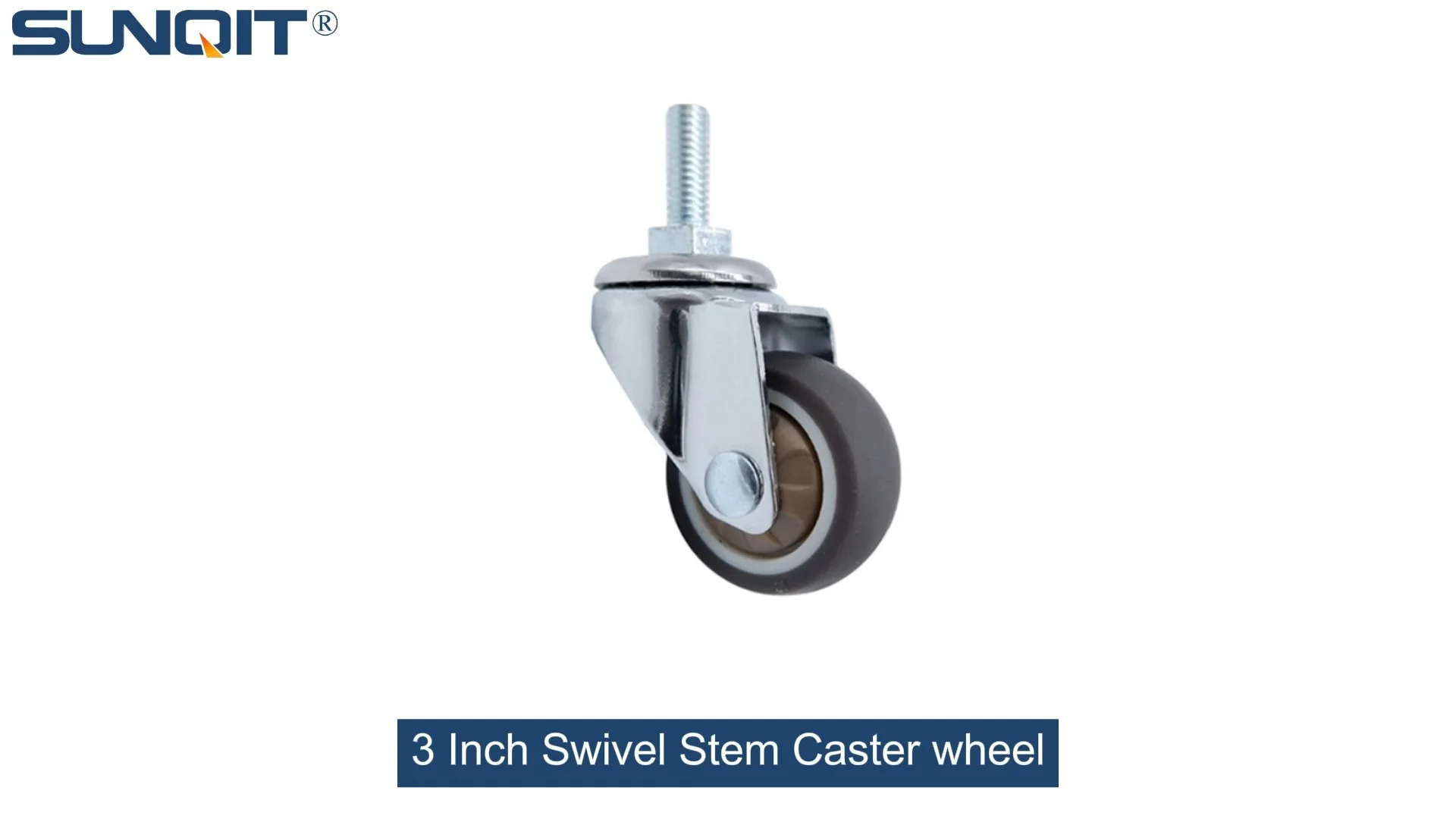
Swivel Stem Caster wheel
360 Degree Swivel Stem Caster. Threaded-post mount design, castors diameter 3 inch.Each swivel caster wheels loading 70KGS. Heavy enough and widely suit for carts, chairs, cabinet, flow rack, workbench, turnover rolley.
Imagine walking into a bustling workshop—tools hum, teams collaborate, and every surface seems to buzz with purpose. Now, picture a workstation that stays stuck in one spot, no matter how much the day's tasks shift. A static desk here, a heavy workbench there, forcing employees to stretch, strain, or waste precious minutes fetching materials. It's a scene that feels all too familiar in many workplaces, but it doesn't have to be. The secret to turning chaos into harmony? Mobility. And at the heart of that mobility lies a small but mighty component: swivel stem caster wheels.
Modular workstations have revolutionized how we think about workspaces. They're flexible, customizable, and designed to grow with your needs—whether you're running a small garage shop, a high-tech manufacturing floor, or a dynamic office. But even the most modular setup falls flat if it can't move. That's where swivel stem caster wheels step in. They're not just "wheels on a stick"; they're the unsung heroes that turn rigid structures into agile, adaptable tools that keep pace with your team's rhythm.
What Are Swivel Stem Caster Wheels, Anyway?
Let's start with the basics. A caster is essentially a wheel mounted on a frame, but swivel stem casters take it a step further. Unlike fixed casters, which only roll forward and backward, swivel casters can rotate 360 degrees, letting you maneuver in any direction with minimal effort. The "stem" part refers to how they're attached: instead of a plate that bolts to the bottom of a piece of furniture, they have a cylindrical stem (usually threaded or smooth) that inserts into a hole or socket on the workstation's frame. It's a simple design, but it's genius in its efficiency—easy to install, strong enough to handle heavy loads, and sleek enough to keep your workstation low to the ground for stability.
Think of them as the pivot point between your workstation and the floor. Whether you're moving a loaded workbench across the shop, repositioning a material rack to streamline your assembly line, or shifting a mobile cart to serve a new team, swivel stem casters make it feel effortless. And in a world where every second counts, that "effortless" factor translates directly to happier employees, fewer injuries, and a workflow that just… flows.
The Anatomy of a Swivel Stem Caster: More Than Just a Wheel
To truly appreciate why swivel stem casters are game-changers, let's break down their parts. It's not just a wheel and a stem—there's a whole system working together to deliver that smooth, 360-degree movement.
1. The Stem: The Unsung Connector
The stem is the caster's "anchor." It's the part that locks the caster to your workstation, and its design matters. Threaded stems are common—they screw into a nut or threaded hole, creating a tight, secure fit. Smooth stems, on the other hand, might use a pin or a collar to hold them in place, which is great for quick adjustments. The length and diameter of the stem depend on your workstation's frame—too short, and it might pop out; too long, and it could stick out awkwardly. That's why choosing the right stem size is crucial (more on that later!).
2. The Swivel Head: Where the Magic Happens
Beneath the stem is the swivel head, a housing that contains bearings (usually ball bearings or roller bearings) and a raceway (the track the bearings roll along). This is what lets the caster spin freely. High-quality swivel heads use precision bearings to reduce friction, so even a fully loaded workstation feels light to push. Cheap casters? Their swivel heads might stick or grind, turning a simple move into a workout. Trust us—investing in a smooth swivel head is worth every penny.
3. The Wheel: Your Connection to the Floor
The wheel itself is where form meets function. Wheel materials vary, and each has its own superpower: Rubber wheels are gentle on hardwood or tile floors, making them perfect for offices or finished spaces. Polyurethane wheels are tough—they resist chemicals, oils, and abrasion, so they're ideal for workshops or factories. Nylon wheels are lightweight and budget-friendly, great for lighter loads. Even the wheel size matters: larger wheels roll over cracks and debris more easily, while smaller wheels keep your workstation lower to the ground for stability. It's all about matching the wheel to your environment.
4. The Brake: When You Need to Stay Put
Mobility is great, but sometimes you need your workstation to stay exactly where you left it. That's where brakes come in. Swivel stem casters often come with two types of brakes: "total lock" brakes, which lock both the wheel and the swivel head (so the caster can't roll OR turn), and "wheel lock" brakes, which only stop the wheel from rolling (letting the caster still swivel). For most modular workstations, total lock brakes are the way to go—they give you that rock-solid stability when you're sawing, assembling, or typing, then release with a quick tap of your foot when it's time to move.
5. Caster Accessories: The Little Extras That Make a Big Difference
No caster is an island, and that's where caster accessories come into play. Stem extenders let you adjust the height if your stem is too short. Floor protectors (like rubber caps) keep your wheels from scratching delicate surfaces. Bearing lubricants ensure smooth swivel action for years. Even simple things like replacement washers or lock nuts can extend the life of your casters. Think of them as the first aid kit for your mobility system—small, but essential when you need them.

Why Modular Workstations Need Swivel Stem Casters
Modular workstations are all about flexibility. They're built to adapt to changing tasks, team sizes, and workflows. But without mobility, that flexibility is limited. Let's say you're running a small electronics assembly line. One day, you're building circuit boards; the next, you're testing finished products. With a fixed workbench, you'd need two separate stations—or you'd spend hours rearranging tools. With a workbench on swivel stem casters? You roll it to the testing area, lock the brakes, and you're ready. It's that simple.
Or think about a busy warehouse. Seasonal demand spikes mean you need to reconfigure your material racks to store more inventory. If those racks are bolted to the floor, you're stuck. But with racks on swivel stem casters? You can shift them, stack them, or create new pathways in minutes. It's not just about saving time—it's about staying competitive. In a world where customer demands change overnight, your workspace can't afford to be static.
And let's not forget ergonomics. Bending, reaching, and straining to access tools or materials is a leading cause of workplace injuries. A mobile workstation puts everything within arm's reach, reducing the risk of back pain or repetitive strain injuries. When your tools move with you, you stay comfortable, focused, and productive. It's a win-win for your team and your bottom line.

Swivel Stem Casters and Lean Systems: A Match Made in Efficiency Heaven
If you're familiar with lean system principles—eliminating waste, streamlining workflows, and continuous improvement—you'll see why swivel stem casters are a natural fit. Lean is all about making every action count, and nothing wastes time like unnecessary movement. A static workstation forces your team to walk back and forth between tools, materials, and assembly points. A mobile workstation? It brings the work to the worker.
Take the "5S" method, a cornerstone of lean systems: Sort, Set in Order, Shine, Standardize, Sustain. Swivel stem casters help with "Set in Order" by letting you arrange workstations in the most efficient layout—no more trying to work around fixed furniture. They support "Shine" (cleanliness) by making it easy to roll workstations out of the way so you can sweep, mop, or sanitize the floor. And they enable "Sustain" by adapting to new layouts as your processes improve. In short, they're not just wheels—they're a lean tool in disguise.

Choosing the Right Swivel Stem Caster for Your Workstation
Not all swivel stem casters are created equal. Choosing the right one depends on your workstation's weight, your floor type, and how you'll use it. Here's a quick guide to help you pick:
| Workstation Type | Typical Load Capacity | Best Wheel Material | Brake Type | Why It Works |
|---|---|---|---|---|
| Office Workbench (Laptops, Files) | 100–200 lbs | Rubber or Polyurethane | Wheel Lock | Light load, gentle on carpets/tile; wheel lock prevents rolling while typing. |
| Assembly Line Workbench (Tools, Parts) | 300–500 lbs | Polyurethane or Nylon | Total Lock | Medium-heavy load; polyurethane resists oils/chemicals; total lock for stability during assembly. |
| Material Rack (Boxes, Inventory) | 500–1000 lbs | Heavy-Duty Polyurethane or Steel | Total Lock | High load capacity; steel wheels handle rough warehouse floors; total lock prevents shifting. |
| Medical Workstation (Equipment, Supplies) | 200–400 lbs | Non-Marking Rubber | Total Lock | Quiet, non-slip, and won't leave marks on hospital floors; critical for sterile environments. |
The key here is to calculate your workstation's total weight (including tools, materials, and the workstation itself) and add a 20% buffer—you don't want to max out your casters, as that leads to premature wear. Also, consider your floor: rough concrete needs tough wheels, while polished hardwood needs gentle ones. And don't skimp on brakes—stability is just as important as mobility.
Aluminum Profile Workstations: The Perfect Partner for Swivel Stem Casters
If swivel stem casters are the mobility, then aluminum profile is the muscle. Aluminum profiles—those sleek, T-slot extrusions you see in modern workstations—are lightweight, strong, and infinitely customizable. They're the backbone of modular systems, and they pair perfectly with swivel stem casters.
Why aluminum? For starters, it's light enough that even a fully loaded workstation on casters is easy to move, but strong enough to support heavy tools and materials. Its T-slot design makes it simple to attach casters, shelves, tool holders, or anything else you need—no welding or drilling required. And unlike steel, it won't rust, so it holds up in damp or humid environments. When you combine aluminum profiles with swivel stem casters, you get a workstation that's both tough and agile—like a race car with a tank's engine.
Take the "Workbench E (Single Deck–Without Caster)" from many modular suppliers. It's a sturdy aluminum frame with a single work surface, designed to be paired with casters. Add four swivel stem casters (with total lock brakes), and suddenly it's a mobile command center. Need to add a shelf? Slide an aluminum profile into the T-slot. Want to mount a lamp? Screw a bracket into the slot. It's flexibility on top of mobility, and it's all thanks to that aluminum backbone.
Real-World Stories: How Swivel Stem Casters Transform Workspaces
Let's ground this in real life. Meet Maria, a small-batch furniture maker. Her workshop is tight on space, so she used to have a fixed workbench in the corner. Every time she needed to sand a piece, she'd carry it across the room to her sanding station. Then she'd carry it back to assemble. It took time, and she often strained her back. Then she added swivel stem casters to her workbench. Now, she rolls the bench to the sanding station, locks the brakes, sands, then rolls it back. "It's like having an extra pair of hands," she says. "I get more done, and my back doesn't ache at the end of the day."
Or take Raj, who runs a small electronics assembly team. His team grows and shrinks with project demands—some weeks, he has 5 people; other weeks, 10. With fixed workbenches, he could never rearrange fast enough. Now, all his workbenches are on swivel stem casters. "When we get a new order, we roll the benches into a U-shape for collaboration," he explains. "When it's quiet, we line them up to save space. It's night and day—no more wasted time moving tools, and the team stays focused."
These stories aren't anomalies. They're proof that swivel stem casters do more than move things—they transform how work gets done. They turn frustration into flow, and static spaces into dynamic ecosystems that adapt to your team, not the other way around.
Installing Swivel Stem Casters: A DIY Guide (It's Easier Than You Think)
You don't need to be a mechanic to install swivel stem casters. With a few basic tools and 30 minutes, you can upgrade almost any workstation. Here's how:
Step 1: Gather Your Tools
You'll need a drill (if your workstation doesn't have pre-drilled holes), a wrench, a measuring tape, and a pencil. If you're using threaded stems, you'll also need a tap and die set to clean the threads (or just some thread locker to keep them tight).
Step 2: Mark the Caster Positions
Flip your workstation upside down (get a friend to help if it's heavy!). Measure equal distances from the corners to mark where the casters will go—usually one near each corner for stability. Pro tip: If your workstation is long, add a fifth caster in the middle to prevent sagging under heavy loads.
Step 3: Drill Holes (If Needed)
If your workstation doesn't have pre-drilled holes for stems, drill holes slightly smaller than your stem diameter (this ensures a tight fit). For aluminum profiles, use a metal drill bit and go slow to avoid stripping the metal.
Step 4: insert the Stems
For threaded stems: Screw them into the holes by hand first, then tighten with a wrench (don't over-tighten—you could crack the frame). For smooth stems: Apply a drop of thread locker to the stem, then push it into the hole and secure with a cotter pin or retaining ring.
Step 5: Test the Casters
Flip the workstation back over and give it a gentle push. It should roll smoothly in all directions. Test the brakes to make sure they lock and release easily. If it wobbles, check that all casters are the same height—you might need to adjust a stem or add a washer.
That's it! You're now the proud owner of a mobile workstation. And if you ever need to replace a caster? Just reverse the steps—easy peasy.
Maintaining Your Swivel Stem Casters: Keep Them Rolling Smoothly
Like any tool, swivel stem casters need a little TLC to stay in top shape. Here's how to make them last for years:
Clean Them Regularly
Dirt, hair, and debris can gunk up the swivel head or wheel bearings. Wipe the wheels with a damp cloth weekly, and use a toothbrush to clean out the swivel raceway (the track where the bearings roll). For sticky swivels, spray a little compressed air to blow out the dust.
Lubricate the Bearings
Every 6 months, apply a few drops of bearing lubricant (like lithium grease) to the swivel head and wheel axles. This reduces friction and prevents rust. Avoid WD-40—it's a cleaner, not a lubricant, and will dry out the bearings over time.
Check the Brakes
Brakes can wear out, especially if you use them often. Test them monthly to make sure they lock firmly and release smoothly. If a brake feels loose, tighten the adjustment nut with a wrench. If the pad is worn, replace it—most suppliers sell replacement brake pads for a few dollars.
replace Worn Wheels
Wheels take the brunt of the wear. If you notice cracks, flat spots, or uneven rolling, replace them ASAP. Most casters let you swap wheels without replacing the entire caster—just pop off the axle pin, remove the old wheel, and slide on a new one.
The Future of Mobility: Where Swivel Stem Casters Are Headed
As workspaces become more dynamic, swivel stem casters are evolving too. We're already seeing smart casters with built-in sensors that track load capacity (alerting you if you're overloading them) or Bluetooth connectivity that lets you lock/unlock them with your phone. There are even self-propelled casters (think tiny motors) for ultra-heavy workstations—perfect for warehouses or labs where manual pushing is a strain.
Sustainability is also a trend. Manufacturers are using recycled materials for wheels and stems, and designing casters that are easier to disassemble and recycle at the end of their life. Even something as simple as low-friction bearings reduces energy use (yes, even for casters!) by making it easier to move heavy loads.
But no matter how fancy they get, the core mission of swivel stem casters will stay the same: to make workspaces more adaptable, efficient, and human-centered. Because at the end of the day, it's not about the wheels—it's about the people using them.
Final Thoughts: Mobility Isn't a Luxury—It's a Necessity
Swivel stem caster wheels might seem like small components, but they're the difference between a workspace that holds you back and one that propels you forward. They turn static workbenches into mobile command centers, rigid material racks into flexible storage solutions, and frustrating daily tasks into smooth, seamless workflows.
If you're building a modular workstation, don't overlook the casters. Invest in quality swivel stem casters with the right load capacity, wheel material, and brakes. Pair them with aluminum profiles for a setup that's strong, lightweight, and ready to adapt. And don't forget the little things—clean them, lubricate them, and replace worn parts. Your team, your back, and your bottom line will thank you.
At the end of the day, work should work for you. With swivel stem caster wheels, it finally can.