- Company Articles
- Products and Technology
- Application Cases
- Swivel Stem Caster Wheels in 3C Assembly: Improving Workstation Efficiency

Swivel Stem Caster Wheels in 3C Assembly: Improving Workstation Efficiency
Related Product
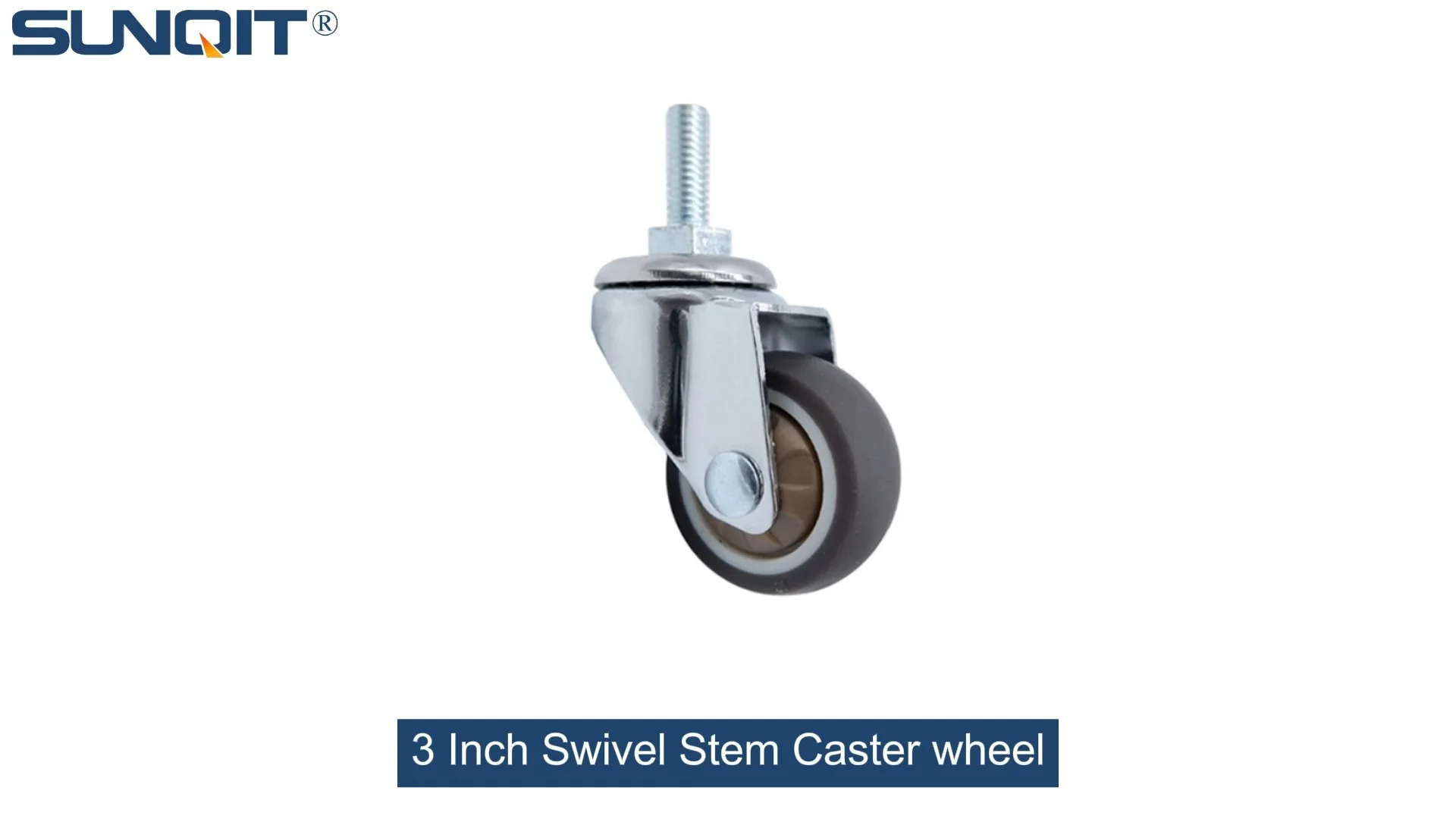
Swivel Stem Caster wheel
360 Degree Swivel Stem Caster. Threaded-post mount design, castors diameter 3 inch.Each swivel caster wheels loading 70KGS. Heavy enough and widely suit for carts, chairs, cabinet, flow rack, workbench, turnover rolley.
In the fast-paced world of 3C manufacturing—where computers, communication devices, and consumer electronics fly off production lines at breakneck speeds—every second counts. Assembly lines hum with the precision of robots and the focus of human workers, all racing to meet tight deadlines without sacrificing quality. Yet, for all the advanced technology in these facilities, one often-overlooked component can make or break daily efficiency: the mobility of workstations. Enter the swivel stem caster wheel —a small but mighty tool that's quietly revolutionizing how 3C assembly lines operate, from ESD workstations to material transport trolleys. Let's dive into how these unassuming wheels are becoming the unsung heroes of lean, agile, and productive manufacturing floors.
The 3C Assembly Challenge: Why Mobility Matters
3C products—think smartphones, laptops, smartwatches—are marvels of miniaturization and complexity. Each device contains hundreds of tiny components, from microchips to delicate wiring, requiring assembly in clean, controlled environments. But here's the catch: production demands are never static. A factory might switch from assembling 5,000 smartphones one week to 10,000 tablets the next, or reconfigure lines to test a new component design. In this dynamic setting, fixed workstations become a liability. Workers waste precious time walking back and forth between static benches and material racks. Heavy tools get stuck in one corner, while assembly stations feel cramped or misaligned with conveyor belts. And in environments where even a small static charge can fry a $500 circuit board, ESD workstations need to stay grounded and remain flexible—a tricky balance.
This is where the principles of a lean system come into play. Lean manufacturing is all about eliminating waste—whether it's time, movement, or unnecessary inventory. In a lean setup, every step should add value, and every piece of equipment should adapt to the workflow, not the other way around. But how do you make heavy workbenches, tool carts, and ESD stations "adaptable"? The answer lies in giving them wheels—specifically, swivel stem caster wheels designed to meet the unique demands of 3C assembly.
What Are Swivel Stem Caster Wheels, Anyway?
Before we dive into their benefits, let's clarify what makes a swivel stem caster wheel different from other casters. Unlike plate-mount casters, which bolt onto the bottom of equipment, stem casters feature a metal rod (the "stem") that inserts into a pre-drilled hole or socket on the workstation, trolley, or rack. This design makes installation quick—no need for complex drilling or welding—and allows for 360-degree rotation, so the wheel can swivel freely in any direction. That's a game-changer for tight spaces, like between conveyor lines or around bulky machinery, where maneuverability is key.
But not all swivel stem casters are created equal. For 3C assembly, they need to check several boxes: load capacity (to support heavy ESD workbenches with tools and components), durability (to withstand constant use on factory floors), and often, ESD compatibility (to prevent static buildup). Many models also include brakes—either wheel locks, swivel locks, or both—to keep workstations stable during assembly, then release quickly when it's time to reposition.

Key Features of Swivel Stem Caster Wheels for 3C Assembly
To understand why these wheels are indispensable, let's break down their most critical features for 3C environments:
1. Precision Maneuverability in Tight Spaces
3C factories are often dense with equipment: conveyor belts snake through the floor, robotic arms reach across work zones, and ESD workstations are clustered to minimize static risks. A standard caster might get stuck or require excessive force to turn in these tight quarters, but swivel stem casters excel here. Their 360-degree rotation lets workers pivot a 200kg ESD workstation with one hand, navigating around corners or squeezing between conveyor lines without disrupting the flow of materials. This agility is especially valuable during line reconfigurations, where every inch of space counts.
2. ESD-Friendly Materials for Sensitive Electronics
Static electricity is the bane of 3C assembly. Even a small discharge can damage a microchip, rendering an entire device useless. That's why ESD workstations are non-negotiable—they're built with conductive materials to dissipate static safely. But if the casters on these workstations aren't ESD-compliant, they can undo all that protection. High-quality swivel stem casters for 3C use conductive rubber or polyurethane wheels, paired with metal stems, to ensure the workstation remains grounded even when moved. Some models even include built-in grounding wires, giving manufacturers peace of mind that sensitive components stay protected, no matter where the workstation rolls.
3. Load Capacity That Handles the Heavy Lifting
An ESD workstation isn't just a table—it's a hub of tools: soldering irons, magnifying lamps, component trays, and sometimes even small testing equipment. All told, these setups can weigh 150kg or more. A flimsy caster will buckle under the load, leading to wobbly workstations, damaged floors, or even safety hazards. Swivel stem casters for industrial use are engineered to handle these weights, with load capacities ranging from 50kg per wheel (for lightweight trolleys) to 300kg per wheel (for heavy-duty workbenches). This durability ensures they stand up to daily use without wearing down, even in 24/7 production environments.
4. Brake Systems for Stability When It Counts
Mobility is great, but there's a time for movement and a time for staying put. When a worker is soldering a tiny wire or aligning a circuit board, the last thing they need is a workstation that rolls mid-task. That's why most industrial swivel stem casters come with dual brakes: a wheel lock to stop rotation and a swivel lock to prevent the wheel from turning. Engaging both locks creates a stable, fixed workstation that feels as secure as a bolted-down bench. When it's time to move—say, to align with a new conveyor position—the brakes release with a simple foot pedal or lever, making transitions quick and seamless.

From Waste to Efficiency: Swivel Stem Casters in Action
It's one thing to list features, but how do these wheels translate to real-world results? Let's look at three common scenarios in 3C assembly where swivel stem casters make a tangible difference.
Scenario 1: The ESD Workstation That Follows the Workflow
Imagine a smartphone assembly line where each ESD workstation is dedicated to a specific task: one for attaching screens, another for soldering batteries, a third for testing cameras. In a fixed setup, workers at the screen station might need parts from a material rack 10 meters away, requiring a 20-meter round trip multiple times an hour. Multiply that by 20 workers per shift, and you're looking at 400 meters of unnecessary walking—time that could be spent assembling devices. With swivel stem casters, the ESD workstation itself becomes mobile. When parts run low, the worker simply unlocks the brakes, rolls the workstation to the material rack, grabs what they need, and rolls back. No more wasted steps, no more interrupted focus.
Scenario 2: Aligning Workstations with Conveyor Systems
Conveyor belts are the arteries of 3C assembly lines, moving partially assembled devices from one station to the next. But if a workstation is even a few inches misaligned with the conveyor, workers have to stretch, bend, or awkwardly reach to grab components—leading to fatigue and increased error rates. Swivel stem casters solve this in seconds: a supervisor can adjust the workstation's position with a gentle push, aligning it perfectly with the conveyor's edge. This not only reduces physical strain but also speeds up transfer times, as components glide smoothly from the conveyor to the workstation without fumbling.
Scenario 3: Adapting to Rapid Line Reconfigurations
A major electronics manufacturer recently shared a case study: they needed to reconfigure their assembly line to test a new tablet design, which required moving 12 workstations, 8 material trolleys, and 4 ESD testing benches. With fixed workstations, this would have taken a full shift—workers using pry bars and forklifts to move heavy equipment, risking damage to floors and tools. With swivel stem casters? The entire reconfiguration was done in 2 hours. Two workers could move each workstation by hand, positioning them into a U-shaped layout (a lean manufacturing best practice) to reduce movement between tasks. The result? The line was back up and running the same day, with no loss in production targets.

Swivel Stem vs. the Rest: Why Not Just Any Caster?
You might be wondering: aren't all casters the same? Couldn't a factory just use cheap, generic wheels instead of investing in industrial swivel stem models? The short answer: no. 3C environments demand precision, durability, and safety that generic casters can't match. Let's compare swivel stem casters to two common alternatives to see why they stand out:
| Feature | Swivel Stem Caster Wheel | Fixed Caster | Plate-Mount Caster |
|---|---|---|---|
| Maneuverability | 360° swivel; pivots in tight spaces | Only rolls forward/backward; no swivel | Swivels, but bulkier design limits tight turns |
| Installation | Stem inserts into pre-drilled hole; 5-minute setup | Bolts or welds required; permanent installation | Bolts to equipment base; requires drilling holes |
| ESD Compatibility | Available with conductive materials and grounding options | Rarely ESD-rated; risks static buildup | Some ESD options, but heavier and less flexible |
| Best For | Mobile workstations, ESD benches, trolleys, conveyor alignment | Straight-line transport (e.g., long conveyor sections) | Heavy machinery that rarely moves (e.g., robotic arms) |
The takeaway? For 3C assembly, where flexibility and ESD safety are non-negotiable, swivel stem casters offer the best balance of maneuverability, ease of installation, and durability. They're designed to adapt to the factory's needs, not the other way around.
Maintaining Your Swivel Stem Casters: Tips for Longevity
Like any tool, swivel stem casters perform best with regular care. Here are simple maintenance steps to keep them rolling smoothly for years:
- Clean the wheels weekly: Factory floors collect dust, metal shavings, and debris, which can get stuck in wheel bearings and slow rotation. A quick wipe with a damp cloth or brush removes buildup.
- Lubricate swivel joints monthly: Apply a small amount of industrial lubricant (avoid oil-based products near ESD areas) to the swivel joint to prevent rust and ensure smooth rotation.
- Check brakes daily: Before each shift, test the wheel and swivel locks to ensure they engage fully. Worn brake pads should be replaced immediately to avoid workstation movement during critical tasks.
- Inspect for wear: Look for cracks in wheel treads, bent stems, or loose bearings. replace damaged casters promptly—waiting can lead to uneven workstation movement or even equipment damage.
Choosing the Right Swivel Stem Caster for Your 3C Facility
Not all swivel stem casters are built for 3C assembly. To find the perfect fit, consider these factors:
Load Capacity
Calculate the total weight of your workstation (including tools, components, and workers) and choose casters with a load rating that exceeds this by 20% (a safety buffer). For example, a 200kg workbench should use casters rated for at least 240kg total (60kg per wheel for a 4-wheel setup).
Wheel Material
Rubber wheels are ideal for smooth floors and shock absorption (great for delicate components), while polyurethane wheels offer better durability on rough or concrete floors. For ESD areas, opt for conductive rubber or polyurethane to dissipate static.
Floor Type
Smooth factory floors work with most wheel types, but if your facility has cracks, thresholds, or uneven surfaces, look for larger wheels (at least 5 inches in diameter) to roll over obstacles more easily.
Brake Type
Dual-locking brakes (wheel + swivel) are non-negotiable for workstations where stability is critical. For trolleys that only move occasionally, a simple wheel lock may suffice.
The Future of 3C Assembly: Lean, Mobile, and Ready to Adapt
As 3C manufacturers face increasing pressure to produce more complex devices faster than ever, the need for agile, adaptable workspaces will only grow. The lean system philosophy—focused on eliminating waste and maximizing value—has already transformed how factories operate, and mobility is a cornerstone of that transformation. Swivel stem caster wheels, by making workstations, ESD benches, and trolleys mobile yet stable, are helping factories embrace this future today.
In the end, it's the little things that often drive big change. A single swivel stem caster wheel might cost less than a cup of coffee, but when multiplied across an entire factory, it becomes a catalyst for efficiency, reducing waste, boosting productivity, and keeping workers safe and focused. So the next time you pick up a smartphone or laptop, take a moment to appreciate the unseen heroes of its creation—including the humble caster wheel that helped bring it to life.
For 3C manufacturers ready to take the next step toward lean, mobile efficiency, the message is clear: don't overlook the power of mobility. Invest in quality swivel stem casters, and watch as your assembly line transforms from a static setup into a dynamic, adaptable ecosystem—one smooth roll at a time.