- Company Articles
- Products and Technology
- Product knowledge
- Swivel Stem Caster Wheels vs Rigid Casters: Mobility Comparison

Swivel Stem Caster Wheels vs Rigid Casters: Mobility Comparison
Related Product
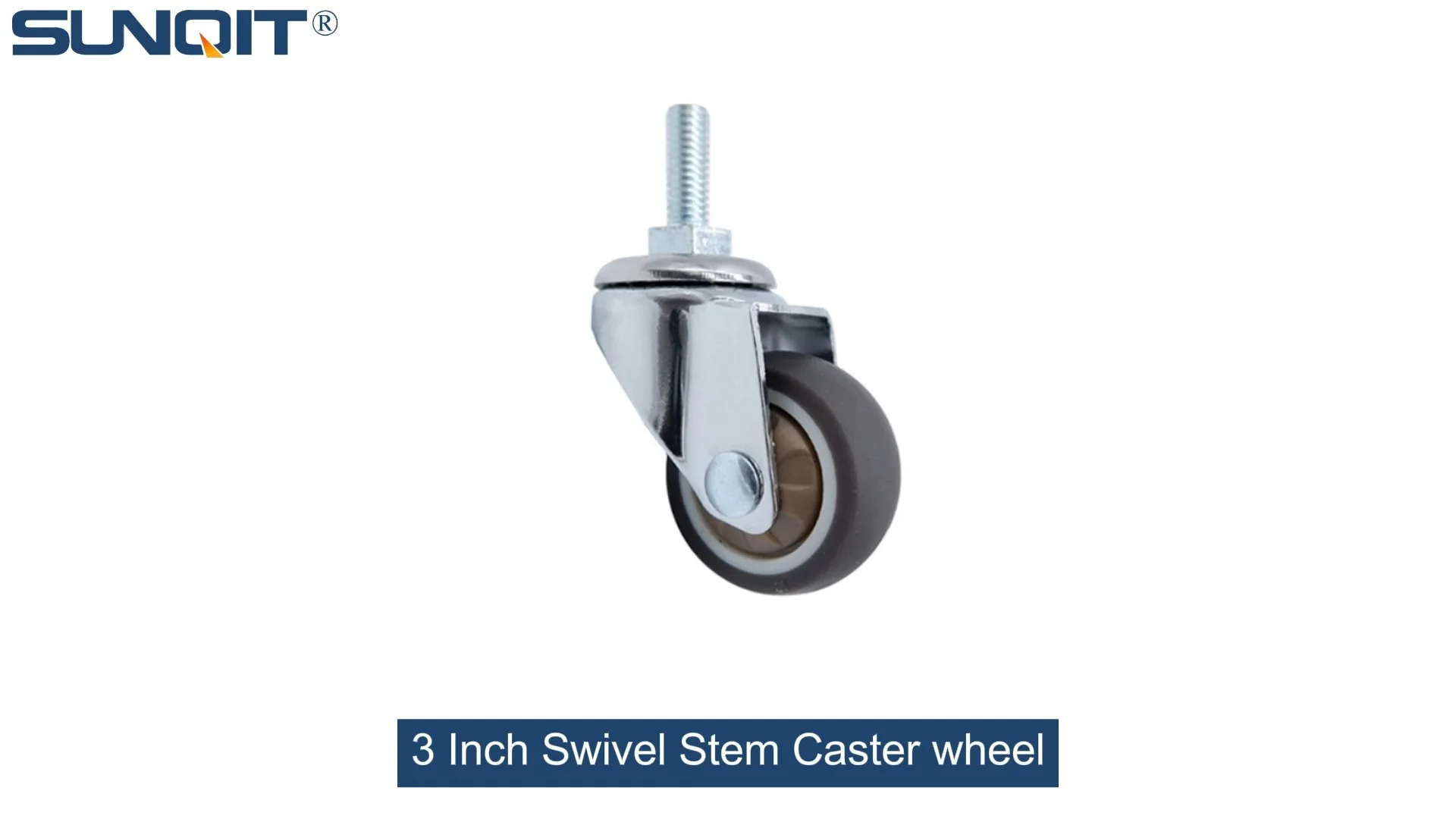
Swivel Stem Caster wheel
360 Degree Swivel Stem Caster. Threaded-post mount design, castors diameter 3 inch.Each swivel caster wheels loading 70KGS. Heavy enough and widely suit for carts, chairs, cabinet, flow rack, workbench, turnover rolley.
In the world of material handling, manufacturing, and everyday equipment, there's a silent workhorse that often goes unnoticed: the caster wheel. These small but mighty components are the reason hospital carts glide through narrow corridors, warehouse trolleys navigate tight aisles, and office chairs swivel with ease. But not all casters are created equal. When it comes to mobility, two types stand out: swivel stem caster wheels and rigid casters. Each has its own strengths, weaknesses, and ideal applications—and choosing the right one can mean the difference between smooth, efficient operations and frustrating, time-wasting delays. Let's dive into what makes these casters unique, how they impact mobility, and which one might be the best fit for your needs.
Understanding Swivel Stem Caster Wheels: The Maneuverability Masters
Swivel stem caster wheels are like the ballet dancers of the caster world—agile, flexible, and built for movement in any direction. At their core, they feature a stem mount (a cylindrical rod that inserts into a socket or bracket) and a swivel head that allows the wheel to rotate 360 degrees. This design lets the caster pivot freely, making it easy to change direction with minimal effort. Think about a medical cart in a busy hospital: nurses need to navigate around patients, doorframes, and other carts quickly. A swivel stem caster wheel makes that possible, allowing the cart to glide around obstacles without stopping or backtracking.
Key Features of Swivel Stem Casters
One of the most popular variants is the swivel stem caster wheel with brake , which adds a locking mechanism to the swivel head or wheel. This is crucial for safety—imagine a tool cart in a workshop: you don't want it rolling away while you're reaching for a wrench. The brake locks the swivel movement or the wheel itself, keeping the cart stable when needed. Other features include different wheel materials (rubber for floor protection, polyurethane for durability), stem lengths (to fit various mounting sockets), and load capacities (from light-duty office chairs to heavy-duty industrial carts).
Mobility in Action: Where Swivel Stem Casters Shine
The mobility advantage of swivel stem casters is all about maneuverability in tight spaces. In a warehouse with narrow aisles, for example, a trolley fitted with swivel stem casters can easily pivot to retrieve items from shelves on both sides without having to back up or turn around. In retail settings, display carts with swivel casters can be rearranged quickly to adapt to changing store layouts. Even in homes, swivel stem casters on furniture (like rolling kitchen islands) make it easy to move heavy items for cleaning or rearranging. The key here is flexibility—swivel casters thrive when movement isn't restricted to straight lines.
Rigid Casters: The Stability Specialists
If swivel stem casters are ballet dancers, rigid casters are more like freight trains—steady, powerful, and built for straight-line movement. Unlike swivel casters, rigid casters have a fixed fork that doesn't rotate. The wheel is mounted on a rigid axle, so it can only roll forward or backward in a straight path. This design prioritizes stability over maneuverability, making rigid casters ideal for applications where consistent, predictable movement is key. A common example is the flat rigid castor wheel , which has a flat mounting plate (instead of a stem) for secure attachment to heavy equipment.
Key Features of Rigid Casters
Rigid casters are all about durability and load capacity. Because their design is simpler (no swivel head or complex pivot mechanisms), they can often support heavier weights than swivel casters of the same size. They also tend to be more resistant to wear and tear, as there are fewer moving parts to break or jam. For example, a rigid caster on a conveyor system in a factory needs to handle constant, repetitive motion without faltering. The fixed direction ensures that materials move along a precise path, reducing the risk of jams or misalignment. Rigid casters also come in various wheel materials, including steel for heavy loads and rubber for quieter operation.
Mobility in Action: Where Rigid Casters Excel
Rigid casters are the go-to choice when movement is linear and stability is non-negotiable. Think about a loading dock: a pallet jack with rigid casters on the front (and swivel casters on the back for steering) can carry heavy pallets in straight lines across the dock without wobbling. In manufacturing, assembly line platforms often use rigid casters to ensure they stay aligned with the production line, preventing costly delays. Even in some office settings, filing cabinets with rigid casters are preferred—they only need to roll forward or backward to access files, and the fixed direction prevents them from drifting into walkways. Rigid casters don't need to pivot; they need to power through straight paths reliably.

Swivel Stem vs. Rigid Casters: A Mobility Showdown
To really understand how these casters stack up, let's compare them head-to-head on the factors that matter most for mobility: maneuverability, stability, load capacity, and more. The table below breaks down their key differences:
| Feature | Swivel Stem Caster Wheels | Rigid Casters |
|---|---|---|
| Maneuverability | Excellent—360° rotation allows movement in any direction; ideal for tight spaces and obstacles. | Limited—only moves forward/backward in a straight line; poor at navigating obstacles. |
| Stability | Lower when moving—swivel head can cause wobbling at high speeds or with heavy loads; improved with brakes. | High—fixed direction prevents swaying; better for heavy, uneven loads or high-speed movement. |
| Load Capacity | Moderate to high—depends on design, but swivel mechanisms add weight limits; typically best for light to medium loads. | High to very high—simpler design supports more weight; often used for heavy machinery or industrial equipment. |
| Floor Protection | Good—often paired with soft wheels (rubber, polyurethane) to avoid scuffing; ideal for hardwood, tile, or sensitive floors. | Variable—can use hard wheels (steel, iron) for durability on rough floors, but may damage softer surfaces. |
| Brake Options | Common—many models include swivel stem caster wheels with brakes to lock rotation or wheel movement. | Less common—brakes are available but often unnecessary, as fixed direction reduces rolling risk. |
| Maintenance Needs | Higher—swivel head requires regular lubrication to prevent jamming; more moving parts mean more potential for wear. | Lower—fewer parts to maintain; occasional wheel cleaning and axle lubrication is usually sufficient. |
| Cost | Higher—complex swivel mechanisms and brake features add to production costs. | Lower—simpler design makes them more affordable, especially for bulk purchases. |

Choosing the Right Caster: It's All About Your Needs
There's no "one-size-fits-all" answer when it comes to swivel stem vs. rigid casters. The best choice depends on your specific application. Here are some key questions to ask yourself:
1. What's the Environment Like?
If you're working in a tight space—like a hospital hallway, a small workshop, or a retail store with narrow aisles—swivel stem casters are likely the way to go. Their ability to pivot means you can navigate around corners and obstacles without stopping. On the other hand, if you're in a large, open area (like a warehouse floor or loading dock) where movement is mostly straight, rigid casters will be more stable and efficient.
2. How Heavy is the Load?
For light to medium loads (think office chairs, tool carts, or small medical equipment), swivel stem casters offer the flexibility you need. But for heavy loads (industrial machinery, large pallets, or bulk material carts), rigid casters are better equipped to handle the weight without wobbling or failing. Remember: even a swivel caster with a high load rating may struggle with stability under heavy weight, while a rigid caster will stay steady.
3. Do You Need to Stop and Start Frequently?
If your equipment needs to be moved, stopped, and repositioned often (like a mobile workbench in a garage or a serving cart in a restaurant), a swivel stem caster wheel with brake is essential. The brake lets you lock the caster in place when stationary, preventing accidental movement. Rigid casters, while stable, don't always come with brakes—and since they only move straight, they're less likely to drift anyway.
4. What's the Floor Surface?
Swivel stem casters often come with softer wheels (rubber, polyurethane) that protect delicate floors like hardwood, tile, or polished concrete from scratches. Rigid casters, especially those used for heavy loads, may have harder wheels (steel, cast iron) that can damage soft floors but hold up better on rough surfaces like asphalt or concrete with cracks. If you're concerned about floor protection, swivel casters are usually the safer bet.

Real-World Examples: When to Use Which Caster
Still on the fence? Let's look at a few real-world scenarios to see how these casters perform in action:
Scenario 1: A Busy Restaurant Kitchen
In a restaurant kitchen, chefs and servers need to move quickly. Food carts must navigate around stoves, prep tables, and other staff. Here, swivel stem caster wheels are a must. A cart with swivel casters can pivot to avoid a sudden spill on the floor or a server rushing by, ensuring food gets to tables on time. Adding brakes means the cart can stay put during prep, preventing accidents.
Scenario 2: A Factory Assembly Line
An automotive assembly line requires platforms that move in precise straight lines to align with the production belt. Rigid casters are perfect here—they keep the platform steady, even when carrying heavy car parts, and ensure it doesn't drift off course. Swivel casters would cause the platform to wobble, leading to misalignment and potential damage to parts.
Scenario 3: A Home Workshop
A hobbyist's workshop has limited space, with tools, materials, and projects scattered about. A mobile tool chest with swivel stem casters can roll around the workspace, making it easy to access tools from any angle. When not in use, the brakes lock the chest in place, so it doesn't roll into the workbench. Rigid casters would limit the chest to moving back and forth, requiring the hobbyist to walk around it—wasting time and energy.
Maintaining Your Casters: Tips for Long-Lasting Mobility
No matter which caster you choose, proper maintenance is key to keeping them rolling smoothly. Here are some tips to extend their lifespan:
For Swivel Stem Casters
- Lubricate the swivel head: The pivot point can get dirty or dry over time, causing the caster to stick. Use a silicone-based lubricant every few months to keep it moving freely.
- Check the brake: If you have a swivel stem caster wheel with brake , test the brake regularly to ensure it locks securely. Tighten loose brake pads or replace worn ones as needed.
- Clean the wheels: Hair, dust, and debris can wrap around the wheel axle, slowing movement. Wipe wheels with a damp cloth or brush to remove buildup.
For Rigid Casters
- Inspect the axle: Rigid casters rely on a fixed axle, which can bend or loosen under heavy loads. Tighten axle nuts regularly and replace bent axles immediately.
- replace worn wheels: Hard wheels can develop flat spots or cracks over time, leading to rough movement. Keep caster accessories like replacement wheels on hand to swap out when needed.
- Align the casters: If your equipment has multiple rigid casters, make sure they're all aligned in the same direction. Misaligned casters can cause uneven wear and make the equipment harder to push.
Remember, caster and accessories like replacement wheels, lubricants, and brake parts are readily available from suppliers—investing in maintenance now can save you from costly replacements later.
Final Thoughts: The Right Caster for the Right Job
Swivel stem caster wheels and rigid casters are both essential tools in the world of mobility—but they're not interchangeable. Swivel stem casters are the choice for flexibility, maneuverability, and tight spaces, while rigid casters excel at stability, heavy loads, and straight-line movement. To choose the best one, ask yourself: How much space do I have? How heavy is the load? Do I need to pivot or move in straight lines? And don't forget to consider maintenance and floor protection.
At the end of the day, the goal is to make movement easier, safer, and more efficient. Whether you're outfitting a hospital cart, a factory platform, or a home workshop trolley, understanding the differences between these casters will help you make a decision that keeps things rolling smoothly—literally.