- Company Articles
- Products and Technology
- Product knowledge
- Swivel Stem Caster Wheels: Why They're Essential for Flexible Material Racks

Swivel Stem Caster Wheels: Why They're Essential for Flexible Material Racks
Related Product
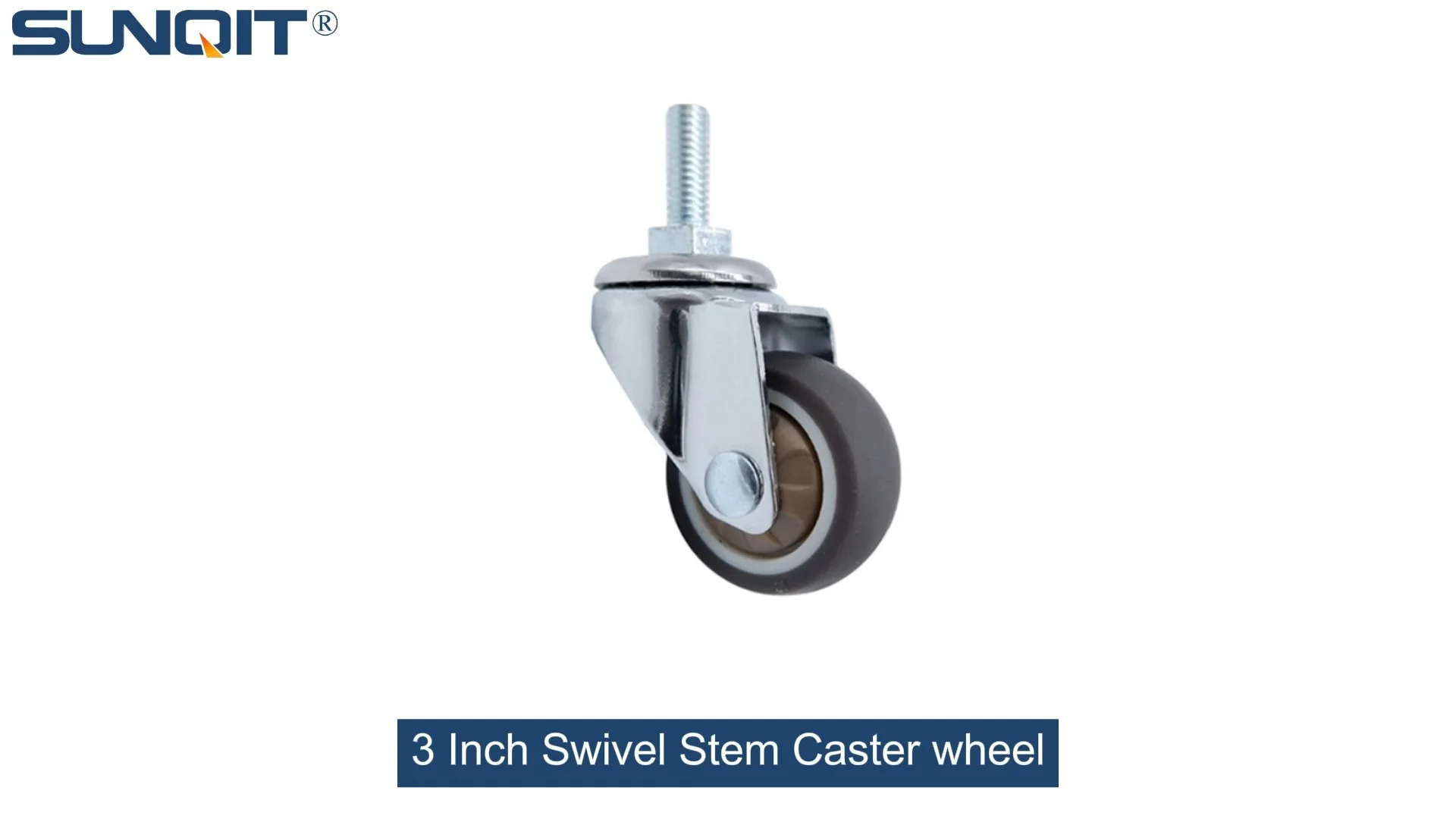
Swivel Stem Caster wheel
360 Degree Swivel Stem Caster. Threaded-post mount design, castors diameter 3 inch.Each swivel caster wheels loading 70KGS. Heavy enough and widely suit for carts, chairs, cabinet, flow rack, workbench, turnover rolley.
In the hustle and bustle of modern warehouses, production floors, and distribution centers, there's a quiet workhorse that often goes unnoticed—until you try to move a heavy rack or trolley without it. We're talking about swivel stem caster wheels. These small but mighty components are the unsung heroes of material handling, turning static storage solutions into agile, adaptable tools that keep operations running smoothly. Today, we're diving deep into why swivel stem caster wheels are non-negotiable for anyone looking to build flexible material racks, enhance workflow efficiency, and embrace the principles of a lean system. Whether you're managing a busy factory floor or optimizing a warehouse layout, understanding the value of these casters will transform how you think about mobility in material handling.
What Are Swivel Stem Caster Wheels, Anyway?
Let's start with the basics. Swivel stem caster wheels are a type of caster (a wheeled device mounted to the bottom of an object) designed to rotate 360 degrees around a vertical axis, allowing the object to move in any direction with minimal effort. Unlike fixed casters, which only roll forward and backward, swivel casters offer unparalleled maneuverability—think of the difference between pushing a shopping cart with fixed wheels versus one with swivel wheels (we've all struggled with the former!).
The "stem" in their name refers to the vertical rod that attaches the caster to the bottom of a rack, trolley, or workbench. This stem is typically inserted into a pre-drilled hole or secured with a nut, making installation straightforward even for those without advanced technical skills. At the top of the stem is the swivel head, a precision mechanism that allows the wheel to rotate smoothly. Below that, you'll find the wheel itself—made from materials like rubber, polyurethane, or steel, depending on the load capacity and floor type—and often a brake lever to lock the wheel in place when stability is needed.
But what really sets swivel stem casters apart is their ability to balance mobility and control. They're not just about moving things from point A to point B; they're about doing so with precision, even in tight spaces. This makes them ideal for material racks, which often need to be repositioned to accommodate shifting inventory, seasonal demand, or production line changes.
Transforming Static Racks: The Case for Material Rack B (3 Row and 3 Floor)
Let's take a concrete example: Material Rack B (3 Row and 3 Floor). This is a common storage solution in warehouses and factories, designed to hold multiple layers of inventory—think small parts, tools, or finished goods. By default, these racks are static, bolted to the floor or left stationary to maximize stability. But here's the problem: in a dynamic environment, static racks become a liability. A sudden rush order might require you to rearrange your layout to prioritize fast-moving items. A new production line might need extra space, forcing you to shuffle racks to make room. Or a maintenance crew might need access to a specific area, requiring racks to be temporarily moved.
Enter swivel stem caster wheels. By adding these casters to the base of Material Rack B, you instantly turn a rigid storage unit into a mobile powerhouse. Suddenly, that 3-row, 3-floor rack isn't stuck in one corner—it can be wheeled to the production line when parts are needed, rolled back to the warehouse when not in use, or even repositioned to create a temporary assembly station. This flexibility isn't just convenient; it's a game-changer for productivity. Workers spend less time walking back and forth to retrieve items, and supervisors can adapt the layout on the fly without calling in a team of movers.
Consider a scenario where a manufacturing plant receives a rush order for a new product. The production team needs quick access to specific components stored in Material Rack B. Without casters, they'd have to unload the rack, move it manually (risking injury and damage), then reload it—a process that could take hours. With swivel stem casters, one worker can simply unlock the brakes, tilt the rack slightly to engage the wheels, and roll it directly to the assembly line. The result? The order is fulfilled on time, and the team avoids unnecessary downtime.

Beyond Racks: Enhancing Turnover Trolley and Rack Systems
Swivel stem caster wheels aren't just for static racks—they're equally vital for turnover trolley and rack systems. Turnover trolleys are the workhorses of material transport, used to move goods between storage, production, and shipping areas. But a trolley is only as good as its casters, and fixed casters here would be a major limitation. Imagine trying to navigate a narrow aisle with a loaded trolley that can only move forward and backward—you'd be constantly stopping to pivot, wasting time and increasing the risk of collisions.
Swivel stem casters solve this problem by allowing the trolley to turn on a dime. Whether you're weaving between workstations or maneuvering around a sudden obstacle (like a misplaced pallet), the 360-degree rotation of the casters ensures smooth, controlled movement. This is especially important for turnover trolleys that carry fragile or high-value items—jerky movements can damage goods, but swivel casters allow for gentle, precise handling.
Take, for example, a pharmaceutical warehouse where turnover trolleys are used to transport temperature-sensitive medications. The aisles are narrow to maximize storage space, and the trolleys must be moved quickly but carefully to maintain product integrity. Swivel stem casters with soft rubber wheels (to absorb shocks) and reliable brakes (to keep the trolley stationary during loading/unloading) make this possible. Workers can navigate tight corners without jostling the cargo, and the brakes ensure the trolley stays put when parked, even on slightly uneven floors.

Supporting Lean Systems: Reducing Waste, Boosting Efficiency
At the heart of any successful material handling strategy is the principles of a lean system. Lean is all about eliminating waste—whether it's time, space, or resources—and optimizing flow to create more value with less effort. Swivel stem caster wheels align perfectly with this philosophy by addressing two key sources of waste: motion waste and waiting waste.
Motion waste refers to unnecessary movement of people or equipment. Without mobile racks and trolleys, workers spend too much time walking to retrieve items or moving heavy objects manually. Swivel stem casters reduce this waste by bringing the materials to the worker, cutting down on steps and fatigue. For example, in a lean manufacturing setup, a production line might use mobile workstations equipped with swivel casters. As the product moves through each stage, the workstation can be repositioned to stay in sync with the flow, eliminating the need for workers to reach or walk long distances.
Waiting waste, on the other hand, occurs when work stops because materials aren't available. Static racks can contribute to this if they're not positioned optimally. With swivel stem casters, material racks can be pre-loaded with the next batch of parts and rolled into place just as the current batch is finishing. This "just-in-time" delivery of materials keeps production lines running without interruption, reducing idle time and increasing throughput.
Moreover, lean systems thrive on adaptability. A production line that can quickly reconfigure to accommodate a new product or a warehouse that can adjust its layout to handle a sudden influx of orders is a lean system in action. Swivel stem casters make this adaptability possible. They turn fixed infrastructure into modular, reconfigurable components that can evolve with your business needs—no costly renovations or downtime required.

Choosing the Right Swivel Stem Caster Wheels: Key Considerations
Not all swivel stem caster wheels are created equal. To get the most out of your material racks and trolleys, you need to choose casters that match your specific needs. Here are the key factors to consider:
Load Capacity
First and foremost, check the load capacity. Each caster is rated to support a maximum weight, and you'll need to account for the total weight of the rack/trolley plus its contents. For Material Rack B (3 Row and 3 Floor), which can hold several hundred pounds of inventory, you'll need casters with a high load rating—typically 200-500 pounds per caster (and remember, most racks have 4 casters, so total capacity is 4x the per-caster rating).
Floor Type
The type of floor in your facility matters. Smooth concrete floors work well with hard wheels (like steel), but if you have polished floors or sensitive surfaces (like epoxy), soft rubber or polyurethane wheels are better—they won't scratch or leave marks. For uneven floors, consider casters with larger wheels or shock-absorbing features to ensure smooth movement.
Environment
Is your facility wet (like a food processing plant), dusty (like a manufacturing shop), or sensitive to static (like an electronics assembly line)? For wet environments, choose casters with rust-resistant materials (like stainless steel). For ESD (electrostatic discharge) areas, look for casters with conductive wheels to dissipate static electricity and protect sensitive components.
Brake Options
Most swivel stem casters come with brake options: either a wheel brake (locks the wheel from rolling) or a total lock (locks both the wheel and the swivel head, preventing movement in any direction). For material racks that need to stay stationary during loading/unloading, total lock brakes are ideal—they prevent accidental shifting, even if someone bumps the rack.
Caster Accessories
Don't overlook caster accessories. Items like stem extenders (for taller racks), floor protectors (to prevent scratches), or replacement wheels (for quick repairs) can extend the life of your casters and improve their performance. For example, if you frequently move racks over thresholds or uneven surfaces, adding a caster with a shock-absorbing spring accessory can reduce wear and tear on both the caster and the rack.
Fixed vs. Swivel Stem Casters: A Quick Comparison
| Feature | Fixed Casters | Swivel Stem Casters |
|---|---|---|
| Maneuverability | Only moves forward/backward; limited to straight paths. | 360° rotation; can move in any direction, ideal for tight spaces. |
| Best For | Heavy, rarely moved objects; straight-line transport. | Frequently repositioned racks, trolleys, or workbenches; dynamic environments. |
| Space Efficiency | Requires more space to turn; may cause bottlenecks in narrow aisles. | Navigates tight spaces easily; reduces aisle width requirements. |
| Workflow Impact | May slow down processes due to limited mobility. | Speeds up workflows by enabling quick, on-demand repositioning. |
| Typical Applications | Large storage racks bolted to the floor; stationary workbenches. | Material Rack B (3 Row and 3 Floor); turnover trolley and rack systems; mobile workstations. |
Real-World Success: How Swivel Stem Casters Transformed a Manufacturing Floor
To put this all into perspective, let's look at a real-world example. A mid-sized automotive parts manufacturer was struggling with inefficient material handling. Their production line relied on static Material Rack B units, which meant workers had to walk 50-100 feet to retrieve parts for each assembly station. This led to wasted time (an estimated 2 hours per worker per day) and frequent delays when parts ran out unexpectedly.
The solution? Outfitting their Material Rack B units with swivel stem caster wheels. They chose heavy-duty polyurethane wheels (to protect their concrete floors) with total-lock brakes (to keep the racks stable during use). Almost immediately, they saw results: workers could now roll the racks directly to their workstations, reducing walking time by 75%. The racks were also repositioned overnight to create a U-shaped production line, which cut down on material transport distances even further.
But the benefits didn't stop there. By embracing mobile racks, the manufacturer was able to implement a more flexible shift schedule. During the day shift, the racks held high-volume parts; during the night shift, they were swapped out for low-volume, specialty parts—no need to build separate storage areas. This adaptability helped the company increase production output by 20% within six months, all while reducing labor costs and improving worker satisfaction (no more sore feet from constant walking!).
Conclusion: Small Casters, Big Impact
Swivel stem caster wheels may seem like small components, but their impact on material handling efficiency is enormous. They transform static, rigid racks into dynamic, mobile tools that adapt to your workflow, support lean system principles, and make even the heaviest loads easy to move. Whether you're using Material Rack B (3 Row and 3 Floor) in a warehouse, turnover trolley and rack systems in a factory, or mobile workstations in a distribution center, these casters are the key to unlocking flexibility, reducing waste, and boosting productivity.
So the next time you're evaluating your material handling setup, don't overlook the humble swivel stem caster wheel. It might just be the unsung hero your operation needs to thrive in today's fast-paced, ever-changing business landscape. After all, in the world of material handling, mobility isn't a luxury—it's a necessity. And swivel stem caster wheels deliver mobility in spades.