- Company Articles
- Products and Technology
- Product knowledge
- T Slot Aluminum Pipe with Board Holder: Bearing Capacity for Electronic Components

T Slot Aluminum Pipe with Board Holder: Bearing Capacity for Electronic Components
Related Product
T Slot Aluminum Pipe with Board Holder
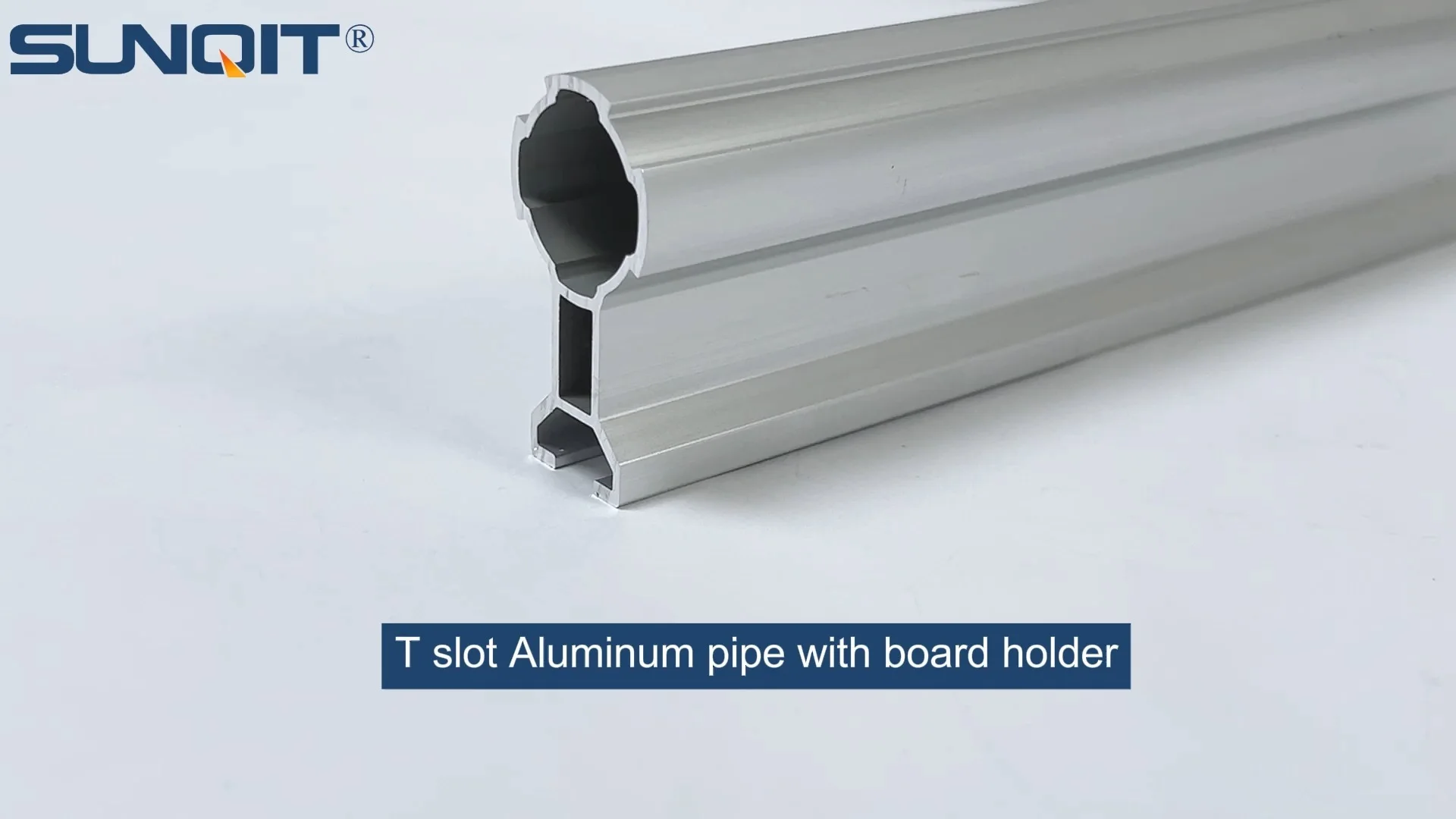
T slot Aluminum pipe with board holder,the pipe one side connected by a joint, the other side with a slot which can hold a tray or a aluminum pannel
Walk into any bustling electronics manufacturing facility today, and you'll likely notice a common thread tying together efficient assembly lines, organized workstations, and smooth material flow: aluminum. From the workbenches where technicians solder delicate circuit boards to the roller tracks that carry components between stations, aluminum's versatility has made it a backbone of modern production. Among its many forms, one component stands out for its ability to balance strength, flexibility, and precision: the T-slot aluminum pipe with board holder. In this article, we'll dive into why this unassuming tool has become indispensable in electronic manufacturing, focusing on its critical role in bearing the weight of sensitive components while keeping operations lean and adaptable.
What Is a T-Slot Aluminum Pipe with Board Holder?
Let's start with the basics. A T-slot aluminum pipe is exactly what it sounds like: a length of aluminum extrusion with a T-shaped groove running along its length. This groove isn't just a design quirk—it's a gateway to customization. It allows you to slide in, bolt on, or clamp a wide range of aluminum profile accessories, from brackets and shelves to, yes, board holders. The board holder itself is a specialized attachment that creates a flat, stable surface (the "board") mounted to the aluminum pipe, designed to hold everything from PCBs (printed circuit boards) and component trays to tools and documentation.
Think of it as a modular building block. Unlike fixed wooden or steel shelves, which are stuck in one configuration, the T-slot system lets you adjust the board holder's height, angle, or even add extra layers as your needs change. For electronics manufacturers, where product lines shift frequently and component sizes vary, this adaptability is a game-changer. But there's more to it than just flexibility—what really makes this setup shine is its ability to reliably support weight, which brings us to the heart of the matter: bearing capacity.
The Critical Role of Bearing Capacity in Electronic Manufacturing
When we talk about "bearing capacity" here, we're referring to how much weight the T-slot aluminum pipe with board holder can safely support without bending, warping, or failing. At first glance, you might think, "Electronic components are small—how much weight can they really be?" But let's break it down. A single PCB might be lightweight, but when you stack dozens of them in a tray, or add tools like soldering irons, magnifying lamps, and anti-static mats to the workbench, the pounds add up. Then there are larger components: power supplies, display panels, or even small assembly jigs, which can weigh several kilograms. Add to that the constant motion of a busy factory—vibrations from machinery, technicians leaning on the workbench, or components being slid on and off the board—and suddenly, a flimsy setup becomes a recipe for damaged parts, delays, or even safety hazards.
For electronic components, in particular, bearing capacity isn't just about "holding weight"—it's about holding it steadily . A warped board or a sagging pipe could tilt a tray of sensitive microchips, causing them to shift and scratch. It could misalign a PCB during assembly, leading to soldering errors. Or, in worst-case scenarios, it could cause the board to collapse entirely, ruining expensive components. That's why manufacturers don't just look for "strong enough"—they need a system they can trust to maintain stability day in, day out, even under repeated use.

Key Features That Enhance Bearing Performance
So, what makes a T-slot aluminum pipe with board holder so good at bearing weight? It's a combination of material science, smart design, and attention to detail. Let's unpack the features that matter most:
1. Aluminum's Strength-to-Weight Ratio
Aluminum is famous for being lightweight, but don't let that fool you—it's surprisingly strong. Pure aluminum isn't the sturdiest, but the aluminum used in these pipes is typically an alloy (like 6063 or 6061) that's heat-treated to boost its strength. This gives it a remarkable strength-to-weight ratio: it can support heavy loads without adding unnecessary bulk. For example, a 2-meter length of 40mm T-slot aluminum pipe (a common size) might weigh just 1.5kg but can easily bear 50kg or more when properly mounted. That's crucial in tight factory spaces where heavy steel setups would be cumbersome and hard to reconfigure.
2. The T-Slot Design: Distributing Weight Evenly
The T-slot isn't just for accessories—it plays a role in strength, too. The groove reinforces the pipe's structure, acting like a rib to prevent bending. When you mount a board holder into the T-slot, the connection is secure and evenly distributed. Unlike a single screw or nail, which concentrates stress in one spot, the T-slot allows the board holder to clamp along the pipe's length, spreading the weight across a wider area. This reduces the risk of stress fractures or warping, even when the load is uneven (like a tray of components stacked off-center).
3. Reinforced Board Holders: Stiffness Matters
The board itself is often made from aluminum composite or thick plywood (sometimes with a metal backing) to add stiffness. A flexible board would bow under weight, but a rigid one keeps the surface flat. Many board holders also include cross-bracing or extra support brackets (another example of aluminum profile accessories) that connect back to the T-slot pipe, creating a triangular support system—engineers love triangles for their stability. This design ensures that even if you place a heavy object near the edge of the board, the weight is transferred down to the pipe, not just relying on the board's own strength.
4. Precision Manufacturing: No Weak Links
Finally, the quality of the aluminum extrusion matters. Reputable lean system suppliers use precision dies to create T-slots with consistent dimensions, ensuring that the groove and pipe walls are uniform. Any inconsistency—a thinner section here, a misaligned slot there—could become a weak point. Cheaply made pipes might save money upfront, but they'll fail faster under load, costing more in the long run.

Real-World Applications: How It Supports Electronic Components
Let's move from theory to practice. How do manufacturers actually use T-slot aluminum pipes with board holders to support electronic components? Here are a few common scenarios:
Assembly Workstations
Imagine a workbench where a technician assembles smartwatch PCBs. The workbench's frame is built from T-slot aluminum pipes, with a board holder at waist height serving as the main workspace. On this board, they place a (anti-static) mat, a tray of tiny capacitors and resistors, and a small PCB holder. The board needs to support the weight of the tools (maybe 2-3kg), the component trays (another 1-2kg), and the technician's occasional lean (up to 50kg of force). Thanks to the aluminum pipe's bearing capacity, the board stays steady, preventing the PCB from shifting during soldering. If the next product line requires a taller workspace, the T-slot system lets the team adjust the board holder's height in minutes—no need to build a whole new workbench.
Component Storage Racks
In warehouses or stockrooms, T-slot aluminum pipes with board holders are often used to build vertical storage racks for component trays. Each board holder acts as a shelf, holding stacks of ESD (electrostatic discharge) trays filled with ICs (integrated circuits) or connectors. A typical setup might have 3-4 shelves per rack, each supporting 15-20kg of trays. The aluminum pipes' strength ensures the shelves don't sag over time, and the T-slot allows for adding dividers or label holders (more aluminum profile accessories) to keep components organized. Unlike wooden shelves, which can warp with humidity, aluminum resists corrosion and maintains its shape, even in the temperature-controlled environments electronics require.
In-Line Material Flow
On the production line, T-slot aluminum pipes with board holders often work alongside roller tracks to move components between stations. For example, after a PCB is populated with components, it might need to be inspected. The inspection station could have a board holder mounted to aluminum pipes, positioned at the end of a roller track. The PCB slides off the roller track onto the board holder, which supports it while the inspector checks for defects. The board holder's flat surface ensures the PCB lies perfectly still, and its bearing capacity means it can handle multiple PCBs at once during peak production.
Comparing with Traditional Materials: Why Aluminum Stands Out
To really appreciate the T-slot aluminum pipe with board holder, let's compare it to the materials it's replacing: wood, steel, and plastic.
| Material | Bearing Capacity (per meter) | Weight (per meter) | Flexibility | Durability |
|---|---|---|---|---|
| Wood (Pine Shelving) | 30-40kg (sags over time) | 5-7kg | Fixed (no customization) | Prone to warping, rot, and scratches |
| Steel (Square Tubing) | 80-100kg (high strength) | 10-15kg | Limited (welding required for changes) | Resistant to damage but heavy and prone to rust |
| Plastic (PVC Pipe) | 10-15kg (low strength) | 1-2kg | Some (but limited accessory options) | Weak to heat and UV light; bends easily |
| T-Slot Aluminum Pipe | 50-70kg (stable, no sagging) | 1.5-3kg | High (T-slot accepts accessories) | Corrosion-resistant, lightweight, no warping |
Wood is cheap but flimsy. It might handle light loads initially, but over time, it sags under constant weight, especially in humid environments. Steel is strong but heavy—try moving a steel workbench across the factory floor, or reconfiguring it for a new product line. Plastic is lightweight but too weak for most manufacturing needs. Aluminum, though, hits the sweet spot: it's strong enough to replace steel in many cases, light enough to move easily, and flexible enough to adapt to changing needs. For electronic components, which demand both strength and precision, it's hard to beat.
Aluminum Profile Accessories: Expanding Functionality Without Sacrificing Strength
One of the best things about T-slot aluminum pipes is how they play well with others—specifically, aluminum profile accessories. These accessories don't just add features; they enhance the system's bearing capacity by reinforcing connections and distributing weight more effectively. Let's look at a few examples:
- Corner Brackets: These L-shaped pieces bolt into the T-slot to connect two pipes at a 90° angle, creating a sturdy frame for the board holder. They add rigidity, preventing the structure from wobbling under load.
- Cross Connectors: When building a multi-level setup (like a workbench with upper and lower board holders), cross connectors link vertical and horizontal pipes, spreading weight across the entire frame instead of concentrating it on a single pipe.
- End Caps: Simple but essential, these plastic or aluminum caps fit over the ends of the T-slot pipe, preventing dust and debris from clogging the groove and ensuring a clean, safe edge—important when components are being slid on and off the board.
- Reinforced Shelf Supports: For heavier loads, you can add extra supports that bolt into the T-slot and under the board holder, acting like "legs" to lift some weight off the main pipe.
The beauty of these accessories is that they're designed to work with the T-slot system, so you don't have to drill holes or weld—just slide them in and tighten a screw. This means you can boost bearing capacity on the fly, whether you're adding a new tool to the workbench or storing heavier components.
Choosing the Right Lean System Supplier for Your Needs
By now, you're probably convinced that a T-slot aluminum pipe with board holder is a smart investment for your electronic manufacturing operation. But here's the catch: not all aluminum extrusions are created equal. The quality of the material, the precision of the T-slot, and the reliability of the board holder attachments can vary drastically between suppliers. That's why choosing the right lean system supplier is just as important as choosing the product itself.
What should you look for in a supplier? Start with material certification—reputable suppliers will use aluminum alloys (like 6063-T5) that meet industry standards for strength and durability. Ask about their manufacturing process: do they use precision extrusion dies to ensure consistent T-slot dimensions? Inconsistent slots can make it hard to attach accessories, weakening the overall structure. Then, check their range of aluminum profile accessories—having options means you can customize the system to your exact needs without cobbling together parts from different brands.
Finally, look for a supplier that understands lean manufacturing. A good lean system supplier won't just sell you pipes and board holders—they'll help you design a setup that reduces waste, improves workflow, and scales with your business. They might even offer samples so you can test the bearing capacity with your actual components before placing a large order. After all, the goal isn't just to buy a product—it's to build a more efficient, reliable production line.
Conclusion: More Than Just a Pipe—A Foundation for Precision
At the end of the day, the T-slot aluminum pipe with board holder might not be the flashiest piece of equipment in your factory, but it's one of the most essential. It's the quiet workhorse that ensures your electronic components are supported safely, your workstations adapt to change, and your operations stay lean. By combining aluminum's strength, the T-slot's flexibility, and the board holder's precision, it solves a critical challenge in electronics manufacturing: how to handle delicate, varied, and sometimes heavy components with consistency and care.
Whether you're assembling smartphones, IoT devices, or industrial control systems, the right setup can make the difference between smooth production and costly delays. So the next time you walk through your facility, take a closer look at those aluminum pipes and board holders. They might just be the unsung heroes keeping your operation running—and your components safe.