- Company Articles
- Products and Technology
- Application Cases
- T Slot Aluminum Pipe with Board Holder in Electronics Manufacturing: Case Studies

T Slot Aluminum Pipe with Board Holder in Electronics Manufacturing: Case Studies
Related Product
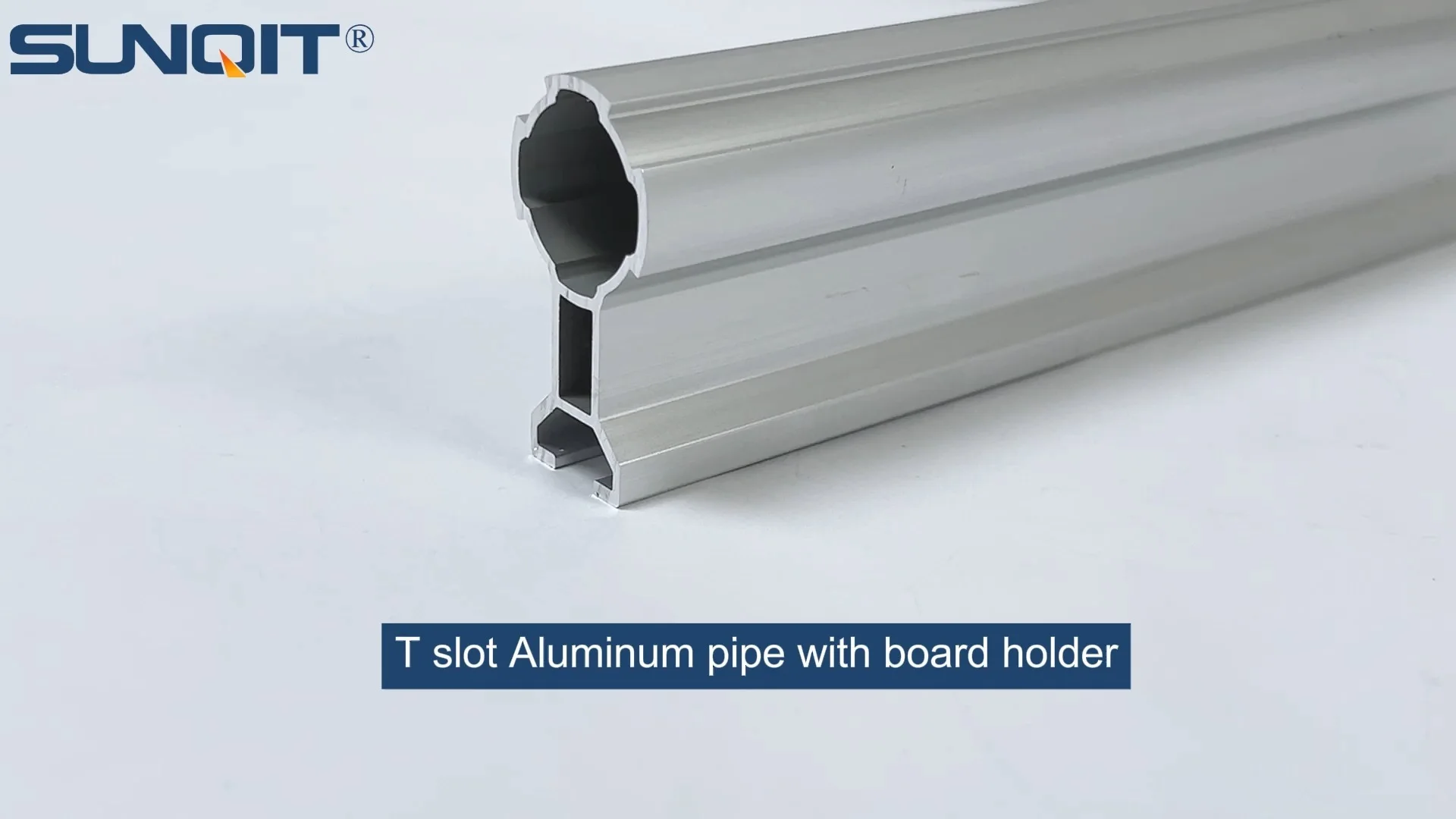
T Slot Aluminum Pipe with Board Holder
T slot Aluminum pipe with board holder,the pipe one side connected by a joint, the other side with a slot which can hold a tray or a aluminum pannel
How a simple, adaptable tool is transforming workspaces, boosting efficiency, and putting people at the center of lean manufacturing
The Heartbeat of Electronics Manufacturing—And the Hidden Struggles
Walk into any electronics manufacturing facility, and you'll hear the hum of machinery, the precise click of components being placed, and the quiet focus of technicians hunched over workbenches. It's a world where milliseconds matter, where a single misplaced resistor can derail a batch, and where the pressure to innovate and scale is constant. But behind the scenes, there's a quieter challenge: the workspace itself.
For decades, manufacturers have relied on rigid setups—fixed workbenches bolted to the floor, clunky metal racks that resist reconfiguration, and toolboards that seem to collect more dust than actual tools. These spaces weren't designed for the realities of modern electronics manufacturing: frequent product launches, small-batch customization, and the need to adapt on the fly. The result? Wasted time. Frustrated employees. And a hidden cost that eats into profits: inefficiency.
Enter the T Slot Aluminum Pipe with Board Holder—a deceptively simple solution that's quietly revolutionizing how electronics factories operate. More than just a piece of hardware, it's a tool that bends to the needs of the people using it, turning chaotic workspaces into hubs of productivity. In this article, we'll dive into real-world case studies of manufacturers who've embraced this technology, exploring how it solved their unique pain points and why it's become a cornerstone of lean system adoption in the industry.
What is T Slot Aluminum Pipe with Board Holder? A Quick Overview
At its core, the T Slot Aluminum Pipe with Board Holder is a modular system built around lightweight, durable aluminum profiles—extruded aluminum pipes with a T-shaped groove running along their length. This groove isn't just a design quirk; it's the secret to the system's flexibility. It allows for easy attachment of accessories: brackets, hooks, shelves, and, of course, the board holder itself.
The board holder, typically a flat, sturdy panel (often ESD-safe for electronics work), becomes the command center of the workstation. It can hold tools, work instructions, small parts bins, or even digital tablets for real-time data access. And because the T Slot Aluminum Pipe is modular, the entire setup—from the height of the board to the placement of accessories—can be adjusted in minutes, no welding or heavy tools required.
Think of it as building with adult Legos, but for manufacturing. Need to add a new tool hook? Slide a bracket into the T-slot and tighten a screw. Want to raise the board holder to reduce back strain for taller technicians? Loosen the joints, adjust, and lock it in place. This adaptability makes it a natural fit for lean systems, where the goal is to eliminate waste—whether that's wasted time, space, or effort.

Case Study 1: Small Batch, Big Impact—A Startup's Fight Against Setup Fatigue
MicroCircuit Innovations: Custom Circuit Boards for Medical Devices
MicroCircuit Innovations is the kind of company that makes the electronics industry exciting. Based in a 5,000-square-foot facility outside Boston, their 15 employees design and build custom circuit boards for medical devices—think heart rate monitors, insulin pumps, and portable diagnostic tools. The work is high-stakes: every board must meet strict FDA standards, and clients often need small batches (as few as 10 units) with tight turnaround times.
But by 2023, their success was starting to backfire. "We were winning more contracts, but our production floor felt like a maze," says Mia Chen, the company's lead manufacturing technician. "Our workbenches were these old wooden tables with fixed shelves. Every time we switched from a heart monitor board to a pump controller, we'd spend 2 hours tearing down the old setup—unbolting shelves, moving toolboxes, repositioning ESD mats—and rebuilding it. By the time we were ready, half the day was gone."
The problem wasn't just time. Technicians were growing frustrated. "I'd spend 10 minutes hunting for a specific screwdriver because it had rolled off the table and into a bin of resistors," Mia recalls. "Or I'd have to bend over to reach parts on the bottom shelf, which killed my back by Friday. We were making great products, but the workspace was fighting us."
The Turning Point: A Supplier's Demo That Changed Everything
In early 2024, MicroCircuit's operations manager, Raj Patel, attended a manufacturing trade show. There, he stumbled on a booth showcasing T Slot Aluminum Pipe with Board Holder systems. "The rep set up a basic workstation in 10 minutes—board holder, tool hooks, a small parts bin—then tore it down and rebuilt it as a mini flow rack, all without tools," Raj says. "I thought, 'This is exactly what we need.'"
MicroCircuit partnered with a local supplier to outfit three workstations with T Slot Aluminum Pipe systems. They customized each with:
- Adjustable board holders at standing height (36 inches) with ESD-safe surfaces
- Tool hooks for screwdrivers, tweezers, and wire cutters, positioned at shoulder height
- Sliding bins for small parts, mounted under the board holder
- Tablet mounts for digital work instructions (no more printed manuals cluttering the space)
The Results: Setup Time Cut by 62%—and Happy Technicians
The impact was immediate. "Our first big test was a batch of 25 circuit boards for a new insulin pump," Mia says. "Before, setup would've taken 2 hours. With the new system? 45 minutes. We just slid the old tool hooks off, popped on the new ones, and adjusted the parts bins. It was like magic."
Over six months, MicroCircuit tracked key metrics:
| Metric | Before T Slot System | After T Slot System | Improvement |
|---|---|---|---|
| Batch Setup Time | 120 minutes | 45 minutes | -62.5% |
| Tool Retrieval Time per Shift | 45 minutes | 18 minutes | -60% |
| Employee Back Pain Complaints | 8 per month | 2 per month | -75% |
| On-Time Delivery Rate | 82% | 97% | +15% |
But the numbers only tell part of the story. "The technicians started coming in early," Raj laughs. "They'd tweak their workstations on their own—adding a second parts bin, adjusting the board angle—because it was so easy. Mia even decorated hers with a small plant. That's when I knew we'd made the right call. It wasn't just a workstation upgrade; it was a morale boost."
"I used to dread batch changes. Now? I actually look forward to them. It's like solving a puzzle, not fighting a battle." — Mia Chen, Lead Technician

Case Study 2: Scaling Up Without the Chaos—A Mid-Sized Firm's Battle Against Bottlenecks
PowerTech Electronics: Consumer Gadgets and the Race to Keep Up with Demand
PowerTech Electronics is a different beast. With 200 employees and a 50,000-square-foot facility in Austin, Texas, they churn out consumer electronics—smartphone chargers, Bluetooth earbuds, and smartwatch batteries—by the tens of thousands. In 2023, their revenue jumped 40% after landing a contract with a major retail chain, and suddenly, their production lines were drowning in growth.
"We went from 3 assembly lines to 5 in six months, but our flow racks and workstations couldn't keep up," says Carlos Mendez, PowerTech's production floor manager. "The old flow racks were these rigid steel structures—you couldn't adjust the height or the spacing between shelves. So parts would pile up on the floor, or technicians would have to walk 20 feet to grab a component. And ESD was a nightmare: we were losing 5% of PCBs monthly to static damage because the workbenches weren't grounded properly."
Worst of all was the bottleneck at the "kitting" station, where components (resistors, capacitors, chips) were sorted into bins for assembly. "The kitting table was a disaster," Carlos recalls. "Workers had to reach across each other to grab bins, and the paper work instructions kept getting crumpled or lost. We were averaging 120 kits per hour—nowhere near enough to feed the assembly lines."
The Solution: T Slot Aluminum Pipe Systems Across the Floor
PowerTech's engineering team had heard about T Slot Aluminum Pipe from industry peers, but they were skeptical. "We thought, 'This is for small shops, not big production lines,'" Carlos admits. But after a trial with one kitting station, they were sold. Over three months, they rolled out the system across:
- All 5 assembly lines (workstations with T Slot Aluminum Pipe and board holders)
- 10 flow racks (using T Slot Aluminum Pipe and roller tracks for smoother material flow)
- The kitting area (3 custom T Slot workstations with dual board holders)
For the kitting stations, the board holders became the star. "We mounted two board holders per station—one for the work instructions (on a tablet) and one for the bins," Carlos explains. "Each bin snaps into a bracket on the board, so workers can slide it right in front of them. No more reaching. And because the T Slot Pipe is ESD-safe, we grounded the whole setup—no more static zaps, no more damaged PCBs."
The Results: 28% Faster Material Flow and a 76% drop in ESD Damage
By the end of the first quarter, PowerTech's metrics told a clear story. The kitting station, once the bottleneck, was now their most efficient process, churning out 174 kits per hour. Material flow time—the time it took for parts to move from the warehouse to the assembly line—dropped from 45 minutes to 32 minutes. And ESD damage? Down to 1.2% of PCBs monthly.
| Metric | Before T Slot System | After T Slot System | Improvement |
|---|---|---|---|
| Kitting Rate (kits/hour) | 120 | 174 | +45% |
| Material Flow Time (warehouse to line) | 45 minutes | 32 minutes | -28% |
| ESD-Related Defects | 5% of PCBs | 1.2% of PCBs | -76% |
| Production Output (units/day) | 8,500 | 9,800 | +15% |
Carlos says the biggest win wasn't on the spreadsheet, though. "The technicians love it. One worker, Maria, has been here 10 years—she came up to me and said, 'Finally, they built a workspace that doesn't make me feel like a robot.' That's the power of this stuff. It's not just about efficiency; it's about respect."
Case Study 3: Enterprise-Level Efficiency—GlobalTech's Fight Against Waste and Turnover
GlobalTech Components: Automotive Electronics and the Cost of Inconsistency
GlobalTech Components is a manufacturing giant. With 1,200 employees across three facilities, they supply critical electronics to automotive companies—think engine control modules, infotainment systems, and ADAS (advanced driver-assistance systems) sensors. For GlobalTech, efficiency isn't just about speed; it's about consistency. A single defective sensor could lead to a recall, costing millions.
But by 2024, two problems were plaguing their main plant in Detroit: waste and turnover. "We were spending $300K annually on excess inventory because parts were getting lost in the shuffle," says Elaine Harper, GlobalTech's lean manufacturing director. "And turnover on the assembly line was 25%—new hires took 8 weeks to get up to speed because every workstation was different. One line had wooden workbenches, another had metal ones; some had toolboards, others didn't. It was chaos."
Elaine's team had tried traditional lean fixes—5S audits, standardized work instructions—but the workstation inconsistency kept undermining their efforts. "We'd train a new hire on Line A, then move them to Line C, and they'd be lost," she says. "And the inventory waste? We'd order extra parts 'just in case,' because we couldn't trust the flow racks to keep things organized."
The Plan: Standardize with T Slot Aluminum Pipe—Across All Lines
Elaine's team spent six months researching solutions before settling on T Slot Aluminum Pipe with Board Holder. "We needed something that was flexible but also standardizable," she explains. "T Slot let us design a 'golden workstation'—the optimal setup for each task—and replicate it across lines. And because it's modular, we could still tweak it for specific products without losing consistency."
GlobalTech partnered with a supplier to build 120 standardized workstations, each with:
- A T Slot Aluminum Pipe frame with height-adjustable board holder (ESD-safe, of course)
- Standardized tool placement (e.g., screwdrivers on the left, tweezers on the right)
- Integrated flow racks (using T Slot Aluminum Pipe and roller tracks) feeding parts directly to the workstation
- Digital display mounts for real-time production metrics (connected to GlobalTech's ERP system)
They also added "quick-change" kits for each product line—pre-assembled sets of accessories (bin holders, tool hooks) that could be swapped out in 15 minutes when switching between products like infotainment systems and ADAS sensors.
The Results: $200K in Annual Savings—and New Hires Productive in 4 Weeks
It took a year to fully roll out the system, but the payoff was massive. By standardizing workstations, GlobalTech cut training time for new hires in half—from 8 weeks to 4. "Now, a new hire trains on one line, then moves to another, and everything is in the same place," Elaine says. "It's like walking into a familiar room, not a foreign country."
Inventory waste plummeted, too. "With the T Slot flow racks, we can track parts visually—no more 'missing' bins," Elaine explains. "We reduced our 'just in case' inventory by 40%, saving $200K annually."
| Metric | Before T Slot System | After T Slot System | Improvement |
|---|---|---|---|
| New Hire Training Time | 8 weeks | 4 weeks | -50% |
| Annual Inventory Waste Cost | $300,000 | $100,000 | -67% |
| Line Turnover Rate | 25% | 12% | -52% |
| Quality Control Rejection Rate | 2.3% | 1.1% | -52% |
For Elaine, the most rewarding part has been the cultural shift. "Lean manufacturing is about respect for people, not just cutting costs," she says. "When workers see that we invested in a workspace that's designed for them—one that's comfortable, organized, and adaptable—they take more pride in their work. And that's priceless."
"Before, I felt like a cog in a machine. Now? I feel like part of a team that cares about how I work. That's why I stayed." — James, Assembly Line Technician, GlobalTech
Beyond the Board Holder: Why T Slot Aluminum Pipe Stands Out in Electronics Manufacturing
These case studies highlight a few key reasons T Slot Aluminum Pipe with Board Holder has become a staple in electronics manufacturing:
1. Flexibility That Grows with Your Business
Whether you're a 15-person startup or a 1,200-person enterprise, your needs change. A new product line, a bigger team, or a shift to remote work (for office-based setups) can render fixed workspaces obsolete. T Slot Aluminum Pipe adapts. MicroCircuit scaled from 3 to 5 workstations without replacing the system; PowerTech added flow racks as they expanded lines. It's a one-time investment that grows with you.
2. ESD Safety Built In
Electronics manufacturing can't afford static electricity. Many T Slot Aluminum Pipe systems are available with ESD-safe components—board holders with conductive surfaces, grounded joints, and ESD mats. PowerTech and GlobalTech both cited reduced ESD damage as a key win, and for good reason: even a small reduction (from 5% to 1.2% at PowerTech) saves thousands in scrap and rework.
3. Ergonomics That Protect Your Team
Manufacturing is physical work. Bending, reaching, and repetitive motions take a toll on bodies—and morale. T Slot Aluminum Pipe lets you adjust workstations to fit people, not the other way around. At MicroCircuit, adjustable board holders cut back pain complaints by 75%; at GlobalTech, height-adjustable setups reduced fatigue during 10-hour shifts. Happier, healthier employees stay longer and work better.
4. Compatibility with Lean Tools
From 5S (sort, set in order, shine, standardize, sustain) to Kaizen (continuous improvement), T Slot Aluminum Pipe supports lean principles. The modular design makes it easy to "set in order" (5S) and standardize workstations. And because it's so easy to reconfigure, teams can experiment with improvements (Kaizen) without waiting for engineering approval. "We had a technician suggest adding a small shelf for coffee cups—we did it in 10 minutes," Carlos from PowerTech laughs. "That's Kaizen in action."
Conclusion: It's Not Just About Pipes and Boards—It's About People
Walk through MicroCircuit, PowerTech, or GlobalTech today, and you'll see T Slot Aluminum Pipe with Board Holder systems hard at work. But look closer, and you'll see something more important: people. Technicians who no longer waste time searching for tools. New hires who feel confident instead of confused. Managers who can focus on innovation instead of fixing workspace chaos.
Electronics manufacturing is often celebrated for its cutting-edge technology—the tiny chips, the sleek devices, the futuristic factories. But at the end of the day, it's people who build those devices. And people thrive in spaces that respect their needs: flexibility, safety, and a sense of control over their work.
T Slot Aluminum Pipe with Board Holder doesn't just organize tools or speed up production lines. It organizes success—for your team, your products, and your bottom line. In a world where manufacturing is more competitive than ever, that's not just an advantage. It's a necessity.