- Company Articles
- Products and Technology
- Product knowledge
- Testing Anti-Slip Adjustable Leveling Feet: Load and Slip Resistance Checks

Testing Anti-Slip Adjustable Leveling Feet: Load and Slip Resistance Checks
Related Product
Anti-slip Adjustable Leveling Feet
Anti-slip Adjustable Leveling Feet are designed to keep machines level when placed on uneven or sloped ground, the rubber base will prevent product slip during work.
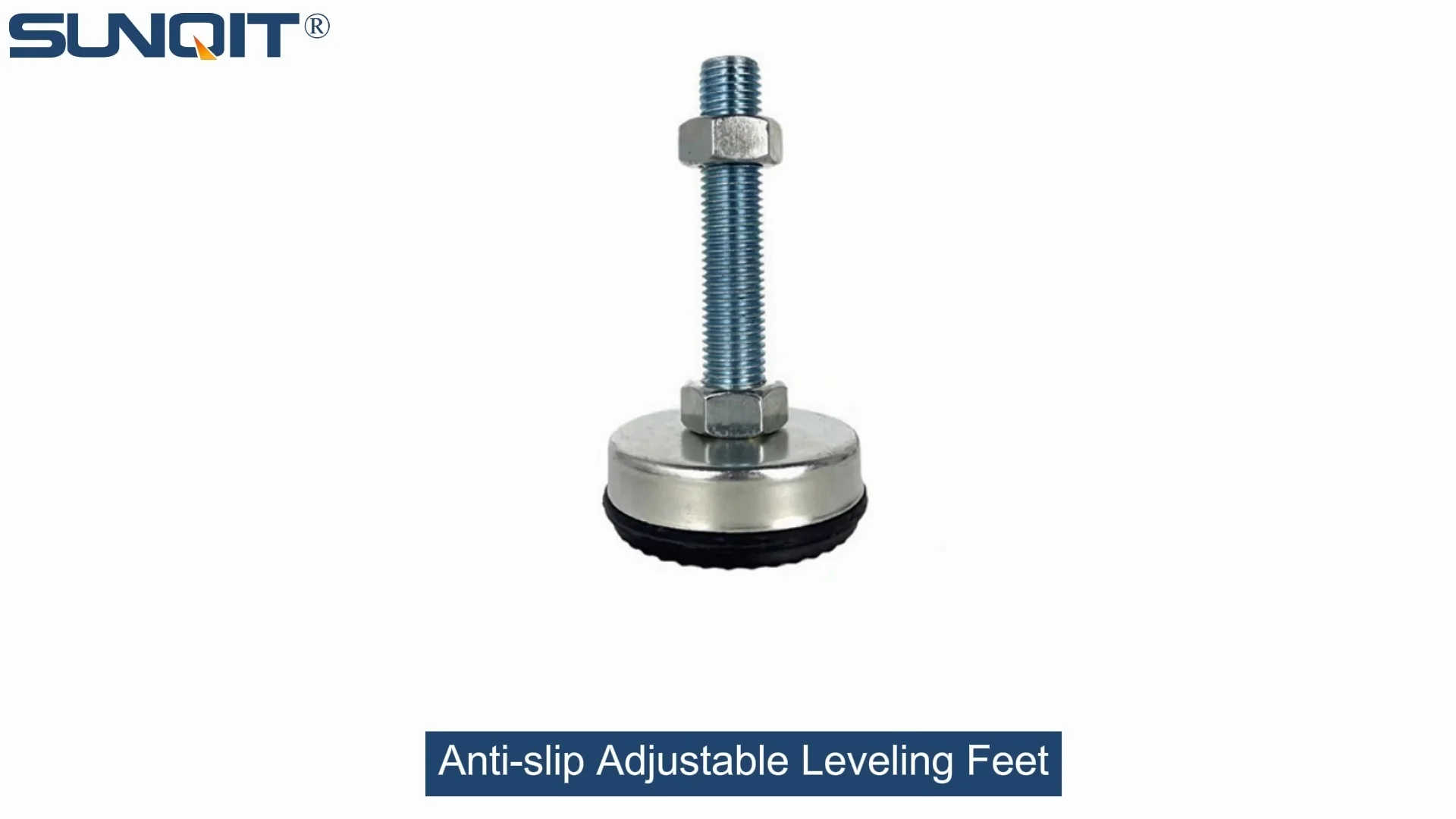
In the world of manufacturing and industrial workspaces, it's often the smallest components that hold the biggest impact. Take, for example, the anti-slip adjustable leveling feet under your workbench or the aluminum profile structures lining your production floor. These unassuming parts might not grab headlines, but they're the unsung heroes keeping operations stable, safe, and efficient. Today, we're diving deep into what makes these feet so critical—specifically, how they're tested for load capacity and slip resistance. Because when a leveling foot fails, the consequences can range from a wobbly workstation to costly product defects, or worse, workplace accidents. Let's unpack why testing matters, how it's done, and what these tests reveal about the reliability of the components that keep our workspaces grounded.
Why Anti-Slip Adjustable Leveling Feet Deserve Your Attention
Before we jump into testing, let's get clear on what anti-slip adjustable leveling feet actually do. Picture a busy assembly line: workbenches cluttered with tools, aluminum profile racks stacked with parts, and workers moving quickly to meet deadlines. Now, imagine one of those workbenches is slightly uneven. Maybe the floor isn't perfectly level, or the caster accessories (which let the bench roll when needed) have worn down. Without proper leveling, that bench might wobble. A wobbly bench means tools slide, parts shift, and precision goes out the window. Enter anti-slip adjustable leveling feet: they screw into the base of equipment, letting you tweak height to compensate for uneven surfaces, and their rubber or textured bases grip the floor to prevent slipping. Simple, right? But simplicity doesn't mean they're low-stakes. In fact, their role in safety and productivity is massive.
Consider a electronics manufacturing plant where delicate circuit boards are assembled on workbenches. If the leveling feet under those benches can't handle the load of the equipment—say, a heavy soldering station plus a bin of components—the feet might compress or crack. That could tilt the bench, causing a circuit board to slip mid-solder, ruining hours of work. Or, in a warehouse, if the feet on a material rack (built with aluminum profile frames) lose their grip on a smooth concrete floor, the rack might shift, risking a collapse. These scenarios aren't just hypothetical; they're why manufacturers and suppliers invest so much in rigorous testing.
The Basics of Load Capacity Testing: How Much Weight Can They Really Handle?
Load capacity is the first big test for any leveling foot. Put simply: how much weight can the foot support before it bends, breaks, or loses its ability to adjust? To find out, testing labs and suppliers follow strict protocols that mimic real-world conditions. Let's walk through a typical load test step-by-step.
Setting Up the Test
First, you need samples. Suppliers usually test multiple feet from the same batch to account for variability—no two components are identical, even in mass production. The feet are mounted to a test rig that simulates how they'd attach to actual equipment, like a workbench or aluminum profile frame. The rig is bolted to a stable base (often concrete) to eliminate external movement, and a hydraulic press or weight stack is positioned above to apply downward force.
Applying Weight: Static vs. Dynamic Loads
Load tests come in two flavors: static and dynamic. Static testing applies a constant weight over time—think of a workbench loaded with tools that rarely moves. Dynamic testing, on the other hand, mimics sudden shifts, like when a worker places a heavy box on a shelf or a machine starts up, creating vibrations. For anti-slip adjustable leveling feet, static load is the baseline, but dynamic load tests are crucial for high-activity environments.
Let's focus on static load first. The test starts with a "working load"—the weight the foot is rated to handle in everyday use. For example, a standard foot might be rated for 500 kg per unit. The press applies this load gradually, holding it for 24 hours. During this time, testers measure for deflection: does the foot compress or bend under the weight? Even minor deflection can be a problem over time, as repeated stress weakens the material. After 24 hours, the load is increased to 125% of the rated capacity (in our example, 625 kg) for another 24 hours. This "overload test" checks for failure points—cracks in the metal body, stripping of the adjustment threads, or separation of the anti-slip pad from the base.
| Test Stage | Weight Applied (kg) | Duration | What We Measure | Pass/Fail Criteria |
|---|---|---|---|---|
| Baseline Load | 500 (rated capacity) | 24 hours | Deflection (mm), thread stability | No deflection > 0.5mm; threads remain functional |
| Overload Test | 625 (125% of rated) | 24 hours | Cracks, pad separation, thread stripping | No visible damage; foot remains adjustable |
| Dynamic Shock Load | 750 (150% of rated, applied suddenly) | 10 cycles | Structural integrity post-impact | No catastrophic failure (e.g., or pad detachment) |
Dynamic testing adds another layer. Using a drop-weight system, testers simulate sudden impacts—like a heavy tool being dropped on the workbench. The weight (often 150% of the rated load) is lifted 30cm and released, slamming into the test rig. This is repeated 10 times. The goal? To ensure the foot doesn't crack, the anti-slip pad doesn't tear, and the adjustment mechanism still works. After all, in a busy shop, "sudden" is the norm, not the exception.

Slip Resistance: When Grip Means Safety
Load capacity is only half the story. Even if a leveling foot can hold 1000kg, it's useless if it slides across the floor. That's where slip resistance testing comes in. The anti-slip pad—the rubber or textured base of the foot—is designed to grip surfaces like concrete, tile, or even smooth aluminum profile floors. But how do we measure "grip" in a way that translates to real-world safety?
The Science of Traction: Coefficient of Friction
Slip resistance boils down to a number: the coefficient of friction (COF). This measures how much force is needed to make two surfaces slide against each other. A higher COF means better grip. For example, rubber on concrete might have a COF of 0.8 (very grippy), while plastic on wet tile could be as low as 0.2 (dangerously slippery). Testing labs use a device called a tribometer to measure COF, dragging a sample of the anti-slip pad across different surfaces under controlled conditions.
But not all surfaces are created equal. A foot that works great on dry concrete might fail on a slightly oily shop floor or a wet warehouse surface. That's why testers replicate common workplace conditions: dry, wet (with water), oily (with machine oil), and even dusty (to simulate buildup over time). For each condition, the tribometer pulls the pad at a constant speed (usually 100mm per minute) and records the force required. The COF is then calculated by dividing that force by the weight pressing the surfaces together (in this case, the load the foot is supporting).
Real-World Scenarios: From Workbenches to Material Racks
Let's put this into context. Imagine a material rack built with aluminum profile—say, a 3-row, 3-floor unit loaded with heavy parts. Each leg of that rack has an anti-slip adjustable leveling foot. If the floor is slightly oily (a common byproduct of machinery), the COF of the feet's pads needs to stay above 0.5 to prevent the rack from shifting. A COF below 0.5 could mean the rack slides with just a gentle push, risking a collapse. To pass safety standards, most industrial feet need a minimum COF of 0.6 on dry surfaces and 0.4 on wet or oily ones.
Another scenario: a workbench in a food processing plant. Here, floors are often sanitized with water or cleaning chemicals, making slip resistance critical. The anti-slip pads on the leveling feet must maintain grip even when soaked. In testing, we've seen low-quality pads degrade quickly under these conditions—their rubber hardens or cracks, lowering COF over time. High-quality pads, though, use oil-resistant, UV-stable rubber compounds that retain their texture and flexibility, keeping COF consistent for years.

What Testing Reveals: Common Failures and Red Flags
Not all leveling feet are created equal, and testing often exposes the shortcuts some manufacturers take. Let's walk through the most common issues uncovered in load and slip resistance checks—and why they matter.
1. Weak Threads and Stripped Adjustment Mechanisms
The adjustable part of the foot—the threaded rod that lets you raise or lower it—is a frequent failure point. In load tests, cheap feet often strip their threads under even baseline loads. This happens when manufacturers use soft metals (like low-grade steel) or cut threads too shallowly. A stripped thread means you can't adjust the foot's height, rendering it useless if the floor unevenness changes. High-quality feet, by contrast, use hardened steel for the rod and precision-cut threads, ensuring they hold up even after repeated adjustments.
2. Anti-Slip Pads That Peel or Degrade
Slip resistance tests often reveal that the pad is just glued on, not mechanically bonded. Over time, heat, oil, or heavy loads can loosen the glue, causing the pad to peel off. In one test we conducted, a budget foot's pad detached completely after just 500 hours of exposure to machine oil. On the flip side, premium feet use vulcanization (a process that bonds rubber to metal under heat and pressure) or mechanical fasteners (like small screws) to keep the pad in place. These methods ensure the pad stays put, even under extreme conditions.
3. Inconsistent Load Distribution
Even if a single foot passes load tests, problems arise when multiple feet are used together—like on a large workbench with four feet. If the feet don't distribute weight evenly, one foot might bear too much load, leading to premature failure. This is why some labs test feet in sets, mounting four to a mock workbench frame and applying weight across the entire surface. Inconsistent feet will show uneven deflection, with some compressing more than others. Quality suppliers, however, sort feet by tolerance (ensuring each foot's height adjustment range is within 0.1mm of others) to guarantee even load distribution.

Behind the Scenes: How Suppliers Ensure Quality
So, what separates a reliable supplier from a fly-by-night vendor? It starts with testing protocols. Reputable suppliers don't just test a few samples—they test every batch. For example, a supplier of aluminum profile and leveling feet might randomly select 5% of each production run for load and slip tests. If even one foot fails, the entire batch is rechecked. This rigorous approach ensures consistency, which is why companies that build critical equipment (like medical device workbenches or aerospace assembly lines) stick to trusted suppliers.
Material selection also plays a role. The best anti-slip adjustable leveling feet use high-grade materials: stainless steel for the rod (to resist corrosion), reinforced nylon or polyurethane for the anti-slip pad (to handle oils and chemicals), and die-cast aluminum for the base (lightweight but strong). Some even add a layer of fiberglass to the pad for extra durability. By contrast, low-cost feet might use plastic rods, thin rubber pads, or recycled metals—all shortcuts that show up quickly in testing.
Certifications matter too. Look for suppliers who comply with standards like ISO 10243 (for mechanical fasteners) or ANSI/ASSE A1264.2 (for slip resistance in work environments). These certifications aren't just logos—they're proof that the feet have been tested independently and meet global safety benchmarks. When you're shopping for leveling feet, ask to see test reports. A reputable supplier will happily share data on load capacity, COF, and durability.
Wrapping Up: Small Parts, Big Impact
Anti-slip adjustable leveling feet might not be the most glamorous components in your workspace, but they're foundational to safety and efficiency. From the workbench where you assemble products to the aluminum profile racks storing your inventory, these feet ensure everything stays stable, level, and secure. Load testing and slip resistance checks aren't just box-ticking exercises—they're how we ensure these small parts can handle the chaos of real-world work. So the next time you adjust the feet on your workstation, take a moment to appreciate the engineering and testing that went into keeping you—and your operation—on solid ground.
At the end of the day, it's the details that define reliability. And when it comes to keeping your workspace safe, there's no such thing as a "small" detail. Whether you're a manufacturer sourcing components or a facility manager maintaining equipment, prioritizing quality leveling feet—backed by rigorous testing—isn't just smart. It's essential.