- Company Articles
- Products and Technology
- Product knowledge
- The Cost-Effectiveness of Aluminum Workbench A: Long-Term Savings for Manufacturers

The Cost-Effectiveness of Aluminum Workbench A: Long-Term Savings for Manufacturers
Related Product
Aluminum Workbench A
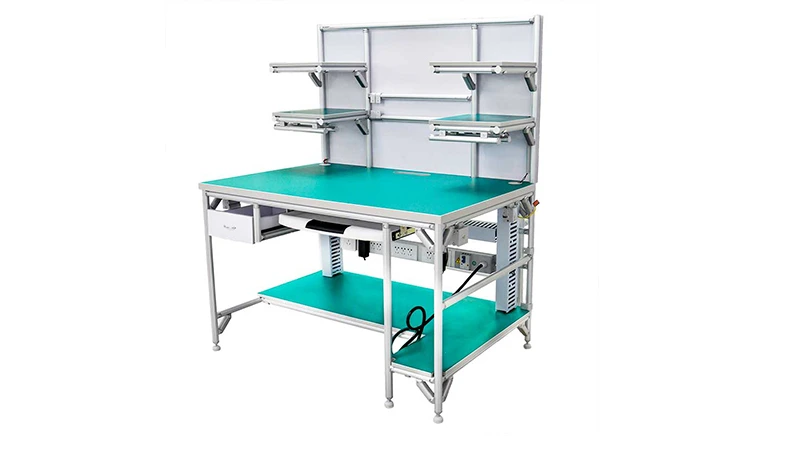
Aluminum tube workbench is more flexible and durable, compared with traditional PE/ABS coated steel tube. It is easy to assemble, anti corrosion, rust protection, and recycle use after disassemble.
Let's start with a scenario many manufacturers know all too well: You walk into your production floor, and there it is—a workbench that's seen better days. Its wooden surface is chipped and stained, the steel frame is rusting at the joints, and one of the wheels is stuck, making it impossible to move when you need to rearrange the line. Last month, you spent $300 replacing that wheel. The month before, $200 on sanding and repainting the frame. And now, your team lead is asking if you can swap out the top for a larger surface because the new product line requires more space. Sound familiar?
Workbenches are the unsung heroes of manufacturing. They're where assembly happens, where parts are inspected, where teams collaborate to keep production moving. But here's the thing: Not all workbenches are created equal. And when it comes to long-term costs, the difference between a "cheap" workbench and a strategic one can add up to tens of thousands of dollars over time. That's where Aluminum Workbench A comes in. It's not just a piece of equipment—it's an investment in your operation's efficiency, durability, and bottom line.
In this article, we're diving deep into why Aluminum Workbench A stands out as a cost-effective choice for manufacturers. We'll break down the hidden costs of traditional workbenches, explore the features that make this aluminum-based solution a smart long-term bet, and even walk through a real-world savings comparison. By the end, you'll see why more and more production managers are swapping out their old workbenches for this modular, durable alternative.
What is Aluminum Workbench A, Anyway?
First, let's get clear on what we're talking about. Aluminum Workbench A is a modular workbench system built around high-quality aluminum profile—a lightweight, durable material that's become a staple in modern manufacturing. Unlike traditional workbenches made of wood, steel, or plastic, this one is designed from the ground up for adaptability and longevity.
At its core, it's made of aluminum profile: extruded aluminum beams with a T-slot design that allows for easy attachment of accessories. Think of it as a grown-up version of building blocks—you can add shelves, tool holders, lighting, or even ESD (electrostatic discharge) mats by sliding accessories into those T-slots. And because it's aluminum, it's resistant to rust, corrosion, and wear—no more dealing with chipped paint or rotting wood.
But what really sets Aluminum Workbench A apart is its focus on the "lean system" philosophy. Lean manufacturing is all about minimizing waste—whether that's time, materials, or space. This workbench aligns with that by being mobile (thanks to optional caster wheels), easy to reconfigure, and built to grow with your needs. Need a longer surface? Add another aluminum profile section. Want to move it to a new part of the line? Lock the casters and roll it—no heavy lifting required.
Simply put, it's not just a workbench. It's a flexible, long-lasting platform that adapts to how you work—instead of forcing you to adapt to it.
The Hidden Costs of "Cheap" Workbenches
We've all been tempted by the "budget-friendly" workbench. You see one online for $200, and it looks sturdy enough. Why spend more? But here's the dirty secret: Cheap workbenches cost you far more in the long run. Let's break down the hidden costs you might not be accounting for.
1. Frequent Repairs and Replacements Wood workbenches warp with humidity, crack under heavy tools, and need sanding or refinishing every year. Steel workbenches rust, especially in factories with moisture or chemicals, and replacing a rusted frame can cost hundreds. Even plastic workbenches, while affordable upfront, scratch easily and can't handle heavy loads—meaning you'll be buying a new one every 2-3 years.
2. Downtime During Fixes When a workbench breaks, production stops. If the tabletop cracks, your team can't assemble parts. If a wheel locks, you can't reposition the bench to optimize flow. Even a small repair—like replacing a loose shelf—takes time. Multiply that by 10 workbenches and a few repairs a year, and suddenly you're losing hours of productive time.
3. Lack of Adaptability Traditional workbenches are fixed in size and shape. If your production line changes—say, you start making a larger product—you can't just "extend" a wooden bench. You have to buy a new one. And if you need to add a shelf or a tool rack? You're drilling holes, using zip ties, or jury-rigging solutions that never quite work.
4. Heavy Lifting and Labor Costs Steel workbenches are heavy—really heavy. Moving one requires 2-3 people and takes valuable time. If you need to rearrange your floor layout for a new project, that's hours of labor just moving furniture. Over time, those labor hours add up to real money.
These costs are easy to overlook when you're staring at a $200 price tag. But over 5 years, that "cheap" workbench could end up costing you 3-4 times its initial price in repairs, replacements, and downtime.

Key Features of Aluminum Workbench A That Drive Long-Term Savings
Now, let's shift to the solution: Aluminum Workbench A. What makes it different? Let's break down the features that directly translate to cost savings over time.
1. Aluminum Profile: Durability That Lasts Decades
Aluminum profile is the star here. Unlike steel, it doesn't rust—even in humid or chemical-heavy environments. Unlike wood, it doesn't warp, crack, or rot. And unlike plastic, it can handle heavy loads (we're talking 500+ pounds on the tabletop) without bending or breaking.
We've talked to manufacturers who've had their aluminum profile workbenches for 10+ years, and they still look almost new. The secret? Aluminum's natural resistance to wear and tear. Even with daily use—tools dropping, parts sliding, spills—it holds up. That means you won't be replacing it every 3-5 years like you would with a wooden or steel bench.
And because it's lightweight (about 1/3 the weight of steel), you avoid the "heavy lifting" labor costs we mentioned earlier. One person can move a small Aluminum Workbench A by themselves—no extra hands needed.
2. Modular Design with Aluminum Profile Accessories
Remember those T-slots in the aluminum profile? They're a game-changer. Aluminum Workbench A is compatible with a huge range of aluminum profile accessories—shelves, tool hooks, monitor mounts, you name it. Need a shelf? Slide a bracket into the T-slot and tighten a screw. Want to add a lamp? Clip it on. No drilling, no glue, no zip ties.
This modularity means your workbench can grow with your needs. Launching a new product that requires more table space? Add an extension section in 15 minutes. Need to reorganize tools for a new workflow? Rearrange the accessories in an hour. You're not stuck with a fixed design—you're in control.
And when you don't need those accessories anymore? Just take them off and reuse them elsewhere. It's a level of flexibility that traditional workbenches can't match—and it means you'll never have to buy a whole new workbench just because your process changes.
3. Mobility with Caster Wheels
Many Aluminum Workbench A models come with optional caster wheels—heavy-duty, lockable wheels that let you move the bench anywhere on the production floor. This might seem like a small feature, but it has big implications for savings.
Imagine you need to reconfigure your assembly line for a rush order. With caster wheels, you can roll the workbench into place in 2 minutes—no team lift required. Or, if a machine breaks down, you can quickly move the bench to a temporary location to keep production going. Less downtime, less labor, more productivity.
The wheels are also lockable, so once the bench is in place, it stays put. No more wobbly work surfaces or accidental movement during use.
4. Lean System Compatibility
Aluminum Workbench A isn't just a tool—it's a lean system enabler. Lean manufacturing is all about eliminating waste, and this workbench checks every box:
- Waste of motion: Mobility means workers don't have to walk as far to get tools or parts.
- Waste of inventory: Modular shelves keep parts organized and visible, reducing overstock.
- Waste of waiting: Quick reconfiguration means the line adapts fast to changes, minimizing downtime.
- Waste of defects: Stable, level surfaces reduce errors in assembly—no more wobbly parts leading to mistakes.
By aligning with lean principles, Aluminum Workbench A doesn't just save you money on the bench itself—it improves your entire workflow, leading to higher output and lower costs across the board.

Long-Term Savings Breakdown: A 5-Year Comparison
Numbers speak louder than words. Let's put this all together with a side-by-side comparison. We'll look at the total 5-year cost of Aluminum Workbench A versus a traditional steel workbench (a common alternative) and a budget wooden workbench.
| Cost Category | Budget Wooden Workbench | Traditional Steel Workbench | Aluminum Workbench A |
|---|---|---|---|
| Initial Purchase Cost | $250 | $600 | $800 |
| Maintenance Costs (5 years) | $400 (sanding, painting, replacing wheels, fixing cracks) | $300 (rust treatment, replacing bolts, wheel repairs) | $50 (occasional tightening of accessories) |
| Replacement Frequency | Every 2-3 years (2 replacements in 5 years) | Every 4-5 years (1 replacement in 5 years) | 10+ years (0 replacements in 5 years) |
| Replacement Cost (5 years) | $500 (2 replacements x $250) | $600 (1 replacement x $600) | $0 |
| Downtime Cost (5 years)* | $1,500 (10 hours/year x $30/hour labor cost) | $1,000 (7 hours/year x $30/hour) | $200 (1 hour/year x $30/hour) |
| Labor for Moving/Reconfiguring (5 years)** | $800 (8 hours/year x $20/hour) | $1,200 (12 hours/year x $20/hour) | $200 (2 hours/year x $20/hour) |
| Total 5-Year Cost | $3,450 | $3,700 | $1,250 |
*Downtime cost assumes 1 hour of lost production per repair/replacement, plus time spent on maintenance. **Labor cost assumes time spent moving the workbench or reconfiguring it for new tasks.
Let that sink in: Over 5 years, Aluminum Workbench A costs less than half of the wooden alternative and a third of the steel one. Even though the initial price is higher, the savings in maintenance, replacement, downtime, and labor add up fast. For a manufacturer with 10 workbenches, that's a 5-year savings of over $20,000.
Real-World Applications: How Manufacturers Are Saving
Don't just take our word for it. Let's look at a real example. A mid-sized electronics manufacturer in Ohio recently switched 15 of their old steel workbenches to Aluminum Workbench A. Here's what they reported after 2 years:
- Maintenance costs dropped by 90%: They used to spend $1,200/year fixing rusted steel frames and replacing wheels. Now, they spend less than $100/year tightening screws on accessories.
- Downtime for reconfiguration is down 75%: When they launch a new product, they reconfigure the workbenches in hours instead of days. "We used to have to build new workbenches from scratch," said their production manager. "Now, we just add extensions and move accessories around."
- Labor costs for moving workbenches cut in half: With caster wheels, one person can reposition a workbench in 10 minutes. They estimate saving 200+ labor hours per year.
Another example: A small automotive parts supplier in Texas replaced 8 wooden workbenches with Aluminum Workbench A. Within a year, they noticed they hadn't needed to replace a single workbench top—something they used to do every 6 months. "The aluminum surface is tough," their shop foreman told us. "We drop tools on it, spill oil, and it just wipes clean. No more sanding or refinishing."
These aren't anomalies. Manufacturers across industries—electronics, automotive, medical devices—are seeing similar results. The common thread? Aluminum Workbench A's durability, modularity, and mobility translate directly to lower costs and smoother operations.
Why Not Just Stick with Steel or Wood?
You might be thinking, "Steel is strong, and wood is cheap—why not just keep using those?" It's a fair question. Let's address the alternatives head-on.
Steel Workbenches: Steel is strong, but it's heavy and prone to rust. Even powder-coated steel eventually chips, exposing the metal to moisture. And while steel workbenches last longer than wood, they still can't match aluminum's longevity. Plus, they're a nightmare to move—costing you time and labor every time you need to rearrange.
Wooden Workbenches: Wood is cheap upfront, but it's high-maintenance. It absorbs moisture, stains, and odors. It scratches easily, and heavy tools can leave permanent dents. For manufacturers working with chemicals or in humid environments, wood is practically a ticking time bomb—you'll be replacing it sooner than you think.
Plastic Workbenches: Lightweight but flimsy. They can't handle heavy loads, and the surface scratches easily. They're a non-starter for most industrial settings.
Aluminum Workbench A isn't just "another option"—it's a step up in every category that matters for long-term cost-effectiveness. It's stronger than plastic, lighter than steel, more durable than wood, and infinitely more adaptable than all three.
Conclusion: Investing in Long-Term Value
At the end of the day, manufacturing is about more than just making products—it's about making smart decisions that keep costs down and efficiency up. Workbenches might seem like a small part of that equation, but as we've seen, they can have a huge impact on your bottom line.
Aluminum Workbench A isn't the cheapest option upfront. But when you factor in maintenance, replacements, downtime, and labor costs, it's hands down the most cost-effective choice over 5+ years. Its aluminum profile construction ensures durability, its modular design with aluminum profile accessories offers unmatched adaptability, and its mobility with caster wheels cuts down on labor. It's a workbench built for the realities of modern manufacturing—where change is constant, and every dollar counts.
So, the next time you're in the market for a workbench, ask yourself: Am I looking for the lowest price today, or the lowest cost over the next decade? If it's the latter, Aluminum Workbench A is worth every penny. Your production line (and your budget) will thank you.