- Company Articles
- Products and Technology
- Technology Sharing
- The Future of Aluminum Profile 3 Way Connectors in Smart Manufacturing

The Future of Aluminum Profile 3 Way Connectors in Smart Manufacturing
Related Product
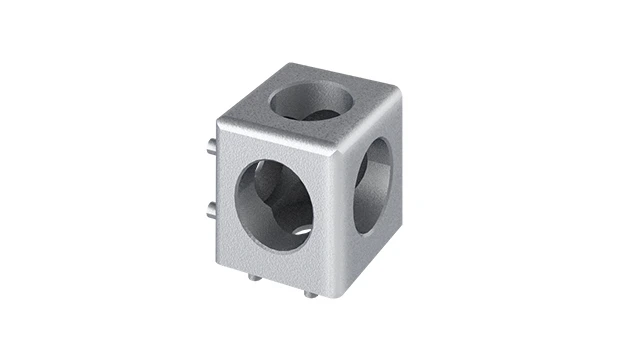
Aluminum Profile 3 Way Connector
The 3 way - squared corner connector is an external fastening method that is typically used to create a corner connection between three profiles. It is a heavy-duty connection that is simple to use and provides a polished look.
Walk into any modern smart factory today, and you'll likely notice a shift—gone are the days of rigid, bolted-down machinery and static production lines. Instead, there's a quiet hum of adaptability: workstations that reconfigure in hours, material racks that expand with a few twists of a wrench, and conveyor systems that pivot to accommodate new product designs overnight. At the heart of this transformation lies a humble yet powerful tool: the aluminum profile 3 way connector. These unassuming components, paired with aluminum extrusion profiles and a suite of aluminum profile accessories, are redefining how factories build, adapt, and thrive in the age of smart manufacturing.
Smart manufacturing isn't just about robots and data dashboards—it's about creating physical spaces that can keep pace with digital agility. Traditional manufacturing setups, built with welded steel or fixed concrete, lock factories into inflexible workflows. When a product design changes, or demand spikes for a new SKU, retooling can take weeks, costing time, money, and opportunities. Aluminum extrusion profiles, however, are like the "Lego bricks" of industrial infrastructure. Lightweight, strong, and infinitely customizable, they owe much of their versatility to connectors—and none more so than the 3 way aluminum profile connector. These small but mighty parts let teams join profiles at multiple angles, turning raw materials into workbenches, flow racks, or even entire production cells in a fraction of the time. In this article, we'll explore how these connectors are shaping the future of smart manufacturing, their role in lean systems, and why they're becoming indispensable for factories aiming to stay competitive.
1. The Evolution of Aluminum Extrusion Profiles: From Basic Shapes to Smart Infrastructure
To understand the rise of 3 way connectors, we first need to appreciate the journey of aluminum extrusion profiles themselves. Aluminum extrusion— the process of forcing heated aluminum through a die to create uniform, complex shapes—has been around for over a century, but its industrial applications have exploded in recent decades. Early profiles were simple: basic tubes or angles used for structural support. Today, they're precision-engineered with T-slots, grooves, and channels that turn them into modular building systems.
What makes aluminum extrusion profiles so ideal for smart manufacturing? For starters, aluminum's strength-to-weight ratio is unbeatable. It's 30% lighter than steel but still sturdy enough to support heavy machinery, making it easy to transport, assemble, and reconfigure. Unlike steel, it resists corrosion, so it holds up in factory environments where moisture, oils, or chemicals are present. And perhaps most importantly, it's infinitely recyclable—aligning with the sustainability goals many modern factories prioritize.
But the real game-changer has been the evolution of profile design. Modern aluminum extrusion profiles feature T-slots running the length of their surfaces, which act as built-in attachment points. This means you don't need to drill holes or weld to add accessories—just slide a bolt, nut, or connector into the slot and tighten. Pair this with aluminum profile accessories like end caps, rubber strips, or panel holders, and suddenly a single profile can become part of a workbench, a safety guard, or a material transport system. It's this flexibility that has made aluminum extrusion profiles the backbone of adaptive manufacturing.
Consider the contrast with traditional steel structures. A steel workbench might take a team of welders a day to build, and once it's welded, it's permanent. If you need to add a shelf six months later, you're looking at cutting, welding, and repainting—assuming the steel hasn't rusted or warped. An aluminum extrusion workbench, by comparison, can be assembled with basic hand tools in an hour. Need to add a shelf? Just slide in a few 3 way connectors, attach a new profile, and you're done. No special skills, no downtime, no waste. It's a shift from "build once, use forever" to "build, adapt, reuse, repeat."
2. The 3 Way Aluminum Profile Connector: The Unsung Hero of Modular Design
If aluminum extrusion profiles are the "bricks" of modular manufacturing, then 3 way aluminum profile connectors are the "mortar" that holds them together—with a twist: this mortar can be taken apart, rearranged, and reused. A 3 way connector, as the name suggests, is a component designed to join three aluminum profiles at once, typically at 90-degree angles (though some models allow for adjustable angles). Think of it as a junction box for industrial infrastructure—one that lets you build in three dimensions without sacrificing stability.
But why 3 way connectors specifically? In manufacturing, most structures aren't flat. A workbench needs legs (vertical profiles), a top (horizontal), and maybe side rails for tools (another horizontal, perpendicular to the top). A flow rack requires vertical supports, horizontal beams, and diagonal bracing to prevent sway. A 3 way connector simplifies these multi-axis builds by letting you connect three profiles in a single, secure joint. Early connectors were basic: metal brackets with holes that required nuts and bolts. Today's versions, however, are feats of engineering.
Modern 3 way aluminum profile connectors come in dozens of designs, each tailored to specific needs. Some use cam levers for tool-less assembly—just flip a lever, and the connector tightens into the T-slot, creating a rock-solid hold. Others feature threaded inserts that lock into the profile's grooves, ensuring zero slippage even under heavy loads. There are even "swivel" 3 way connectors that allow profiles to rotate slightly, making it easier to align components during assembly. What unites them all is their ability to turn a pile of aluminum extrusion profiles into a functional structure in minutes, not days.
Take a typical scenario: a factory needs to build a temporary inspection station for a new product line. With traditional methods, this might involve ordering custom steel parts, waiting for delivery, then welding them on-site—taking up to a week. With 3 way connectors and aluminum extrusion profiles? The team can measure the space, pick profiles from inventory, and assemble the station in under two hours. They'll use 3 way connectors to attach vertical legs to a horizontal frame, add a plywood top (secured with T-slot bolts), and even mount a small conveyor (using roller track accessories, another type of aluminum profile accessory) to feed parts into the station. When the project ends, they can disassemble the whole thing, pack the profiles and connectors into storage, and reuse them for the next task. It's this "build, use, rebuild" cycle that makes 3 way connectors so valuable.
| Aspect | Traditional Steel/Welded Setups | Aluminum Profile + 3 Way Connector Systems |
|---|---|---|
| Assembly Time | Days to weeks (requires welding, drilling, custom parts) | Hours to days (tool-less or basic tools, off-the-shelf components) |
| Modification Ease | Costly and time-consuming (requires cutting/welding; often damages materials) | Simple and fast (loosen connectors, reposition profiles, retighten) |
| Cost Over Time | High (one-time use; disposal costs for obsolete setups) | Low (reusable components; minimal waste; lower labor for reconfigurations) |
| Weight | Heavy (difficult to move; requires heavy machinery for repositioning) | Lightweight (teams can reconfigure by hand; reduces floor load stress) |
| Sustainability | High waste (steel is recyclable but often ends up in landfills due to damage) | Eco-friendly (aluminum is 100% recyclable; connectors and profiles reused repeatedly) |
The table above highlights why factories are swapping traditional setups for aluminum profile systems. For example, a mid-sized electronics manufacturer in Ohio recently reported cutting retooling time by 80% after switching to 3 way connector-based workstations. When they needed to adjust their assembly line for a smaller circuit board, instead of waiting for a custom steel fixture, they reconfigured existing profiles and connectors in a single shift. "We used to lose a week of production every time we changed products," said the plant manager. "Now, we're up and running by lunch."

3. Synergy with Lean Systems: Eliminating Waste, Boosting Flow
Smart manufacturing and lean systems go hand in hand. Lean principles—focused on eliminating waste (muda), optimizing flow, and continuous improvement—are the backbone of efficient, agile factories. Aluminum extrusion profiles and 3 way connectors aren't just tools for building; they're tools for leaning manufacturing processes. By enabling quick changes, reducing downtime, and minimizing waste, they turn lean ideals into tangible results.
Let's start with waste elimination. In lean terms, "waste" includes everything from overproduction to unnecessary motion. Traditional setups often create waste in the form of "waiting" (downtime during retooling) and "inventory" (storing custom fixtures that may never be used again). Aluminum profile systems with 3 way connectors attack both. Since they're modular, you only build what you need, when you need it—no more stockpiling extra parts. And when a process changes, you don't need to wait for new equipment; you repurpose what you already have.
Take "motion waste," for example. In a factory with fixed workbenches, operators might walk extra steps to retrieve tools or materials because the layout can't be adjusted to their workflow. With 3 way connectors, teams can redesign workstations on the fly. A line worker might notice that a tool is always out of reach—so the team uses 3 way connectors to add a small shelf above the bench, cutting motion time by 15%. It's a small change, but multiplied across shifts and stations, it adds up to significant efficiency gains.
Flow optimization is another area where 3 way connectors shine. Lean systems emphasize creating smooth, uninterrupted workflows—whether for materials, information, or people. Fixed conveyor belts or rigid material racks can bottleneck flow when production volumes or product sizes change. Aluminum extrusion flow racks, built with 3 way connectors and roller track accessories, solve this. For instance, a food packaging plant might use such a rack to feed bottles into a labeling machine. If they switch to a taller bottle, they can adjust the rack's height by moving the 3 way connectors, ensuring bottles still glide smoothly into the machine. No need to replace the entire rack—just reposition a few profiles.
Perhaps the most powerful lean benefit is "continuous improvement" (kaizen). Lean isn't a one-time project; it's a culture of ongoing tweaks. Aluminum profile systems make kaizen actionable. Teams don't need to wait for management approval or budget to test a new layout—they can grab profiles and 3 way connectors, build a prototype, and trial it the same day. If it works, they keep it; if not, they disassemble and try again. This "fail fast, learn fast" approach accelerates innovation, turning every employee into a potential process improver.
A case in point: a automotive parts supplier in Michigan adopted lean manufacturing five years ago but struggled with rigid workstations that stifled kaizen. After switching to aluminum extrusion profiles and 3 way connectors, they launched a "Kaizen Wednesdays" program, where teams spend two hours each week reconfiguring their work areas. In one instance, the welding team used 3 way connectors to build a rotating workbench, reducing the need to lift heavy parts and cutting ergonomic injuries by 40%. Another team reorganized their material rack (using 3 way connectors to add more levels) to bring high-demand parts closer to the line, slashing pick times by 25%. "The connectors turned our kaizen ideas into reality," said the plant's lean coordinator. "Before, we'd talk about improvements; now, we do them."

4. Technological Innovations: Making Connectors Smarter, Stronger, Faster
As smart manufacturing evolves, so too do the tools that power it. 3 way aluminum profile connectors are no exception. Today's connectors aren't just metal brackets—they're integrating with digital tools, advanced materials, and even IoT (Internet of Things) to become smarter, more reliable, and more connected than ever before.
One of the most exciting innovations is "smart connectors" embedded with RFID tags or sensors. These connectors can track when a structure was built, which profiles it's attached to, and even how much weight it's supporting. Imagine a factory where every 3 way connector has an RFID chip. When a workbench is disassembled, the system automatically logs which profiles and connectors are returned to inventory, making asset tracking a breeze. Sensors in connectors can also monitor for loosening—if a bolt starts to slip (a common issue in high-vibration environments), the sensor sends an alert to maintenance, preventing accidents before they happen.
Material science is also pushing connectors forward. Traditional connectors were often made of steel, which added weight and risk of corrosion. Now, many are crafted from high-strength aluminum alloys or even carbon fiber composites. These materials are lighter than steel but just as strong, making structures easier to move and more durable in harsh environments. For example, stainless steel 3 way connectors are becoming popular in food and pharmaceutical factories, where hygiene is critical—they resist rust and are easy to sanitize, unlike painted steel.
Tool-less connectors are another breakthrough. Early connectors required wrenches or hex keys, which slowed assembly. Today's "quick-connect" 3 way connectors use cam locks, levers, or push-button mechanisms. A worker can tighten or loosen them with a simple twist or pull, cutting assembly time by up to 50%. Some even feature color-coded levers to indicate tension—green for "secure," yellow for "needs checking"—reducing human error during setup.
Digital design tools are also transforming how factories use 3 way connectors. CAD software now includes libraries of aluminum extrusion profiles and connectors, letting engineers model entire systems in 3D before building. Some tools even simulate stress loads, ensuring that a design using 3 way connectors can support the intended weight. Once the design is finalized, the software generates a parts list—telling the team exactly how many profiles, 3 way connectors, and aluminum profile accessories they need. It's like having a virtual factory planner in your computer, reducing trial-and-error and ensuring projects stay on budget.
Looking ahead, we might see even more integration with smart manufacturing technologies. Imagine a 3 way connector that syncs with a factory's digital twin—a virtual replica of the physical space. When the digital twin suggests a layout change, the connector could send real-time data on how the physical structure is being reconfigured, updating the twin automatically. Or connectors with built-in LEDs that light up to guide workers during assembly, reducing mistakes. The possibilities are endless, but the core value remains the same: making factories more adaptable, efficient, and human-centered.
5. Case Study: How a Tier-1 Auto Supplier Scaled Production with 3 Way Connectors
To truly understand the impact of 3 way aluminum profile connectors, let's dive into a real-world example. Precision Auto Parts (PAP), a tier-1 supplier to major automakers, faced a critical challenge in 2023: demand for electric vehicle (EV) components was surging, and their factory needed to double production capacity without expanding their physical footprint. Their existing setup—filled with welded steel workbenches and fixed conveyor lines—was too rigid to adapt. PAP turned to aluminum extrusion profiles and 3 way connectors, and the results were transformative.
Before the switch, PAP's EV motor assembly line was a bottleneck. The line had been built for a single motor model, using custom steel fixtures. When a new motor design was introduced, retooling took 10 days, during which the line sat idle. Inventory piled up, and customers threatened penalties for late deliveries. The team knew they needed a way to reconfigure the line in hours, not days.
Step one: replace steel workbenches with aluminum extrusion profiles and 3 way connectors. PAP chose 4040 EU standard aluminum profiles (a common size for industrial use) and cam-lock 3 way connectors for tool-less assembly. Within a week, they'd disassembled the old steel benches and built 12 new workstations. Each station featured adjustable shelves (using 3 way connectors to attach vertical supports), integrated tool holders (secured via T-slots), and even small conveyors (built with roller track accessories) to move parts between stations.
The first test came three weeks later, when a new motor design required the line to be reconfigured for a shorter component. Instead of shutting down for days, the team spent four hours repositioning the 3 way connectors: lowering the conveyor height, adjusting the workbench depth, and reangling the tool shelves. Production resumed by lunch, and the line hit its new output target by the end of the shift. "We couldn't believe how smooth it was," said the production manager. "Before, retooling felt like a crisis. Now, it's just another task on the checklist."
Next, PAP tackled material flow. Their old steel racks couldn't be adjusted to fit the new, bulkier EV motor casings, leading to parts being stacked on the floor (a lean "waste of space"). Using aluminum extrusion profiles, 3 way connectors, and roller track accessories, they built modular flow racks. The racks' height, width, and depth could be adjusted by moving the 3 way connectors, so they fit both old and new casings. Workers could now slide casings directly from the rack into the assembly line, cutting handling time by 20%.
The results spoke for themselves: within six months, PAP increased EV motor production by 85% without adding square footage. Retooling time dropped from 10 days to under 8 hours. Scrap rates fell by 12% because the adjustable workstations reduced part damage. And employee satisfaction scores rose—workers reported feeling more empowered to suggest layout changes, knowing they could be implemented quickly with 3 way connectors.
"The 3 way connectors didn't just solve a production problem—they changed our culture," said PAP's CEO. "We used to see our factory as a fixed asset. Now we see it as a living, breathing system that can grow with us. That's the future of manufacturing."
6. Challenges and the Road Ahead: What's Next for 3 Way Connectors?
For all their benefits, aluminum profile 3 way connectors aren't without challenges. As factories adopt them at scale, new hurdles emerge—from standardization to cost perceptions. Addressing these will be key to ensuring they continue to drive smart manufacturing forward.
Standardization is a top concern. While aluminum extrusion profiles have largely standardized (with EU and national standards), connectors remain fragmented. A 3 way connector from one supplier might not fit a profile from another, even if the profile size is the same. This "vendor lock-in" can frustrate factories, who may hesitate to invest in a system if they can't mix and match components. The solution? Industry-wide standards for connector dimensions and T-slot compatibility. Trade groups like the Aluminum Extruders Council are already working on this, but progress is slow. In the meantime, factories can mitigate risk by choosing suppliers that offer compatible lines of profiles, connectors, and aluminum profile accessories.
Cost perception is another barrier. Aluminum extrusion profiles and 3 way connectors often have a higher upfront cost than welded steel or plastic alternatives. Some factory managers see this as a deterrent, focusing on short-term savings over long-term value. To overcome this, suppliers and manufacturers need to better communicate the total cost of ownership (TCO). While steel might be cheaper to buy, it costs more to install, modify, and replace. Aluminum systems, with their reusability and quick assembly, often pay for themselves within 1–2 years through reduced downtime and labor costs. PAP, for example, calculated that their aluminum profile investment paid off in 14 months, thanks to faster retooling and lower scrap rates.
Skill gaps can also slow adoption. While 3 way connectors are designed for ease of use, some teams still lack confidence in assembling modular systems. Training is key here. Suppliers are starting to offer workshops on "modular manufacturing basics," teaching workers how to design, build, and modify structures with profiles and connectors. Online tutorials and CAD toolkits are also helping—turning even novice users into capable builders.
Looking to the future, the potential for 3 way connectors is boundless. As smart factories become more automated, we'll see connectors integrating with collaborative robots (cobots). Imagine a cobot using AI to identify a 3 way connector, then autonomously loosening it to reconfigure a workstation—no human input needed. We'll also see growth in "sustainable connectors," made from recycled aluminum or biodegradable composites, aligning with global carbon neutrality goals.
Another trend is miniaturization. As electronics manufacturing shifts to smaller, more complex devices, factories will need tiny, precise connectors. Micro 3 way connectors—small enough to build phone assembly jigs or medical device workstations—are already in development. These will open new doors for industries where space is at a premium.
Finally, the rise of "digital twins" will make 3 way connectors even more integral. Factories will design entire production lines in virtual space, test them with simulation software, then send the specs to the shop floor—where workers use 3 way connectors to bring the digital design to life. The connectors will even feed data back into the twin, updating it on the physical structure's status. It's a closed loop of design, build, and optimization that will redefine manufacturing speed and precision.
7. Conclusion: Building the Factories of Tomorrow, Today
In the rush to embrace smart manufacturing, it's easy to focus on flashy technologies: AI, robots, big data. But the true unsung heroes are the tools that make these technologies possible—tools like aluminum extrusion profiles and 3 way aluminum profile connectors. They're not glamorous, but they're the foundation on which agile, efficient, and human-centered factories are built.
From the factory floor at Precision Auto Parts to the smallest electronics workshop, 3 way connectors are proving that flexibility isn't a luxury—it's a necessity. They let factories adapt to new products, scale production, and empower workers to drive continuous improvement. They turn lean principles into action, eliminate waste, and make sustainability achievable. In short, they're the "glue" that holds the smart manufacturing revolution together.
As we look ahead, one thing is clear: the future of manufacturing isn't just digital—it's physical, too. And that physical future will be built with aluminum extrusion profiles, 3 way connectors, and the endless creativity of the teams who use them. So the next time you walk through a smart factory, take a closer look at the workbenches, the flow racks, the conveyor lines. Chances are, you'll spot a 3 way connector—quietly, reliably, building the future.