- Company Articles
- Products and Technology
- Product knowledge
- The Future of Anti-Slip Adjustable Leveling Feet in Smart Manufacturing

The Future of Anti-Slip Adjustable Leveling Feet in Smart Manufacturing
Related Product
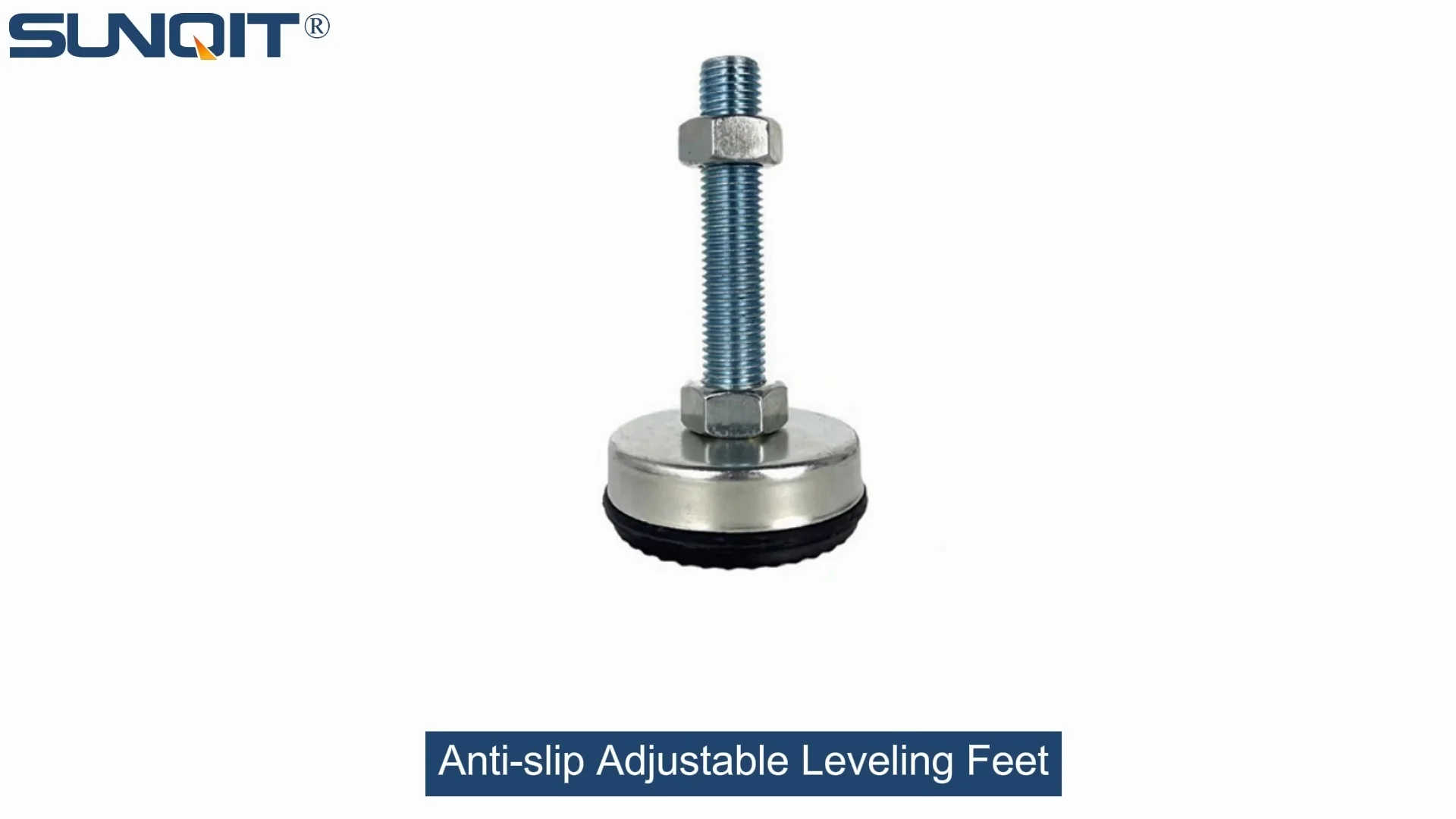
Anti-slip Adjustable Leveling Feet
Anti-slip Adjustable Leveling Feet are designed to keep machines level when placed on uneven or sloped ground, the rubber base will prevent product slip during work.
How a "Small" Component is Shaping the Next Era of Factory Efficiency, Safety, and Precision
Introduction: The Quiet Revolution in Smart Manufacturing
Walk into any modern factory today, and you'll likely be dazzled by the sight of robotic arms assembling products with pinpoint accuracy, IoT sensors tracking every step of the production line, and workers collaborating with AI-powered tools to optimize workflows. This is smart manufacturing—a world where data, automation, and connectivity converge to redefine how things are made. But amid all this high-tech fanfare, there's a humble component working behind the scenes that rarely gets the spotlight: the anti-slip adjustable leveling feet .
At first glance, these small, often rubber-tipped devices might seem trivial compared to the advanced machinery they support. They're the unsung heroes underpinning workbenches where delicate electronics are assembled, conveyor systems transporting heavy components, and even robotic cells that demand millimetric precision. Yet, as smart manufacturing evolves, the role of these "feet" is becoming more critical than ever. In a world where downtime costs thousands of dollars per minute, where a fraction of a millimeter of misalignment can ruin a batch of products, and where worker safety is non-negotiable, the future of anti-slip adjustable leveling feet is not just about "leveling"—it's about enabling the entire smart factory ecosystem to thrive.
This article explores why these unassuming components are poised to become key players in the next phase of manufacturing innovation. We'll dive into their current role, the challenges smart manufacturing presents, and how advancements in materials, design, and integration with lean systems are transforming them from simple tools into intelligent, adaptive solutions. Along the way, we'll see how they intersect with everything from workbench design to sustainability goals, and why forward-thinking manufacturers are already investing in their evolution.
Today's Anti-Slip Adjustable Leveling Feet: The Foundation of Stability
Before we look to the future, let's ground ourselves in the present. What exactly are anti-slip adjustable leveling feet, and why do factories rely on them today?
Simply put, these devices are designed to do two core things: adjust the height of equipment to compensate for uneven floors, and prevent that equipment from slipping or shifting during operation. Imagine a workbench in an electronics factory where workers assemble circuit boards. If the floor is slightly uneven—common in older facilities or those with heavy machinery vibrations—the workbench might wobble. A wobbling workbench means shaky hands, misaligned components, and increased risk of errors. Enter leveling feet: bying (twisting) the feet, workers can raise or lower each corner of the bench until it's perfectly stable. The "anti-slip" feature, usually a rubber or textured base, ensures the bench doesn't slide even when heavy items are moved across it or when the floor is wet (from cleaning, for example).
Today's leveling feet come in various designs, but most share basic components: a threaded stem that screws into the equipment, a base (often with a rubber pad), and a locking mechanism to keep the height fixed once adjusted. They're used everywhere—from lightweight workbenches to heavy-duty conveyor systems, and even medical equipment where sterility and stability are critical. But while they're effective for basic needs, traditional models have limitations that are becoming increasingly apparent in smart factories.
Real-World Impact: When Stability Fails
A mid-sized automotive parts manufacturer in Ohio recently faced a costly problem: their robotic welding stations kept producing defective parts. The robots were calibrated correctly, the materials were up to spec, but the welds were inconsistent. After weeks of troubleshooting, engineers discovered the culprit: the concrete floor under one station had settled slightly, causing the robot's base to tilt by just 0.5 degrees. This tiny misalignment threw off the robot's precision, leading to $20,000 in wasted materials and downtime. The solution? Upgrading to heavy-duty anti-slip adjustable leveling feet with fine-tuning capabilities. Within hours, the base was leveled, and production resumed with zero defects. It's a small fix, but it highlights just how much depends on these foundational components.
A mid-sized automotive parts manufacturer in Ohio recently faced a costly problem: their robotic welding stations kept producing defective parts. The robots were calibrated correctly, the materials were up to spec, but the welds were inconsistent. After weeks of troubleshooting, engineers discovered the culprit: the concrete floor under one station had settled slightly, causing the robot's base to tilt by just 0.5 degrees. This tiny misalignment threw off the robot's precision, leading to $20,000 in wasted materials and downtime. The solution? Upgrading to heavy-duty anti-slip adjustable leveling feet with fine-tuning capabilities. Within hours, the base was leveled, and production resumed with zero defects. It's a small fix, but it highlights just how much depends on these foundational components.
So, what's holding back today's leveling feet? For one, adjustability is often manual. In a factory with hundreds of workbenches or conveyor sections, manually adjusting each foot is time-consuming and prone to human error. Second, the anti-slip grip is static—traditional rubber pads work well on concrete but may fail on newer, smoother factory floors (like polished epoxy) or in environments with oils or coolants. Third, durability can be an issue: in high-wear settings, the rubber pads degrade quickly, leading to frequent replacements and unexpected downtime. Finally, they lack "smart" features—there's no way to monitor if a foot has loosened over time or if the equipment is becoming unstable until a problem occurs.
These limitations are manageable in traditional manufacturing setups, but smart manufacturing changes the game. Let's explore why.

Why Smart Manufacturing Demands a New Generation of Leveling Feet
Smart manufacturing isn't just about adding robots or sensors to old factories—it's a complete rethink of how production systems are designed, operated, and maintained. Three key trends in this revolution are driving the need for advanced anti-slip adjustable leveling feet: precision, adaptability, and data-driven decision-making.
1. Precision: When "Good Enough" Isn't Enough
Modern manufacturing processes, especially in sectors like aerospace, medical devices, and electronics, demand microscopic precision. A 3D printer producing a surgical implant can't tolerate even a hair's-width of wobble. Similarly, collaborative robots ("cobots") that work alongside humans need stable bases to ensure they don't drift off course and risk injury. Traditional leveling feet, which often adjust in 1mm increments, are too coarse for these applications. Smart factories need feet that can be adjusted with sub-millimeter accuracy—and stay adjusted, even under vibration from nearby machinery.
2. Adaptability: The Rise of Modular Factories
Smart factories are no longer static. To keep up with fast-changing consumer demands, manufacturers are adopting modular layouts: production lines that can be reconfigured in hours, not days. A lean system might call for moving a workbench from one corner of the factory to another to optimize workflow, or adding a new conveyor section to handle a sudden surge in orders. Traditional leveling feet slow this down: each move requires re-leveling the equipment, which is tedious and disrupts production. Tomorrow's factories need feet that can adjust quickly—even automatically—as equipment is moved, and that can lock into place securely to avoid rework.
3. Data-Driven Maintenance: Predicting Problems Before They Happen
Smart manufacturing thrives on data. Sensors monitor everything from machine temperature to inventory levels, allowing teams to predict failures and schedule maintenance proactively. But what about the stability of the equipment itself? A leveling foot that loosens over time won't trigger an alert until the equipment starts wobbling—by which point damage may already be done. Smart factories need leveling feet that can "talk"—sensors that measure vibration, tilt, or slippage and send real-time data to the factory's IoT platform. This way, maintenance teams can tighten a foot or replace a worn pad before it causes issues.
These trends—precision, adaptability, and data—are pushing leveling feet beyond their traditional role. They're no longer just about stability; they're about enabling the entire smart ecosystem to function at peak efficiency. So, what will the next generation of these feet look like?

Key Features Shaping the Future of Leveling Feet
Innovation in anti-slip adjustable leveling feet is being driven by the needs of smart manufacturing, but it's also enabled by advancements in materials science, engineering, and connectivity. Here are the key features that will define their future:
1. Micro-Adjustment and Locking Technology
To meet the precision demands of smart factories, future leveling feet will offer finer adjustability—think 0.1mm increments instead of 1mm. This will be achieved through improved threading designs and possibly motorized adjustment (for high-end applications), allowing for automated leveling via the factory's control system. Even manual models will feature ergonomic, tool-free adjustment knobs for faster, more accurate setup. Equally important is better locking mechanisms: once adjusted, feet must stay in place, even under continuous vibration. New designs may use friction-locking or magnetic systems to prevent loosening over time.
2. Adaptive Anti-Slip Materials
The "anti-slip" part is getting a high-tech upgrade, too. Traditional rubber pads work, but they're not one-size-fits-all. Future feet will use adaptive materials—like shape-memory polymers or textured surfaces that grip better under pressure—that adjust to different floor types (concrete, epoxy, tile) and environmental conditions (wet, oily, dusty). Some may even have replaceable pads with QR codes, so maintenance teams can track wear and order replacements automatically when needed.
3. Embedded Sensors and IoT Connectivity
This is where leveling feet truly become "smart." Tiny sensors (accelerometers, tilt sensors, load cells) embedded in the base or stem will monitor stability in real time. If a foot starts to slip, if the equipment tilts beyond a threshold, or if the load exceeds capacity, the sensor sends an alert to the factory's IoT dashboard. Imagine a conveyor system where each leveling foot tracks vibration; a sudden spike could indicate a failing bearing upstream, allowing teams to fix the problem before the conveyor jams. For critical applications, like pharmaceutical manufacturing, sensors could even log stability data for regulatory compliance.
4. Lightweight, High-Strength Materials
Smart factories are also focused on sustainability and energy efficiency, which means reducing the weight of equipment (to lower transportation and installation costs) without sacrificing strength. Enter advanced materials like carbon fiber composites and high-grade aluminum profile alloys. Aluminum, in particular, is gaining traction: it's lightweight, corrosion-resistant, and easy to machine, making it ideal for leveling feet stems and bases. Some manufacturers are even exploring recycled aluminum to align with circular economy goals.
5. Modular Design for Easy Integration
To keep up with modular factory layouts, leveling feet will feature standardized, snap-on components. Need a longer stem for a taller workbench? Swap it out in seconds. Need a larger base for a heavier load? Click it into place. This modularity reduces inventory costs (factories can stock a few core components instead of dozens of specialized feet) and speeds up reconfiguration when production lines change.
These features aren't just theoretical—some are already in prototype or early adoption stages. For example, a German supplier recently unveiled a leveling foot with a built-in RFID tag that stores calibration data, allowing maintenance teams to scan the foot with a smartphone and see its adjustment history. Meanwhile, a U.S.-based firm is testing a magnetic base design that increases grip on metal floors by 40% compared to rubber pads. As these innovations scale, they'll become standard in smart factories.

Integration with Lean Systems and Workbench Design
Smart manufacturing and lean systems go hand in hand. Lean principles—eliminating waste, optimizing workflows, continuous improvement—are amplified by data and automation, making factories more efficient and responsive. Anti-slip adjustable leveling feet play a quiet but vital role in this integration, especially when it comes to workbench and material handling design.
Lean systems emphasize "5S" (Sort, Set in Order, Shine, Standardize, Sustain), which includes organizing the workspace for maximum efficiency. A well-designed workbench is central to this: it should be at the right height, have tools within easy reach, and—crucially—be stable. Unstable workbenches create waste: time spent readjusting, defective products, and even worker fatigue from compensating for wobble. By ensuring workbenches are always level and slip-free, advanced leveling feet reduce these wastes, aligning with lean goals.
But their role in lean systems goes beyond workbenches. Consider material flow, another cornerstone of lean manufacturing. Conveyor systems, flow racks, and turnover trolleys must move materials smoothly from one station to the next. If a conveyor is tilted, materials might jam or move too slowly, creating bottlenecks. Leveling feet ensure these systems are aligned, keeping flow steady and reducing the "motion waste" of workers having to unjam or adjust equipment. In modular lean setups, where lines are reconfigured frequently, quick-adjust leveling feet make it faster to rearrange workstations without sacrificing stability—shortening changeover times and increasing flexibility.
The Synergy with Aluminum Profile Workbenches
Modern workbenches in lean systems often use aluminum profile frames for their lightweight, modular, and durable properties. Aluminum profiles are easy to assemble, reconfigure, and recycle, making them perfect for lean's focus on adaptability and sustainability. Advanced leveling feet are being designed specifically to pair with these profiles: their stems fit seamlessly into the profile's T-slots, and their aluminum bases match the profile's finish for a cohesive look. This integration isn't just aesthetic—it ensures the entire workbench system (profile + feet) is optimized for strength, weight, and adjustability. For example, a workbench made with 40x40mm aluminum profiles might use leveling feet with a 50mm diameter aluminum base, creating a stable, lightweight unit that can be moved and re-leveled in minutes.
By aligning with lean principles and modern workbench design, anti-slip adjustable leveling feet are becoming an integral part of the "lean smart" ecosystem—proving that even the smallest components can drive big efficiency gains.
Traditional vs. Future Anti-Slip Adjustable Leveling Feet: A Comparison
To better understand how these components are evolving, let's compare traditional leveling feet with the smart, future-ready versions:
| Feature | Traditional Leveling Feet | Future-Ready Leveling Feet |
|---|---|---|
| Adjustment Precision | 1-2mm increments; manual adjustment with tools | 0.1mm increments; motorized or tool-free manual adjustment |
| Anti-Slip Technology | Basic rubber pads; fixed grip | Adaptive materials (shape-memory polymers, textured surfaces); replaceable, QR-coded pads |
| Durability | Steel or plastic stems; rubber pads wear quickly in harsh environments | Aluminum profile or carbon fiber stems; corrosion-resistant coatings; longer-lasting pads |
| Smart Features | None; no data collection | Embedded sensors (tilt, vibration, load); IoT connectivity; alerts for maintenance |
| Modularity | Fixed design; specialized feet for different equipment | Modular components (stems, bases, pads); snap-on integration with aluminum profiles |
| Sustainability | Often single-use; non-recyclable materials | Recycled aluminum; replaceable parts (reducing waste); energy-efficient production |
This table highlights a clear shift: future leveling feet are not just better at their core job—they're becoming active participants in the smart factory, contributing to data collection, sustainability, and efficiency. They're evolving from "dumb" tools to "smart" components that align with the broader goals of the manufacturing ecosystem.
Challenges and Opportunities in Adoption
While the future of anti-slip adjustable leveling feet is promising, widespread adoption in smart factories will face challenges. Understanding these hurdles is key to accelerating innovation and ensuring these components deliver on their potential.
Challenges: Cost, Standardization, and Legacy Systems
One of the biggest barriers is cost. Smart leveling feet with sensors and IoT connectivity will likely come with a higher price tag than traditional models. For small and medium-sized manufacturers (SMEs) with tight budgets, this could be a deterrent—especially if they don't immediately see the ROI. Education will be critical here: manufacturers need to understand that the upfront cost is offset by reduced downtime, fewer defects, and lower maintenance costs over time.
Standardization is another challenge. With multiple suppliers developing smart feet with different sensor protocols and connectivity options, factories may face compatibility issues with their existing IoT platforms. Industry-wide standards for data formats and communication (like OPC UA, a common industrial IoT protocol) will be needed to ensure seamless integration.
Finally, legacy systems pose a problem. Many factories are upgrading to smart manufacturing gradually, meaning they have a mix of old and new equipment. Traditional leveling feet on legacy machines can't be easily retrofitted with sensors, creating data gaps in stability monitoring. Solutions like aftermarket sensor kits (which can be attached to existing feet) could bridge this gap, but they add complexity and cost.
Opportunities: Partnerships, Customization, and Sustainability
Despite these challenges, there are significant opportunities for manufacturers and suppliers. Partnerships between leveling foot suppliers and IoT platform providers, for example, could lead to turnkey solutions that simplify integration. Suppliers could also offer tiered products: basic smart feet with tilt sensors for SMEs, and fully motorized, AI-connected versions for large enterprises.
Customization is another growth area. Factories have unique needs—some require feet for cleanrooms (where materials must be sterile), others for outdoor use (where corrosion resistance is key). Suppliers that offer tailored solutions (custom materials, sizes, sensor packages) will stand out. For example, a food and beverage manufacturer might need stainless steel feet with anti-microbial pads, while a semiconductor factory could use ESD (electrostatic discharge)-safe feet to protect sensitive chips.
Finally, sustainability is a major opportunity. As factories aim for net-zero goals, they're looking for eco-friendly components. Suppliers that use recycled materials, design for disassembly (so parts can be replaced instead of the whole foot), and offset production emissions will appeal to this growing market. Some forward-thinking suppliers are even exploring circular business models, where old feet are collected, refurbished, and resold—reducing waste and lowering costs for customers.
The Road Ahead: What Manufacturers Can Do Now
The future of anti-slip adjustable leveling feet is exciting, but it's not a distant dream—it's unfolding now. So, what can manufacturers do to prepare?
First, audit your current equipment. Take stock of where leveling feet are used, how often they're adjusted, and if stability issues have caused problems in the past. This will help you identify priority areas for upgrade—like critical workbenches or high-precision machinery. Next, engage with suppliers early. Ask about their smart foot roadmaps, and share your specific needs (precision, environment, connectivity). The more feedback suppliers get, the better they can tailor their products.
Finally, start small. Pilot a few smart leveling feet on a key production line, monitor the data, and measure the impact (reduced defects, fewer maintenance calls). Use that data to build a business case for wider adoption. Remember, smart manufacturing is a journey, and upgrading foundational components like leveling feet is a step that pays dividends in the long run.
Conclusion: Small Feet, Big Impact
Anti-slip adjustable leveling feet may not be the most glamorous technology in smart manufacturing, but their role is undeniable. They are the quiet foundation upon which precision, safety, and efficiency are built. As factories become more automated, data-driven, and modular, these components are evolving from simple tools into intelligent, adaptive solutions—with micro-adjustment, sensor connectivity, and sustainable materials leading the way.
The future belongs to manufacturers who recognize that success lies in both the high-tech and the high-touch—who invest in robots and AI, but also in the leveling feet that keep those robots stable. By embracing the evolution of these small but critical components, factories can unlock new levels of productivity, reduce waste, and create safer, more sustainable work environments.
So, the next time you walk through a smart factory, take a moment to look down. Those feet under the workbench? They're not just holding up equipment—they're holding up the future of manufacturing.