- Company Articles
- Products and Technology
- Product knowledge
- The Importance of Precision in Aluminum Profile 3 Way Connector Manufacturing

The Importance of Precision in Aluminum Profile 3 Way Connector Manufacturing
Related Product
Aluminum Profile 3 Way Connector
The 3 way - squared corner connector is an external fastening method that is typically used to create a corner connection between three profiles. It is a heavy-duty connection that is simple to use and provides a polished look.
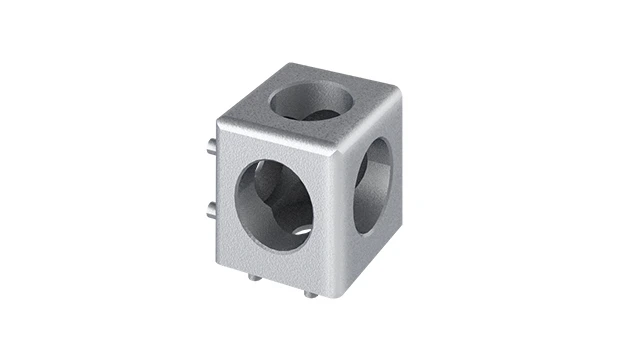
Introduction: The Unsung Hero of Manufacturing Efficiency
Walk through any modern factory, warehouse, or assembly line, and you'll notice a silent backbone holding everything together: aluminum profiles. These sleek, versatile structures form workbenches, material racks, conveyor systems, and even entire production cells. But what makes these aluminum extrusion profiles truly indispensable isn't just the profiles themselves—it's the small, often overlooked components that bring them to life: connectors. Among these, the aluminum profile 3 way connector stands out as a linchpin of modular design, enabling the creation of stable, flexible, and efficient workspaces. Yet, for all its importance, the quality of this tiny component is often taken for granted. In reality, precision in manufacturing aluminum profile 3 way connectors isn't just a technical detail—it's the difference between a production line that runs like clockwork and one plagued by delays, safety risks, and unnecessary costs.
Imagine a scenario: a busy electronics manufacturing plant relies on a series of workbenches built with aluminum profiles and 3 way connectors. These workbenches hold delicate circuit boards, tools, and testing equipment. If even one connector is slightly out of spec—maybe the thread depth is off by a fraction of a millimeter, or the angle isn't perfectly 90 degrees—the entire structure might wobble. A wobbling workbench could lead to a technician's hand slipping, damaging a circuit board worth hundreds of dollars. Multiply that by dozens of workbenches across a factory, and the cost of imprecision becomes clear. This isn't just about parts; it's about the people who depend on these structures daily, the businesses striving for efficiency, and the end products that reach consumers. Precision here is personal.
The Role of Aluminum Profile 3 Way Connectors in Modern Manufacturing
To understand why precision matters, let's first unpack what an aluminum profile 3 way connector does. As the name suggests, this small component joins three aluminum profiles at a single point, allowing for the creation of three-dimensional structures. Unlike fixed joints, these connectors are designed to be modular—meaning they can be disassembled, reconfigured, and reused as production needs change. This flexibility is the cornerstone of lean system principles, where adaptability and waste reduction are paramount. A factory might need to retool a workbench for a new product line, or expand a material rack to accommodate larger components; with precise 3 way connectors, these changes can happen in hours, not days.
But flexibility doesn't mean sacrificing stability. Aluminum extrusion profiles are chosen for their strength-to-weight ratio, and connectors must match that strength. A 3 way connector must securely hold profiles in place, even under heavy loads—think of a material rack stacked with metal parts, or a workbench supporting a 200kg assembly tool. The connector's design ensures that weight is distributed evenly across the profiles, preventing bending, warping, or collapse. This balance of flexibility and stability is what makes aluminum profile systems so popular in industries ranging from automotive to pharmaceuticals.
Beyond stability and flexibility, 3 way connectors also play a critical role in ensuring alignment. In conveyor systems, for example, profiles must be perfectly parallel to prevent jams or uneven product movement. A connector that's slightly misaligned can throw off the entire track, leading to products getting stuck, damaged, or even falling off the line. Similarly, in a cleanroom environment, where precision is non-negotiable, even a minor gap between connected profiles could allow dust or contaminants to enter, compromising sensitive processes. In these cases, the 3 way connector isn't just a structural component—it's a gatekeeper of quality control.

Why Precision Isn't Just a Metric—It's a Necessity
Precision in manufacturing aluminum profile 3 way connectors is often measured in micrometers, but its impact is measured in much larger terms: productivity, safety, and profitability. Let's break down why every fraction of a millimeter matters.
1. Structural Integrity: The Foundation of Safe Workspaces
At its core, a 3 way connector's job is to hold weight. When a connector is manufactured with precision, its internal threads (which attach to the profile's T-slots) are cut to exact specifications, ensuring a tight, seamless fit. The angles between the connector's arms are calibrated to 90 degrees (or the required angle), so the connected profiles don't twist or bow under load. This isn't just about preventing collapse—though that's critical. It's about consistency. A worker leaning on a workbench shouldn't feel it shift; a material rack holding 50kg of parts shouldn't wobble when a trolley passes by. Imprecise connectors, however, create weak points. A thread that's too shallow might strip under tension, causing a section of the structure to come loose. An arm that's bent by just 1 degree can create uneven stress across the profile, leading to metal fatigue over time. And in high-stakes environments—like automotive assembly lines where heavy tools hang from overhead racks—these weaknesses can have catastrophic consequences.
2. Modularity Without Compromise
One of the biggest advantages of aluminum profile systems is their modularity. A factory might reconfigure a workbench into a turnover trolley or a material rack into a conveyor support structure overnight. For this to work, connectors must be interchangeable. A 3 way connector from one batch should fit perfectly with a profile from another batch, even if they're manufactured months apart. Imprecision shatters this interchangeability. If a connector's arm diameter is 0.1mm larger than standard, it might not slide into the profile's T-slot. If the thread pitch is off, it might not fasten securely with standard bolts. This forces workers to waste time filing down connectors, searching for "matching" parts, or even abandoning modular designs altogether in favor of fixed, permanent structures—undoing the very flexibility that makes aluminum profiles so valuable. In lean system terms, this is "waste" in its purest form: time, labor, and resources spent fixing problems that shouldn't exist.
3. Cost Efficiency: Precision Saves More Than Just Parts
It's easy to assume that cutting corners on connector precision would save money. After all, cheaper manufacturing processes might reduce per-unit costs. But this is a false economy. Imprecise connectors lead to a cascade of hidden expenses:
- Maintenance Downtime: Loose or damaged connectors require frequent tightening, replacement, or repairs. Each minute a workbench is out of service is a minute production stops.
- Replacement Costs: A single failed connector can damage the profiles it's attached to, turning a $5 part problem into a $50 profile replacement.
- Wasted Labor: Workers spend hours adjusting misaligned structures, troubleshooting wobbles, or redesigning systems that don't perform as expected.
- Quality Control Issues: As mentioned earlier, unstable workbenches or racks can lead to product damage, rework, or even recalls.
In contrast, precision-manufactured connectors reduce these costs to near zero. They fit right the first time, stay tight, and last for years. For businesses, this translates to higher uptime, lower operational costs, and a workforce that can focus on value-adding tasks instead of fixing preventable issues.

The Ripple Effects of Imprecise Connectors: A Case Study
To illustrate the real-world impact of imprecision, let's look at a hypothetical but realistic case study. A mid-sized automotive parts supplier recently expanded its production line to meet increased demand. To save costs, they sourced aluminum profiles and 3 way connectors from a new, lower-cost supplier. Initially, everything seemed fine—the workbenches and material racks were assembled quickly, and production began. Within weeks, however, problems emerged.
First, workers reported that the material racks (used to store heavy metal components) wobbled when loaded. This made it difficult to safely retrieve parts, slowing down assembly times. Then, a workbench in the quality control area began to shift, causing a measuring device to misalign. This led to several batches of parts being incorrectly labeled as "within spec" when they were actually defective—costing the company thousands in rework and customer trust. Upon investigation, engineers discovered the root cause: the 3 way connectors from the new supplier had inconsistent thread depths. Some were too shallow, leading to loose connections, while others were too deep, stripping the T-slot threads in the aluminum profiles. The supplier had cut corners on quality control, using outdated machinery that couldn't maintain tight tolerances.
The company was forced to replace all connectors—at a cost of $10,000—and repair damaged profiles, resulting in three days of production downtime. The total cost of this "cheap" connector decision? Over $50,000, not including the hit to their reputation. This story isn't an anomaly; it's a cautionary tale that plays out in factories worldwide when precision is deprioritized.
How Precision is Achieved in Manufacturing Aluminum Profile 3 Way Connectors
So, what does it take to manufacture a truly precise aluminum profile 3 way connector? It starts with three key pillars: material selection, advanced machining, and rigorous quality control.
1. Material Matters: Choosing the Right Aluminum Alloy
Not all aluminum is created equal. 3 way connectors are typically made from high-strength aluminum alloys (such as 6061 or 6063), chosen for their durability, corrosion resistance, and machinability. These alloys can withstand repeated tightening and stress without deforming, ensuring the connector maintains its shape over time. Cheap connectors, by contrast, often use recycled or low-grade aluminum that is prone to bending or cracking—even if the machining is precise.
2. Advanced Machining: From Design to Production
Precision machining begins with computer-aided design (CAD) models, where engineers specify exact dimensions: thread pitch, arm length, angle tolerance, and surface finish. These models are then fed into CNC (Computer Numerical Control) machines, which cut the connector with accuracy—often to tolerances of ±0.01mm. CNC machining eliminates human error, ensuring every connector is identical to the last. For critical features like threads, specialized tapping machines are used to create uniform, clean threads that mate perfectly with standard aluminum profile accessories like bolts and T-nuts.
3. Quality Control: Testing Every Connector, Every Time
Even with advanced machinery, quality control is non-negotiable. Reputable manufacturers subject every batch of connectors to rigorous testing: thread gauges check for proper depth and pitch; coordinate measuring machines (CMMs) verify angles and dimensions; and tensile strength tests ensure the connector can withstand specified loads without failing. Some suppliers even conduct real-world assembly tests, building small structures with the connectors to simulate actual use. This level of scrutiny ensures that only connectors meeting strict standards reach customers.
Precision in Numbers: The Data Behind the Difference
To quantify the impact of precision, let's compare two scenarios: a factory using precision-manufactured 3 way connectors and one using imprecise alternatives. The data speaks for itself:
| Metric | Precision Connectors | Imprecise Connectors | Difference |
|---|---|---|---|
| Assembly Time per Structure | 2 hours | 3.5 hours | +75% longer with imprecise connectors |
| Mean Time Between Failures (MTBF) | 60 months | 12 months | 5x longer lifespan with precision |
| Maintenance Frequency | Once per year | Once per month | 12x more maintenance with imprecise connectors |
| Safety Incidents (per 100 structures/year) | 0.2 | 3.5 | 17x higher risk with imprecise connectors |
| Total Cost of Ownership (5-year span) | $200 per structure | $850 per structure | 425% higher cost with imprecise connectors |
These numbers aren't just statistics—they represent real savings, safer workplaces, and more reliable operations. For a factory with 50 structures, switching to precision connectors could save over $30,000 in five years, not to mention countless hours of frustration and risk.
The Future of Precision: Innovations in Connector Manufacturing
As manufacturing evolves, so too does the demand for precision. Emerging technologies are pushing the boundaries of what's possible in aluminum profile 3 way connector production:
1. Additive Manufacturing (3D Printing)
While still in its early stages for mass production, 3D printing offers the potential to create highly customized connectors with complex geometries that traditional machining can't match. This could lead to connectors optimized for specific loads, angles, or environments—all while maintaining tight tolerances.
2. AI-Powered Quality Control
Artificial intelligence and machine learning are being integrated into inspection processes, allowing for real-time analysis of connector dimensions, thread quality, and material integrity. This reduces the risk of human error and ensures 100% of parts are checked, not just samples.
3. Smart Materials
New aluminum alloys with enhanced strength-to-weight ratios and corrosion resistance are being developed, allowing connectors to handle heavier loads while remaining lightweight. These materials also maintain their precision over longer periods, even in harsh industrial environments.
Conclusion: Precision as a Commitment to Excellence
In the world of manufacturing, it's easy to focus on the big-ticket items: the robots, the conveyor belts, the high-tech machinery. But as we've explored, the smallest components often have the biggest impact. The aluminum profile 3 way connector may be small, but its role in creating efficient, safe, and adaptable workspaces is enormous. Precision in its manufacturing isn't just about meeting specs—it's about respecting the workers who rely on stable structures, the businesses striving for efficiency, and the customers who depend on quality products.
For manufacturers and suppliers, investing in precision isn't a cost—it's an investment in reliability, safety, and long-term success. It's a statement that says, "We care about the details that make a difference." For workers, it's the assurance that their tools and workspaces are built to last, allowing them to focus on what they do best: creating, innovating, and driving progress.
So the next time you walk through a factory or use a workbench, take a moment to appreciate the aluminum profile 3 way connector. It may be small, but its precision is the silent force that keeps the world of manufacturing moving forward—one perfectly aligned connection at a time.