- Company Articles
- Products and Technology
- Product knowledge
- The Modular Advantage: How Aluminum Workbench A Adapts to Changing Workflows

The Modular Advantage: How Aluminum Workbench A Adapts to Changing Workflows
Related Product
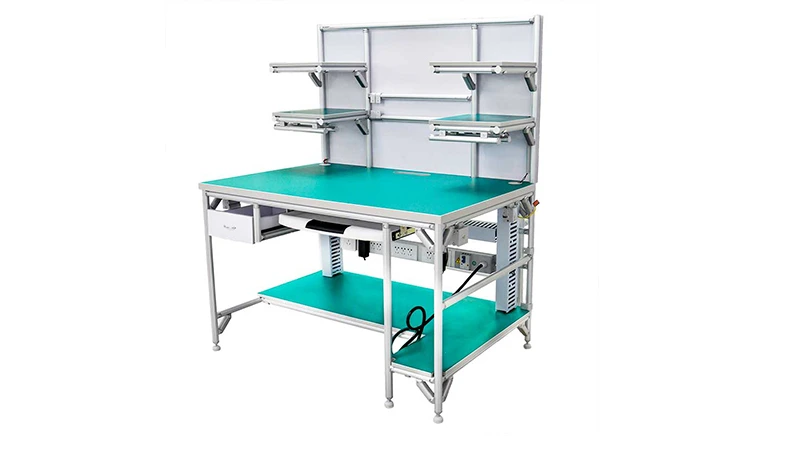
Aluminum Workbench A
Aluminum tube workbench is more flexible and durable, compared with traditional PE/ABS coated steel tube. It is easy to assemble, anti corrosion, rust protection, and recycle use after disassemble.
Walk into any modern workshop, factory floor, or tech lab, and you'll notice a silent revolution unfolding. The days of rigid, one-size-fits-all workstations are fading, replaced by setups that bend, shift, and evolve with the people using them. In an era where production lines retool overnight, R&D teams pivot between projects, and logistics hubs juggle ever-changing inventory, the need for adaptable workspace solutions has never been more critical. Enter Aluminum Workbench A—more than just a table, it's a modular chameleon designed to keep pace with the chaos of modern workflows. Let's dive into how this unassuming piece of equipment is redefining efficiency, one adjustable joint and customizable component at a time.
The Shifting Landscape of Workflows: Why Static Just Doesn't Cut It Anymore
Think about the last time your team had to rearrange your workspace. Maybe a new product line required extra shelving, or a sudden surge in orders meant reconfiguring assembly stations. If you're like most operations, that process involved heavy lifting, drilling new holes, or even buying entirely new furniture—wasting time, money, and energy. Static workbenches, once the backbone of industrial spaces, are now bottlenecks. They're built for a single purpose, in a single layout, and when that purpose changes? They become expensive paperweights.
Take manufacturing, for example. A automotive parts plant might produce 10,000 units of Part X one month, then switch to Part Y the next—each with different tool requirements, storage needs, and worker ergonomics. A static workbench with fixed shelves and immovable fixtures can't keep up. Workers end up stacking tools on the floor, stretching to reach materials, or wasting steps walking to and from storage. The result? Downtime, increased errors, and frustrated employees. In logistics, warehouses handling seasonal inventory face similar issues: a bench that works for small packages in Q1 might be useless for bulkier items in Q4. Even in offices and labs, where workflows are less physical but no less dynamic, teams need workspaces that adapt to collaborative projects one week and focused individual tasks the next.
This is where modular design steps in. Modularity isn't just a buzzword—it's a philosophy. It's about building systems from interchangeable parts that can be reconfigured quickly, without specialized tools or expertise. And at the heart of this philosophy lies the humble aluminum profile—the building block that makes Aluminum Workbench A not just a workstation, but a workflow partner.
Aluminum Workbench A: The Basics of a Modular Powerhouse
At first glance, Aluminum Workbench A might look like any other sturdy workbench. But peek under the surface (or, more accurately, at the joints and connectors), and you'll see why it's different. Its frame is constructed from high-grade aluminum extrusion profiles—lightweight yet surprisingly strong, with precision-engineered T-slots running along their length. These slots aren't just for show; they're the secret to its adaptability. Slide a bracket into a T-slot, tighten a screw, and suddenly you've added a shelf. Swap out a fixed leg for one with a caster wheel, and your bench becomes mobile. Need to raise the height by 6 inches? Swap the standard legs for extended ones. It's like building with industrial-grade Legos, but for grown-ups solving real-world problems.
But Aluminum Workbench A isn't just about the frame. It's a system. Pair it with accessories like flow racks for material handling, adjustable shelves for tool storage, or even ESD (electrostatic discharge) mats for electronics assembly, and it transforms to fit virtually any task. And because it's built around aluminum profiles—a material known for its durability and resistance to corrosion—it's built to last, even in harsh factory environments. This combination of flexibility and longevity is why it's quickly becoming a staple in industries where change is the only constant.

The Building Blocks: Aluminum Profiles and the Art of Modularity
Let's talk about aluminum extrusion profiles—the unsung heroes of Aluminum Workbench A. These aren't your average metal tubes. They're precision-manufactured by forcing heated aluminum through a die, creating uniform cross-sections with built-in T-slots, grooves, and channels. The result? A material that's both lightweight (about a third the weight of steel) and incredibly strong, capable of supporting heavy tools, machinery, and materials without bending or warping.
The T-slots are where the magic happens. Imagine a long, narrow groove running the length of the profile, with a wider "T" shape inside. This design lets you slide in specialized connectors, brackets, or accessories, then secure them with a simple bolt or knob. No drilling, no welding, no guesswork. Need to add a monitor arm for a quality control station? Slide a bracket into the T-slot, tighten the screw, and you're done. Want to attach a flow rack to the side for easy access to components? Snap on a connector, lock it in place, and your materials are now within arm's reach. It's this "plug-and-play" simplicity that turns Aluminum Workbench A from a static surface into a customizable ecosystem.
And aluminum profiles aren't just versatile—they're also sustainable. Unlike wooden workbenches that splinter or steel ones that rust, aluminum resists corrosion, dents, and wear. It's also 100% recyclable, making it a greener choice for eco-conscious operations. Over time, this durability translates to cost savings: instead of replacing a workbench every 3-5 years, you're reconfiguring the same one for decades, adding new components as needed.
From Sketch to Setup: How Customization Actually Works
Let's get practical. Suppose you run a small electronics assembly shop, and you've just landed a contract to build custom circuit boards. Your current setup has a basic workbench, but you need more: a shelf for tools, a tray for small components, and ESD protection to prevent static damage. With Aluminum Workbench A, here's how you'd transform it:
- Start with the base: Aluminum Workbench A (single deck, without casters) gives you a sturdy, flat surface. Its frame uses 4040 EU standard aluminum profiles—wide enough to support heavy equipment but narrow enough to stay space-efficient.
- Add height-adjustable legs: Your tallest technician is 6'4", and your shortest is 5'2". Swap out the standard legs for adjustable ones with anti-slip feet, letting each worker set their ideal height to reduce strain.
- Attach a flow rack: Mount a small material rack B (3 rows, 3 floors) to the side using aluminum profile connectors. Now, resistors, capacitors, and diodes are organized and within reach, cutting down on time spent hunting for parts.
- Install ESD accessories: Lay an ESD mat on the deck, and use T-slot brackets to attach an ESD wristband holder. Static damage? Problem solved.
- Add mobility (when needed): Next month, you'll need to move the workbench to a new corner of the shop. Swap out two legs for caster wheels with brakes—suddenly, a two-person lift becomes a one-person push.
Total setup time? Maybe an hour, with no special tools beyond a hex key. Compare that to a traditional wooden workbench, where adding a shelf would require measuring, drilling, and hoping the screws don't split the wood. That's the modular advantage in action: customization without the headache.
Pro Tip: Keep a box of spare aluminum profile accessories on hand—joints, brackets, caster wheels, and shelf brackets. When a workflow change hits, you won't have to wait for parts to arrive; you can reconfigure on the spot.

Lean Systems in Harmony: How Aluminum Workbench A Supports Continuous Improvement
If you're familiar with lean manufacturing principles—eliminating waste, streamlining processes, and continuous improvement—you'll recognize Aluminum Workbench A as a kindred spirit. Lean systems thrive on adaptability; they're about identifying inefficiencies and fixing them, often by rearranging workflows or reallocating resources. A static workbench is the antithesis of lean—it creates waste in the form of time lost to reconfiguration, space wasted on unused features, and money spent on redundant equipment.
Aluminum Workbench A, on the other hand, is lean by design. Let's break down how it aligns with core lean principles:
- Waste Reduction (Muda): No more overbuying workbenches for one-off projects. With modular components, you can repurpose the same bench for assembly, testing, and packaging. Need extra space for a large order? Dismantle the shelves, fold down the side panels (if using a foldable model), and you've freed up square footage.
- 5S Organization: Sort, Set in order, Shine, Standardize, Sustain. Aluminum Workbench A's customizable layout makes "Set in order" a breeze. Use T-slot brackets to mount tool holders exactly where workers need them, label shelves with color-coded bins, and keep everything within the "golden zone" (the area between shoulder and knee height) to minimize reaching and bending.
- Continuous Improvement (Kaizen): Kaizen is all about small, incremental changes. Suppose your team notices that workers are walking 10 extra steps per hour to grab materials. With Aluminum Workbench A, you can quickly add a flow rack to the side, cutting that waste immediately. No need for a committee meeting or a capital expenditure request—just a few minutes and a hex key.
Take a real-world example: a medical device manufacturer I worked with last year. They'd been using static steel workbenches for years, but their lean coordinator kept hitting a wall: every time they optimized a process, the workbench layout became obsolete. After switching to Aluminum Workbench A, they reported a 22% reduction in setup time between product runs and a 15% drop in worker fatigue (thanks to adjustable heights). One technician even joked, "It's like the bench finally listens to what we need."
Beyond the Bench: Integrating with the Wider Ecosystem
Aluminum Workbench A doesn't exist in a vacuum. It's part of a larger modular family, designed to play nice with other tools and systems. Need to connect it to a conveyor belt for automated material transfer? Use aluminum guide rail A to bridge the gap. Want to create a mobile workstation that can follow a production line? Add swivel caster wheels with brakes, and suddenly your bench is part of the flow. Even small accessories—like swivel roller balls (1 inch) mounted on the surface—turn the workbench into a mini conveyor, letting parts glide from one station to the next without manual lifting.
This interoperability is key. In a warehouse, for instance, Aluminum Workbench A might sit between a flow rack (storing incoming parts) and a roller track (feeding finished goods to shipping). Its height can be adjusted to match both, creating a seamless "U" shape that minimizes movement. In a lab, it could pair with a stainless steel pipe series frame for chemical-resistant shelving, or a turnover trolley for transporting samples between stations. The possibilities are as endless as your workflow's demands.
A Closer Look: Key Features That Make Aluminum Workbench A Stand Out
Let's put this all together with a side-by-side comparison. How does Aluminum Workbench A stack up against a traditional static workbench? Let's break it down:
| Feature | Traditional Static Workbench | Aluminum Workbench A |
|---|---|---|
| Customization | Limited to pre-drilled holes; requires tools to modify (drills, saws). | Unlimited via T-slot aluminum profiles; reconfigure with basic hand tools in minutes. |
| Mobility | Fixed in place; requires disassembly to move. | Optional caster wheels with brakes; move entire workstation with minimal effort. |
| Durability | Wood: prone to splintering, warping. Steel: heavy, rusts over time. | Aluminum profile: corrosion-resistant, lightweight, and built to withstand heavy loads. |
| Integration with Lean Systems | Static layout resists process changes; creates waste during reconfigurations. | Designed for 5S and Kaizen; adapts quickly to new workflows, reducing downtime. |
| Cost Over Time | Lower upfront cost, but requires replacement every 3-5 years. | Higher upfront cost, but lasts decades with component swaps; lower total cost of ownership. |
The data speaks for itself: while Aluminum Workbench A might cost more initially, its ability to adapt means you're not constantly buying new furniture. It's an investment in your team's flexibility—and in an era where adaptability is a competitive advantage, that's priceless.
Real-World Stories: How Teams Are Using Aluminum Workbench A to Thrive
Let's hear from the people on the ground. Here are two quick case studies that highlight the bench's impact:
Case Study 1: A Small Electronics Repair Shop
MegaFix Repairs, a 10-person electronics repair shop in Chicago, was drowning in disorganization. Their techs worked on everything from smartphones to laptops, each requiring different tools and parts. Static workbenches meant tools were scattered, and setup time for each device type ate into billable hours. After switching to Aluminum Workbench A, they added:
- Adjustable dividers to separate phone vs. laptop tools
- Small flow racks (0.5 inch swivel roller balls) for parts bins
- Height-adjustable legs to suit each tech's posture
Result? Setup time per device dropped from 15 minutes to 3, and customer wait times shrank by 25%. "We used to spend more time organizing than repairing," said shop manager Lila. "Now the bench works around us, not the other way around."
Case Study 2: A Mid-Size Automotive Parts Manufacturer
AutoPro Parts, which makes custom brackets for electric vehicles, struggled with seasonal demand spikes. During peak periods, they needed to add 5 temporary assembly stations—each with specific tooling. Traditional workbenches were too expensive to buy in bulk, and folding tables lacked stability. Aluminum Workbench A solved both problems: they bought 5 base units, then swapped accessories (shelves, tool holders, flow racks) between stations as needed. When demand dropped, they disassembled the extra benches and stored the components, saving 80% of storage space compared to traditional tables.
The Future of Workspaces: Why Modularity Is Just the Beginning
As workflows continue to evolve—driven by automation, remote work, and rapid technological change—modularity will become the norm, not the exception. Aluminum Workbench A is a glimpse into that future: a workspace that's as dynamic as the people using it. But what's next? Imagine smart benches with embedded sensors that track tool usage and suggest layout optimizations. Or AI-powered design tools that let you sketch a workflow change on a tablet, and the bench automatically adjusts its components (hydraulic legs, motorized shelves) to match. Sound like science fiction? Maybe today, but tomorrow's Aluminum Workbench A could be just that.
For now, though, the value is clear. In a world where change is constant, Aluminum Workbench A doesn't just keep up—it leads the way. It's a reminder that the best tools aren't just built for the job you have; they're built for the job you'll have next week, next month, and next year. So the next time you're stuck staring at a static workbench, wondering how to make it work for your team's latest pivot, remember: there's a better way. And it starts with a simple aluminum profile, a few T-slot brackets, and a whole lot of adaptability.
Final Thought: Workflows don't stand still, and neither should your workspace. Aluminum Workbench A isn't just a piece of equipment—it's an investment in your team's ability to adapt, innovate, and thrive. After all, the most valuable asset in any operation isn't the tools or the technology; it's the people. Give them a workspace that bends to their needs, and watch what they can achieve.