- Company Articles
- Products and Technology
- Product knowledge
- The Role of Aluminum Profile 3 Way Connectors in Flexible Production Lines

The Role of Aluminum Profile 3 Way Connectors in Flexible Production Lines
Related Product
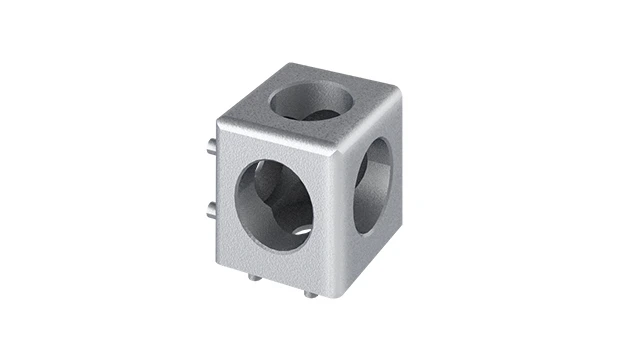
Aluminum Profile 3 Way Connector
The 3 way - squared corner connector is an external fastening method that is typically used to create a corner connection between three profiles. It is a heavy-duty connection that is simple to use and provides a polished look.
Introduction: The Need for Flexibility in Modern Manufacturing
Walk into any modern factory today, and you'll notice a shift away from rigid, fixed production lines. The days of building a assembly line once and using it for decades are fading—replaced by a demand for agility. Customers want customized products, markets shift overnight, and new regulations can upend workflows in an instant. In this environment, manufacturers are turning to flexible production systems that can adapt as quickly as their challenges change. At the heart of this revolution lies a deceptively simple component: the aluminum profile 3 way connector. These small but mighty parts are the unsung heroes enabling factories to reconfigure, resize, and repurpose their workspaces with the ease of rearranging building blocks.
Aluminum extrusion profiles have long been the backbone of modular manufacturing setups. Lightweight yet strong, corrosion-resistant, and infinitely customizable, they offer the perfect balance of durability and adaptability. But without the right connectors, even the best profiles remain just pieces of metal. Enter the 3 way connector—a specialized accessory designed to join three aluminum profiles at once, opening up a world of structural possibilities. Whether you're building a workbench that needs extra support, a material rack with multiple shelves, or a conveyor system that curves around obstacles, these connectors turn static structures into dynamic, flexible tools. In this article, we'll explore how aluminum profile 3 way connectors are transforming production lines, the key benefits they bring to manufacturers, and why they've become indispensable in the age of lean manufacturing and rapid change.
Aluminum Extrusion Profiles: The Foundation of Modular Systems
Before diving into connectors, it's important to understand the star of the show: the aluminum extrusion profile. These profiles are created by pushing heated aluminum through a die, shaping it into consistent, precise cross-sections. The result? Long, uniform lengths of aluminum with built-in features like T-slots—those iconic grooves running along the sides that make modular assembly possible. T-slots are the secret sauce here: they allow accessories like connectors, brackets, and shelves to be attached anywhere along the profile without drilling or welding. This design turns passive metal bars into active, building blocks.
Aluminum extrusion profiles come in a range of sizes and configurations, from small 20x20mm profiles for light-duty workbenches to heavy-duty 80x80mm beams for industrial racks. Common series include 2020, 3030, 4040, and 4080, each named for their width and height in millimeters. What makes them ideal for production lines is their versatility. A single 4040 profile can be part of a workbench today, a material cart tomorrow, and a safety guard next month—all without being cut or modified. This reusability is a cornerstone of lean manufacturing, reducing waste and lowering long-term costs.
But aluminum profiles don't work alone. They rely on a ecosystem of aluminum profile accessories to reach their full potential. End caps protect edges and hide sharp corners, rubber strips seal T-slots to prevent dust buildup, and brackets add stability to joints. Among these accessories, connectors are the most critical. They're the glue that holds the system together—literally and figuratively. And while there are many types of connectors (90° angle brackets, 45° elbows, straight couplers), 3 way connectors stand out for their ability to create complex, multi-directional structures with minimal parts.

What Are Aluminum Profile 3 Way Connectors?
At first glance, an aluminum profile 3 way connector might look like a simple metal piece with three openings. But its design is the result of careful engineering. These connectors are typically made from die-cast aluminum alloy, chosen for its strength-to-weight ratio and resistance to wear. Their job? To join three aluminum profiles at once, either at 90° angles, 135°, or even custom angles, depending on the model. Unlike welding or bolting profiles directly, which requires precision tools and permanent modifications, 3 way connectors slide into the T-slots of the profiles and are secured with set screws or bolts. This "click-and-lock" system makes assembly fast, tool-free (in some cases), and reversible—no more cutting metal or patching holes when you need to make a change.
There are several variations of 3 way connectors, each tailored to specific needs. The most common is the "T-shaped" connector, which joins one profile perpendicular to two parallel ones—perfect for adding a crossbeam to a frame. Then there's the "Y-shaped" connector, which splits one profile into two at a 60° angle, ideal for triangular structures or supports. Some connectors are fixed-angle, while others are adjustable, letting users fine-tune the angle between profiles to match their exact requirements. Heavy-duty models even feature reinforced walls or steel inserts for extra load capacity, making them suitable for industrial shelving or machinery frames.
What truly sets these connectors apart is their compatibility with standard aluminum profiles. Most are designed to fit popular series like 3030 or 4040, meaning you don't need to buy specialized profiles to use them. This standardization is a game-changer for manufacturers, who can mix and match components from different suppliers without worrying about fit issues. Whether you're using a 2020 profile for a lightweight workbench or a 4080 for a heavy material rack, there's a 3 way connector designed to bridge the gap.

Key Benefits of 3 Way Connectors in Production Lines
So, why have aluminum profile 3 way connectors become a staple in modern factories? Let's break down their most impactful benefits:
1. Unmatched Flexibility
The biggest advantage of 3 way connectors is their ability to turn static structures into dynamic ones. Imagine a workbench that was originally built for assembling small electronics. When the company lands a contract for larger devices, instead of buying a new bench, the team can use 3 way connectors to add side extensions, extra shelves, or even a raised platform—all in a matter of hours. This flexibility eliminates the need for custom-built furniture, which is expensive and time-consuming to replace. Manufacturers can now adapt their workspace to the job, not the other way around.
2. Faster Assembly and Reconfiguration
Traditional production setups often require welding, drilling, or hiring a contractor to modify structures. With 3 way connectors, assembly is as simple as sliding the connector into the T-slot and tightening a screw. A team of two workers can build a fully functional material rack in under an hour, compared to half a day with welded steel. Even better, reconfiguration is just as fast. If a production line needs to shift from three shifts to two, or if a new machine is added that changes the workflow, the existing structures can be taken apart and rebuilt in a fraction of the time. This speed is critical in industries where downtime equals lost revenue.
3. Cost Savings Over Time
At first glance, aluminum profiles and connectors might seem more expensive than basic steel or wood. But the long-term savings are undeniable. Steel structures are heavy, hard to modify, and prone to rust—meaning they need to be replaced every few years. Wood warps, rots, and can't handle heavy loads. Aluminum, on the other hand, is corrosion-resistant and lasts decades. Since 3 way connectors allow profiles to be reused in new configurations, manufacturers avoid the cost of buying new materials for every project. A single set of profiles and connectors can be repurposed dozens of times, drastically reducing the total cost of ownership.
4. Improved Safety and Ergonomics
Safety is non-negotiable in manufacturing, and 3 way connectors contribute here too. Unlike welded joints, which can weaken over time or develop cracks, these connectors create secure, uniform connections that maintain their strength even with repeated use. Many models also feature rounded edges or plastic covers to prevent cuts, and their modular design makes it easy to add safety guards, railings, or anti-slip surfaces. Ergonomics benefit as well: workers can adjust the height of workbenches, the angle of conveyor belts, or the placement of tool racks to reduce strain, leading to fewer injuries and higher productivity.
5. Support for Lean Manufacturing Principles
Lean manufacturing is all about eliminating waste—whether it's time, materials, or space. 3 way connectors align perfectly with this philosophy. By enabling modular, on-demand structures, they reduce the need for excess inventory (no more storing spare parts for every possible setup). They also minimize downtime during reconfigurations, keeping production flowing. Perhaps most importantly, they support the "5S" methodology (Sort, Set in Order, Shine, Standardize, Sustain) by making it easy to organize workspaces efficiently. A messy, disorganized factory becomes a thing of the past when you can quickly rearrange shelves, tool holders, and workstations to keep everything in its place.
Comparing Connector Types: Why 3 Way Stands Out
Aluminum profile accessories include a wide range of connectors, each with its own purpose. To understand why 3 way connectors are so valuable, let's compare them to other common types:
| Connector Type | Primary Use | Key Advantage | Limitations |
|---|---|---|---|
| 90° Angle Connector | Joining two profiles at a right angle (e.g., workbench legs to a top frame) | Simple, low-cost, ideal for basic frames | Only connects two profiles; limited structural complexity |
| 45° Connector | Creating diagonal supports or sloped surfaces (e.g., chutes, ramps) | Adds stability to angled structures | Specialized use case; not versatile for general assembly |
| Straight Connector | Extending a profile (e.g., joining two short profiles to make a long one) | Seamless length extension | Only works in straight lines; no branching |
| 3 Way Connector | Joining three profiles (e.g., adding a shelf to a frame, supporting a crossbeam) | Enables multi-directional structures; reduces need for multiple connectors | Slightly bulkier than 2-way connectors; may require more space |
The table above highlights a clear pattern: while other connectors excel at specific tasks, 3 way connectors offer unmatched versatility. They can replace multiple 2-way connectors in a single joint, reducing the number of parts needed and simplifying assembly. For example, building a material rack with three shelves would require dozens of 90° connectors to join the vertical posts to each shelf. With 3 way connectors, each vertical post can connect to three shelves (top, middle, bottom) with just one connector per post, cutting down on parts and assembly time.
Another scenario: a conveyor system that needs to split into two lanes. Using 3 way connectors, the main track can branch into two secondary tracks with minimal additional support, whereas 90° connectors would require extra crossbeams and brackets to reinforce the joint. This not only saves time but also reduces the overall weight of the structure, making it easier to move or reconfigure later.
Case Study: How a Electronics Manufacturer Used 3 Way Connectors to Cut Changeover Time by 70%
A mid-sized electronics company in China specializing in smartphone chargers faced a common problem: their production line was built for one charger model, but customer demand was shifting to smaller, faster chargers. The existing setup included fixed steel workbenches, welded material racks, and a rigid conveyor system—all of which were too large for the new product. Rebuilding the line from scratch would cost $50,000 and take six weeks, during which production would halt.
Instead, the company turned to aluminum profiles and 3 way connectors. They purchased 4040 aluminum profiles, a variety of 3 way and 90° connectors, and aluminum honeycomb panels for workbench tops. Over a weekend, their team disassembled the old steel benches and built new, smaller workstations using 3 way connectors to add side shelves for tools and component bins. The material racks, once fixed with three shelves, were reconfigured with 3 way connectors to add a fourth shelf for smaller parts, doubling storage capacity without increasing footprint. Even the conveyor system was modified: using Y-shaped 3 way connectors, they split the main line into two smaller tracks, allowing two assembly teams to work simultaneously on the new chargers.
The result? The entire line was reconfigured in just 48 hours, at a cost of $12,000—less than a quarter of the original estimate. Changeover time for future product shifts dropped from weeks to days, and the team reported higher satisfaction with the ergonomic, customizable workstations. "We used to dread product changes," said the production manager. "Now, we see them as opportunities to improve our setup. The 3 way connectors made it possible to think of our line as a living, breathing system, not a fixed structure."
Practical Applications: Where 3 Way Connectors Shine
3 way connectors aren't just theoretical—they're hard at work in factories around the world. Here are some of their most common applications:
Workbenches: Customizable Workspaces for Every Task
Workbenches are the heart of any production line, and 3 way connectors make them infinitely adaptable. A basic workbench might start as a simple frame: four legs, a top, and a bottom shelf. But with 3 way connectors, you can add side extensions for extra workspace, overhead racks for tool storage, or even a tilted shelf for monitors or instruction manuals. For ESD-sensitive environments (like electronics manufacturing), ESD workbenches can be built using conductive aluminum profiles and 3 way connectors, ensuring static electricity is safely grounded. The ability to adjust height, add or remove shelves, and reposition components makes these workbenches ideal for lean system setups, where efficiency and worker comfort are top priorities.
Material Racks: Maximizing Storage Without Wasting Space
Material racks are another area where 3 way connectors excel. Traditional racks are often one-size-fits-all, with fixed shelf heights that leave gaps between items. With 3 way connectors, manufacturers can build racks with adjustable shelves, ensuring every inch of vertical space is used. For example, a material rack B (3 row and 3 floor) can be modified to add a fourth floor using 3 way connectors, or the spacing between shelves can be widened to accommodate taller boxes. Some manufacturers even use 3 way connectors to build "mobile racks" by adding casters to the base, turning stationary storage into movable units that can be rolled directly to the assembly line, reducing time spent fetching parts.
Conveyor Systems: Navigating Complex Factory Layouts
Conveyors are critical for moving parts between workstations, but they often need to navigate around machinery, walls, or other obstacles. 3 way connectors make it easy to build conveyor frames that turn, split, or merge. For instance, a roller track conveyor can be split into two lanes using Y-shaped 3 way connectors, allowing parts to be directed to different workstations based on priority. The connectors also add stability to the frame, ensuring the conveyor doesn't wobble under the weight of heavy parts. And if the factory layout changes, the conveyor can be disassembled and rebuilt in a new path—no need for expensive custom fabrication.
Turnover Trolleys: Durable, Lightweight Transport
Turnover trolleys are essential for moving materials across the factory floor, but they need to be both strong and lightweight. Aluminum profiles with 3 way connectors are perfect for this. The connectors allow for the creation of sturdy frames with minimal weight, making the trolleys easy to push even when loaded. Some trolleys use 3 way connectors to add fold-down shelves or removable bins, adapting to different load sizes. And because the connectors are corrosion-resistant, the trolleys hold up well in harsh environments, from dusty warehouses to cleanrooms.
Choosing the Right 3 Way Connector for Your Needs
Not all 3 way connectors are created equal. To get the most out of your modular system, consider these factors when selecting connectors:
Load Capacity
First, determine how much weight the connector will need to support. Heavy-duty applications like industrial shelving or machinery frames require connectors with reinforced walls or steel inserts. Light-duty uses like workbench shelves can use standard aluminum connectors. Most manufacturers list load ratings for their connectors (e.g., "supports up to 200kg per joint"), so check these specs before buying.
Profile Series Compatibility
Connectors are designed to fit specific profile series. A 3 way connector for 3030 profiles won't fit 4040 profiles, as the T-slot sizes and profile widths differ. Always match the connector to your profile series—mixing sizes will lead to loose joints or damaged profiles.
Angle Requirements
Do you need a T-shape (90° angles), a Y-shape (60° angles), or an adjustable angle? Fixed-angle connectors are cheaper and more stable for standard setups, while adjustable connectors offer flexibility for custom angles. If you're unsure, opt for adjustable models—they can be locked into place once the angle is set.
Environment
Consider the factory environment. In wet or corrosive settings (like food processing), choose stainless steel connectors. For ESD-sensitive areas (like electronics manufacturing), look for connectors with ESD coatings to prevent static buildup. In cleanrooms, anodized aluminum connectors are best, as they resist dust and are easy to clean.
The Future of Flexible Manufacturing: 3 Way Connectors and Beyond
As manufacturing continues to evolve, the demand for flexible systems will only grow. Industry 4.0, with its focus on smart factories and IoT integration, is pushing manufacturers to build production lines that can communicate, adapt, and self-optimize. While much of the focus is on sensors and software, the physical infrastructure—aluminum profiles and connectors—will remain critical. 3 way connectors, in particular, will play a key role in enabling the "plug-and-play" factories of the future, where new machines or workstations can be added in hours, not weeks.
Sustainability is another trend driving the adoption of aluminum systems. Aluminum is 100% recyclable, and modular setups reduce waste by reusing components instead of replacing them. 3 way connectors, by extending the life of aluminum profiles, help manufacturers reduce their carbon footprint while saving money. In a world increasingly focused on eco-friendly practices, this combination of sustainability and cost-effectiveness is hard to beat.
Finally, as more manufacturers embrace lean system principles, the need for tools that eliminate waste and improve efficiency will grow. 3 way connectors are a natural fit here, enabling the kind of on-demand, customizable setups that lean manufacturing demands. They're not just accessories—they're strategic tools that give manufacturers a competitive edge in a fast-changing market.
Conclusion: Small Parts, Big Impact
Aluminum profile 3 way connectors may be small, but their impact on manufacturing is enormous. By turning rigid structures into flexible, adaptable systems, they're helping factories keep up with the pace of modern business. From reducing changeover times to cutting costs, improving safety to supporting sustainability, these connectors are the unsung heroes of the modular revolution.
For manufacturers still using fixed steel or wood setups, the message is clear: it's time to make the switch. Aluminum extrusion profiles and 3 way connectors offer a level of flexibility and efficiency that traditional methods can't match. And with a wide range of sizes, styles, and load capacities available, there's a solution for every need—whether you're building a simple workbench or a complex conveyor system.
In the end, the true power of 3 way connectors lies in their ability to transform how we think about production lines. No longer are they static, unchanging entities—they're dynamic, living systems that grow and adapt with your business. And in a world where change is the only constant, that's not just an advantage—it's a necessity.