- Company Articles
- Products and Technology
- Product knowledge
- The Role of Aluminum Profile 3 Way Connectors in Lean Kaizen Improvements

The Role of Aluminum Profile 3 Way Connectors in Lean Kaizen Improvements
Related Product
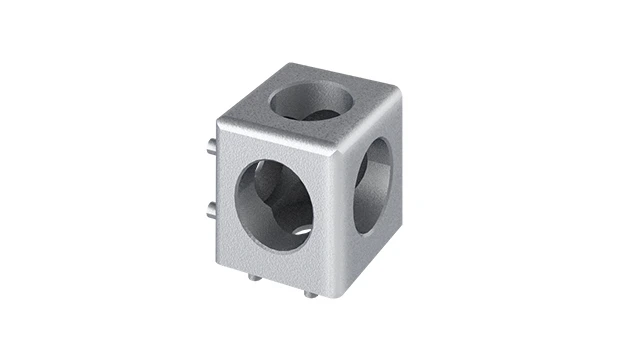
Aluminum Profile 3 Way Connector
The 3 way - squared corner connector is an external fastening method that is typically used to create a corner connection between three profiles. It is a heavy-duty connection that is simple to use and provides a polished look.
The Unsung Heroes of Continuous Improvement
Walk into any thriving manufacturing facility, and you'll feel it immediately—the quiet hum of efficiency, the seamless movement of materials, the sense that every tool, every workstation, every inch of space has a purpose. This isn't magic; it's the result of Lean Kaizen, the philosophy of continuous, incremental improvement that turns good operations into great ones. But behind that hum are countless small, often overlooked components that make those improvements possible. Today, we're shining a light on one such component: the aluminum profile 3 way connector. It might not grab headlines, but for teams on the front lines of manufacturing, this unassuming piece of hardware is a game-changer in the pursuit of better, faster, and smarter work.
Think about the last time your team needed to adjust a workstation. Maybe a new product line required a taller shelf, or a material flow bottleneck called for a reconfigured flow rack. If you're still using rigid, welded steel structures or one-size-fits-all fixtures, that adjustment probably meant days of downtime, a call to the maintenance team, and maybe even a budget request for custom parts. Sound familiar? That's the frustration of working with inflexible systems—a frustration that directly contradicts the Lean Kaizen spirit of adaptability and waste reduction. Enter aluminum profile 3 way connectors: simple, sturdy, and surprisingly versatile, they're the bridge between rigid legacy systems and the agile, responsive workspaces modern manufacturing demands.
Understanding Lean Kaizen: The Why Behind the "Small Changes"
Before diving into the nuts and bolts of aluminum profile 3 way connectors, let's ground ourselves in what Lean Kaizen really means. At its core, Kaizen is a Japanese philosophy that translates to "change for the better"—but not just any change. It's about incremental change: small, daily improvements driven by the people who do the work, not just managers or engineers. The goal? Eliminate waste ( muda ), smooth out unevenness in production ( mura ), and reduce overburden on workers and equipment ( muri ). In short, it's about making work easier, safer, and more efficient—one tweak at a time.
But here's the catch: for Kaizen to work, teams need tools that can keep up with those tweaks. If adjusting a workstation takes weeks, or if reconfiguring a flow rack requires specialized tools and training, even the best-intentioned improvement ideas get shelved. That's where flexibility becomes critical. Lean systems thrive on adaptability—on being able to pivot quickly when a bottleneck emerges, when product specs change, or when a team member suggests a better way to arrange their tools. And that's exactly where aluminum profile 3 way connectors step in: they're not just connectors; they're enablers of that flexibility.

What Are Aluminum Profile 3 Way Connectors, Anyway?
Let's start with the basics. Aluminum profile 3 way connectors are small, lightweight components designed to join three pieces of aluminum extrusion profile at various angles. They're part of the broader ecosystem of aluminum profile accessories, which includes everything from end caps to hinges to pipe clamps. But what makes these connectors special is their ability to create strong, stable joints without welding, drilling, or specialized tools. Most are made from high-grade aluminum (the same material as the profiles themselves), which means they're corrosion-resistant, durable, and lightweight—perfect for the wear and tear of daily manufacturing use.
If you're familiar with aluminum extrusion profiles, you know they feature T-slots—longitudinal grooves that run the length of the profile. These slots are the secret sauce: they allow accessories like 3 way connectors to slide into place and lock securely with bolts, set screws, or cam levers. For 3 way connectors, this means they can join profiles in configurations that traditional connectors (like nuts and bolts or welded brackets) simply can't match. Need to build a corner shelf that connects a vertical post to two horizontal beams? A 3 way connector handles that. Want to add a diagonal support to a workbench frame? There's a 3 way connector for that, too. The key is their versatility: they adapt to the angle, the load, and the task at hand.
But don't just take our word for it. Let's break down their design: most aluminum profile 3 way connectors have three arms, each sized to fit standard profile widths (think 2020, 3030, or 4040 series aluminum profiles). Each arm has a T-slot compatible interface, so once positioned, a simple bolt or lever tightens the connector into place, creating a joint that's strong enough to support tools, materials, or even heavy machinery. And because they're reusable, you can disassemble and reconfigure them as often as needed—no waste, no hassle, no extra cost.

Why Lean Teams Can't Afford to Ignore Them
Now, let's get to the heart of the matter: how do these connectors fuel Lean Kaizen improvements? Let's break it down into three key areas: flexibility, waste reduction, and employee empowerment.
Flexibility: Adapt or Fall Behind
In manufacturing, change is constant. A new product line might require taller workbenches; a seasonal spike in demand could mean rearranging flow racks to speed up material delivery; a safety audit might call for adding guardrails to a conveyor system. With traditional rigid systems, each of these changes would be a project. With aluminum profile 3 way connectors? It's a morning's work.
Take workbenches, for example. A standard aluminum workbench (like the "Workbench E (single deck-without caster)" from many suppliers) is built using aluminum extrusion profiles and connectors. If a team needs to add a third tier to hold tools, they can simply grab a few extra profiles and 3 way connectors, slide them into the T-slots of the existing frame, and tighten them down. No welding, no cutting, no waiting for a custom bracket. The same goes for flow racks: a "Material Rack B (3 row and 3 floor)" can be reconfigured into a 2-row, 4-floor setup in an hour by repositioning the 3 way connectors that hold the vertical and horizontal supports. This kind of flexibility isn't just convenient—it's essential for Kaizen, where the best improvements often come from quick, iterative tests.
Waste Reduction: Every Minute, Every Penny Counts
Lean Kaizen is obsessed with eliminating waste, and one of the biggest wastes in manufacturing is downtime . When a workstation is out of commission for days while a welder modifies it, that's waste. When you have to stockpile custom brackets "just in case" you need to adjust a flow rack, that's waste. Aluminum profile 3 way connectors attack both of these.
Installation time is a prime example. Traditional welded joints take hours to set up, cure, and finish. By contrast, a 3 way connector can be installed in minutes—literally. A study by a mid-sized automotive parts manufacturer found that switching to aluminum profiles and 3 way connectors reduced workstation reconfiguration time by 78%: from 8 hours for a welded steel bench to just 90 minutes for an aluminum one. That's 6.5 hours of recovered productivity per change—time that can be spent making parts, not modifying tools.
Then there's inventory waste. With rigid systems, you need to stock custom brackets, corner pieces, and specialized hardware for every possible configuration. With 3 way connectors, one type of connector can handle dozens of angles and profile sizes. A single box of 3 way connectors replaces a closet full of one-off parts, freeing up storage space and reducing carrying costs. That's muda eliminated, plain and simple.
Employee Empowerment: The Heart of Kaizen
Kaizen isn't just about tools—it's about people. The best improvement ideas come from the workers who use the equipment every day, but those ideas only matter if the workers feel empowered to act on them. Aluminum profile 3 way connectors lower the barrier to action.
Imagine a line operator notices that parts are piling up at a workstation because the flow rack is too low. With traditional systems, they'd have to submit a request, wait for maintenance, and hope the change gets approved. With aluminum profiles and 3 way connectors? They can grab a few profiles, adjust the rack themselves, and test the new setup by the end of their shift. If it works, great—if not, they can just as easily revert it. This kind of autonomy turns employees from "workers" into "problem-solvers," which is where the real power of Kaizen lies.
Traditional vs. Aluminum Profile 3 Way Connectors: A Head-to-Head Comparison
Still not convinced? Let's put aluminum profile 3 way connectors up against traditional options—welded steel brackets, plastic snap-fit connectors, and even standard two-way metal clamps—in a side-by-side comparison. The results might surprise you.
| Feature | Traditional Welded Steel Brackets | Plastic Snap-Fit Connectors | Aluminum Profile 3 Way Connectors |
|---|---|---|---|
| Installation Time | 4–8 hours (welding, curing, finishing) | 30–60 minutes (requires precise alignment) | 5–15 minutes (slide into T-slot, tighten with hex key) |
| Flexibility | Zero—permanent once welded | Low—can break if reconfigured frequently | High—easily disassembled and reconfigured |
| Durability | High (but prone to rust if not painted) | Low (degrades under heavy loads or UV exposure) | High (aluminum resists corrosion; T-slot joints maintain strength) |
| Cost (Long-Term) | High (labor, materials, and replacement costs) | Medium (cheap upfront, but frequent replacements add up) | Low (one-time purchase, reusable indefinitely) |
| Kaizen Compatibility | Poor (too slow for iterative changes) | Fair (good for small tweaks, but not heavy-duty) | Excellent (enables quick, frequent improvements) |
The data speaks for itself: aluminum profile 3 way connectors outperform traditional options in nearly every category that matters for Lean Kaizen. They're faster to install, more flexible, more durable, and more cost-effective over time. But perhaps most importantly, they're accessible —any team member can learn to use them, which means improvement ideas don't get stuck in approval limbo.
Real-World Impact: How One Manufacturer Transformed Their Line
Let's bring this to life with a real example (names changed for privacy). Precision Parts Co., a mid-sized manufacturer of electronic components, was struggling with their assembly line. Their workstations were a mix of welded steel benches and plastic snap-fit flow racks, and Kaizen ideas were piling up—literally. Employees suggested adding tool hooks, adjusting shelf heights, and reconfiguring material delivery, but each request took weeks to implement. Downtime was frequent, and morale was low.
Then, their Lean coordinator suggested a pilot: replace two of the steel workstations with aluminum extrusion profile setups using 3 way connectors. The results were immediate. Within the first month, the team had:
- Reconfigured the workbench heights three times to find the optimal ergonomic position, reducing worker fatigue complaints by 40%.
- Added a diagonal support using 3 way connectors to stabilize a wobbly flow rack, cutting material jams by 65%.
- Built a custom mini flow rack for small parts using leftover profiles and 3 way connectors, eliminating a 15-minute daily walk to the central parts bin.
Encouraged, Precision Parts Co. rolled out aluminum profiles and 3 way connectors across the entire line. Within six months, they reported a 22% increase in assembly line throughput, a 31% reduction in workstation-related downtime, and a 57% uptick in employee-submitted Kaizen ideas. "It sounds silly, but being able to grab a connector and fix something myself—that's empowering," said one line operator. "Before, I'd have to ask for permission. Now, I can test an idea before lunch."
Overcoming the Hurdles: Why Some Teams Hesitate (and How to Convince Them)
If aluminum profile 3 way connectors are so great, why isn't every manufacturer using them? Common concerns include upfront cost ("Aluminum is more expensive than steel!"), unfamiliarity ("Our team doesn't know how to use T-slot systems!"), and skepticism ("Will they really hold up under heavy loads?").
Let's tackle these head-on. First, upfront cost: While aluminum profiles and connectors do cost more than basic steel or plastic, they pay for themselves quickly. Precision Parts Co. calculated their ROI at just 3.5 months, thanks to reduced downtime and eliminated waste. Second, unfamiliarity: T-slot systems are surprisingly intuitive. Most suppliers offer free training, and a 15-minute demo is usually enough to get a team comfortable. Finally, durability: High-grade aluminum 3 way connectors (like those made from 6063-T5 aluminum) can handle loads up to 500 lbs per joint—more than enough for most manufacturing applications. And if you need extra strength? Add a second connector or reinforce with a bracket—another benefit of the system's modularity.
The Future of Lean: Small Components, Big Impact
Lean Kaizen isn't going anywhere. In fact, as manufacturing grows more competitive, the need for flexible, adaptable systems will only increase. Aluminum profile 3 way connectors are more than just a trend—they're a foundational tool for the factories of tomorrow, where continuous improvement isn't a buzzword, but a daily reality.
So, the next time you walk through your facility, take a look at your workstations, flow racks, and material handling systems. Are they holding your team back, or enabling them to thrive? If it's the former, maybe it's time to start small—with a box of aluminum profile 3 way connectors and a team ready to make change. After all, in Lean Kaizen, the biggest improvements often start with the smallest parts.