- Company Articles
- Products and Technology
- Product knowledge
- The Role of Flat Adjustable Swivel Castor Wheels in Agile Manufacturing Systems

The Role of Flat Adjustable Swivel Castor Wheels in Agile Manufacturing Systems
Related Product
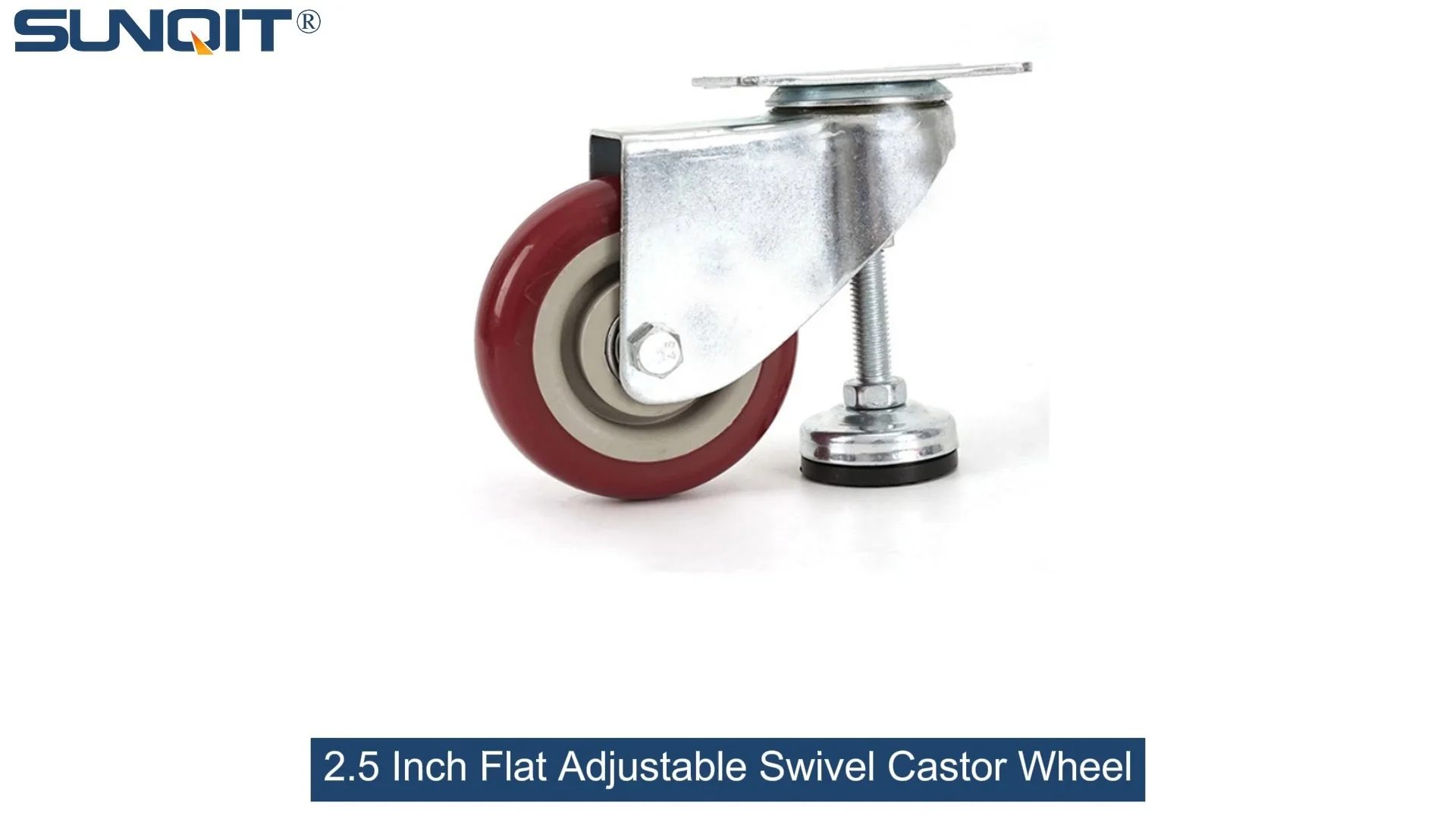
Flat Adjustable Swivel Castor Wheel
Swivel Chair Casters Ball Bearing Wheels Rubber Base with adjustable height function. Resistant to abrasion, impact and corrosion. Heavy payload can hold 80Kgs per pcs,which can make it works at a stable and smooth status.
Understanding Agile Manufacturing: The Need for Flexibility
In an era where customer demands shift overnight and product life cycles shrink by the month, manufacturing systems can no longer afford to be static. Agile manufacturing isn't just a methodology—it's a survival strategy. At its core, agility is about responding quickly to change: whether that means ramping up production for a sudden surge in orders, pivoting to a new product design, or reconfiguring a production line to reduce bottlenecks. But here's the thing: agility isn't just about software or data analytics. It starts with the physical space where work happens.
Imagine a factory floor where every workstation is bolted to the ground, where material racks are too heavy to move, and where reconfiguring a production line takes days of downtime. In such a setup, even the best-laid agile plans fall flat. The missing piece? Mobility. The ability to move, adjust, and repurpose equipment on demand turns rigid layouts into dynamic ecosystems. And that's where components like flat adjustable swivel castor wheels come into play—quietly but powerfully bridging the gap between agile goals and real-world execution.
Mobility as a Foundation for Agility
Mobility in manufacturing isn't just about "being able to roll things around." It's about intentional flexibility. When workbenches, material carts, and assembly stations can be repositioned in minutes—not days—teams gain the freedom to experiment, iterate, and optimize. This is especially critical in lean systems, where the goal is to eliminate waste (think: unnecessary movement, idle time, or overproduction) and create value for customers. A mobile workspace reduces "transportation waste" by bringing tools and materials directly to workers, cuts down on "waiting waste" by allowing quick line rebalancing, and even reduces "inventory waste" by eliminating the need for duplicate fixed workstations.
But not all mobility solutions are created equal. Standard castor wheels might let you roll a cart from Point A to Point B, but they often lack the precision, stability, or adaptability needed for industrial environments. Uneven factory floors can make carts wobble, heavy workbenches might strain to turn, and fixed-height designs can force workers into awkward ergonomic positions. This is where flat adjustable swivel castor wheels step in—designed to address these pain points and turn "basic mobility" into "strategic agility."

Flat Adjustable Swivel Castor Wheels: What Are They, and How Do They Work?
Let's start with the basics. A flat adjustable swivel castor wheel is a mobility component engineered to mount directly to the base of equipment—think workbenches, turnover trolleys, or material racks. Unlike generic castors, these are built with two game-changing features: 360-degree swivel rotation for effortless maneuverability, and height adjustability to fine-tune stability and alignment. Together, these features transform static equipment into tools that adapt to your workflow—not the other way around.
Breaking Down the Design
At first glance, a flat adjustable swivel castor might look simple, but its design is a study in industrial problem-solving. Let's break down its key components:
- The Wheel: Typically made from polyurethane or rubber, the wheel is chosen for durability (to handle heavy loads) and floor protection (to avoid scuffing concrete or warehouse floors). For ESD-sensitive environments (like electronics manufacturing), conductive wheels are even available to dissipate static charge.
- The Swivel Plate: This allows the wheel to rotate 360 degrees, making tight turns or navigating narrow aisles possible—critical for maneuvering large workbenches in crowded spaces.
- The Adjustment Mechanism: Most models use a threaded stem or bolt that can be twisted to raise or lower the castor by a few inches. A lock nut secures the height once set, ensuring stability even under heavy loads.
- The Flat Mounting Plate: Unlike castors with angled brackets, the flat plate mounts flush to the equipment base, distributing weight evenly and reducing the risk of tipping—especially important for top-heavy workbenches loaded with tools.
What Makes Them "Adjustable" and "Flat"?
The "adjustable" part is straightforward: if your factory floor has a slight slope or uneven patches (and let's be real, most do), you can tweak the height of each castor to keep the workstation level. No more wobbly tables or materials sliding off. The "flat" mounting plate, meanwhile, is a subtle but critical detail. By sitting flush against the equipment base, it minimizes the gap between the castor and the tool, lowering the center of gravity and reducing during movement. This is a big deal when you're moving a workbench loaded with sensitive machinery or fragile components.

Supporting Lean Systems: From Waste Reduction to Flow Optimization
Agile manufacturing and lean systems go hand in hand—lean focuses on eliminating waste, and agility relies on efficient, waste-free processes. Flat adjustable swivel castor wheels support lean principles in ways that might not be obvious at first, but add up to significant gains over time.
Eliminating "Transportation Waste"
In traditional setups, moving materials from storage to the assembly line might involve multiple steps: a forklift hauls a pallet to a fixed staging area, then workers manually carry parts to workstations. With mobile carts equipped with flat adjustable castors, materials can be rolled directly to where they're needed—eliminating unnecessary handling and cutting down on transit time. For example, a lean system might use a "milk run" approach, where a single cart (on castors) delivers parts to multiple workstations in a loop, reducing the number of trips and freeing up workers to focus on value-added tasks.
Reducing "Waiting Waste" with Quick Reconfigurations
Lean systems thrive on continuous improvement, which often means experimenting with new layouts. Without mobile equipment, testing a new "U-shaped cell" layout might require days of unbolting workbenches, renting forklifts, and readjusting power cords. With flat adjustable castors, that same reconfiguration could take hours. Workers can roll stations into place, adjust heights to align with roller tracks, and lock the castors—all without specialized tools. The result? Less downtime, more experimentation, and faster adoption of improvements.
Optimizing "Human Movement" Waste
Ergonomics is a cornerstone of lean—tired workers make mistakes, and unnecessary movement leads to fatigue. Flat adjustable castors let you tailor workbench height to each operator, reducing strain on backs and shoulders. A 5'2" worker and a 6' tall worker can share the same workstation by simply adjusting the castors to their ideal height. This not only cuts down on "human movement waste" (reaching, bending, stretching) but also boosts morale and reduces absenteeism.

Workbenches: Transformed by Mobility
Workbenches are the heart of any manufacturing line—where assembly happens, tools are stored, and quality checks are performed. But a fixed workbench is a one-trick pony. Add flat adjustable swivel castors, and it becomes a Swiss Army knife of productivity.
Consider a typical scenario: A electronics manufacturer produces two models of circuit boards, each requiring different tools and testing equipment. With fixed workbenches, they'd need two separate lines—one for Model A and one for Model B—taking up valuable floor space. With mobile workbenches on flat adjustable castors, they can reconfigure the line daily: in the morning, set up for Model A by rolling in soldering stations and ESD workbenches; in the afternoon, swap those out for Model B's inspection tools. No more idle workstations, no more wasted space.
Another example: Ergonomic flexibility. A workbench used for assembly in the morning might double as a packing station in the afternoon. By adjusting the castor height, workers can lower the bench to a comfortable packing level (reducing bending) after spending the morning at a higher assembly height. It's small adjustments like these that turn "good" workspaces into "great" ones.
Synergy with Roller Tracks: Smoother Material Flow
Mobility doesn't exist in a vacuum. In many lean systems, roller tracks are used to move materials horizontally—think of a gravity-fed rack where bins slide from storage to picking stations. Flat adjustable castor wheels complement roller tracks by solving a common problem: how to get materials to the roller track, or from the track to the workstation.
Here's how it works: A mobile cart (fitted with flat adjustable castors) is loaded with raw materials. The castors' height is adjusted to match the height of the roller track, ensuring the cart's edge aligns perfectly with the track. Workers can then slide bins from the cart onto the track with minimal effort—no lifting, no awkward angles, no spills. When the cart is empty, it's rolled back to storage, and another takes its place. This seamless handoff reduces "material handling waste" and keeps the production line flowing without interruptions.
In high-volume environments, this synergy is a game-changer. For instance, an automotive parts supplier using roller tracks to feed assembly lines reported a 25% reduction in material handling time after switching to carts with adjustable castors—simply because workers no longer had to struggle with misaligned cart edges or wobbly loads.
Real-World Impact: Case Study in Agility
Let's ground this in a real example (with details anonymized to protect client privacy). A mid-sized medical device manufacturer was struggling to keep up with demand for a new line of diagnostic tools. Their production floor was laid out in a traditional linear fashion, with fixed workbenches and material racks. To switch from producing 500 units/day to 1,000 units/day, they needed to add a second shift—but their floor space was limited, and reconfiguring the line would require shutting down for a week.
Their solution? Retrofitting all workbenches and material carts with flat adjustable swivel castor wheels. Overnight, the static line became a modular system. Here's what happened next:
- Day 1: Workbenches were rolled into a U-shaped cell layout, reducing the distance parts traveled between stations by 40%.
- Day 2: Castor heights were adjusted to align workbenches with existing roller tracks, eliminating manual lifting of heavy component bins.
- Day 3: The second shift launched, with the same cell layout—no need for duplicate workstations, as the first shift's equipment was simply repositioned for the night team.
The result? The factory hit its 1,000-unit target within a week, with zero downtime for reconfiguration. Workers reported less fatigue (thanks to adjustable heights), and material handling errors dropped by 18%. All from a relatively small upgrade: better castors.
Comparing Castor Types: Why "Flat Adjustable Swivel" Stands Out
Not all castors are created equal. To understand why flat adjustable swivel castors are ideal for agile systems, let's compare them to common alternatives:
| Castor Type | Maneuverability | Stability on Uneven Floors | Ergonomic Adjustability | Best For |
|---|---|---|---|---|
| Standard Fixed Castors | Low (only moves forward/backward) | Low (no height adjustment) | None | Light, rarely moved equipment (e.g., storage racks) |
| Swivel (Non-Adjustable) Castors | High (360° rotation) | Low (fixed height) | None | Light carts, frequent movement but even floors |
| Flat Adjustable Swivel Castors | High (360° rotation) | High (adjustable height) | High (custom height per worker) | Heavy workbenches, dynamic layouts, uneven floors |
| Locking Brake Castors | Medium (swivel locks when braking) | Low (fixed height) | None | Equipment needing occasional stability (e.g., workbenches that stay in one place 90% of the time) |
The takeaway? For agile systems that demand mobility, stability, and adaptability, flat adjustable swivel castors are the clear front-runner. They're not the cheapest option, but their ROI comes from reduced downtime, improved ergonomics, and the ability to reconfigure on the fly—all critical for staying competitive in fast-moving markets.
Future-Proofing Manufacturing: Castors in Industry 4.0
As manufacturing evolves toward Industry 4.0—with smart sensors, IoT connectivity, and automation—you might wonder: Do physical components like castors still matter? Absolutely. In fact, they become more important. Smart factories rely on real-time data to optimize workflows, but if the physical equipment can't adapt to those optimizations, the data is useless.
Looking ahead, we're already seeing innovations like castors with built-in sensors that track movement patterns (to identify bottlenecks) or alert maintenance teams when wheels need lubrication. Some manufacturers are even experimenting with "self-adjusting" castors that use small motors to level workstations automatically, guided by floor sensors. But even these high-tech solutions build on the foundation of flat adjustable swivel design—proving that mobility, stability, and adjustability will remain critical for years to come.
Conclusion: Small Components, Big Impact
In the grand scheme of manufacturing, flat adjustable swivel castor wheels might seem like a small detail. But in agile systems, details matter. They're the difference between a factory that talks about agility and one that lives it. By enabling quick reconfigurations, reducing waste, and supporting lean principles, these castors turn static floors into dynamic workspaces where change is not just possible—it's easy.
So, the next time you're mapping out your agile manufacturing strategy, don't overlook the physical tools that make flexibility possible. After all, even the most advanced software can't move a bolted-down workbench. But with the right castors? Your factory can adapt, evolve, and thrive—one roll at a time.