- Company Articles
- Products and Technology
- Product knowledge
- The Role of Free Flow Chain Conveyors in Streamlining Assembly Processes

The Role of Free Flow Chain Conveyors in Streamlining Assembly Processes
Related Product
Free Flow Chain Conveyor
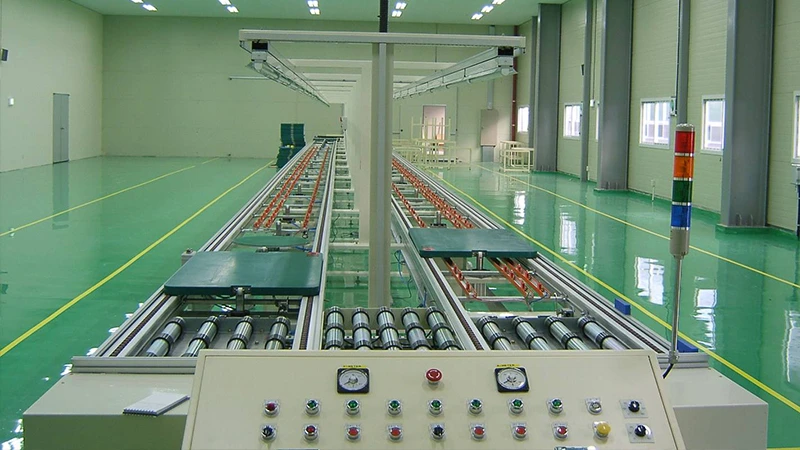
The free flow conveyor system uses a free flow chain that can increase the speed of the tooling board that supports the products. This can improve the efficiency and quality of the production process, as well as reduce the wear and tear of the system.
Walk into any modern manufacturing facility, and you'll likely hear the hum of machinery, the clink of tools, and the steady rhythm of products moving from one workstation to the next. Assembly lines are the lifeblood of production—they turn raw materials into finished goods, one precise step at a time. But for all their importance, assembly processes often grapple with hidden inefficiencies: parts get stuck in transit, operators waste time fetching materials, and bottlenecks emerge when one station lags behind. These small snags add up, eating into productivity, increasing lead times, and fraying the nerves of teams trying to meet tight deadlines.
This is where free flow chain conveyors step in. More than just a piece of equipment, they're a quiet revolution in how assembly lines operate—designed to keep products moving smoothly, reduce friction (both literal and figurative), and align with the principles of lean systems that prioritize efficiency and waste reduction. When paired with tools like flow racks and ergonomic workbenches , free flow chain conveyors transform chaotic workflows into synchronized symphonies of productivity. Let's dive into how these unassuming systems are redefining what it means to streamline assembly processes.
What Are Free Flow Chain Conveyors, Anyway?
At first glance, a free flow chain conveyor might look like any other conveyor belt: a series of rollers or chains stretched between two points. But beneath that simplicity lies a clever design built for one purpose: to move products with minimal resistance. Unlike traditional belt conveyors, which rely on friction between the belt and the product, free flow chain conveyors use a series of interconnected chains with small, free-spinning rollers. These rollers reduce friction to almost nothing, allowing products to glide along the track—whether powered by gravity, a gentle motor, or even manual push.
Imagine a line of toy cars coasting down a smooth ramp—that's the idea, but scaled up for industrial use. The chains are mounted on a frame, often adjustable in height or angle, and can be configured in straight lines, curves, or even vertical climbs. What sets them apart is their "free flow" nature: there's no need for constant power to keep products moving. In gravity-fed systems, a slight incline is all it takes to keep items rolling toward their next destination. In motorized setups, the chain moves slowly but steadily, ensuring products arrive at workstations at just the right pace—no more, no less.
This design makes free flow chain conveyors incredibly versatile. They handle everything from small electronic components (think circuit boards or phone parts) to larger items like automotive parts or appliance panels. And because they're modular, they can be customized to fit the unique layout of a factory. Need to add a detour around a workstation? Swap out a straight section for a curve. Want to connect two floors? Add a vertical lift section. It's this flexibility that makes them a favorite in industries where production needs change as often as product designs.
The Lean Connection: Aligning with the Principles of Waste Reduction
To understand why free flow chain conveyors are so impactful, we need to talk about lean systems . Lean manufacturing, pioneered by Toyota in the mid-20th century, is all about eliminating "muda"—the Japanese word for waste. Waste comes in many forms: overproduction, waiting, unnecessary movement, defects, and more. Lean systems aim to root out these inefficiencies, leaving only what adds value to the product.
Free flow chain conveyors are a lean dream come true. Let's break down how they tackle common sources of waste:
- Waiting Waste: In traditional setups, operators might finish assembling a part and then wait for the next one to arrive. With free flow conveyors, the next part is already on its way—no more standing around. The steady flow ensures workstations are never idle.
- Motion Waste: Ever watched an operator walk 20 feet to grab a bin of screws, then walk back? That's motion waste. Free flow conveyors, paired with flow racks positioned right at the workstation, bring materials to the operator. No more wasted steps.
- Inventory Waste: When parts pile up because they can't move to the next station, that's excess inventory—a lean no-no. Free flow conveyors keep inventory "pulled" through the line, meaning parts only move when the next workstation is ready. This keeps stock levels low and fresh.
Take, for example, a electronics assembly plant that switched to free flow conveyors. Before, workers spent 15% of their shift fetching components from a distant storage area. After installing conveyors that fed parts directly from flow racks to their workbenches, that time dropped to 3%. The result? A 12% boost in daily output, and operators reported less fatigue—proof that small changes in material flow can have a big impact on both productivity and morale.
Beyond the Conveyor: How Flow Racks and Workbenches Complete the System
A free flow chain conveyor is powerful on its own, but it truly shines when it's part of a larger ecosystem. Two key players in this ecosystem are flow racks and workbenches—both designed to work hand-in-hand with conveyors to create a seamless workflow.
Flow Racks: The "Feeders" of the Line
Flow racks are like the silent partners of conveyors. They're storage systems with inclined shelves fitted with rollers, designed to hold bins of parts or materials. When a bin at the front of the rack is emptied, the bin behind it automatically slides forward—thanks to gravity—ensuring there's always a fresh supply. This is called "first-in, first-out" (FIFO) inventory management, which reduces the risk of parts expiring or becoming obsolete.
Here's how it works with a free flow conveyor: A flow rack is positioned at the start of the line, loaded with bins of screws, brackets, or circuit boards. As the conveyor moves products along, operators at each workstation reach into the flow rack (which is at arm's length, thanks to the conveyor's height adjustment) and grab what they need. When a bin is empty, a signal (often a simple light or flag) alerts the material handler, who refills the rack from the back. No more stopping the line to restock—just a continuous flow of materials and products.
Workbenches: The Heart of the Operation
If flow racks feed the line and conveyors move the products, then workbenches are where the magic happens—the actual assembly. But not all workbenches are created equal. The best ones are ergonomically designed, with height-adjustable surfaces, built-in tool storage, and cutouts to accommodate the conveyor track. This way, the product glides right up to the operator, who can work comfortably without leaning, stretching, or straining.
Consider a workstation where an operator assembles small electric motors. With a standard workbench, the motor might sit on a flat surface, requiring the operator to bend over or twist to reach tools. With an ergonomic workbench paired with a free flow conveyor, the motor rolls to waist height, tools are stored in drawers beneath the surface, and the conveyor extends right up to the bench edge. The operator stays in a neutral, comfortable position, reducing the risk of repetitive strain injuries and increasing focus.
Together, conveyor, flow rack, and workbench form a triangle of efficiency: materials come in (flow rack), products move through (conveyor), and assembly happens (workbench). It's a closed loop that minimizes waste and maximizes productivity.
Real-World Impact: Case Studies in Streamlining
Numbers and theories are one thing, but real stories show the true power of free flow chain conveyors. Let's look at two examples of how these systems transformed assembly lines in different industries.
Case Study 1: Automotive Parts Manufacturer
A mid-sized automotive parts manufacturer was struggling with bottlenecks in its brake caliper assembly line. The line used manual carts to move parts between stations, which often got stuck in narrow aisles or were delayed by human error. Lead times for orders were inconsistent, and the plant manager estimated that 20% of daily production time was lost to material handling.
The solution? A gravity-fed free flow chain conveyor system with integrated flow racks and adjustable workbenches. The conveyor was installed along the length of the line, with flow racks mounted above the conveyor to save floor space. Each workstation had a small "pocket" in the conveyor where parts could pause while being assembled, then release once finished. Within three months, the results were striking:
- Material handling time dropped by 65% (no more carts!)
- Bottlenecks decreased by 80%—the line flowed smoothly, even during peak hours
- Lead times stabilized, with 95% of orders shipping on time (up from 78%)
The plant manager summed it up: "We used to spend so much time putting out fires—chasing down lost carts, reworking parts that got damaged in transit. Now, the line runs like a well-oiled machine. Our team can focus on building quality parts, not moving them around."
Case Study 2: Electronics Assembly Plant
A manufacturer of smart home devices faced a different challenge: high variability in product size. One day, they might assemble small sensors (the size of a deck of cards); the next, larger control panels (the size of a laptop). Their old conveyor system was rigid—fixed in width and height—so switching between products meant stopping the line for 30-45 minutes to reconfigure.
They replaced it with a modular free flow chain conveyor system, where sections could be quickly swapped out or adjusted. The flow racks were fitted with adjustable dividers to hold different bin sizes, and the workbenches had telescoping surfaces that could expand or contract. The result? Changeover time dropped from 45 minutes to 5 minutes. The plant now runs three different product lines per day, with no loss in productivity.
"We used to avoid small-batch orders because the changeover was too costly," said the production supervisor. "Now, we can take on custom orders without hesitation. The conveyor's flexibility opened up a whole new revenue stream for us."
Choosing the Right System: Key Considerations
Not every free flow chain conveyor system is right for every facility. To get the most out of your investment, consider these factors before diving in:
| Consideration | What to Ask | Why It Matters |
|---|---|---|
| Load Capacity | How much weight will the conveyor need to carry? (e.g., 5 lbs per product vs. 50 lbs) | Overloading can damage the chain or rollers, leading to breakdowns. |
| Product Size & Shape | Are products flat, irregularly shaped, or fragile? | Irregular shapes may need custom guides; fragile items may require slower speeds. |
| Space Constraints | Is the facility tight on space? Do you need curves or vertical sections? | Modular systems with compact designs work best in small areas. |
| Power Source | Gravity-fed or motorized? (Gravity is cheaper; motorized offers more control.) | Motorized systems are better for heavy loads or long distances. |
| Future Growth | Will you need to expand the line or add new products? | Modular systems can grow with your business; rigid systems may need full replacement. |
It's also worth involving your team in the decision. Operators who work on the line every day have insights into pain points you might miss—like a workstation that's always too cramped or a corner where carts get stuck. Their input can help you design a system that works with your team, not against them.
Maintenance: Keeping the Flow Going
Even the best conveyor system needs a little TLC to keep running smoothly. The good news is that free flow chain conveyors are low-maintenance compared to other types of conveyors . Here's a quick checklist to keep yours in top shape:
- Daily Checks: Wipe down the chain and rollers to remove dust or debris (which can cause jams). Check for loose bolts or misaligned rollers.
- Weekly Lubrication: Apply a light industrial lubricant to the chain links—this reduces friction and extends the life of the system.
- Monthly Inspections: Test the conveyor at full load to ensure it's moving smoothly. Check for signs of wear, like cracked rollers or stretched chains.
- Quarterly Deep Clean: Disassemble and clean hard-to-reach parts, like the inside of the chain links. replace any worn components (most suppliers offer easy-to-swap parts).
Many modern systems also come with built-in sensors that alert maintenance teams to issues before they become problems—like a roller that's starting to stick or a chain that's losing tension. This proactive approach means fewer unexpected breakdowns and more uptime.
The Future of Assembly: Where Free Flow Conveyors Are Headed
As manufacturing evolves, so too will free flow chain conveyors. Here are a few trends to watch:
Smart Integration: Imagine a conveyor that "talks" to your ERP system. When inventory in the flow rack runs low, it automatically sends a request to the warehouse. When a product is delayed at a workstation, it alerts the supervisor via app. This level of connectivity is already being tested in advanced facilities, and it's only a matter of time before it becomes standard.
Sustainability: Manufacturers are increasingly looking for eco-friendly options, and free flow conveyors are stepping up. New designs use recycled materials for rollers and energy-efficient motors that use 30% less power than older models. Some gravity-fed systems even generate small amounts of electricity as products roll down the track—though we're still in the early days of that technology.
Collaborative Robots (Cobots): Cobots—small, flexible robots that work alongside humans—are becoming more common on assembly lines. Free flow conveyors are being designed with special tracks that guide cobots to pick up or drop off products, further reducing the need for manual handling.
But no matter how advanced they get, the core purpose of free flow chain conveyors will remain the same: to make assembly lines work for people, not the other way around. They're a reminder that sometimes, the most impactful innovations aren't flashy or high-tech—they're simply about removing obstacles and letting the work flow.
Final Thoughts: Streamlining Isn't Just About Speed
When we talk about streamlining assembly processes, it's easy to focus on speed—how many products can we make in an hour? But there's more to it than that. Streamlining is about creating a workplace where operators feel valued, where frustration is replaced with focus, and where every part of the process has a purpose.
Free flow chain conveyors, paired with flow racks, workbenches, and lean systems, do exactly that. They turn chaotic lines into calm, efficient spaces where products move like water—smooth, steady, and unstoppable. They reduce waste, boost productivity, and yes, make manufacturing a little less stressful for everyone involved.
So the next time you walk through a factory and hear that gentle hum of a free flow conveyor, take a moment to appreciate it. It's not just moving products—it's moving the industry forward, one smooth roll at a time.