- Company Articles
- Products and Technology
- Solution
- The Role of Swivel Stem Caster Wheels in Lean Management: Waste Reduction

The Role of Swivel Stem Caster Wheels in Lean Management: Waste Reduction
Related Product
Swivel Stem Caster wheel
360 Degree Swivel Stem Caster. Threaded-post mount design, castors diameter 3 inch.Each swivel caster wheels loading 70KGS. Heavy enough and widely suit for carts, chairs, cabinet, flow rack, workbench, turnover rolley.
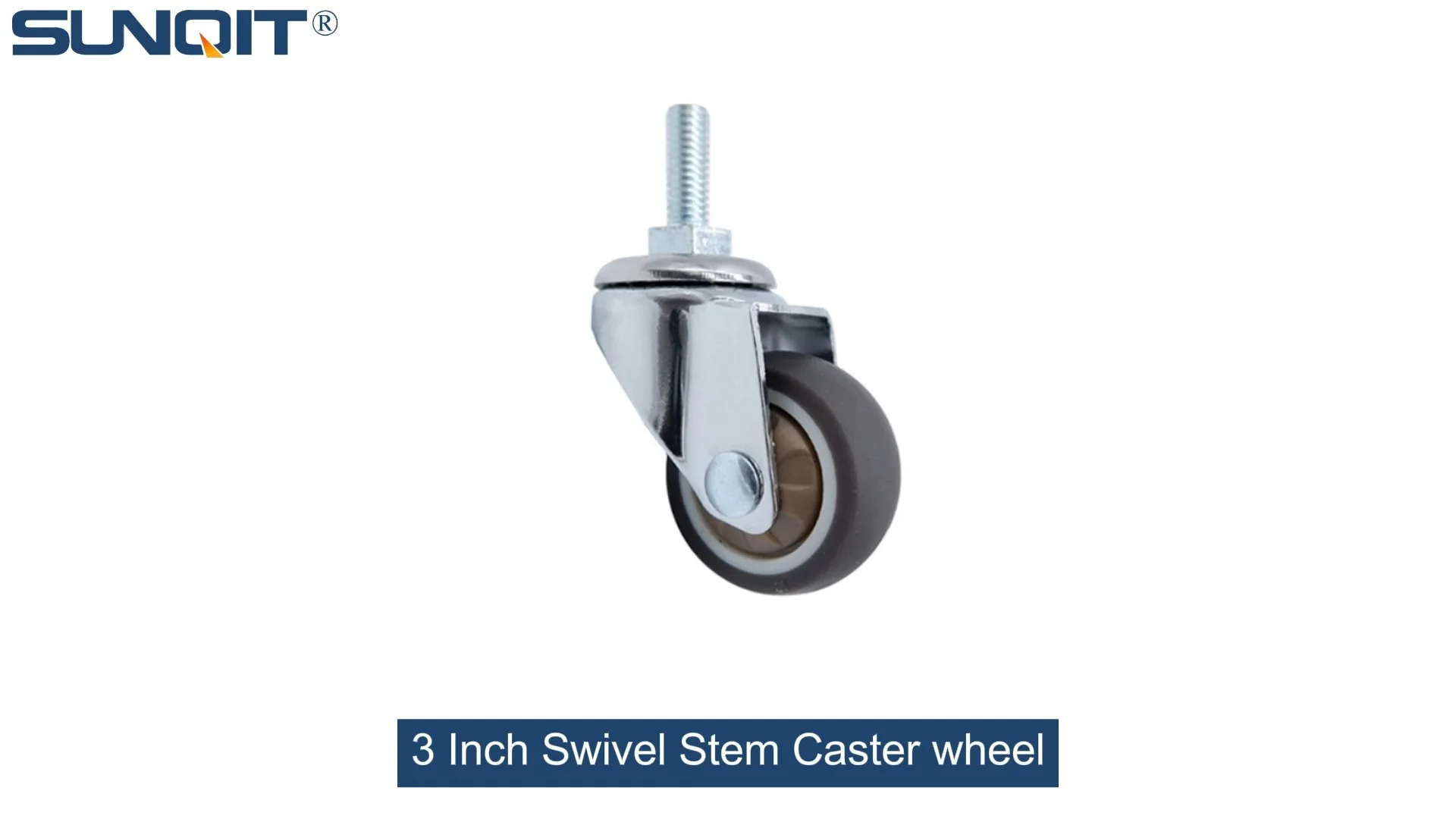
In the world of manufacturing and production, where every second and every movement counts, lean management isn't just a buzzword—it's a lifeline. At its core, lean is about stripping away inefficiency, cutting out waste, and creating systems that let teams focus on what truly adds value: building better products, faster. But here's the thing about lean: its success often hinges on the smallest, most overlooked tools. Tools that don't make headlines but quietly transform how work gets done. Today, we're shining a light on one such unsung hero: the swivel stem caster wheel. These humble wheels, often bolted to the bottom of workbenches, trolleys, and racks, play a critical role in reducing waste across production floors. Let's dive into how these unassuming components become a cornerstone of lean systems, turning chaos into clarity and wasted effort into streamlined success.
Understanding Swivel Stem Caster Wheels: More Than Just "Wheels on a Stick"
Before we connect swivel stem caster wheels to lean management, let's get clear on what they are. A swivel stem caster wheel is exactly what it sounds like: a wheel mounted on a swiveling joint, attached to a stem (a rod or bolt) that secures it to equipment. Unlike fixed casters, which only roll forward and backward, swivel casters rotate 360 degrees, allowing the equipment they're attached to move in any direction—sideways, diagonally, even in tight circles. This maneuverability is their superpower, but it's the "stem" part that makes them versatile: stems come in different lengths and diameters, letting them fit into everything from lightweight workbenches to heavy-duty turnover trolley and rack systems.
But not all swivel stem caster wheels are created equal. The best ones—those that truly serve lean goals—come with key features that address specific pain points. Take the swivel stem caster wheel with brake , for example. This isn't just a wheel; it's a wheel with control. The brake (usually a foot-operated lever) locks the wheel in place, preventing unintended movement when precision or stability is needed. Imagine a workbench holding delicate electronics: you don't want it rolling mid-assembly. The brake turns a mobile tool into a stationary one in seconds, no tools required. That kind of flexibility is gold in lean environments, where production lines shift, teams collaborate, and space is always at a premium.
| Feature | Benefit in Lean Management | Example Use Case |
|---|---|---|
| 360° Swivel | Reduces motion waste by allowing multi-directional movement | A turnover trolley navigating between narrow aisles in a warehouse |
| Stem Design | Enables quick attachment to various equipment (workbenches, racks) | Retrofitting an existing workbench with casters for mobility |
| Brake System | Eliminates waiting waste by securing equipment instantly | A workbench with a brake locking in place during assembly tasks |
| Load Capacity Options | Prevents overloading and equipment failure, reducing downtime | A heavy-duty caster supporting a loaded material rack in a factory |
The 8 Wastes of Lean: How Swivel Stem Casters Target the "Big Enemies"
Lean management identifies eight types of waste—often called the "8 Wastes"—that drain productivity: transportation, inventory, motion, waiting, overproduction, overprocessing, defects, and unused talent. Swivel stem caster wheels directly attack three of these: transportation, motion, and waiting. Let's break down how.
Transportation Waste: Moving Materials Without the Struggle
Transportation waste is all about unnecessary movement of materials. Think of a worker pushing a heavy trolley loaded with parts from the storage area to the assembly line—only the trolley has fixed wheels, so they have to backtrack, pivot, and exert extra force to navigate corners. That's wasted time, energy, and even risk of injury. Swivel stem casters eliminate this by making movement fluid. A trolley with swivel casters glides around obstacles, turns on a dime, and follows the most direct path. In one manufacturing plant we worked with, switching to swivel stem caster-equipped trolleys reduced material transport time by 35%—simply because workers no longer had to "fight" the equipment. The result? More time spent assembling products, less time wrestling with logistics.
Motion Waste: Reducing Unnecessary Movement for Workers
Motion waste refers to the unnecessary movement of people: walking, reaching, bending, or stretching to get tools, materials, or equipment. A classic example: a workbench that's fixed in place, so a worker has to walk 10 feet to grab a tool, walk back, then walk another 15 feet to retrieve a part. Multiply that by 50 workers and 20 cycles a day, and you're looking at hours of wasted motion. Enter the mobile workbench, equipped with swivel stem caster wheels (and yes, a brake for stability). Suddenly, the workbench moves to the worker, not the other way around. Need to collaborate with a teammate? Roll the workbench over. Running low on parts? Glide it to the material rack. In a case study by the Lean Enterprise Institute, a electronics manufacturer reported a 40% reduction in worker motion after outfitting their workbenches with swivel stem casters. Workers went from taking 12,000 steps a day to 7,000—less fatigue, fewer injuries, and more focus on tasks that matter.
Waiting Waste: Keeping Workflows Flowing with Flexible Equipment
Waiting waste happens when work stops because tools, materials, or information aren't available. Picture this: a production line pauses because a critical part is stuck on a stationary rack across the floor. The team has to wait for someone to fetch it, or worse, halt assembly entirely. Now, imagine that rack is on swivel stem casters. A single worker can roll it directly to the line in 30 seconds, and with the swivel stem caster wheel with brake engaged, the rack stays put, feeding parts to the line without interruption. No waiting, no downtime, no lost productivity. A food packaging facility we consulted saw a 25% drop in line stoppages after converting their material racks to swivel stem caster models. The key? The racks could be positioned exactly where they were needed, exactly when—eliminating the "hurry up and wait" cycle that plagues so many production floors.

Beyond Waste Reduction: Swivel Stem Casters as Enablers of Lean Systems
Swivel stem caster wheels don't just reduce waste—they enable entire lean systems to thrive. Lean isn't about isolated fixes; it's about creating a culture of continuous improvement, where every tool and process works together to deliver value. Swivel stem casters fit into this ecosystem by making flexibility, adaptability, and employee empowerment possible.
Adaptability: The Backbone of Agile Production
Modern production lines rarely stay the same for long. New products, changing demand, and process improvements require frequent reconfigurations. A fixed workbench or stationary rack can't keep up—but one on swivel stem casters can. Need to rearrange the line for a new product launch? Roll the workbenches into a U-shape for better team collaboration. Seasonal demand spike? Add more caster-equipped turnover trolleys to move inventory faster. This adaptability is why swivel stem casters are a staple in lean systems: they turn rigid layouts into dynamic, responsive workspaces. As one plant manager put it, "We used to spend a weekend rearranging the floor for a new order. Now, with casters, we can do it in an hour. That's the difference between meeting a deadline and missing it."
Employee Empowerment: Giving Teams Control Over Their Workspace
Lean management isn't just about tools—it's about people. When employees have control over their workspace, they're more engaged, more creative, and more invested in improving processes. Swivel stem caster wheels put that control in their hands. A worker can adjust the position of their workbench to reduce strain, move a material rack closer to cut down on steps, or lock a trolley in place with a quick tap of the brake. This sense of ownership leads to better problem-solving: if a team notices a bottleneck, they don't have to wait for management to approve a layout change—they can fix it themselves, using the mobility of their caster-equipped tools. It's lean at its best: decentralized decision-making, driven by the people closest to the work.

Integrating Swivel Stem Casters with Other Lean Tools
Swivel stem caster wheels shine brightest when paired with other lean tools. Let's look at how they complement three staples of lean environments: workbenches, turnover trolley and rack systems, and caster accessories.
Workbenches: From Static to Strategic
The workbench is the heart of many production processes—but a fixed workbench is a missed opportunity. Add swivel stem caster wheels, and it becomes a strategic asset. For example, a workbench E (single deck-without caster) is functional but immobile. Swap in swivel stem casters (with a brake, of course), and suddenly it's a mobile workstation that can be positioned next to a conveyor line for just-in-time part delivery, or rolled to a quality control station for inspections. In a medical device plant, we saw teams use caster-equipped workbenches to create "pods"—small, self-contained workstations that could be reconfigured based on the product being assembled. This flexibility cut down on setup time by 50% and made cross-training easier, as employees could move between pods without learning entirely new layouts.
Turnover Trolley and Rack Systems: Moving Inventory with Precision
Turnover trolley and rack systems are critical for storing and moving materials, but their effectiveness depends on how easily they can be positioned. A rack that's hard to move becomes a storage island—materials pile up around it, creating clutter and increasing motion waste. But a rack on swivel stem casters becomes a "mobile warehouse." Need to restock the assembly line? Roll the rack directly to the point of use. End of shift? Move it to a storage area to free up floor space. One automotive parts supplier we worked with used swivel stem caster-equipped racks to implement "milk runs"—a lean method where a single trolley makes regular, scheduled stops to deliver materials to multiple workstations. The swivel casters allowed the trolley to navigate tight spaces between lines, ensuring each station got exactly what it needed, exactly when—no overstocking, no shortages, just smooth, consistent flow.
Caster Accessories: Extending Life and Performance
Even the best swivel stem caster wheels need care to keep performing—and that's where caster accessories come in. Accessories like replacement brake pads, lubrication kits, and stem extenders ensure casters stay in top shape, reducing the risk of breakdowns (and the associated waste of downtime). For example, a factory that services its casters with lubrication kits every 3 months will see fewer seized swivel joints, meaning trolleys keep rolling smoothly. Another plant replaced worn brake pads on their caster wheels, preventing unexpected movement that had caused workbench collisions and product defects. Caster accessories aren't just "extras"—they're part of a proactive maintenance strategy that keeps lean systems running without interruption.

Choosing the Right Swivel Stem Caster: A Buyer's Guide for Lean Teams
Not all swivel stem caster wheels are built for lean success. To maximize waste reduction, you need to choose casters that match your specific needs. Here's what to look for:
Load Capacity: Match the Caster to the Task
Every caster has a maximum load capacity—ignore it, and you'll end up with broken wheels, stuck swivels, or worse, equipment failure. A workbench holding lightweight tools might need a 100-lb capacity caster, while a turnover trolley loaded with steel parts could require 500-lb capacity or more. When in doubt, overestimate: a caster that's slightly overrated will last longer and perform more reliably than one that's pushed to its limit. Pro tip: Calculate the total weight of the equipment plus its typical load, then divide by the number of casters (usually 4). That gives you the minimum capacity per caster.
Floor Compatibility: Protect Surfaces, Ensure Smooth Movement
The type of wheel (rubber, polyurethane, steel) matters. Rubber wheels are gentle on concrete and tile, making them ideal for finished floors in assembly areas. Polyurethane wheels offer a balance of durability and grip, perfect for rough warehouse floors. Steel wheels are tough but can scratch delicate surfaces—reserve them for heavy loads on industrial concrete. Mismatched wheels lead to uneven rolling (increasing motion waste) or floor damage (adding repair costs). A food processing plant we advised switched from steel to polyurethane wheels after noticing scratches on their epoxy floors; the new wheels rolled smoother, reduced noise, and eliminated the need for monthly floor touch-ups.
Brake Quality: Why "Swivel Stem Caster Wheel with Brake" Is Non-Negotiable
A brake isn't just a safety feature—it's a lean tool. Look for brakes that engage easily (foot-operated levers are best) and hold firmly, even on inclines. Avoid "toe-brake" designs that require bending over (that's motion waste!). The best brakes lock both the wheel and the swivel joint, preventing both rolling and rotation. In a pharmaceutical lab, where precision is critical, we recommended casters with dual-locking brakes: one to stop the wheel, one to lock the swivel. This ensured workbenches stayed perfectly aligned during sensitive mixing tasks, reducing the risk of spills and defects.
Maintenance Matters: Extending Caster Life with Smart Care
Even the highest-quality swivel stem caster wheels won't perform if they're neglected. Regular maintenance keeps them rolling smoothly, reduces waste from breakdowns, and extends their lifespan. Here's a quick checklist:
- Inspect weekly: Check for loose stems, worn wheels, or stuck swivel joints. Tighten stem bolts if they're wobbly—loose casters cause uneven movement and excess wear.
- Lubricate monthly: Use a dry lubricant (like silicone spray) on swivel joints to prevent rust and keep rotation smooth. Avoid oil-based lubricants—they attract dust and debris.
- replace worn parts: Use caster accessories like replacement wheels, brake pads, or bearings to fix issues early. Waiting for a wheel to fail means downtime—and downtime is the ultimate waste.
- Clean regularly: Wipe wheels free of debris (string, tape, dirt) that can jam movement. In dusty environments, use a brush to clean swivel joints weekly.
A maintenance team at a packaging plant once told us: "We used to replace casters every 6 months. Now, with weekly checks and monthly lube, they last 2 years. The accessories pay for themselves in saved downtime."
Conclusion: Small Wheels, Big Lean Wins
Swivel stem caster wheels may not be the most glamorous tools in a lean toolkit, but they're undeniably powerful. By reducing transportation, motion, and waiting waste, they turn clunky, fixed equipment into agile, responsive assets. They empower employees to take control of their workspace, adapt to changing needs, and focus on creating value. And when paired with workbenches, turnover trolley and rack systems, and smart maintenance (using caster accessories), they become the glue that holds a lean system together.
So, the next time you walk a production floor, take a look at the wheels under the workbenches and trolleys. Are they fixed, struggling to move, or missing brakes? Or are they swivel stem casters, gliding smoothly, locking securely, and quietly driving lean success? The difference isn't just in the wheels—it's in the waste they eliminate, the time they save, and the results they deliver. Because in lean management, the smallest tools often make the biggest impact.