- Company Articles
- Products and Technology
- Product knowledge
- The Science Behind Aluminum Honeycomb Panel Strength: Material Engineering Insights

The Science Behind Aluminum Honeycomb Panel Strength: Material Engineering Insights
Related Product
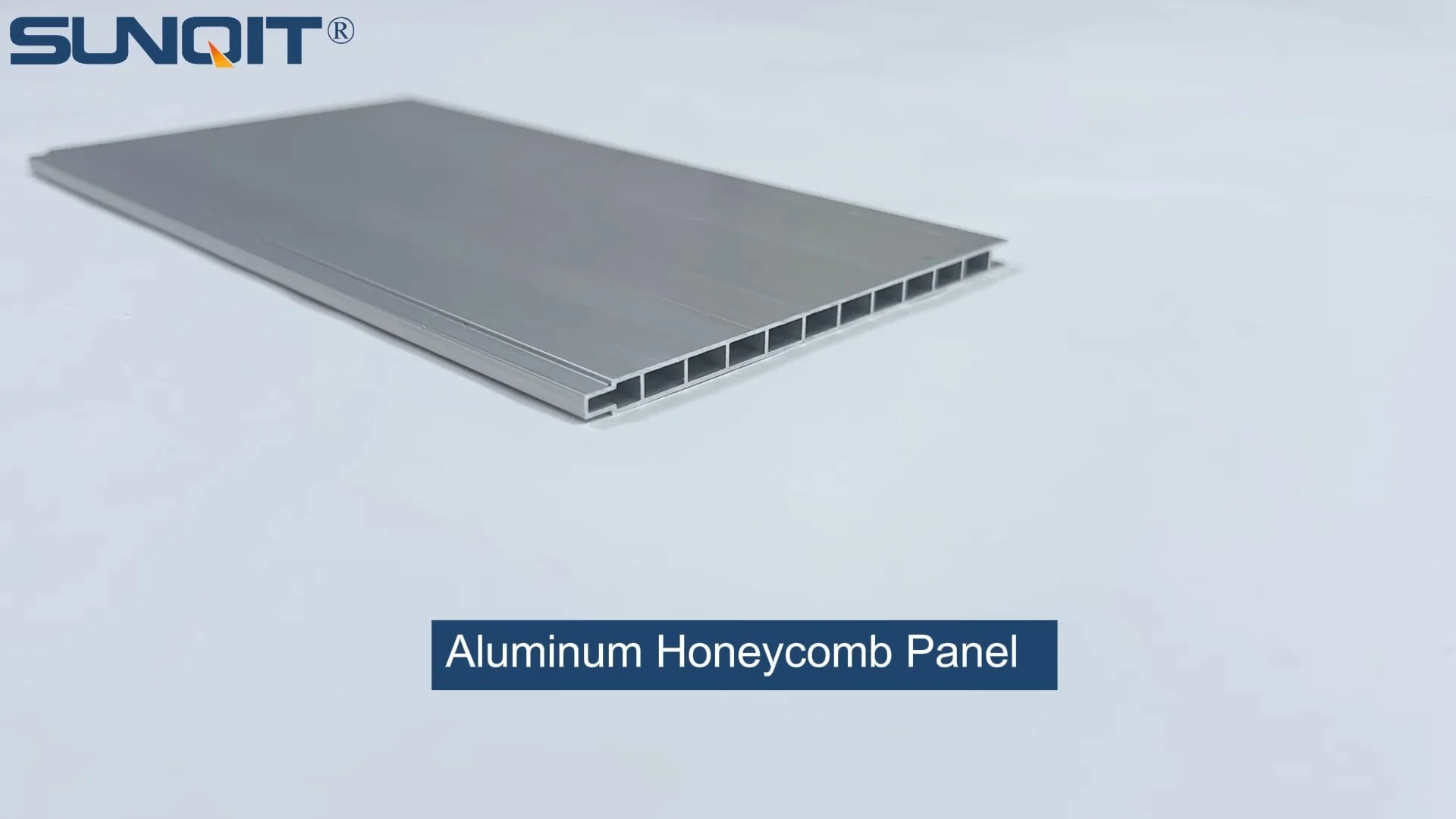
Aluminum Honeycomb Panel
Aluminum honeycomb panel used as table top, side wall, it is connected one pcs by one pcs from the side slot to make a full pieces.This panel width 105mm, 55mm, 35mm are optional for slection.
Walk into a modern airport, run your hand along the sleek interior panels of an airplane, or lean against a lightweight yet surprisingly sturdy office workbench—chances are, you're touching something engineered with the quiet brilliance of aluminum honeycomb panels. These unassuming materials, with their sandwich-like structure of thin aluminum face sheets and a hexagonal core, have revolutionized industries from aerospace to construction. But what makes them so remarkably strong, especially considering how lightweight they are? Let's dive into the material science, geometry, and engineering ingenuity that give aluminum honeycomb panels their impressive strength.
Nature's Blueprint: The Honeycomb Core
Before we get into the lab specifics, let's start with a trip to the garden. Beehives, with their perfect hexagonal cells, have long fascinated engineers. A beehive's structure is a masterclass in efficiency: it uses the least amount of wax to create a lattice that can support 20 times its own weight. This "biomimicry" isn't just a coincidence—it's the foundation of aluminum honeycomb panel design. By replicating the hexagonal cell pattern in an aluminum core, engineers tap into nature's proven formula for strength without excess weight.
An aluminum honeycomb panel typically consists of three layers: two thin, rigid face sheets (made from high-strength aluminum alloys) bonded to a lightweight honeycomb core (also aluminum). The magic lies in how these layers work together. When force is applied—say, a heavy load on a workbench or wind pressing against a building facade—the face sheets handle tension and compression, while the honeycomb core resists shear forces, preventing the panel from bending or buckling. It's a teamwork of materials that outperforms solid aluminum, wood, or even steel in key metrics like strength-to-weight ratio.
Material Selection: Why Aluminum?
Not all aluminum is created equal, and the choice of alloys for honeycomb panels is critical. Let's break down the components:
Face Sheets: The Panel's "Skin"
The outer layers, or face sheets, are often made from 5000-series or 6000-series aluminum alloys. 5000-series alloys (like 5052 or 5083) are prized for their excellent corrosion resistance and high tensile strength, making them ideal for outdoor applications like building facades. 6000-series alloys (such as 6061 or 6082), on the other hand, offer superior stiffness and are heat-treatable, which is why they're common in aerospace and automotive parts where precision and durability matter most. These alloys are rolled into thin sheets—often just 0.5mm to 2mm thick—striking a balance between strength and weight.
Honeycomb Core: The "Skeleton"
The core is where the honeycomb pattern comes to life, and it's usually made from even thinner aluminum—think 0.03mm to 0.1mm thick foil, similar to the thickness of a heavy-duty kitchen foil but engineered for structural integrity. 3000-series alloys (like 3003) are a popular choice here because they're highly formable, allowing the foil to be shaped into precise hexagonal cells without cracking. The core's aluminum is also often coated with a thin layer of adhesive to bond securely to the face sheets during manufacturing.

The Geometry of Strength: Why Hexagons?
You might wonder: Why hexagons, and not squares, triangles, or circles? The answer lies in stress distribution. A hexagonal cell has six sides, each sharing a wall with adjacent cells. When pressure is applied, the load spreads evenly across all six walls, minimizing stress concentration at any single point. In contrast, square cells have sharp corners where stress can build up, leading to cracks, while triangular cells are stiffer but less efficient at distributing weight. Hexagons, quite simply, are nature's (and engineers') optimal shape for balancing strength, weight, and material usage.
But the core's strength isn't just about shape—it's also about size and thickness. Engineers tweak three key variables: cell size (the distance between opposite sides of a hexagon), wall thickness (how thin the aluminum foil is), and core height (the distance between the two face sheets). Smaller cells with thicker walls, for example, boost compressive strength, making the panel better at supporting heavy loads. Larger cells with thinner walls, by contrast, are lighter and more flexible, ideal for applications where weight savings matter most, like airplane interiors.
| Core Cell Size (mm) | Wall Thickness (μm) | Compressive Strength (MPa) | Weight (kg/m²) |
|---|---|---|---|
| 6 (Small) | 30 | 12.5 – 15.0 | 4.2 – 4.8 |
| 10 (Medium) | 40 | 9.8 – 11.2 | 3.8 – 4.3 |
| 15 (Large) | 50 | 7.6 – 8.9 | 3.5 – 3.9 |
| 20 (Extra Large) | 60 | 6.1 – 7.2 | 3.3 – 3.6 |
*Table: Typical mechanical properties of aluminum honeycomb cores with varying cell sizes and wall thicknesses. Values may vary by manufacturer and alloy type.

Precision Manufacturing: The Role of Aluminum Extrusion Profile
Creating a honeycomb core that performs consistently requires more than just cutting aluminum foil into hexagons. The manufacturing process is a feat of precision, and much of it relies on aluminum extrusion profile technology. Extrusion—where molten aluminum is forced through a die to create complex cross-sectional shapes—ensures that the honeycomb cells are uniform in size, wall thickness, and angle. This consistency is critical because even minor variations in cell geometry can create weak spots in the core.
Here's a simplified look at how it's done: First, the aluminum foil is cut into strips and bonded together at specific intervals using heat or adhesive. These strips are then stretched (a process called "expansion") to pull the bonded sections apart, forming the hexagonal cells. Alternatively, some manufacturers use a "corrugation" method, where foil is bent into a wave pattern and stacked to create cells. In both cases, aluminum extrusion profile tools help shape the foil into precise, repeatable patterns, ensuring every cell in a 4x8-foot panel behaves the same way under stress.
Once the core is formed, it's bonded to the face sheets. Adhesives like epoxy resins are applied to both sides of the core, and the face sheets are pressed onto it under heat and pressure. This "curing" process creates a molecular bond between the layers, turning three separate components into a single, rigid panel. The result? A material that can withstand forces that would crumple solid aluminum of the same weight.
Strength in Action: Real-World Performance
To truly appreciate aluminum honeycomb panels, let's compare them to solid aluminum. Imagine two panels: one made from solid 6061 aluminum, 10mm thick, and another honeycomb panel with 0.8mm face sheets and a 20mm honeycomb core. The solid panel weighs about 27 kg/m², while the honeycomb panel weighs just 8 kg/m²—less than a third of the weight. Yet, in a bending test, the honeycomb panel is stiffer: it deflects (bends) only half as much as the solid panel under the same load. That's the power of the honeycomb structure: it does more with less.
This strength-to-weight ratio makes aluminum honeycomb panels indispensable in industries where every kilogram counts. In aerospace, for example, they're used in airplane flooring, cargo liners, and even wing components. A Boeing 787 Dreamliner uses honeycomb panels in its interior, reducing overall weight and improving fuel efficiency. In construction, they're used for cladding—think of the shimmering, lightweight facades on modern skyscrapers that withstand high winds and earthquakes without adding bulk to the building's frame.
Even in everyday products, their impact is felt. A workbench made with an aluminum honeycomb top is lightweight enough for a single person to move but sturdy enough to support heavy tools and machinery. Similarly, automotive manufacturers use honeycomb panels in door panels and trunk floors, cutting vehicle weight to meet fuel efficiency standards without sacrificing crash safety.
Beyond Strength: Other Advantages
Aluminum honeycomb panels aren't just strong—they're versatile. Their hollow core makes them excellent insulators, both thermally and acoustically. A honeycomb panel with a 50mm core has better soundproofing than a solid drywall panel, making it ideal for recording studios or office partitions. Thermally, they slow heat transfer, which is why they're used in refrigerated truck walls and building facades in extreme climates.
They're also durable. Aluminum is naturally resistant to corrosion, and the honeycomb structure doesn't trap moisture (unlike wood or particleboard), so panels won't rot or warp. This longevity reduces maintenance costs in applications like outdoor signage or marine decks. Plus, aluminum is 100% recyclable, making honeycomb panels a sustainable choice for eco-conscious industries.
The Future of Honeycomb Panels
As material science advances, aluminum honeycomb panels are only getting better. Engineers are experimenting with hybrid cores, combining aluminum with carbon fiber or aramid fibers to boost impact resistance. New adhesives are being developed to improve bonding at high temperatures, opening up use in jet engine components. Even 3D printing is entering the mix, allowing for custom cell geometries tailored to specific loads—imagine a panel with larger cells in low-stress areas and smaller cells in high-stress areas, optimizing strength and weight even further.
Another trend is the integration of smart technologies. Researchers are embedding sensors into honeycomb cores to monitor strain or temperature in real time, turning panels into "structural health monitors" for bridges or buildings. This could revolutionize maintenance, allowing engineers to spot issues before they become failures.
Conclusion: The Science of Doing More with Less
Aluminum honeycomb panels are a testament to engineering's greatest triumph: solving complex problems with elegant simplicity. By borrowing from nature's hexagonal efficiency, selecting the right aluminum alloys, and leveraging precision manufacturing like aluminum extrusion profile, these panels deliver strength that defies their lightweight appearance. They're not just materials—they're a bridge between science and practicality, enabling innovations in aerospace, construction, and everyday design that were once impossible.
The next time you see a sleek office building, board a plane, or even use a sturdy workbench, take a moment to appreciate the honeycomb panel at work. It's a reminder that the strongest solutions often aren't the thickest or heaviest—they're the ones that work with, not against, the laws of science. And in a world where efficiency and sustainability matter more than ever, aluminum honeycomb panels are leading the way.