- Company Articles
- Products and Technology
- Product knowledge
- The Science Behind Aluminum Profile 3 Way Connector Structural Stability

The Science Behind Aluminum Profile 3 Way Connector Structural Stability
Related Product
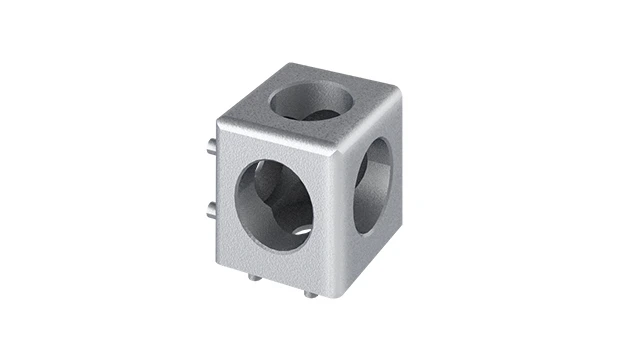
Aluminum Profile 3 Way Connector
The 3 way - squared corner connector is an external fastening method that is typically used to create a corner connection between three profiles. It is a heavy-duty connection that is simple to use and provides a polished look.
In the bustling world of manufacturing, logistics, and industrial design, there's an unsung hero that keeps operations running smoothly: the aluminum profile. These lightweight, versatile structures form the backbone of workbenches, material racks, conveyor systems, and even lean manufacturing cells. But what holds these aluminum extrusion profiles together? Enter connectors—the critical components that transform individual tubes and beams into robust, functional systems. Among these, the aluminum profile 3 way connector stands out for its ability to join three profiles at once, enabling complex, multi-directional designs. Yet, not all connectors are created equal. The structural stability of a 3 way aluminum profile connector isn't just a matter of engineering—it's a science that blends material selection, mechanical design, and real-world performance. In this article, we'll dive deep into the forces, formulas, and innovations that make these connectors reliable, and why their stability matters for everything from factory floors to laboratory setups.
What Are Aluminum Profile 3 Way Connectors?
Before we explore their stability, let's clarify what aluminum profile 3 way connectors are and why they're indispensable. Aluminum extrusion profiles are long, hollow beams with T-shaped slots running along their length—these slots allow accessories like connectors, brackets, and panels to be attached without welding. A 3 way connector, as the name suggests, is a component designed to link three aluminum profiles at a single junction. Unlike 2 way connectors (which join two profiles end-to-end or at a right angle), 3 way connectors enable branching designs: think of a T-junction where a vertical profile meets two horizontal ones, or a Y-shape that splits a main line into two directions.
These connectors come in various designs, but most share a core purpose: to distribute loads evenly across the connected profiles while maintaining rigidity. Some are fixed, locking profiles at a specific angle (like 90° or 45°), while others are adjustable, allowing for custom configurations. They're typically made from the same aluminum alloys as the profiles themselves, ensuring compatibility and minimizing galvanic corrosion. And because they're part of the broader family of aluminum profile accessories, they integrate seamlessly with other components like end caps, hinges, and caster wheels—turning simple frames into fully functional workstations or material handling systems.
Why Structural Stability Matters: Beyond "Just Holding It Together"
At first glance, a connector's job might seem simple: hold the profiles in place. But structural stability is about much more than basic attachment. In industrial settings, aluminum profile systems are subjected to constant stress: tools are placed on workbenches, heavy materials slide across flow racks, and conveyor systems vibrate during operation. A unstable connector could lead to:
- Safety risks : A collapsing workstation or a tipping material rack could injure workers or damage equipment.
- Operational downtime : Loose connectors mean frequent repairs, slowing production and increasing costs.
- Inconsistent performance : Wobbly structures might cause materials to shift, leading to errors in assembly or inventory mismanagement.
Nowhere is this more critical than in lean systems—manufacturing setups designed to minimize waste and maximize efficiency. In a lean system, every component must work in harmony: a stable workbench ensures precise assembly, while a rigid flow rack keeps materials moving smoothly. A 3 way connector that flexes under load could disrupt this balance, turning a "lean" process into one plagued by delays and rework. Simply put, structural stability isn't a luxury; it's the foundation of reliable, efficient operations.

Material Science: The Foundation of Stability
The first secret to a stable 3 way connector lies in what it's made of. Aluminum alloys are the material of choice, and for good reason. Most connectors are crafted from 6061-T6 or 6063-T5 aluminum—alloys prized for their strength-to-weight ratio, corrosion resistance, and machinability. Let's break down why these alloys matter:
Strength-to-Weight: A Balancing Act
Aluminum is lightweight, but pure aluminum is too soft for structural use. By adding elements like magnesium and silicon, alloys like 6061-T6 gain tensile strength (the ability to resist pulling forces) of up to 310 MPa—strong enough to withstand the stresses of industrial use, yet light enough to keep the overall system easy to assemble and reconfigure. This balance is crucial: a heavier connector would add unnecessary weight to the system, increasing the load on the profiles themselves, while a weaker alloy would deform under stress.
Heat Treatment: Hardening for Durability
The "T6" in 6061-T6 refers to the heat treatment process: solution annealing followed by artificial aging. This process strengthens the alloy by forming tiny, uniform precipitates within the metal matrix, which resist dislocation (the atomic-level movement that causes deformation). Without this treatment, the connector might bend or warp when subjected to repeated loads—like a workbench that sags after months of tool use. For 6063-T5, the treatment is similar but optimized for extrusion, ensuring the alloy retains its shape during the manufacturing process while still offering excellent structural integrity.
Corrosion Resistance: Longevity in Tough Environments
Factories, warehouses, and even laboratories can be harsh environments: humidity, chemicals, and temperature fluctuations can take a toll on metal components. Aluminum naturally forms a thin oxide layer that prevents rust, but alloys like 6061 and 6063 enhance this resistance. This means the connector won't degrade over time, maintaining its structural properties even in damp or dusty conditions. For applications like food processing or cleanrooms, some connectors are also anodized—a process that thickens the oxide layer, adding extra protection and a sleek finish.

Engineering Design: The Art of Distributing Stress
Material alone isn't enough to guarantee stability. A connector's design determines how well it distributes stress across the connected profiles. Engineers use principles from statics and mechanics to ensure that no single point bears too much load. Let's explore the key design features that make 3 way connectors stable:
Load Distribution: The "Path of Least Resistance" for Stress
When a force is applied to a connected system—say, a worker placing a 50kg tool on a workbench—the stress travels through the profiles and into the connector. A poorly designed connector might concentrate this stress at a single bolt or contact point, leading to cracks or slippage. A well-designed one, however, spreads the load evenly. For example, many 3 way connectors use multiple set screws that bite into the T-slots of the profiles. By spacing these screws apart, the connector ensures that stress is distributed along the length of the slot, rather than.
Take the "internal rotary aluminum joint"—a type of 3 way connector that allows limited rotation between profiles. Its design includes a central hub with three arms, each ending in a clamp that grips the profile's T-slot. The hub acts as a central load-bearing point, while the arms distribute the stress radially. This geometry mimics a tripod, where three legs share the weight of the structure above—nature's own example of stable load distribution.
Friction and Clamping Force: The Invisible "Glue" Holding It All Together
Most 3 way connectors rely on friction to stay in place. When a set screw is tightened into the T-slot, it presses against the profile's inner wall, creating friction between the connector and the profile. The amount of friction depends on two factors: the clamping force (how tight the screw is) and the coefficient of friction (how "sticky" the surfaces are). Engineers calculate this using the formula: F_friction = μ * F_normal, where μ is the coefficient of friction and F_normal is the clamping force from the screw.
To maximize friction, some connectors have serrated or knurled contact surfaces—tiny ridges that dig into the profile's aluminum, increasing μ. Others use T-nuts, which distribute the clamping force over a larger area, reducing the risk of the screw digging into the profile and weakening it. For high-load applications, like heavy-duty material racks, connectors might even use bolts instead of set screws, as bolts can generate higher clamping forces without stripping the T-slot threads.
Tolerance and Precision: Why "Close Enough" Isn't Good Enough
Aluminum profiles are manufactured with tight tolerances—typically ±0.1mm for dimensions like slot width or wall thickness. Connectors must match these tolerances to ensure a snug fit. If a connector's clamp is too loose, the profile will wobble; too tight, and it might warp the profile or make assembly difficult. Precision machining is key here: using CNC (computer numerical control) tools, manufacturers can shape connector components to exact specifications, ensuring that every arm, screw hole, and contact surface aligns perfectly with the profile's T-slots.
This precision also matters for repeatability. In lean systems, where multiple identical workstations might be built, connectors must perform consistently across all units. A tolerance of ±0.05mm in the connector's arm length ensures that each workstation has the same structural stability, preventing variability in performance.
Testing and Validation: Proving Stability in the Lab and Field
Even the best-designed connector isn't ready for the factory floor until it's been tested. Manufacturers subject 3 way connectors to a battery of tests to simulate real-world conditions, ensuring they meet industry standards for strength and durability. Let's look at the most common tests:
Static Load Testing: How Much Weight Can It Bear?
Static load testing measures a connector's ability to support a constant weight over time. For example, a workbench connector might be tested by placing a 200kg load on the connected profile and leaving it for 24 hours. Engineers then check for deformation: if the connector bends by more than 0.5mm, it fails. This test ensures that the connector can handle the steady loads of daily use, like tools resting on a bench or boxes stacked on a rack.
Dynamic Load Testing: Surviving the "Bumps and Shakes"
Unlike static loads, dynamic loads are changing—think of a conveyor system vibrating as products move along it, or a turnover trolley being pushed across a factory floor. Dynamic load testing uses machines to simulate these conditions, applying oscillating forces to the connector. For example, a connector for a roller track might be tested with 10,000 cycles of 50kg loads slamming into it (mimicking boxes sliding down the track). If the connector loosens or cracks, it's back to the drawing board.
Fatigue Testing: The Hidden Enemy of Long-Term Stability
Even small, repeated stresses can weaken metal over time—a phenomenon called fatigue. A connector might pass a static load test but fail after months of daily use because of fatigue cracks. To prevent this, manufacturers perform fatigue testing: applying a cyclic load (e.g., 100kg up and down) millions of times and monitoring for failure. The goal is to ensure the connector can withstand at least 1 million cycles without breaking—equivalent to several years of typical use.
Environmental Testing: Thriving in Harsh Conditions
As mentioned earlier, industrial environments can be tough. Environmental testing exposes connectors to extreme temperatures (-40°C to 80°C), humidity (95% relative humidity), and even salt spray (to simulate coastal or chemical exposure). After exposure, the connectors are retested for strength—if their load capacity drops by more than 10%, they're deemed unsuitable for harsh environments. This is especially important for aluminum profile systems used in outdoor settings or industries like automotive, where chemicals like oil and coolant are present.
Real-World Applications: Where Stability Makes a Difference
To understand why the science of 3 way connector stability matters, let's look at real-world scenarios where these connectors shine. From lean manufacturing cells to medical device assembly, their reliability directly impacts productivity, safety, and cost.
Lean System Workstations: Efficiency Through Stability
Lean manufacturing is all about eliminating waste—including wasted time spent adjusting unstable workbenches or retrieving fallen tools. A typical lean workstation uses aluminum profiles to create a custom setup: a main frame with shelves, a tool rail, and a conveyor for parts. 3 way connectors join the vertical supports to the horizontal shelves and the conveyor track. If the connectors are unstable, the shelves might sag, causing tools to slide off, or the conveyor might misalign, jamming parts. A stable 3 way connector ensures the workstation remains rigid, even when workers lean on it or place heavy equipment (like soldering irons or assembly jigs) on the surface. This stability reduces downtime and keeps the lean process flowing smoothly.
Material Racks and Flow Racks: Keeping Inventory Secure
Material racks, especially flow racks (which use gravity to feed parts to assembly lines), rely on 3 way connectors to support multiple levels of shelving. Each level might hold boxes of components weighing 20-30kg. A unstable connector could cause a shelf to tilt, spilling parts and disrupting production. In one case study, a automotive parts supplier switched to high-strength 3 way connectors after a flow rack collapse damaged $10,000 worth of components. The new connectors, with reinforced arms and serrated contact surfaces, reduced shelf deflection by 75% and eliminated further incidents.
Laboratory and Cleanroom Setups: Precision in Sensitive Environments
In laboratories, aluminum profile systems are used for equipment mounts, storage racks, and even fume hood frames. Here, stability isn't just about safety—it's about precision. A wobbly rack holding a microscope or analytical instrument could compromise measurements. 3 way connectors designed for cleanrooms are often anodized to prevent particle shedding and feature smooth surfaces that are easy to sanitize. Their stability ensures that sensitive equipment remains level and vibration-free, even when nearby equipment is in use.
Comparing 3 Way Connectors: Which Design Is Right for You?
Not all 3 way connectors are the same. Depending on your load requirements, angle flexibility, and budget, different designs offer trade-offs in stability and versatility. The table below compares four common types of 3 way aluminum profile connectors, highlighting their material, load capacity, and best applications:
| Connector Type | Material | Max Static Load (kg per Arm) | Angle Flexibility | Best For |
|---|---|---|---|---|
| Standard T-Slot 3 Way Connector | 6061-T6 Aluminum | 150 | Fixed (90° only) | Basic workbenches, static shelving |
| Heavy-Duty Reinforced 3 Way Connector | 6063-T5 Aluminum with Steel Bolts | 300 | Fixed (90° or 45°) | Heavy material racks, conveyor supports |
| Adjustable Swivel 3 Way Connector | 6061-T6 Aluminum with Nylon Locking Inserts | 100 | Adjustable (0°–180°) | Custom angled structures, temporary setups |
| Internal Rotary Aluminum Joint | 6061-T6 Aluminum with Stainless Steel Bearings | 80 | Rotary (360° limited rotation) | Dynamic systems (e.g., adjustable conveyor guides) |
As the table shows, fixed connectors generally offer higher load capacities than adjustable ones, making them better for heavy, static loads. Adjustable connectors, on the other hand, are ideal for setups that need to be reconfigured—like prototype assembly lines or event displays. The key is to match the connector's specs to the application's demands: over-engineering (using a heavy-duty connector for a light load) adds unnecessary cost, while under-engineering risks failure.
Future Innovations: Making 3 Way Connectors Even More Stable
The science of connector stability is always evolving. Manufacturers are exploring new materials, designs, and technologies to push the limits of what these small components can do. Here are a few innovations on the horizon:
Composite Materials: Lighter, Stronger, Smarter
While aluminum alloys are excellent, researchers are testing composite connectors made from carbon fiber-reinforced polymers (CFRP). CFRP has a higher strength-to-weight ratio than aluminum, meaning connectors could be lighter while supporting the same loads. Early prototypes show promise for aerospace and automotive applications, where weight reduction is critical. However, CFRP is more expensive than aluminum, so it may remain niche until manufacturing costs come down.
Smart Connectors: Monitoring Stability in Real Time
Imagine a connector that can alert you before it fails. Smart connectors with embedded strain gauges or RFID tags could monitor clamping force or deformation and send data to a central system. If a connector loosens or weakens, maintenance teams would be notified immediately, preventing downtime. This technology is already being tested in high-risk applications like nuclear power plant equipment racks, where failure could have catastrophic consequences.
3D Printing: Custom Connectors for Unique Loads
3D printing (additive manufacturing) allows for complex, organic shapes that traditional machining can't produce. Engineers are using 3D printing to create 3 way connectors with optimized lattice structures—honeycomb-like patterns that reduce weight while maintaining strength. These connectors can be tailored to specific load distributions, making them ideal for one-of-a-kind projects, like custom laboratory equipment or art installations that use aluminum profiles.
Conclusion: The Invisible Science That Keeps Us Moving
Aluminum profile 3 way connectors may be small, but their impact is huge. The science behind their structural stability—material selection, load distribution, precision engineering, and rigorous testing—ensures that the aluminum extrusion profiles we rely on daily remain safe, efficient, and durable. From lean system workstations that boost productivity to medical setups that demand precision, these connectors are the quiet force holding our industrial world together.
As technology advances, we can expect even more innovative designs—stronger, lighter, and smarter than ever before. But for now, the next time you walk into a factory, lab, or warehouse, take a moment to look at the aluminum structures around you. Chances are, there's a 3 way connector hard at work, applying the laws of physics and materials science to keep everything stable. And that, in itself, is something to appreciate.