- Company Articles
- Products and Technology
- Product knowledge
- The Science Behind Aluminum Workbench D's Lightweight Yet Strong Construction

The Science Behind Aluminum Workbench D's Lightweight Yet Strong Construction
Related Product
Aluminum Workbench D
Aluminum tube workbench is more flexible and durable, compared with traditional PE/ABS coated steel tube. It is easy to assemble, anti corrosion, rust protection, and recycle use after disassemble.
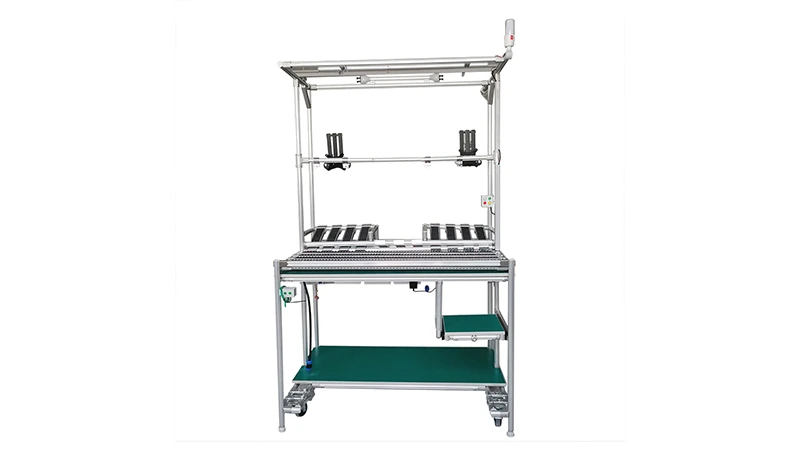
Walk into any modern workshop, manufacturing plant, or electronics assembly line, and you'll notice a silent workhorse that keeps operations running smoothly: the workbench. It's where precision meets productivity, where delicate components are assembled, and where heavy tools are set down day in and day out. But not all workbenches are created equal. For years, workshop managers have faced a frustrating trade-off: sturdiness versus mobility . A steel workbench might handle heavy loads, but try moving it across the floor, and you'll need a forklift. A wooden bench is lighter, but it sags under weight and warps over time. Enter Aluminum Workbench D—a game-changer that defies this trade-off. How does it manage to be both featherlight and rock-solid? Let's dive into the science, materials, and engineering that make this possible.
Why Aluminum? The Foundation of Lightweight Strength
At the heart of Aluminum Workbench D's magic is aluminum itself—a material celebrated for its remarkable strength-to-weight ratio. Unlike steel, which relies on bulk for strength, aluminum offers comparable structural integrity at a fraction of the weight. But not all aluminum is the same. The workbench leverages aluminum extrusion profile , a manufacturing process that transforms raw aluminum into complex, custom shapes with precision and consistency. Here's how it works: molten aluminum is forced through a die (a specialized mold) under high pressure, resulting in long, continuous profiles with intricate cross-sections. For Aluminum Workbench D, the extrusion features a T-slot design—a series of grooves along the length of the profile that act as built-in connection points. This isn't just a design quirk; it's engineering genius.
Think of the T-slot as a universal language for customization. It allows users to attach aluminum profile accessories —like brackets, shelves, tool holders, or even monitor arms—without drilling or welding. Need to add a side rack for parts bins? Slide a bracket into the T-slot and tighten a screw. Want to mount a power strip? There's an accessory for that. This flexibility means the workbench adapts to your needs, not the other way around. But the T-slot does more than enable customization; it reinforces the profile's strength. The grooves distribute stress evenly along the length of the aluminum, preventing weak points that could lead to bending or cracking under load.
The Honeycomb Secret: A Top That's Light, Stiff, and Resilient
While the frame relies on aluminum extrusion profiles, the workbench's top is where another engineering marvel shines: the aluminum honeycomb panel . If you've ever picked up a solid wooden workbench top, you know it's heavy—so heavy that even a small 4-foot top can weigh 50+ pounds. Steel tops? Even worse. Aluminum Workbench D's top, by contrast, feels almost surprisingly light, yet it can support hundreds of pounds without flexing. The secret is in the honeycomb structure.
Imagine slicing open the workbench top: you'd find a core made of aluminum foil formed into a honeycomb pattern, sandwiched between two thin sheets of aluminum alloy. This isn't just a random design; it's inspired by nature. Bees build honeycomb hives because the hexagonal cells distribute weight and stress with incredible efficiency. Similarly, the honeycomb core in the workbench top turns a lightweight material into a rigid powerhouse. The air pockets in the honeycomb reduce mass, while the interconnected cells resist bending and compression. When you place a heavy tool on the top, the force spreads across the entire surface, rather thaning on a single point. Tests show that a 1-inch thick aluminum honeycomb panel has the same bending stiffness as a solid aluminum plate 10 times thicker—yet weighs 70% less.
But the benefits don't stop at weight and strength. The aluminum sheets on the top and bottom are treated with a scratch-resistant coating, making them resistant to dents, chemicals, and daily wear. Unlike wooden tops, they won't warp from moisture or splinter under heavy use. And because aluminum is non-porous, cleaning is a breeze—just wipe with a damp cloth, and it's ready for the next task. For industries like electronics manufacturing, where static control is critical, the panels can even be treated with an ESD (electrostatic discharge) coating, turning Aluminum Workbench D into a safe workspace for sensitive components.

Stability in Every Foot: The Role of Adjustable Leveling Feet
A workbench is only as good as its ability to stay steady, even when pushed, pulled, or loaded unevenly. That's where adjustable leveling feet come in—and Aluminum Workbench D doesn't skimp here. These small but mighty components are the unsung heroes of stability, ensuring the workbench stays level and secure, no matter the floor conditions.
Picture a busy factory floor: concrete that's cracked from years of heavy machinery, or a workshop with slightly sloped floors. A traditional workbench with fixed feet might rock back and forth, making precision work impossible. Aluminum Workbench D's adjustable feet solve this with a simple yet effective design: each foot has a threaded stem that screws into the workbench's base, with a rubber pad at the bottom. By twisting the foot, you raise or lower that corner of the workbench, compensating for uneven surfaces. The rubber pad adds grip, preventing the bench from sliding during use, and it also protects delicate floors from scratches—perfect for labs or cleanrooms where floor integrity matters.
But what makes these feet truly user-friendly is how they integrate with the aluminum extrusion profile. Using aluminum profile accessories like flange nuts and washers, the feet attach directly to the T-slots in the frame, eliminating the need for extra brackets or drilling. This means installation is a 5-minute job: align the foot, insert the hardware into the T-slot, tighten, and adjust. Even better, if you need to move the workbench to a new location with different floor conditions, readjusting the feet takes seconds. It's this attention to detail—making stability accessible and hassle-free—that sets Aluminum Workbench D apart from generic workbenches.

By the Numbers: How Aluminum Workbench D Stacks Up Against the Competition
To truly appreciate Aluminum Workbench D's engineering, let's compare it to two common alternatives: a traditional steel workbench and a solid wood workbench. The table below breaks down key metrics like weight, maximum load capacity, corrosion resistance, and recyclability—factors that matter in real-world use.
| Feature | Aluminum Workbench D | Steel Workbench (Standard) | Solid Wood Workbench |
|---|---|---|---|
| Weight (4-foot model) | 35 lbs (15.8 kg) | 120 lbs (54.4 kg) | 85 lbs (38.5 kg) |
| Maximum Load Capacity | 500 lbs (227 kg) | 600 lbs (272 kg) | 300 lbs (136 kg) |
| Corrosion Resistance | High (aluminum oxide layer) | Low (prone to rust without coating) | Low (swells with moisture) |
| Recyclability | 100% recyclable | Recyclable (high energy cost) | Biodegradable (limited lifespan) |
| Customization | High (T-slot accessories) | Low (welding/ drilling required) | Low (permanent modifications) |
The numbers tell a clear story: Aluminum Workbench D offers 80% of the load capacity of steel at just 30% of the weight. It outperforms wood in both strength and durability, and its corrosion resistance makes it ideal for humid environments like food processing plants or coastal workshops. And when it comes to sustainability, aluminum is infinitely recyclable—melting it down to make new products uses just 5% of the energy required to produce raw aluminum. For businesses aiming to reduce their carbon footprint, that's a win-win.
Real-World Impact: Where Aluminum Workbench D Shines
To understand why Aluminum Workbench D has become a favorite in industries worldwide, let's step into a few workplaces where it's making a difference.
Automotive Repair Shops: Lightweight Mobility, Heavy-Duty Performance
Joe, a master mechanic at a busy auto repair shop, used to dread rearranging his workspace. His old steel workbench weighed over 100 pounds, so moving it to accommodate a truck engine teardown required two people and a lot of grunting. Then he switched to Aluminum Workbench D. "Now I can slide it across the floor by myself," he says. "Last week, I had a customer come in with a transmission issue—I moved the bench next to the car, laid out my tools, and got to work. When I was done, I rolled it back to its spot in 30 seconds." But mobility isn't the only perk. The aluminum honeycomb top easily handles the weight of a transmission (around 200 lbs), and the T-slots let Joe attach a magnetic tool holder and a parts bin. "No more hunting for sockets under the bench," he laughs.
Electronics Manufacturing: ESD Safety and Cleanliness
In a semiconductor factory, where even a tiny static discharge can ruin a $10,000 microchip, Aluminum Workbench D's ESD-treated honeycomb top is a lifesaver. Maria, a production supervisor, explains: "We need workbenches that are grounded to prevent static buildup. The aluminum top conducts electricity safely to the floor, and the smooth surface doesn't trap dust or particles—critical for our cleanroom standards. Plus, when we reconfigure the production line for a new chip model, we can move the workbenches in minutes. With steel benches, we'd have to schedule downtime and hire a crew to rearrange them. Aluminum Workbench D has cut our changeover time by 40%."
Medical Labs: Sterility and Precision
Hospitals and research labs demand workbenches that are easy to sanitize and stable enough for delicate equipment. Dr. Elena Kim, a microbiologist, uses Aluminum Workbench D in her lab for preparing cultures and analyzing samples. "The aluminum surface resists chemicals like bleach and alcohol, which we use multiple times a day to disinfect. The adjustable leveling feet keep the bench steady, so when I'm using a pipette to measure tiny volumes, there's no wobble. And because it's lightweight, we can wheel it into the autoclave room for deep cleaning—something we could never do with our old wooden benches, which warped after the first steam cycle."
The Future of Workbenches: More Than Just a Table
Aluminum Workbench D isn't just a tool—it's a glimpse into the future of workspace design. As industries move toward agile manufacturing, flexible workspaces, and sustainability, the demand for equipment that balances performance, adaptability, and efficiency will only grow. Aluminum extrusion profiles, honeycomb panels, and smart accessories like adjustable leveling feet are more than components; they're building blocks for workspaces that evolve with your needs.
But what's next? Engineers are already experimenting with integrating sensors into the honeycomb panels to monitor load levels in real time—alerting users if they're exceeding the weight limit. Others are exploring solar-powered LED strips embedded in the T-slots for task lighting. The possibilities are endless, but the core principle remains: using science and materials innovation to create tools that work with people, not against them.
Conclusion: Strength Without the Weight, Innovation Without the Compromise
Aluminum Workbench D's lightweight yet strong construction isn't an accident—it's the result of decades of materials science, engineering ingenuity, and a deep understanding of what workers need. From the T-slotted aluminum extrusion profiles that form its backbone to the honeycomb panel top that defies gravity, every component is designed to deliver performance without sacrifice. It's a workbench that can be moved by one person but stand up to a lifetime of heavy use. A surface that's easy to clean, customizable, and gentle on delicate components. A solution that makes workspaces more efficient, sustainable, and adaptable.
So the next time you walk into a workshop, lab, or factory, take a closer look at the workbenches. Chances are, if it's lightweight, sturdy, and looks like it was built for the future, it might just be an Aluminum Workbench D. And now, you'll know the science behind its silent strength.