- Company Articles
- Products and Technology
- Product knowledge
- The Science Behind Chrome-Plated Five Way Straight Lean Pipe Joint Adhesion

The Science Behind Chrome-Plated Five Way Straight Lean Pipe Joint Adhesion
Related Product
Five Way Straight Lean Pipe Joint
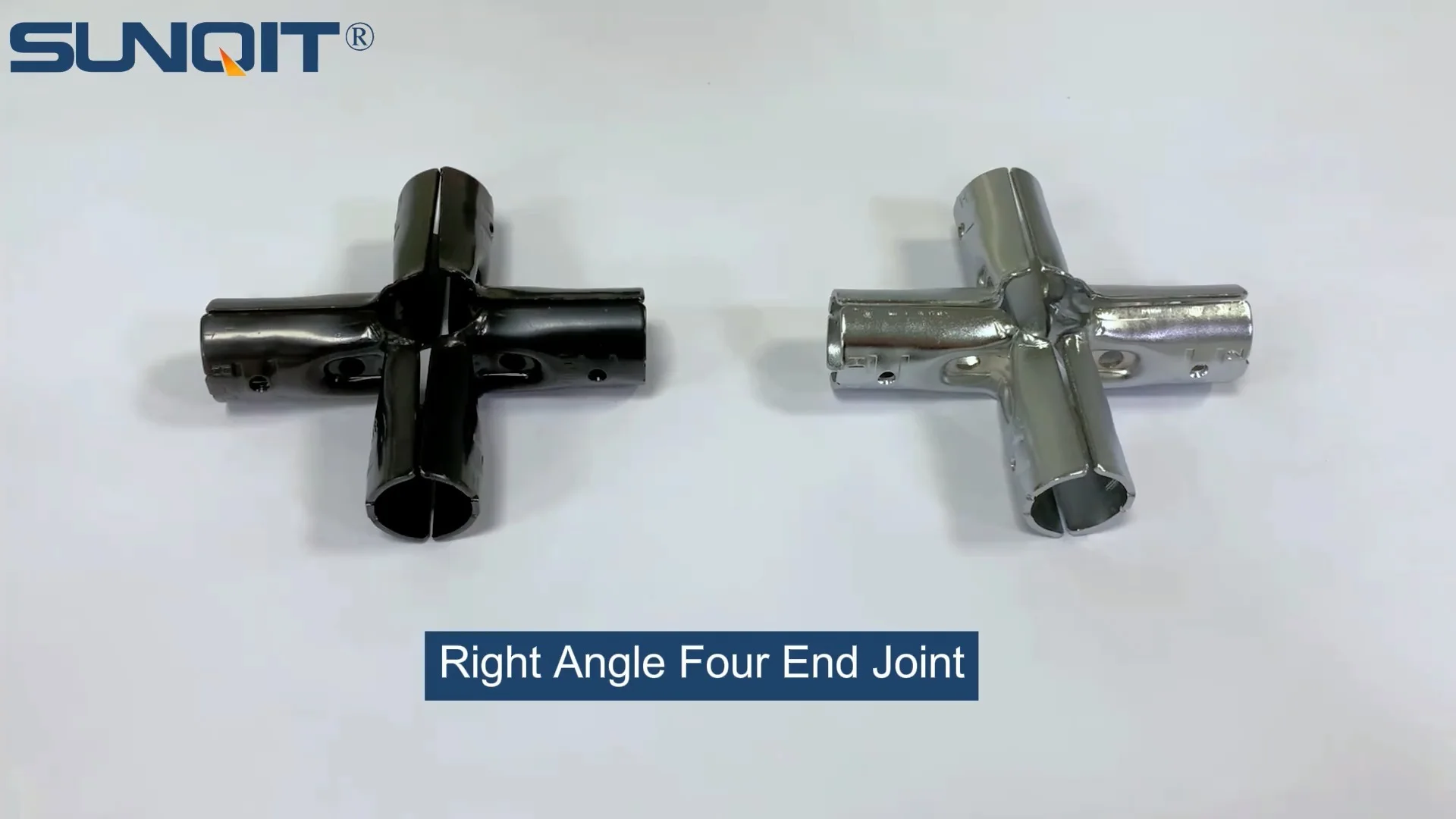
Five way straight lean pipe joint, for 5 pcs 28mm lean pipe connect in straight angle,which used widely in workbench, flow rack, hand trolley frame connection.
Unlocking the Secrets of Durability in Lean Manufacturing Systems
Walk into any modern factory, and you'll likely spot a network of lean pipe structures—workbenches humming with assembly tasks, material racks stacked with components, and conveyor systems gliding with precision. These setups are the backbone of lean manufacturing, designed to streamline workflows, reduce waste, and boost productivity. But behind their seamless operation lies an unsung hero: the chrome-plated five way straight lean pipe joint . This small but mighty component connects multiple pipes at once, forming the skeleton of everything from workstations to turnover trolleys. Yet, its true power lies not in its shape, but in something invisible: the adhesion between its chrome plating and the underlying metal. Without strong adhesion, these joints would fail under stress, vibrations, and the daily grind of industrial use. So, what makes chrome-plated five way joints stick—and stay stuck—when it matters most? Let's dive into the science.
What Is a Chrome-Plated Five Way Straight Lean Pipe Joint?
Before we unpack adhesion, let's get to know the star of the show. A lean pipe joint is a connector that links lean pipes (hollow metal tubes, often steel or aluminum) to build modular structures. The "five way" design means it can connect five pipes at once—typically four in a horizontal plane and one vertical—making it ideal for complex setups like multi-tiered material racks or branching workbench frames. Unlike fixed joints, this straight version allows pipes to align in a linear path, ensuring stability while maintaining flexibility for reconfiguration.
But what sets the chrome-plated variant apart? Chrome plating adds a thin layer of chromium to the joint's surface, enhancing corrosion resistance, hardness, and wear resistance. In factories where oils, coolants, and humidity are constants, this plating acts as a shield, preventing rust and extending the joint's lifespan. However, for the plating to work, it must bond tightly to the joint's base material (usually steel). Weak adhesion means the chrome layer could chip, peel, or flake off, exposing the metal underneath to damage. So, the question becomes: How do manufacturers ensure that chrome plating clings to these joints like a second skin?
Adhesion 101: Why It Matters in Lean Systems
Adhesion is the force that holds two dissimilar materials together. In the case of chrome-plated joints, it's the bond between the chrome plating and the joint's base metal (often carbon steel). This bond isn't just about "sticking"—it's about withstanding the forces of daily use. Imagine a workbench in an automotive plant: operators lean on it, tools bang against it, and heavy parts are placed and removed hundreds of times a day. Each action sends stress through the joints. If adhesion is weak, the chrome layer might crack, allowing moisture to seep in and corrode the steel. Over time, the joint could loosen, wobble, or even snap, bringing the entire structure crashing down.
Strong adhesion, on the other hand, creates a unified interface. The chrome layer acts as a barrier, while the bond ensures it moves and flexes with the base metal, resisting peeling or chipping. This durability is why chrome-plated five way joints are trusted in high-stakes environments, from electronics assembly lines (where precision is critical) to heavy machinery workshops (where load-bearing is non-negotiable).

Materials Matter: The Building Blocks of Adhesion
Adhesion doesn't happen by accident—it's engineered through careful material selection and processing. Let's break down the two key players in chrome-plated five way joints: the base metal and the chrome plating.
The Base Metal: Steel's Role in Bonding
Most lean pipe joints start as carbon steel. Steel is chosen for its strength, affordability, and malleability—properties that make it easy to mold into the joint's intricate shape (think: five hollow ports for pipe insertion, threaded interiors for secure fitting). But steel alone isn't enough for adhesion. Its surface must be prepped to "grab" the chrome plating. That's where surface roughness comes in. A smooth steel surface would repel the plating, like water on a waxed car. Instead, manufacturers etch the steel (using acids or mechanical abrasion) to create tiny grooves and pits. These micro-irregularities act like Velcro, giving the chrome plating something to lock onto—a phenomenon called mechanical adhesion .
Chrome Plating: More Than Just Shine
Chrome plating isn't just for aesthetics (though its mirror-like finish does resist fingerprints and grime). Chromium is a hard, corrosion-resistant metal that forms a protective layer over the steel. But to bond with steel, it needs help from a middleman: a layer of nickel. Nickel adheres well to steel and provides a smooth, uniform surface for chrome to stick to. Together, the "nickel-chrome" stack creates a multi-layered shield that's both tough and adhesive.
But here's the catch: chromium and steel don't naturally bond chemically. Unlike, say, aluminum profile (which forms a natural oxide layer that enhances adhesion), steel relies on mechanical and electrostatic forces to hold the plating. That's why pre-treatment is so critical.

The Science of Sticking: How Adhesion Actually Works
Adhesion in chrome-plated joints is a dance of three forces: mechanical interlocking, electrostatic attraction, and diffusion bonding. Let's break them down.
Mechanical Interlocking: The "Velcro Effect"
Remember those etched grooves in the steel? When the joint is electroplated, chromium ions flow into these tiny crevices and solidify, creating a physical lock. It's like pouring concrete into a cracked sidewalk—the concrete fills the gaps and hardens, bonding with the existing surface. The deeper and more irregular the grooves, the stronger the lock. Manufacturers optimize this by controlling the etching process: too shallow, and adhesion is weak; too deep, and the steel becomes brittle. It's a delicate balance.
Electrostatic Attraction: Opposites Attract
During electroplating, the steel joint is submerged in a chromium-rich solution and connected to an electric current. The current ionizes the chromium, giving it a positive charge, while the steel joint is negatively charged. Opposites attract, so the chromium ions are drawn to the steel, where they gain electrons and solidify. This electrostatic pull ensures the plating adheres evenly, even in hard-to-reach corners of the five way joint (like the inner threads of the pipe ports).
Diffusion Bonding: When Atoms "Shake Hands"
At the microscopic level, something even more fascinating happens: atoms from the steel and chromium start to mix. Under the heat and pressure of plating, some steel atoms diffuse into the chromium layer, and vice versa, creating a gradual transition zone (called an interphase) where the two materials merge. This isn't just adhesion—it's fusion . Think of it like two pieces of clay pressed together; over time, their edges blend into one. Diffusion bonding is strongest when the plating is applied at high temperatures, allowing atoms to move more freely. It's what makes the joint resistant to peeling, even under extreme stress.

From Raw Steel to Reliable Joint: The Manufacturing Journey
Creating a chrome-plated five way joint with strong adhesion is a multi-step process, where each stage builds on the last. Let's walk through the key steps.
- Shaping the Joint: Steel is heated and molded into the five way shape using die casting or forging. This forms the basic structure, with ports sized to fit standard lean pipes (often 28mm or 30mm in diameter).
- Cleaning: The raw joint is degreased with solvents to remove oils and dirt, then pickled in acid to dissolve rust and scale. Any contaminants here would block adhesion later.
- Etching: The joint is dipped in a stronger acid (like hydrochloric or sulfuric acid) to create those all-important surface grooves. The etch time is carefully controlled—too long, and the steel weakens; too short, and adhesion suffers.
- Nickel Plating: A thin layer of nickel (5-10 microns thick) is applied via electroplating. This acts as a primer, improving chrome adhesion and preventing corrosion if the chrome layer ever gets scratched.
- Chrome Plating: The joint is submerged in a chromium trioxide solution and connected to a power source. Over 30-60 minutes, chromium ions deposit onto the nickel layer, forming a 2-5 micron thick chrome coat.
- Post-Treatment: The joint is rinsed to remove excess solution, then baked at 180-200°C to harden the plating and enhance diffusion bonding. Finally, it's inspected for defects (like blisters or uneven coverage) before being packaged for shipment.
Each step is monitored with precision. For example, the pH of the plating solution must stay between 2 and 3; a single point deviation can weaken adhesion. Similarly, the current density (measured in amps per square foot) determines how fast chromium deposits—too high, and the plating becomes porous; too low, and it's too thin to protect the steel.
Testing Adhesion: How Manufacturers Ensure Reliability
Adhesion isn't just a theory—it's tested rigorously before a joint ever reaches a factory floor. Here are the most common methods used to verify bond strength:
| Test Method | Purpose | Procedure | Pass/Fail Criteria |
|---|---|---|---|
| Bend Test | Check adhesion under flexure | A sample joint is bent 180° around a mandrel. The plating is inspected for cracks or peeling. | No visible peeling; cracks must be less than 0.5mm long. |
| Peel Test | Measure force required to peel plating | A strip of plating is pried up with a tool and pulled at a 90° angle. The force (in Newtons) needed to remove it is recorded. | Adhesion strength must exceed 50 N/cm (industry standard for industrial components). |
| Impact Test | Simulate sudden shocks (e.g., tool drops) | A weighted pendulum strikes the joint at 3 m/s. Plating is checked for chipping or delamination. | No chipping larger than 2mm in diameter; no delamination around the impact site. |
| Salt Spray Test | Test corrosion resistance (indirectly measures adhesion) | Joints are exposed to a 5% saltwater mist at 35°C for 48 hours. Rust or blistering indicates poor adhesion (since moisture penetrated the plating). | No rust or blisters; plating must remain intact. |
These tests aren't just box-checking—they're lifesavers. A joint that fails the peel test, for example, could loosen on a workbench mid-assembly, risking product defects or worker injury. By these standards, suppliers ensure their joints can handle the chaos of real-world manufacturing.
Real-World Impact: How Adhesion Drives Lean Success
Strong adhesion isn't just a technical achievement—it directly impacts a factory's bottom line. Let's look at two scenarios where chrome-plated five way joints shine:
Case 1: Electronics Assembly Workbench
In a smartphone factory, a workbench might see 500+ assemblies per day. Each operator places circuit boards, screws, and screens onto the bench, which is supported by a frame of lean pipes and five way joints. Over time, the constant weight (up to 50kg per workstation) and vibrations from tools like screwdrivers test the joint's adhesion. A well-bonded chrome layer prevents the joint from corroding (even in humid environments, where electronics thrive), ensuring the bench remains stable for years. This reduces downtime from repairs and extends the workbench's lifespan, lowering replacement costs.
Case 2: Heavy-Duty Material Rack
A car parts supplier uses a five tier material rack, built with lean pipes and five way joints, to store engine blocks (each weighing 80kg). The joints at the corners must support vertical loads of over 400kg. Weak adhesion here would cause the chrome to crack, exposing the steel to oil and grease from the parts. Rust would form, weakening the joint until it buckles under the weight. But with strong adhesion, the chrome layer acts as a barrier, keeping the steel intact. The rack stays upright, and parts are retrieved safely—no costly accidents, no delays in production.
Challenges and Innovations: The Future of Adhesion
Despite advances, adhesion in chrome-plated joints faces challenges. For one, environmental regulations are tightening: traditional chrome plating uses hexavalent chromium, a toxic chemical. Suppliers are shifting to trivalent chromium (a safer alternative), but it requires new plating recipes to maintain adhesion strength. Another challenge is cost: high-quality plating processes are expensive, and some manufacturers cut corners (e.g., skipping nickel plating), leading to joints that fail prematurely.
But innovation is on the horizon. Nanotechnology, for example, is being used to create "nano-rough" steel surfaces—even smaller grooves than traditional etching—that boost mechanical adhesion by 30%. Similarly, hybrid coatings (chrome mixed with ceramic particles) are being tested to improve wear resistance without sacrificing adhesion. And 3D printing may one day allow joints to be printed with built-in adhesion-promoting structures, eliminating the need for etching altogether.
The Invisible Force That Powers Lean Manufacturing
The next time you walk past a lean pipe workbench or a material rack, take a closer look at the joints. What you'll see is more than just metal—you'll see the result of centuries of materials science, precision engineering, and a deep understanding of adhesion. The chrome-plated five way straight lean pipe joint may be small, but its ability to stick—through mechanical locks, electrostatic attraction, and atomic diffusion—is what keeps lean systems running smoothly, day in and day out. As manufacturing evolves, so too will the science of adhesion, ensuring these unsung heroes continue to support the factories of tomorrow.