- Company Articles
- Products and Technology
- Product knowledge
- The Science Behind Two Way Aluminum Pipe Joint Grip Strength: What You Need to Know

The Science Behind Two Way Aluminum Pipe Joint Grip Strength: What You Need to Know
Related Product
Two Way Aluminum Pipe Joint
Aluminum 2 way pipe joint for 28mm aluminum pipe connection in 2 direction.
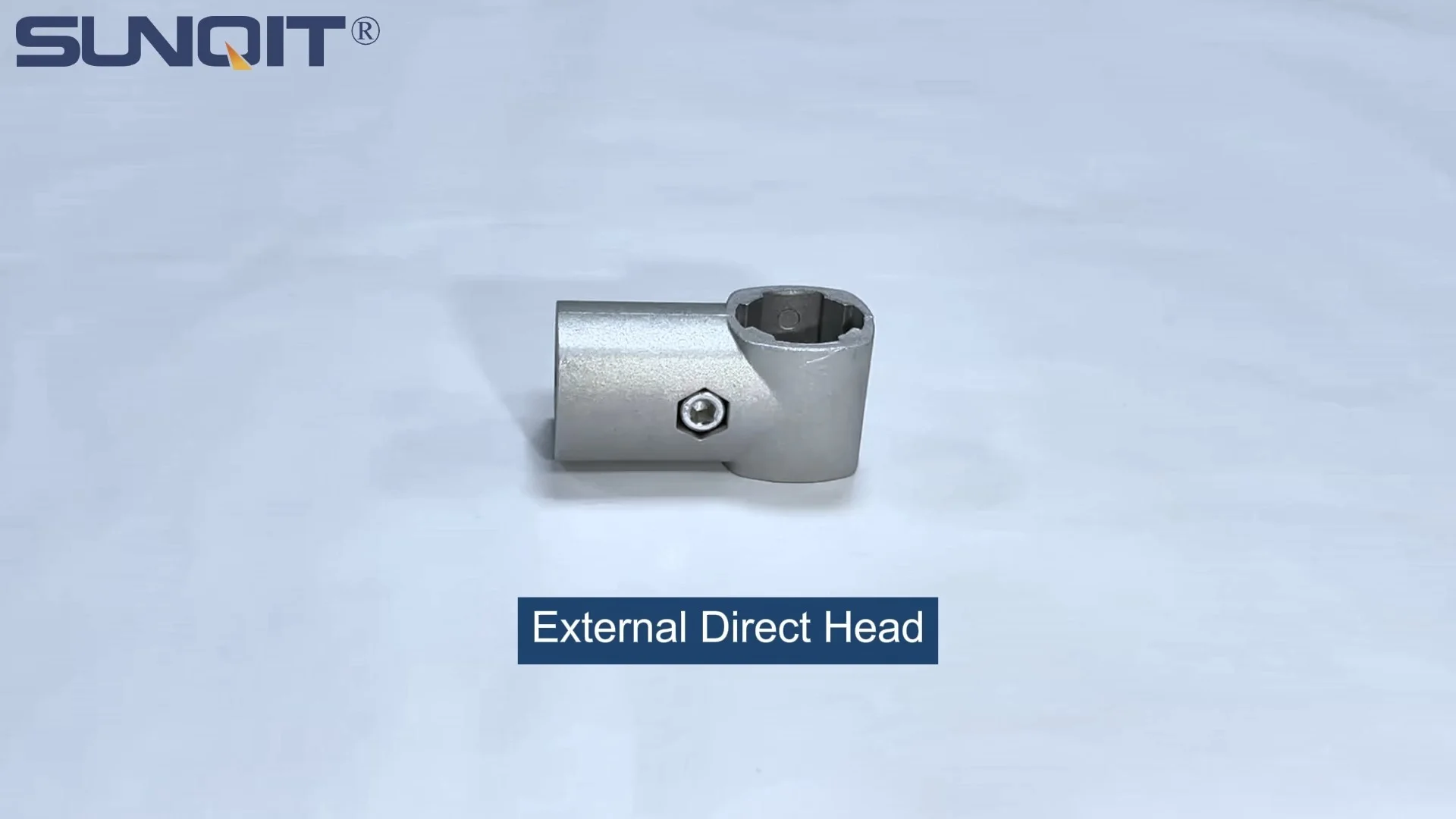
Introduction: Why Grip Strength in Aluminum Joints Isn't Just a "Technical Detail"
Walk into any modern factory, warehouse, or manufacturing plant, and you'll likely see a maze of structures holding everything together: workbenches where assemblers piece together components, flow racks guiding parts through production lines, and modular carts transporting materials from one station to the next. What you might not notice, though, is the unsung hero keeping all these systems stable: the two way aluminum pipe joint. These small, unassuming connectors are the backbone of lean systems worldwide, quietly bearing the weight of tools, materials, and daily operations.
But here's the thing: not all joints are created equal. A joint with weak grip strength isn't just a minor inconvenience—it's a ticking time bomb. Imagine a workbench in an electronics assembly line suddenly wobbling mid-operation because a joint slips, or a flow rack collapsing under the weight of inventory because the connection between pipes couldn't hold. The result? Delays, damaged products, and even safety risks for workers. That's why understanding the science behind what makes a two way aluminum pipe joint grip tightly—consistently, reliably, and over time—is critical for anyone building or maintaining these systems.
In this article, we're diving deep into that science. We'll explore how materials, design, and manufacturing processes come together to create joints that don't just "hold" but perform . We'll look at the tests that prove a joint's mettle, the real-world scenarios where grip strength makes or breaks productivity, and even how to spot a high-quality joint when you're shopping around. Whether you're a plant manager, a procurement specialist, or just someone curious about the engineering behind everyday industrial tools, this is the guide to understanding why grip strength in aluminum joints matters—and how to ensure you're getting the best of it.
Aluminum: The Material That Makes Grip Strength Possible
Before we talk about joints, let's talk about the star of the show: aluminum. Why is it the go-to material for these systems, and how does its nature influence grip strength? Unlike steel, which is strong but heavy, aluminum strikes a rare balance: it's lightweight, corrosion-resistant, and surprisingly robust—especially when alloyed with other metals. For context, a typical aluminum extrusion profile used in industrial joints weighs about 30% less than a steel equivalent, making it easier to assemble and reconfigure (a key feature for lean systems that need to adapt to changing production needs).
But aluminum's real advantage lies in its alloys. Most industrial aluminum pipe joints are made from alloys like 6061 or 6063, each with unique properties tailored to grip strength. 6061 aluminum, for example, contains magnesium and silicon, giving it excellent tensile strength (around 30,000 psi) and good machinability—meaning it can be precision-cut and threaded to create tight-fitting joints. 6063 aluminum, on the other hand, is softer and more malleable, often used for aluminum extrusion profiles where a smooth finish and formability are priorities. When paired with the right joint design, these alloys create a "sweet spot" of strength and flexibility that steel, with its rigidity, can't match.
Another factor? Aluminum's natural oxide layer. When exposed to air, aluminum forms a thin, protective film of aluminum oxide that resists corrosion. But this layer also plays a role in grip strength: it increases friction between the joint and the pipe, creating a "stickier" surface that prevents slipping. Manufacturers often enhance this effect through surface treatments like anodizing, which thickens the oxide layer and adds texture—think of it like adding tiny bumps to a handshake, making it harder for the joint to let go.
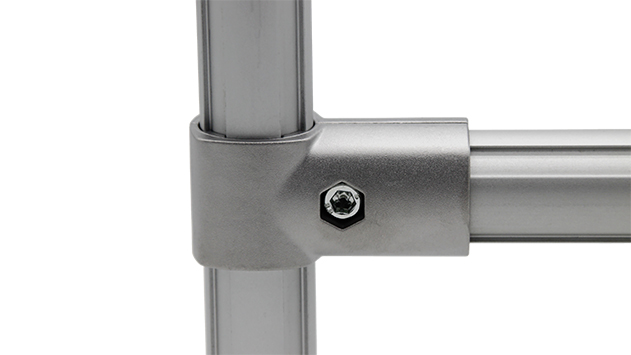
Anatomy of a Two Way Aluminum Pipe Joint: It's All in the Design
At first glance, a two way aluminum pipe joint might look simple: a small, T-shaped or L-shaped piece with holes for inserting pipes. But under the surface, every curve, thread, and groove is engineered to maximize grip. Let's break down the key design elements that determine how well a joint holds onto its pipes.
First, there's the insertion mechanism . Most two way joints use one of two methods: threading or press-fit. Threaded joints have internal threads that match external threads on the aluminum pipe, creating a mechanical lock when screwed together. Press-fit joints, by contrast, rely on friction: the joint's inner diameter is slightly smaller than the pipe's outer diameter, so when the pipe is forced into the joint, the metal deforms slightly, creating a tight seal. Both methods work, but they excel in different scenarios: threading is better for applications where joints might need to be disassembled frequently, while press-fit offers higher shear strength for static loads.
Next, geometric distribution of force . A well-designed two way joint doesn't just clamp down on the pipe—it distributes stress evenly around the circumference. Look at a high-quality joint, and you'll notice that the contact area between the joint and pipe is maximized. Some joints even have "ridges" or "teeth" that dig into the pipe's surface (gently enough not to damage it, but firmly enough to prevent rotation). This ensures that when weight is applied—say, a heavy tool on a workbench—the force isn't concentrated in one spot, which could weaken the grip over time.
Then there are the accessories that enhance grip. Aluminum pipe accessories like set screws, locking pins, or friction pads are often used to reinforce the joint. A set screw, for example, can be tightened through the joint's body to press directly against the pipe, adding an extra layer of security. Friction pads, made from rubber or high-grip plastic, line the inside of the joint, increasing surface friction and reducing the chance of slippage. These small additions might seem minor, but in high-stress environments, they can make the difference between a joint that lasts for years and one that fails in months.
To visualize how these elements work together, let's compare two hypothetical joints: one poorly designed, one well-designed. The poorly designed joint has a smooth inner surface, minimal contact area, and no additional locking features. When a pipe is inserted, it relies solely on basic friction—fine for light loads, but prone to slipping if jostled. The well-designed joint, by contrast, has a textured inner surface, a tapered insertion end to guide the pipe into place, and a set screw for reinforcement. When the pipe is inserted, the taper ensures a snug fit, the texture increases friction, and the set screw locks everything in place. It's like the difference between a loose handshake and a firm, confident grip.

The Science of Grip Strength: Friction, Force, and Failure Points
Now, let's get technical. What exactly is "grip strength," and how do engineers measure it? In simplest terms, grip strength is the maximum force a joint can withstand before the pipe slips or the joint fails. To understand this, we need to dive into two key concepts: static friction and shear stress.
Static friction is the force that resists the start of motion between two surfaces in contact. For a joint and pipe, this is the force that keeps the pipe from sliding out when you try to pull it. The formula for static friction is straightforward: F = μN, where F is the frictional force, μ is the coefficient of friction (a measure of how "sticky" the surfaces are), and N is the normal force (the force pressing the two surfaces together). In a press-fit joint, N comes from the deformation of the joint and pipe; in a threaded joint, it comes from the torque applied when screwing them together. The higher μ and N are, the stronger the grip.
Shear stress , on the other hand, is the force that acts parallel to the joint's surface—think of it as trying to slide the pipe sideways out of the joint. Aluminum has a specific shear strength (the maximum stress it can withstand before breaking), and the joint's design must ensure that shear stress never exceeds this limit. For example, if a joint is holding a 50kg load on a horizontal pipe, the shear stress at the joint-pipe interface depends on the load's distance from the joint (the lever arm) and the joint's contact area. Engineers calculate this using the formula τ = F/A, where τ is shear stress, F is the applied force, and A is the contact area. If τ exceeds the aluminum's shear strength, the joint will fail.
To put this into perspective, let's look at a real-world example. Suppose we have a two way aluminum pipe joint made from 6061-T6 aluminum (a common alloy for structural applications), with a press-fit design and anodized surfaces. The pipe has an outer diameter of 25mm, and the joint's contact area with the pipe is 100mm². The coefficient of friction (μ) between anodized aluminum and aluminum is about 0.6, and the normal force (N) from the press-fit is 500N. Using F = μN, the static friction force is 0.6 * 500 = 300N. That means you'd need to pull with 300N of force (about 30kg) to make the pipe slip—a strong grip for most industrial applications.
But what if the joint is poorly made? If the contact area is smaller (say, 50mm²), the shear stress increases, and the grip weakens. Or if the anodizing is uneven, μ drops, reducing friction. This is why manufacturing precision is so critical—even a 1mm error in the joint's inner diameter can change N enough to halve the grip strength.
| Joint Design Feature | Effect on Grip Strength | Real-World Impact |
|---|---|---|
| Anodized surface (thick oxide layer) | Increases μ (coefficient of friction) by 30-50% | Reduces chance of slippage under vibration (common in assembly lines) |
| Maximized contact area (≥80% of pipe circumference) | Reduces shear stress by distributing force | Extends joint lifespan by 2-3x in high-load applications |
| Set screw reinforcement | Adds 15-20% to static friction force | Prevents loosening in joints that are frequently bumped or moved |

Manufacturing: How Extrusion and Machining Shape Grip Strength
You could have the perfect joint design on paper, but if the manufacturing process is sloppy, the grip strength will suffer. Let's walk through how aluminum extrusion profiles and joints are made, and where quality control can make or break the final product.
It starts with the aluminum extrusion profile itself. Extrusion is the process of forcing heated aluminum billet through a die to create long, uniform shapes—like the pipes used in lean systems. The key here is precision : the die must be machined to exact specifications to ensure the pipe's outer diameter is consistent along its entire length. If the diameter varies by even 0.1mm, a press-fit joint might be too loose in some spots and too tight in others, leading to uneven grip.
Once the pipes are extruded, they're often heat-treated to strengthen the aluminum. For 6061 aluminum, this means solution heat treatment (heating to 530°C, then quenching in water) followed by aging (leaving the metal at room temperature for several days to allow precipitates to form, which harden the alloy). This process increases tensile strength by up to 40%, making the pipe more resistant to deformation when inserted into a joint.
Then comes machining the joints. High-quality manufacturers use CNC (computer numerical control) machines to cut and shape joints, ensuring that threads (if used) are uniform and holes are centered. Even a small misalignment—say, a hole that's off-center by 0.5mm—can cause the pipe to sit at an angle, reducing contact area and weakening the grip. Some suppliers also use laser measurement to inspect each joint, checking dimensions to within 0.01mm tolerances. It's overkill? Not when you consider that a single faulty joint can compromise an entire workbench or flow rack.
Finally, there's the assembly of aluminum pipe accessories. Joints rarely work alone; they're often paired with casters, brackets, or end caps that add functionality. But if these accessories aren't designed to work with the joint's grip strength, they can undermine it. For example, a caster wheel that's too heavy for the joint's load capacity will put extra stress on the connection, causing it to loosen over time. That's why reputable suppliers design their accessories to complement their joints—ensuring that the entire system works together to maintain grip.
Testing Grip Strength: Separating Hype from Reality
So, how do you know if a joint's grip strength is as good as the manufacturer claims? The answer lies in rigorous testing. But not all tests are created equal—some are more relevant to real-world use than others. Let's explore the most common methods and what they actually tell you.
The tensile test is the gold standard for measuring grip strength. In this test, a joint is connected to two aluminum pipes, and a machine pulls the pipes apart with increasing force until the joint slips or fails. The maximum force before slippage is recorded as the "grip strength." For industrial joints, a good benchmark is 500-800N (about 50-80kg) of tensile strength—enough to hold a fully loaded toolbox or a stack of heavy inventory.
Then there's the shear test , which mimics the sideways force a joint might experience in a workbench or flow rack. Here, the joint is fixed to a base, and a force is applied perpendicular to the pipes until the joint rotates or the pipe bends. Shear strength is crucial for applications where the joint supports overhanging loads—think of a shelf extending from a vertical pipe. A strong joint should withstand at least 300N of shear force without deformation.
Perhaps the most underrated test is the cyclic load test , which simulates real-world wear and tear. Joints are subjected to repeated loading and unloading (e.g., placing and removing a 20kg weight 10,000 times) to see if grip strength degrades over time. This is especially important for lean systems, where joints are often jostled, moved, or loaded/unloaded multiple times a day. A joint that passes a static tensile test but fails after 1,000 cycles is useless in a busy factory.
When evaluating a supplier, ask to see their test reports. Reputable companies will have data from accredited labs showing results for tensile strength, shear strength, and cyclic loading. Be wary of vague claims like "high strength" or "industrial grade"—these mean nothing without hard numbers. And remember: the best joints aren't just strong once—they're consistently strong, batch after batch.
Real-World Applications: When Grip Strength Saves the Day
Let's ground this science in real scenarios. Where does grip strength in two way aluminum pipe joints actually make a difference in day-to-day operations? Here are three common applications where weak joints lead to big problems—and strong joints turn into silent productivity boosters.
1. Lean Manufacturing Workbenches : In electronics assembly, workbenches often hold sensitive equipment like oscilloscopes, soldering irons, and bins of small components. A joint with poor grip strength can cause the bench to wobble, leading to shaky hands during delicate soldering work or misaligned parts. One electronics manufacturer I worked with once had to scrap an entire batch of circuit boards because a workbench joint slipped mid-assembly, causing components to be placed incorrectly. After switching to high-grip joints with set screw reinforcement, they saw a 90% reduction in assembly errors related to bench stability.
2. Flow Racks in Distribution Centers : Flow racks use gravity to move boxes or totes from the back to the front, making picking faster. But if the joints holding the roller tracks together are weak, the tracks can sag, causing boxes to get stuck. A warehouse in Texas once lost 8 hours of productivity after a flow rack collapsed under a load of 50kg boxes—the root cause? A press-fit joint that had worn down over time, losing grip. Upgrading to anodized, threaded joints with increased contact area solved the problem, and the racks now handle 30% more weight without issues.
3. Mobile Carts in Automotive Plants : Automotive plants use mobile carts to transport heavy parts like engines or transmissions. These carts are constantly moving, bouncing over uneven floors, and being loaded/unloaded. A joint that slips here isn't just a delay—it's a safety hazard. A major auto manufacturer reported a 40% drop in cart-related accidents after switching to joints with higher shear strength. The secret? The new joints distributed force more evenly, preventing the cart from tipping when cornering with heavy loads.
Common Grip Strength Issues (and How to Fix Them)
Even the best joints can develop grip issues over time. Here are the most common problems and how to address them before they lead to failure.
Wear and Tear on Threads : Threaded joints can lose grip if threads become worn from repeated assembly/disassembly. The fix? Use thread-locking compound (like Loctite) to fill in worn areas and increase friction. For joints that need to be taken apart frequently, choose models with replaceable thread inserts—these can be swapped out when worn, extending the joint's life.
Corrosion in Humid Environments : In warehouses or plants with high humidity, aluminum joints can corrode, weakening the oxide layer and reducing friction. Prevention is key: opt for joints made from 6063 aluminum (more corrosion-resistant than 6061) and ensure they're anodized. If corrosion does occur, gently clean the joint with a wire brush (avoiding abrasives that damage the oxide layer) and apply a thin coat of anti-corrosion lubricant.
Overloading : It's tempting to push joints beyond their rated capacity, but this is a recipe for failure. Always check the manufacturer's load ratings and never exceed them. If you need to support heavier loads, use reinforced joints —these have thicker walls or additional support brackets that distribute weight more effectively.
Choosing the Right Supplier: What to Look for Beyond the Price Tag
When shopping for two way aluminum pipe joints, it's easy to focus on cost—but the cheapest joint might end up costing you more in repairs, downtime, or replacements. Here's what to prioritize instead:
Material Sourcing : Ask where the aluminum comes from. Reputable suppliers use high-purity aluminum alloys (99.5%+ purity) and can provide certificates of analysis (COAs) proving the alloy composition. Avoid suppliers that use recycled aluminum with unknown impurities—these can weaken the joint's structure.
Testing Protocols : Does the supplier test every batch of joints, or just sample testing? Look for companies that perform 100% inspection of critical dimensions (like inner diameter and thread pitch) and can provide test reports for grip strength. Bonus points if they follow international standards like ISO 9001 for quality management.
Design Expertise : A good supplier doesn't just sell joints—they solve problems. If you explain your application (e.g., "I need joints for a workbench that holds 100kg and gets moved daily"), they should recommend specific designs (e.g., threaded with set screws) and accessories (e.g., anti-slip pads) to maximize grip strength. Avoid suppliers that push a one-size-fits-all product.
Customer Support : Even the best joints can have issues. Choose a supplier with responsive technical support—someone who can help troubleshoot grip problems and offer replacement parts quickly. A supplier that stands behind their products with a warranty (at least 1 year) is a sign they believe in their grip strength.
Conclusion: Grip Strength is About Trust—In Your Joints, and Your System
At the end of the day, the science behind two way aluminum pipe joint grip strength is about more than formulas and tests—it's about trust. Trust that the workbench won't wobble, the flow rack won't collapse, and the cart won't tip. Trust that your lean system, built on these small but mighty connectors, will keep running smoothly, day in and day out.
So the next time you're evaluating joints for your facility, remember: it's not just a purchase. It's an investment in reliability, safety, and productivity. By understanding the materials, design, and testing that go into a strong grip, you'll be able to choose joints that don't just meet your needs—they exceed them. And in the fast-paced world of manufacturing, that's the difference between falling behind and staying ahead.