- Company Articles
- Products and Technology
- Product knowledge
- Three Way Lean Pipe Joint vs Welded Connections: Cost Analysis

Three Way Lean Pipe Joint vs Welded Connections: Cost Analysis
Related Product
Three Way Lean Pipe Joint
Three way lean pipe joint for 3 pcs 28MM lean pipe connection in straight angle, which used widely in workbench, flow rack, hand trolley frame connection.
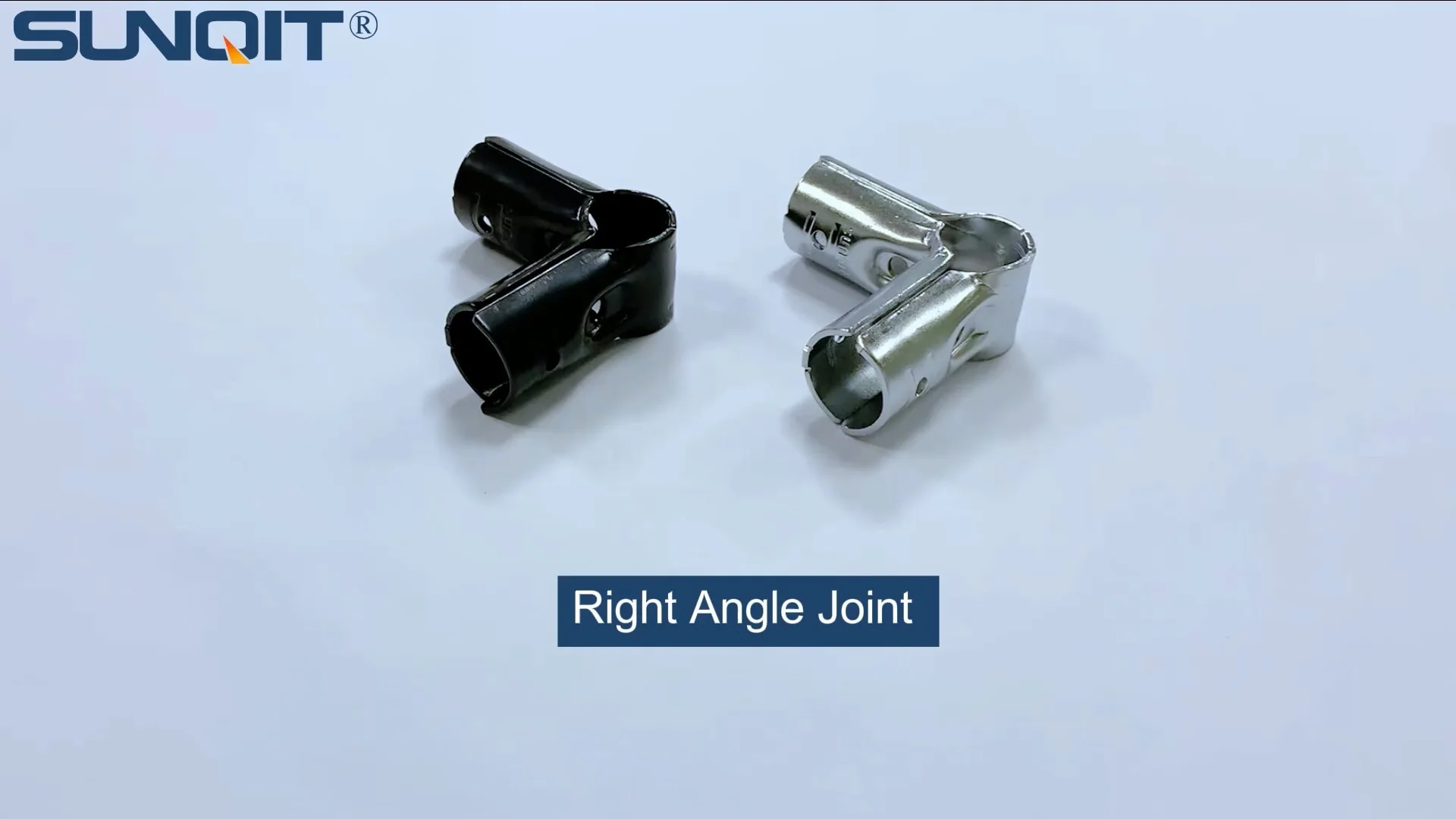
Walk into any manufacturing facility, and you'll notice a silent hero keeping operations moving: the structures that hold tools, transport materials, and organize workspaces. From the workbench where an assembler puts together circuit boards to the flow rack feeding parts to the production line, these systems are the backbone of efficiency. But how are they built? For decades, the default answer was welded connections—strong, permanent, and seemingly unbeatable. But in recent years, a new contender has emerged: the three-way lean pipe joint. Today, we're diving into the cost battle between these two methods, breaking down where your money really goes, and why the choice might not be as straightforward as you think.
Let's start with the basics. Lean pipe —often made of steel or aluminum with a plastic coating—has become a staple in lean manufacturing environments. Paired with joints that snap, twist, or lock into place, it lets teams build everything from workbenches to material racks in hours, not days. Welded connections, on the other hand, involve melting metal to fuse pipes together, creating a rigid structure that's been the industry standard for generations. But "standard" doesn't always mean "cost-effective." Let's unpack the numbers, the hidden expenses, and the long-term impact on your bottom line.
What Are Three-Way Lean Pipe Joints, Anyway?
If you've never seen a lean pipe joint in action, picture this: a metal or plastic connector with multiple openings, designed to fit snugly over the ends of lean pipes. The "three-way" part means it can connect three pipes at once—say, one vertical and two horizontal—without a single drop of welding. These joints come in all shapes: swivel joints that let pipes rotate, fixed joints for stability, and even adjustable joints that can be loosened and repositioned with a hex key. They're the building blocks of modular lean system setups, where flexibility is king.
Modern lean pipe joints are engineered for strength. Take aluminum lean pipe joints, for example—lightweight but tough enough to support heavy tooling on a workbench. Or steel joints with zinc plating to resist rust in damp warehouses. The magic isn't just in their durability, though; it's in their simplicity. A worker with no welding experience can assemble a basic flow rack in under an hour by sliding pipes into joints and tightening a screw. No sparks, no waiting for metal to cool, no grinding down rough edges. Just click, tighten, and done.
Welded Connections: The Old Reliable (But Is It Reliably Costly?)
Welded connections have been around since the 19th century, and for good reason: they create a bond that's hard to beat for sheer rigidity. When a welder fuses two steel pipes together, the result is a single, solid piece of metal. For decades, this was the go-to method for building everything from factory workbenches to industrial shelving. If you needed something that wouldn't budge—even under thousands of pounds of pressure—welding was the answer.
But here's the catch: that rigidity comes with a price. Welding requires skilled labor—certified welders who charge premium rates (often $30–$50 per hour, depending on location). It also demands precision: pipes must be measured, cut to exact lengths, and clamped in place before welding. Any mistake—like a pipe cut half an inch too short—means starting over. Then there's the cleanup: grinding down weld beads, painting to prevent rust, and ventilating fumes to keep the workspace safe. All of this adds time, and in manufacturing, time is money.

Cost Showdown: Breaking Down the Numbers
To really understand the difference, let's compare the two methods across five key cost categories: initial materials, installation labor, maintenance, flexibility, and long-term total cost of ownership (TCO). We'll use a real-world example: building a 10-foot-long flow rack for a small electronics assembly line. This rack needs to hold 50-pound bins of components, with three levels and a roller track to let bins slide easily to workers.
1. Initial Material Costs: Pipes, Joints, and Welding Supplies
First, the upfront cost of materials. For the welded flow rack, you'll need: raw steel pipes (cut to specific lengths), welding rods, flux, protective paint, and grinding discs. Let's say the steel pipes cost $150, welding consumables add $30, and paint/grinding supplies another $20. Total: $200 in materials.
For the lean pipe version, you'll need lean pipes (usually pre-cut to standard lengths, like 4 feet or 6 feet), three-way lean pipe joints, roller track components, and end caps. A typical lean pipe costs $8–$12 per foot, so 10 feet of pipe for the frame would be around $100. Three-way joints cost $5–$8 each; you'll need about 12 joints for the rack, totaling $72. Roller track and end caps add another $50. Total: $222 in materials. On paper, the welded version is cheaper upfront—by $22. But that's just the start.
2. Installation Labor: Time Is Money (and Welders Take a Lot of Time)
Here's where the lean pipe joint starts to pull ahead. Let's calculate labor costs for both methods. For welding:
- Measuring and cutting pipes: 1 hour (general labor, $18/hour)
- Setting up welding equipment (torch, gas, ventilation): 30 minutes ($18/hour)
- Welding the frame (12 joints total, 10 minutes per joint): 2 hours (certified welder, $40/hour)
- Grinding welds and painting: 1 hour (general labor, $18/hour)
Total labor time: 4.5 hours. Total labor cost: (1.5 hours x $18) + (2 hours x $40) = $27 + $80 = $107.
Now for the lean pipe rack:
- Sorting pipes and joints: 15 minutes (general labor, $18/hour)
- Assembling the frame (sliding pipes into joints, tightening screws): 45 minutes (general labor, $18/hour)
- Installing roller track: 30 minutes (general labor, $18/hour)
Total labor time: 1.5 hours. Total labor cost: 1.5 hours x $18 = $27. That's a difference of $80 in labor alone—more than enough to offset the $22 higher material cost for lean pipe. And remember, this is for a small 10-foot rack. Scale up to a 50-foot production line, and the labor gap grows exponentially.
3. Maintenance Costs: When "Permanent" Becomes a Problem
Welded structures are tough, but they're not invincible. Over time, welds can crack—especially if the rack is moved, bumped by forklifts, or exposed to temperature changes. When that happens, you can't just "fix" a weld; you have to cut out the damaged section, re-weld it, and repaint. Let's say a weld on our flow rack cracks after 2 years. Repairing it would take:
- Shutting down the assembly line (1 hour of downtime, costing $200 in lost production)
- Cutting out the cracked weld: 30 minutes (welder, $40/hour)
- Re-welding and grinding: 1 hour (welder, $40/hour)
- Repainting: 30 minutes (general labor, $18/hour)
Total repair cost: $200 + ($40 x 1.5) + ($18 x 0.5) = $200 + $60 + $9 = $269.
Now, imagine the same scenario with a lean pipe rack. If a joint loosens or wears out, you don't need a welder. A worker can simply:
- Loosen the joint with a hex key: 5 minutes
- replace the joint (costing $5–$8): $7
- Tighten the new joint: 5 minutes
Total repair cost: $7 + (10 minutes of labor at $18/hour) = $7 + $3 = $10. No downtime, no expensive labor—just a quick fix. Over 5 years, if the welded rack needs two repairs and the lean pipe rack needs three joint replacements, the welded version costs $538 in maintenance, while lean pipe costs $30. That's a $508 difference.
4. Flexibility: The Hidden Cost of "We Can't Change It"
Manufacturing isn't static. Production lines get reconfigured, product sizes change, and new tools require new workbench layouts. Here's where welded connections fall flat: they're permanent. If your company launches a new product that's taller than the old one, that welded flow rack with a fixed height becomes obsolete. You can't just "raise" the shelves—you have to cut the old rack apart, scrap the materials, and weld a new one from scratch.
Let's quantify that. Suppose after 3 years, your electronics line needs to expand, and you need to add two more levels to your flow rack. For the welded version:
- Scrapping the old rack (labor + disposal): $50
- Buying new materials for the taller rack: $250
- Welding labor for the new rack: $150 (as calculated earlier)
Total cost: $50 + $250 + $150 = $450.
For the lean pipe rack? You just buy two extra sets of pipes and joints ($60 total), loosen the existing joints, add the new levels, and tighten. Labor: 30 minutes ($9). Total cost: $60 + $9 = $69. That's a savings of $381—all because you could reuse 90% of the original materials.

Total Cost Over 5 Years: The TCO Table
Let's wrap all these numbers into a total cost of ownership (TCO) analysis for our 10-foot flow rack over 5 years. This includes materials, labor, maintenance, and one reconfiguration (for the lean pipe rack) or replacement (for the welded rack).
| Cost Category | Three-Way Lean Pipe Joint | Welded Connection |
|---|---|---|
| Initial Materials | $222 | $200 |
| Installation Labor | $27 | $107 |
| Maintenance (5 years) | $30 | $538 |
| Reconfiguration/Replacement | $69 | $450 |
| Total 5-Year Cost | $348 | $1,295 |
The numbers speak for themselves: over 5 years, the welded flow rack costs nearly four times as much as the lean pipe version. And this is for a small, single rack. Scale up to a factory with 10 flow racks, 5 workbenches, and 3 material trolleys, and the savings could top $10,000. That's money that could go toward new equipment, employee training, or expanding production.

But Wait—Is Lean Pipe Strong Enough? Debunking the Myths
We've all heard the objections: "Lean pipe feels flimsy compared to welded steel!" or "Welded racks can hold more weight!" It's true that a fully welded steel structure might support slightly more weight than a lean pipe setup—if both are built with the same gauge of metal. But in most manufacturing scenarios, lean pipe joints are more than strong enough.
Take a standard aluminum lean pipe (1.5mm wall thickness) with a three-way steel joint. Tests show it can support up to 500 pounds per linear foot—more than enough for bins of circuit boards, automotive parts, or even small appliances. For heavier loads, you can upgrade to thicker steel lean pipes (2.5mm walls) or reinforced joints. And because lean pipe systems are modular, you can add extra support beams or vertical pipes if needed—something you can't do with a welded rack without cutting and re-welding.
Another myth: "Lean pipe joints loosen over time." Modern joints—especially those with locking screws or friction-fit designs—stay tight even with daily use. Many manufacturers offer lifetime warranties on their joints, confident that they won't fail under normal conditions. And if a joint does loosen? As we saw earlier, it's a 10-minute fix, not a production-stopping crisis.
Why Lean Pipe Joints Fit the Lean System Mold
At the heart of every lean system is a simple idea: eliminate waste. Waste of time, waste of materials, waste of space. Welded connections create waste in spades: wasted labor (waiting for welds to cool), wasted materials (scrapping mis-cut pipes), wasted space (permanent racks that can't be reconfigured for new layouts). Lean pipe joints, by contrast, are designed to eliminate waste.
Think about it: when you can assemble a workbench in an hour instead of a day, you're cutting down on "lead time waste." When you can reconfigure a flow rack to fit a new product instead of building a new one, you're cutting "overproduction waste." When you don't need to hire a welder for every repair, you're cutting "labor waste." It's no coincidence that lean pipe systems are a cornerstone of Toyota's famous Toyota Production System—the gold standard for lean manufacturing.
In fact, many manufacturers report that switching to lean pipe joints helped them reduce setup times for new production lines by 50% or more. One auto parts supplier we worked with replaced all their welded workbenches with lean pipe setups and saved 12 hours per week in reconfiguration time alone. That's 624 hours per year—time that could be spent training employees, improving quality, or launching new products.
Real-World Example: Small Shop vs. Large Factory
Let's bring this down to earth with two examples: a small machine shop with 5 employees and a large automotive plant with hundreds of workers.
Small Machine Shop: Joe runs a shop that makes custom metal brackets. He needs 3 workbenches and 2 flow racks for materials. With welded connections, he'd pay $200 per workbench in materials, $150 in labor per bench, and $200 per flow rack (materials + labor). Total upfront cost: $3*(200+150) + 2*(200+150) = $1,750. Over 5 years, maintenance and reconfigurations add another $1,200, totaling $2,950. With lean pipe, upfront cost is $3*(150+30) + 2*(222+27) = $3*180 + 2*249 = $540 + $498 = $1,038. Maintenance and reconfigurations add $100, totaling $1,138. Joe saves $1,812—enough to buy a new CNC tool.
Large Automotive Plant: A plant with 20 production lines needs 50 flow racks, 30 workbenches, and 10 material trolleys. Welded setup cost: $50*(200+107) + 30*(200+150) + 10*(150+80) = $50*307 + 30*350 + 10*230 = $15,350 + $10,500 + $2,300 = $28,150. Over 5 years, maintenance and reconfigurations hit $25,000, totaling $53,150. Lean pipe setup: $50*(222+27) + 30*(150+30) + 10*(120+20) = $50*249 + 30*180 + 10*140 = $12,450 + $5,400 + $1,400 = $19,250. Maintenance and reconfigurations: $3,000. Total: $22,250. Savings: $30,900—enough to fund a six-month training program for employees.
So, Which Should You Choose?
Is there ever a scenario where welded connections are better? Maybe—if you're building a structure that will never, ever need to change, in a environment with extreme conditions (like constant vibration or temperatures over 500°F). For example, a steel mill might still use welded racks for molten metal containers. But for 95% of manufacturers—from electronics assembly to food packaging to automotive parts—lean pipe joints are the smarter choice.
They're cheaper over time, easier to install, simpler to maintain, and infinitely more flexible. They align with lean principles, reduce waste, and let you adapt to changing production needs without breaking the bank. And with modern materials and joint designs, they're just as strong as most welded setups for everyday use.
Final Thoughts: It's Not Just About Pipes—It's About Progress
At the end of the day, the choice between three-way lean pipe joints and welded connections isn't just about cost. It's about future-proofing your business. Manufacturing is evolving faster than ever—custom orders, shorter product cycles, and the rise of automation demand flexibility. Welded structures lock you into the past, while lean pipe systems let you pivot, adapt, and grow.
So the next time you're planning a new workbench, flow rack, or material trolley, ask yourself: "Do I want to build something that will cost me time and money every time my needs change? Or do I want something that grows with my business?" For most of us, the answer is clear. Lean pipe joints aren't just a tool—they're an investment in efficiency, adaptability, and the bottom line.