- Company Articles
- Products and Technology
- Application Cases
- Top 5 Applications of 40 Roller Track Placon Mount Flat in 3C Manufacturing

Top 5 Applications of 40 Roller Track Placon Mount Flat in 3C Manufacturing
Related Product
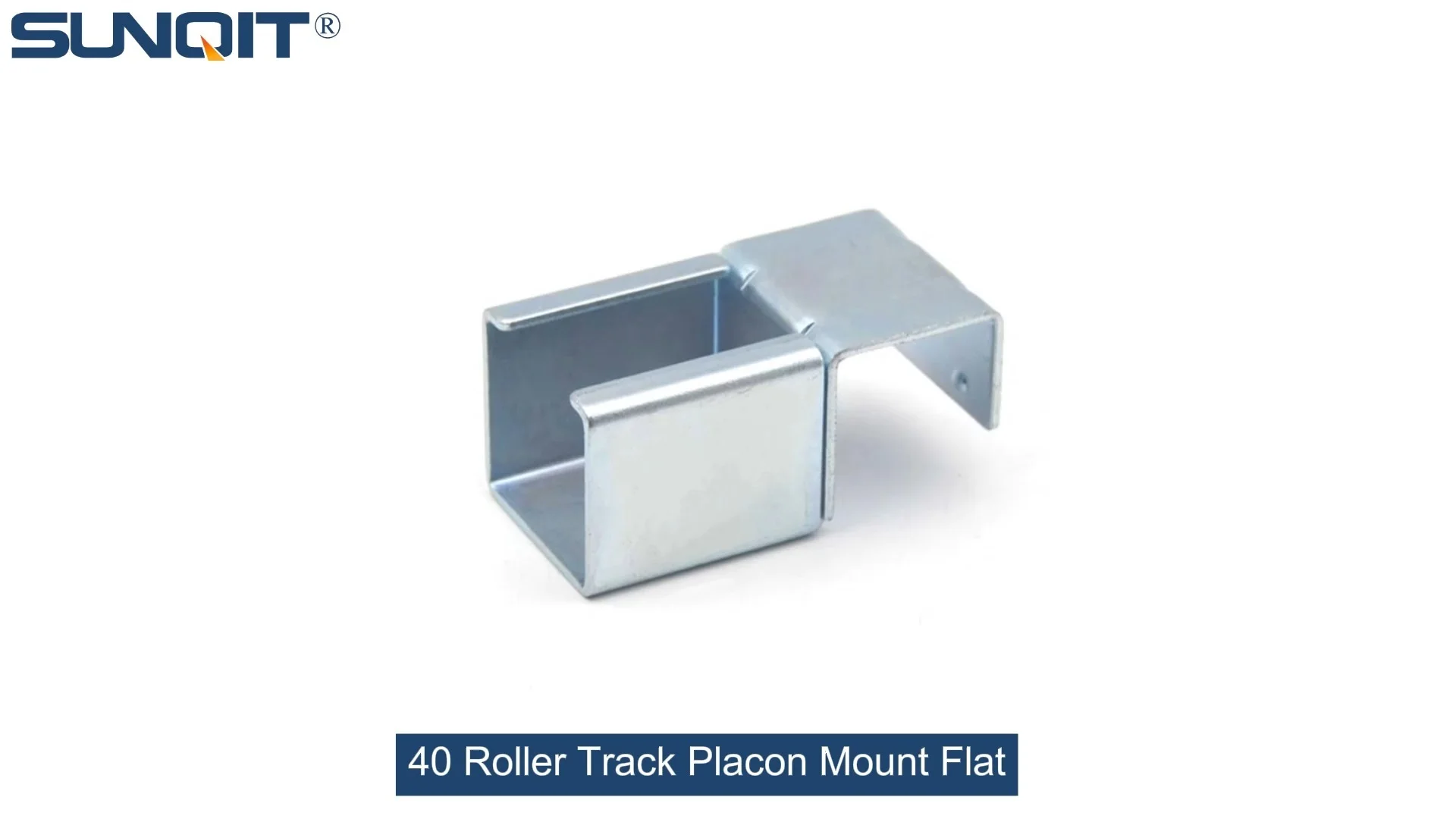
40 Roller Track Placon Mount Flat
Roller track placon mount work as a connector for roller track and pipe or aluminum profile in rack syetem, it is a necessary parts in rack system which widely used in industrial plant and logistic,warehouse storage.
How this component transforms efficiency, flexibility, and precision in the fast-paced world of consumer electronics production
Introduction: The Pulse of 3C Manufacturing
In the dynamic realm of 3C manufacturing—where smartphones, laptops, and wearables evolve faster than the blink of an eye—every second counts. Production lines hum with the urgency of meeting market demands, while workers strive to assemble delicate components with unwavering precision. Here, in this high-stakes environment, the difference between success and stagnation often lies in the tools that bridge human skill and industrial efficiency. Enter the 40 Roller Track Placon Mount Flat —a humble component that has quietly become the backbone of lean operations in 3C factories worldwide. More than just a conveyor track, it's a catalyst for smoother workflows, reduced waste, and the kind of adaptability that lets manufacturers keep pace with innovation.
1. Precision Component Conveyance: The Silent Workhorse of Assembly Lines
Imagine a 3C assembly line where tiny circuit boards, microchips, and connectors need to glide from station to station—no jolts, no delays, no risk of damage. This is where the 40 Roller Track Placon Mount Flat truly shines. Its low-friction roller design ensures that even the most delicate components move with ballet-like grace, minimizing the chance of micro-cracks or misalignment that could render a $500 device useless.
In practice, this translates to tangible results. A leading smartphone manufacturer in Shenzhen reported a 12% reduction in component damage rates after retrofitting their lines with these roller tracks. "Before, we'd spend hours inspecting parts that got jostled during transfer," says Li Wei, a production supervisor there. "Now, the track does the heavy lifting—smooth, consistent, and reliable. Our team can focus on assembly, not fixing preventable mistakes."
Paired with compatible conveyor systems, the 40 Roller Track Placon Mount Flat also syncs seamlessly with automated feeding mechanisms. Whether it's transporting battery modules for laptops or camera lenses for tablets, the track's modular design allows for easy integration with sensors that trigger stop-start functions, ensuring components arrive exactly when the assembler is ready. It's not just about speed—it's about harmony between man and machine.

2. Flexible Workstation Integration: Building Lines That Adapt, Not Just Assemble
3C manufacturing isn't static. One month, a factory might be churning out 10,000 units of a budget smartphone; the next, it's pivoting to a premium model with entirely different assembly requirements. This constant shift demands workstations that can evolve as quickly as product designs—and the 40 Roller Track Placon Mount Flat is the linchpin of this flexibility.
When combined with lean pipe workbench and aluminum profile frames, the roller track transforms into a customizable workstation hub. For example, during the assembly of smartwatches, workers need easy access to small screws and gaskets. By mounting the roller track on the workbench's edge, parts bins can slide along effortlessly, reducing the need for workers to stretch or reach across cluttered surfaces. "It's like having a personal assistant that hands you exactly what you need, exactly when you need it," laughs Zhang Mei, an assembler with five years of experience. "My shoulder pain from reaching for tools? Gone. My focus on the watch in front of me? Sharper than ever."
What's more, the track's compatibility with ESD (Electrostatic Discharge) materials makes it indispensable for handling sensitive electronics. In environments where a single static spark could fry a motherboard, the track's anti-static properties act as a silent guardian, ensuring both product quality and worker safety. It's this attention to detail that turns a workstation from a fixed setup into a dynamic, people-centric space.

3. Smart Warehousing for Small Parts: Where Space Meets Speed
In 3C manufacturing, the battle for efficiency often starts in the warehouse. With thousands of SKUs—from 0.5mm screws to 2-inch display panels—storing and retrieving parts quickly can make or break production timelines. The 40 Roller Track Placon Mount Flat, when integrated into flow rack systems, becomes the key to unlocking "first-in, first-out" (FIFO) efficiency without the need for complex automation.
Consider a typical electronics warehouse where space is at a premium. Traditional shelving forces workers to bend, reach, and search—wasting precious minutes per pick. But with roller track-equipped flow racks, parts slide forward automatically as the front bin is emptied, keeping inventory visible and accessible. A Shanghai-based 3C parts supplier saw their picking accuracy jump from 92% to 99.7% after installing these racks, while pick times dropped by an average of 45 seconds per order. "We used to have two people dedicated to fixing picking mistakes," says Wang Jun, the warehouse manager. "Now, those roles have shifted to optimizing inventory—because the track system does the hard part of keeping things organized."
The track's durability is another unsung advantage. Made from high-grade aluminum, it withstands the daily wear of heavy bins and constant sliding, ensuring a long service life that aligns with the lean principle of sustainable investment. It's not just about storing parts—it's about storing them in a way that respects the rhythm of production.

4. Streamlined Testing & Inspection: Where Precision Meets Peace of Mind
In 3C manufacturing, testing is the gatekeeper between production and market. A single faulty device can lead to costly recalls, damaged reputations, and lost customer trust. That's why testing stations demand the same precision as assembly lines—and the 40 Roller Track Placon Mount Flat delivers here, too.
During quality checks for laptop motherboards, for instance, stability is non-negotiable. The motherboard must lie perfectly flat as probes test its circuits; any wobble could result in false readings or missed defects. The roller track's rigid aluminum frame and smooth-rolling balls ensure that test fixtures glide into place with micron-level accuracy, creating a stable platform for even the most sensitive diagnostic equipment. "Before, we'd spend 10 minutes calibrating the test setup for each board," explains Chen Hao, a QA engineer. "Now, the track positions the fixture automatically. We test 30% more boards per hour, and our defect catch rate has climbed by 18%."
Beyond stability, the track's modularity allows for easy integration with testing software. Sensors along the track can detect when a component is in position, triggering the test sequence automatically. This not only reduces human error but also frees up technicians to focus on analyzing results rather than manually starting tests. It's a small change that adds up to big gains in both speed and reliability.
5. Adaptive Production Line Reconfiguration: The Secret to Staying Ahead
In the 3C industry, yesterday's bestseller is tomorrow's obsolete model. To survive, manufacturers must be able to reconfigure lines in days, not weeks. Here, the 40 Roller Track Placon Mount Flat proves its mettle as a cornerstone of lean solution strategies.
Take the launch of a new tablet model, for example. The production line needs to switch from assembling 10-inch screens to 12-inch ones, requiring longer conveyor paths and adjusted workstation heights. With traditional fixed tracks, this would mean days of downtime for disassembly and reinstallation. But with the 40 Roller Track's modular design—featuring easy-to-connect placon mounts and lightweight aluminum construction—teams can reconfigure the line in hours. "Last quarter, we had to shift from producing smart speakers to AR glasses," recalls Zhao Xin, a plant manager in Guangzhou. "With the roller track system, we had the new line up and running in 18 hours. Our competitors were still planning their reconfigurations when we shipped our first batch."
This adaptability extends beyond physical reconfiguration. The track's compatibility with a range of accessories—from side guides to stop blocks—means it can evolve with changing production needs. Need to add a buffer zone for quality checks? Simply attach a few extra track sections. Want to integrate a new robotic arm? The track's standardized mounting points make it a breeze. It's not just a tool for today's production—it's an investment in tomorrow's innovation.
Comparing the Impact: 40 Roller Track Applications in 3C Manufacturing
| Application Scenario | Core Benefit | Key Products | Typical 3C Use Case |
|---|---|---|---|
| Precision Conveyance | 12-15% reduction in component damage | Conveyor systems, ESD roller wheels | Smartphone circuit board transfer |
| Flexible Workstations | 25% faster workstation reconfiguration | Lean pipe workbench, aluminum profile | Smartwatch assembly stations |
| Smart Warehousing | 45-second average pick time reduction | Flow rack, plastic roller guides | Small component storage (screws, connectors) |
| Testing & Inspection | 30% increase in test throughput | ESD workbench, sensor integration kits | Laptop motherboard diagnostic testing |
| Adaptive Lines | 70% reduction in reconfiguration downtime | Placon mounts, swivel roller balls | AR glasses production line switchover |
Conclusion: More Than a Track—A Partner in Lean Excellence
In the grand scheme of 3C manufacturing, the 40 Roller Track Placon Mount Flat may not grab headlines like the latest AI-powered robot or cutting-edge 3D printer. But for the workers on the floor, the supervisors managing deadlines, and the manufacturers racing to innovate, it's a silent partner that makes excellence possible. It's the difference between a line that stumbles and one that flows, between waste that piles up and processes that hum with efficiency.
As 3C manufacturing continues to evolve—pushing the boundaries of miniaturization, connectivity, and user experience—the tools that support it must evolve too. The 40 Roller Track Placon Mount Flat, with its focus on adaptability, precision, and human-centric design, isn't just keeping up—it's leading the way. Because in the end, lean manufacturing isn't just about machines and metrics. It's about empowering people to do their best work, day in and day out. And that's a goal worth rolling toward.