- Company Articles
- Products and Technology
- Application Cases
- Top Applications of Aluminum Profile 3 Way Connectors in 3C Assembly

Top Applications of Aluminum Profile 3 Way Connectors in 3C Assembly
Related Product
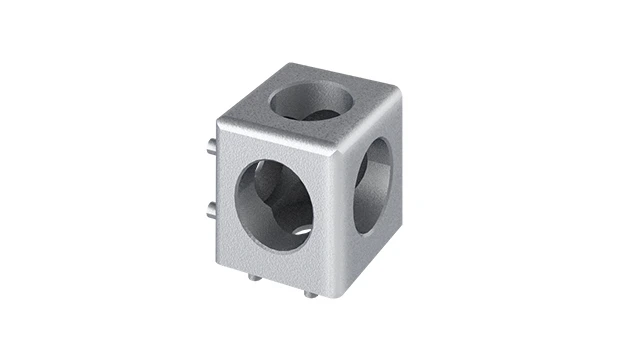
Aluminum Profile 3 Way Connector
The 3 way - squared corner connector is an external fastening method that is typically used to create a corner connection between three profiles. It is a heavy-duty connection that is simple to use and provides a polished look.
In the high-speed world of 3C manufacturing—where smartphones, laptops, and smartwatches roll off production lines by the millions—efficiency isn't just a goal; it's the backbone of survival. Every second saved, every adjustment made, and every dollar optimized can mean the difference between leading the market and falling behind. At the heart of this relentless pursuit of efficiency lies a quiet hero: the aluminum profile 3 way connector. This unassuming component, often overlooked in the chaos of assembly lines, is the unsung architect of the flexible, modular systems that power modern 3C production. Let's dive into how this small but mighty connector is transforming how we build, adapt, and innovate in 3C assembly.
Understanding the Role of Aluminum Profile 3 Way Connectors
Before we jump into applications, let's take a moment to appreciate what makes the aluminum profile 3 way connector so indispensable. In essence, it's the "glue" that holds modular aluminum extrusion profile systems together—but not the messy, permanent kind. These connectors are designed to join three aluminum profiles at precise angles (often 90°, 45°, or 135°) with nothing more than a hex key, no welding, no drilling, and no specialized tools required. Made from lightweight yet durable aluminum alloy, they're built to withstand the daily wear and tear of factory floors while keeping systems lightweight enough to reconfigure by hand.
What truly sets them apart, though, is their flexibility. Unlike traditional welded steel structures—fixed, heavy, and nearly impossible to modify—aluminum profiles paired with 3 way connectors create systems that can be disassembled, reconfigured, and repurposed in hours, not weeks. For 3C manufacturers, where product lifecycles shrink from years to months (and sometimes even weeks), this adaptability is game-changing. Need to shift from assembling 6-inch smartphones to 7-inch tablets? Swap out a few profiles, adjust the connectors, and your line is ready. Launching a new smartwatch with smaller components? Reconfigure your material racks in a morning. This isn't just convenience; it's survival in an industry where change is the only constant.
Real-World Context: The Cost of Rigidity
A leading 3C manufacturer once shared a story that highlights this perfectly. A few years back, they invested in custom steel workbenches for a new smartphone model. Six months later, the model was updated with a larger battery, requiring deeper work surfaces. The steel benches? Useless. They sat in a warehouse, collecting dust, while the company spent $150,000 on new benches. Today, they use aluminum extrusion profiles and 3 way connectors. When the next model update hit, their team reconfigured 80% of the existing workbenches in two days—costing just $5,000 in new profiles and connectors. That's the power of modularity.
Application 1: Modular Workbenches—The Heart of 3C Assembly Lines
Walk into any 3C assembly plant, and the first thing you'll notice is the sea of workbenches. These aren't your average office desks; they're specialized stations where technicians assemble circuit boards, attach screens, test components, and package finished products. And nearly all of them—if the plant is forward-thinking—are built with aluminum profiles and 3 way connectors.
Why? Because 3C assembly demands workbenches that are more than just flat surfaces. They need to integrate tool holders, ESD (electrostatic discharge) mats (critical for protecting sensitive electronics), cable management systems, and even overhead lighting. They need to adjust to different technician heights to reduce fatigue. They need to be mobile (with casters) for line rebalancing, or fixed for stability during precision work. And when a new product comes in with different assembly steps? They need to evolve.
This is where the aluminum profile 3 way connector shines. Let's break down a typical workbench setup: vertical legs (aluminum profiles) connected to horizontal frames (more profiles) using 3 way connectors at the corners. Add a middle shelf for tool storage? Use a 3 way connector to branch off the vertical leg, creating a stable platform. Need to mount a monitor arm for assembly instructions? Attach it to the back frame with a 3 way connector, angled at 90° for optimal viewing. Even accessories like bin rails for small parts or anti-fatigue mat supports can be added by simply clamping onto the profiles via the connectors.
Consider a smartphone assembly workbench. At the start of the line, technicians handle delicate PCBs (printed circuit boards). Here, the workbench might have a static-dissipative top, supported by aluminum profiles connected with 3 way connectors that also hold a small ESD wristband terminal. A few stations down, another workbench is configured for screen attachment—this one has a tilting platform (adjusted via connectors) to reduce neck strain, and a side rail (added with a 3 way connector) for holding adhesive dispensers. Later, a testing station workbench integrates a small conveyor (powered by roller track) for moving devices to the next step, with the conveyor frame bolted to the workbench legs via—you guessed it—3 way connectors.
The beauty? When the next smartphone model requires a wider PCB, the team doesn't need new workbenches. They loosen the connectors, swap out the horizontal profiles for longer ones, re-tighten, and the bench is 6 inches wider. When a technician complains of back pain, they adjust the leg height by repositioning the connectors, raising the work surface by 2 inches. No welding, no cutting, no waiting for a maintenance crew. Just a hex key and 10 minutes of work.

Application 2: Material Handling Racks—From Chaos to Order
In 3C assembly, materials are everything. From tiny screws and capacitors to larger components like batteries and screens, the sheer variety of parts flowing through a plant is staggering. Misplace a batch of camera lenses, and an entire production run grinds to a halt. Store components in hard-to-reach bins, and technicians waste precious minutes rummaging instead of assembling. This is where material handling racks, built with aluminum profiles and 3 way connectors, turn chaos into order.
Traditional material racks are often one-size-fits-all: welded steel shelves with fixed heights, too deep to reach the back, or too shallow to hold bulkier items. They're heavy, hard to move, and impossible to adjust when component sizes change. Enter modular racks built with aluminum extrusion profiles and 3 way connectors. These racks are designed to grow, shrink, and reshape with your needs—all thanks to the flexibility of the connectors.
Let's take a common scenario: a component rack for smartphone batteries. Early in production, the batteries are small—say, 50mm thick—and fit neatly on 6-inch tall shelves. The rack is built with vertical aluminum profiles, connected horizontally with 3 way connectors every 6 inches to form shelves. A few months later, the next phone model upgrades to a thicker battery (70mm). Instead of buying new racks, the team removes the 3 way connectors from the middle shelves, slides them up by 1 inch, and re-tightens. Now the shelves are 7 inches tall, and the batteries fit perfectly. No new steel, no wasted space, just a 20-minute adjustment.
But it's not just about shelf height. 3 way connectors also enable racks with specialized features critical for 3C parts. For example, racks holding small, fragile components (like camera modules) often need dividers to prevent jostling. These dividers can be added by attaching vertical aluminum profiles to the shelf frames via 3 way connectors, creating custom-sized compartments. Racks for heavy items (like laptop chassis) might need reinforced corners—easily achieved by adding a third profile at each joint with a 3 way connector, distributing weight more evenly.
Mobility is another advantage. Many material racks in 3C plants are mounted on casters (another key accessory in the aluminum profile ecosystem) to roll directly to assembly lines, reducing walking time for technicians. The connection between the rack legs and caster mounts? You guessed it: 3 way connectors, ensuring the casters are securely attached while still allowing for easy removal if the rack needs to be fixed in place long-term.
| Feature | Traditional Welded Steel Racks | Aluminum Profile Racks with 3 Way Connectors |
|---|---|---|
| Assembly Time | Days (requires welding, painting) | Hours (tool-free assembly with hex key) |
| Adjustability | None (fixed shelves, welded joints) | Unlimited (shelves, height, and layout modified in minutes) |
| Weight | Heavy (difficult to move without equipment) | Lightweight (can be moved by 2 people) |
| Reusability | Low (welded joints make disassembly destructive) | High (100% reusable; components repurposed for new racks) |
| Cost Over Time | High (replacement needed for new components) | Low (adjustments cost a fraction of new racks) |

Application 3: Integrating Roller Track Systems for Seamless Material Flow
In 3C assembly, parts and products don't just sit on shelves—they move. From PCBs traveling from SMT (surface-mount technology) machines to assembly stations, to finished devices moving to packaging, a smooth material flow is critical to avoiding bottlenecks. Roller track systems are the workhorses here, using gravity or motorized rollers to move items along a path. And while the rollers get all the attention, it's the aluminum profile 3 way connectors that make these systems adaptable and reliable.
Roller track systems need sturdy frames to support the weight of moving items, whether it's a tray of 50 circuit boards or a single laptop. These frames are almost always built with aluminum extrusion profiles, and 3 way connectors are the go-to choice for joining the vertical supports, horizontal rails, and cross-braces that form the track's skeleton. For example, a typical gravity-fed roller track might slope gently downward from a material rack to an assembly workbench. The frame for this track would use vertical aluminum profiles as legs, connected to horizontal profiles (the track rails) via 3 way connectors at the top. Cross-braces, added halfway up the legs with 3 way connectors, prevent swaying when heavy trays pass through.
But the real magic is in the track's adaptability. Let's say a production line needs to add a "merge" point, where two roller tracks feed into one. With traditional steel frames, this would require custom welding and precise alignment—time-consuming and expensive. With aluminum profiles and 3 way connectors? It's a matter of cutting a few extra profiles, using 3 way connectors to create a Y-shaped junction, and attaching the roller track sections to the new frame. The connectors ensure the angles are precise (critical for smooth merging), and if the merge needs to be repositioned later? Loosen the connectors, shift the frame, and re-tighten.
Another common scenario: height adjustments. Roller tracks often need to align with workbench surfaces or material rack shelves, which can vary in height depending on the station. 3 way connectors make it easy to tweak the vertical legs of the track frame. A technician can simply loosen the connector bolts, slide the horizontal track rail up or down the vertical profile, and re-tighten—no cutting, no drilling, just a few turns of a hex key. This is especially useful in mixed-model production lines, where one track might feed into a smartphone assembly station (lower) and another into a tablet station (higher).
Even specialized roller track accessories, like side guides (to keep items from falling off) or end stops (to prevent overshooting), rely on 3 way connectors. Side guides, often made of plastic or aluminum, can be clamped onto the track frame's horizontal profiles using 3 way connectors, adjusted for width to fit different tray sizes. End stops, which cushion items as they reach the end of the track, are mounted on small vertical profiles attached to the frame via—you guessed it—3 way connectors. If a new tray design is wider? Adjust the side guides by sliding the connectors. If items are heavier and need a sturdier end stop? Swap out the small vertical profile for a thicker one, using the same connector.
Case Study: A Smartwatch Assembly Line's Roller Track Makeover
A major 3C manufacturer producing smartwatches was struggling with bottlenecks at their final testing station. The roller track feeding the station was too narrow for the new, larger test trays, causing jams. Their old steel track frame was welded, so adjusting the width meant replacing the entire system—costing $20,000 and taking 3 days of downtime. Instead, they switched to an aluminum profile frame with 3 way connectors. The team loosened the connectors holding the side guides, slid them outward by 2 inches, and re-tightened. Total cost? $0 (they reused the existing profiles and track). Total time? 45 minutes. The line was back up and running the same day, and the new frame was so lightweight they could reposition it later when adding a second testing station.
Application 4: Building Custom Test and Inspection Stations
In 3C manufacturing, "good enough" isn't enough. Every device must undergo rigorous testing—drop tests, water resistance tests, connectivity checks, and more—to ensure quality. These tests require specialized setups: fixtures to hold devices at precise angles, mounts for cameras or sensors, and platforms for simulating real-world use. Building these setups used to mean custom machining or welding, which was slow and expensive. Today, aluminum profile 3 way connectors are changing the game, allowing teams to build test stations in days instead of weeks.
Take a drop test station, for example. To test a smartphone's durability, the device is dropped from a specific height onto a hard surface. The station needs a vertical frame to control the drop height, a clamp to hold the device, and a release mechanism. With aluminum profiles and 3 way connectors, the vertical frame can be built in hours: vertical profiles connected with horizontal cross-braces (using 3 way connectors for stability), a sliding carriage (mounted on T-slot aluminum profiles) to adjust drop height, and a custom clamp attached via—you guessed it—a 3 way connector. If the next phone model is taller, the team can extend the vertical profiles by adding a section with a 3 way connector, increasing the maximum drop height.
Or consider a camera-testing station for laptops. This setup needs to hold the laptop at a 45° angle while a sensor array captures images of the screen and camera output. The station's base is an aluminum profile frame, with a tilting platform supported by two vertical profiles connected via 3 way connectors at the back. The angle can be adjusted by repositioning the connectors, and the sensor array is mounted on a horizontal arm attached to the frame with—you guessed it again—a 3 way connector. When a new laptop model with a different screen size comes in, the platform can be widened by swapping out the horizontal profiles, using the same connectors to attach the new sections.
The best part? These test stations aren't just for big, expensive equipment. Even small, niche tests benefit from modularity. A technician needing to test a smartwatch's heart-rate sensor might build a simple jig with aluminum profiles and 3 way connectors: a base profile, a vertical arm with a 3 way connector, and a small clamp to hold the watch at chest height. No need to wait for engineering to design a custom jig—they can build it themselves in an hour, test the sensor, and then disassemble the jig for parts when the project ends.
Application 5: Supporting Lean System Principles in 3C Assembly
Lean manufacturing isn't just a buzzword in 3C assembly—it's a way of life. The goal? Eliminate waste, optimize flow, and empower teams to continuously improve. Aluminum profile 3 way connectors align perfectly with lean principles, enabling the "5S" methodology (Sort, Set in Order, Shine, Standardize, Sustain) and flexible line design that are cornerstones of lean systems.
Take "Set in Order," for example. In a lean workspace, every tool and part has a designated place to reduce search time. Modular tool boards built with aluminum profiles and 3 way connectors make this easy. A vertical aluminum frame, connected with 3 way connectors to horizontal crossbars, can hold hooks, bins, and tool holders. If a new tool is added, a quick trip to the maintenance room for an extra profile and connector, and the board is updated. No more drilling holes in walls or waiting for custom pegboards.
Or consider "Continuous Improvement" (Kaizen). In lean systems, teams are encouraged to suggest small changes that boost efficiency. A technician might notice that a workbench is too low, causing back strain. With traditional setups, this would require a maintenance request and days of waiting. With aluminum profiles and 3 way connectors? The team can adjust the leg height themselves in 10 minutes by repositioning the connectors. Another example: a line supervisor might propose rearranging workstations to reduce walking distance. Since the workstations are built with modular aluminum frames (held together by 3 way connectors), they can be rolled into a new layout in an afternoon, tested for a week, and adjusted again if needed—all without disrupting production for days.
Even "Waste Reduction" benefits. Traditional manufacturing setups often result in "overproduction" of fixed assets—building more workbenches or racks than needed because they're hard to modify. With modular systems, you build only what you need today, and add on tomorrow. If a product line is discontinued, the aluminum profiles and connectors can be repurposed for other projects, reducing scrap and saving money.
The Future of 3C Assembly: Small Connectors, Big Impact
As 3C manufacturers race to keep up with consumer demand for smarter, faster, and more innovative devices, the tools they use to build these products matter more than ever. The aluminum profile 3 way connector may not grab headlines, but its impact is undeniable. By enabling flexible workbenches, adaptable material racks, seamless roller track systems, custom test stations, and lean workflows, it's not just a component—it's a catalyst for innovation.
Looking ahead, as 3C assembly leans more into automation, IoT integration, and sustainability, the role of modular systems will only grow. Imagine a future where assembly lines reconfigure themselves overnight using AI-driven analytics, with aluminum profiles and 3 way connectors making those changes possible. Or where sustainability goals are met by reusing 90% of factory infrastructure via modular components. In that future, the humble 3 way connector will still be there, quietly holding it all together.
So the next time you pick up your smartphone or power on your laptop, take a moment to appreciate the invisible network of aluminum profiles and connectors that helped bring it to life. In the world of 3C manufacturing, it's the small, flexible, and adaptable solutions that make the biggest waves—and the aluminum profile 3 way connector is riding that wave all the way to the future.