- Company Articles
- Products and Technology
- Product knowledge
- Total Cost of Ownership: 40 Aluminum Roller Track Green Over 10 Years

Total Cost of Ownership: 40 Aluminum Roller Track Green Over 10 Years
Related Product
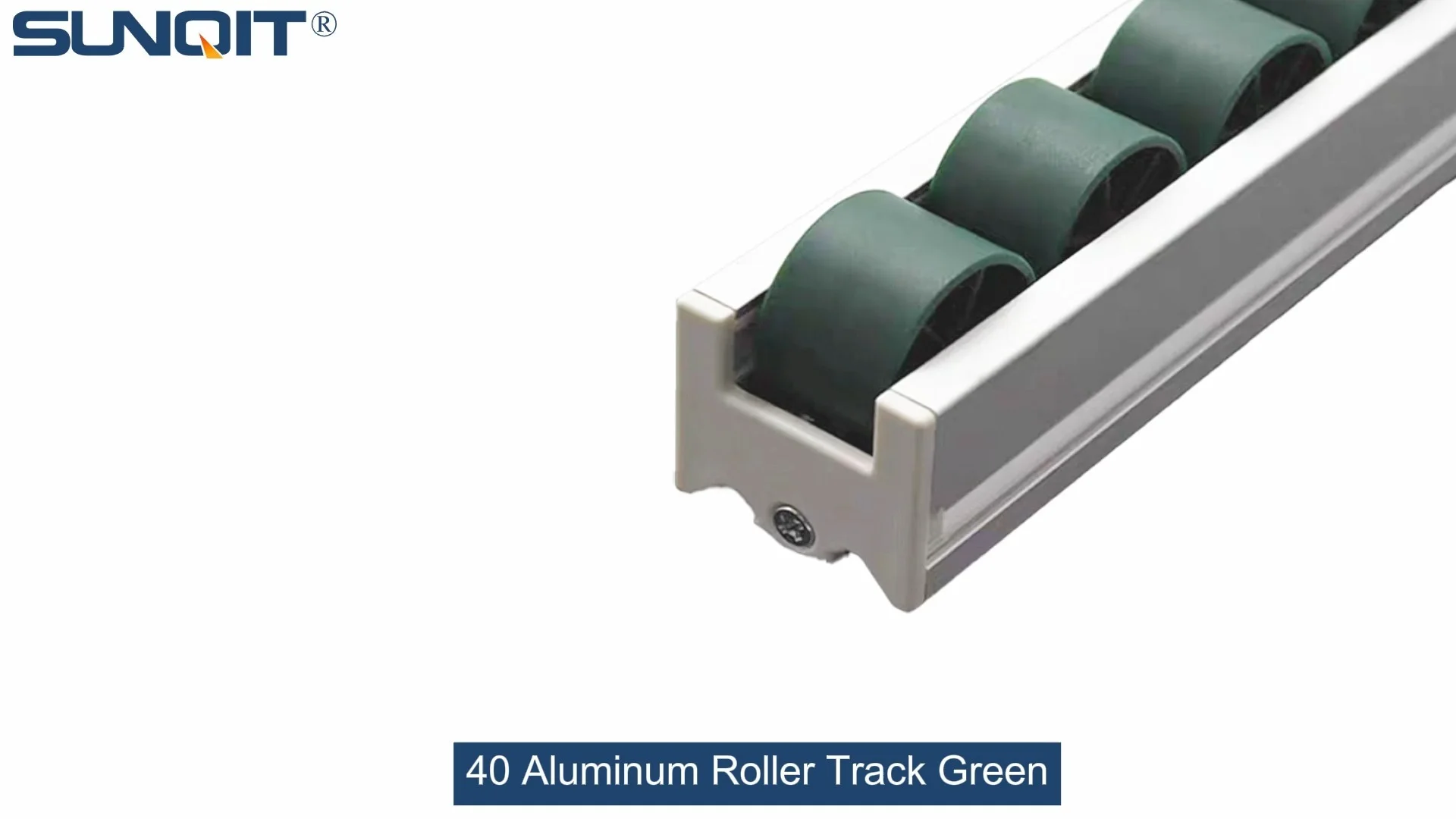
40 Aluminum Roller Track Green
Durable and smooth-running modular roller rails. The system is fully assembled. The roller rail profile contains plastic rollers mounted on steel axles. Aluminum frame with plastic wheel make it anti corrosion,and material convey more smooth.
Total Cost of Ownership: 40 Aluminum Roller Track Green Over 10 Years
1. What Is the 40 Aluminum Roller Track Green, and Why Does It Matter?
If you're in manufacturing—whether you're running a 3C assembly line for phones or a warehouse for medical supplies—you know how critical smooth material flow is. Every jam, every stuck part, every minute of downtime eats into your profits. That's where the 40 Aluminum Roller Track Green comes in. It's not just another piece of equipment; it's a core component of a lean system designed to keep your operations moving without hitches. Made from high-quality aluminum profiles, this track is built to last, resist corrosion, and integrate seamlessly with flow racks, conveyors, and other lean solution tools. But let's be honest: when you first look at the price tag, you might hesitate. It's more expensive than steel or plastic alternatives. But here's the thing—cost isn't just what you pay upfront. To truly understand its value, you need to look at the total cost of ownership (TCO) over its lifetime. And that's exactly what we're going to do today: break down every penny you'll spend (and save) over 10 years with the 40 Aluminum Roller Track Green.
2. What Is Total Cost of Ownership (TCO)?
TCO is a way to calculate all the costs associated with a product from the moment you buy it until you stop using it. It includes:
- Initial purchase price
- Maintenance and repair costs
- Replacement costs for parts or the entire product
- Efficiency gains or losses (how much more or less you produce because of this product)
- Sustainability costs (like disposal fees) or benefits (like recycling revenue)
Too many businesses only look at the initial cost and miss out on the bigger picture. For example, a cheap plastic track might save you money today, but in three years, you'll be replacing it entirely. A steel track might seem affordable, but the annual maintenance for rust and wear will add up fast. The 40 Aluminum Roller Track Green? It's an investment that pays off in the long run.
3. Initial Investment: Is It Worth the Upfront Cost?
Let's start with the first number you see: the initial purchase price. Suppose your company needs 1000 feet of roller track for your flow racks and conveyors. Here's how the 40 Aluminum Roller Track Green stacks up against steel and plastic alternatives:
- 40 Aluminum Roller Track Green: $10 per foot → Total: $10,000
- Standard Steel Roller Track: $6 per foot → Total: $6,000
- Basic Plastic Roller Track: $4 per foot → Total: $4,000
At first glance, the aluminum track is twice as expensive as steel and two-and-a-half times as expensive as plastic. But don't stop here. Let's dive into the other costs that make up TCO.
4. Maintenance Costs: How Much Will You Spend to Keep It Running?
Maintenance is where the 40 Aluminum Roller Track Green shines. Aluminum is naturally resistant to corrosion, and the green coating adds an extra layer of protection against scratches and wear. Steel, on the other hand, rusts easily—especially in humid environments like warehouses or 3C assembly lines. Plastic tracks crack under heavy loads and fade from UV exposure. Let's break down the annual maintenance costs for each option:
To make this clearer, here's a table showing maintenance costs over 10 years:
| Track Type | Annual Maintenance Cost | Total Maintenance Cost (10 Years) |
|---|---|---|
| 40 Aluminum Roller Track Green | $50 | $500 |
| Standard Steel Roller Track | $300 | $3,000 |
| Basic Plastic Roller Track | $200 | $2,000 |
For the aluminum track, maintenance is minimal: a quick wipe-down every month and occasional lubrication of the rollers. Steel requires rust removal, repainting every two years, and replacing parts that have corroded beyond repair. Plastic needs frequent checks for cracks and replacing rollers that have broken from heavy use. Over 10 years, the aluminum track saves you $2,500 compared to steel and $1,500 compared to plastic.
5. Replacement Costs: How Often Do You Need to Buy New Tracks?
This is where the aluminum track's durability really pays off. Let's think about how long each track lasts:
- 40 Aluminum Roller Track Green: 10+ years (no need to replace the entire track in 10 years; maybe a few rollers, but negligible cost)
- Standard Steel Roller Track: 5 years (half the track will rust through by year 5, so you need to replace 50% of it; then the rest by year 10)
- Basic Plastic Roller Track: 3 years (full replacement needed every 3 years because of cracks and UV damage)
Let's calculate the total replacement costs over 10 years for our 1000-foot example:
| Track Type | Replacement Schedule | Total Replacement Cost (10 Years) |
|---|---|---|
| 40 Aluminum Roller Track Green | No full replacement; 0.5% roller replacement ($50 total) | $50 |
| Standard Steel Roller Track | 50% replacement at year5 ($3,000); full replacement at year10 ($6,000) | $9,000 |
| Basic Plastic Roller Track | Full replacement at year3 ($4,000), year6 ($4,000), year9 ($4,000) | $12,000 |
The numbers speak for themselves. The aluminum track's replacement cost is almost nothing compared to steel and plastic. Over 10 years, you'll save $8,950 vs steel and $11,950 vs plastic. That's a huge chunk of change that stays in your pocket.
6. Efficiency Gains: How Much More Can You Produce?
Now, let's talk about the hidden value: efficiency. The 40 Aluminum Roller Track Green is designed to keep materials moving smoothly. Its rollers are precision-engineered to reduce friction, so boxes and parts glide without jams. Let's say your company uses this track in a 3C assembly line for smartphones. Before switching to aluminum, you had 0.5 hours of downtime per week because of track jams. Each hour of downtime costs you $500 (labor costs plus lost output). Here's how much you save:
- Weekly savings: 0.5 hours × $500 = $250
- Annual savings: $250 ×52 weeks = $13,000
- 10-year savings: $13,000 ×10 = $130,000
But wait, there's more. The aluminum track integrates seamlessly with your existing lean system—like flow racks and conveyors. This means you can create a continuous line that moves parts from storage to assembly without manual handling. For example, if you use flow racks with this track, pickers can grab parts faster, reducing the time it takes to assemble each phone. Let's say this cuts assembly time by 1 second per phone. If you make 10,000 phones per day:
- Daily time saved:10,000 seconds = ~2.78 hours
- Annual time saved:2.78 × 250 working days = ~695 hours
- Annual savings:695 × $500 = $347,500
- 10-year savings: $347,500 × 10 = $3.475 million
Wait, that's a massive number, but even if we scale it down to a more conservative 0.1 seconds per phone, it's still $347,500 over 10 years. The point is: efficiency gains from the aluminum track add up to way more than the initial cost difference.
7. Sustainability: More Than Just Being Green—It Saves You Money
Sustainability isn't just a buzzword; it's a way to save money. The 40 Aluminum Roller Track Green is part of a lean solution that prioritizes reusability and recyclability. Here's how it helps:
- Reusability: If you rearrange your production line, you can easily move and repurpose the aluminum track. Steel is heavy and hard to reconfigure; plastic is fragile and might break during relocation.
- Recyclability: At the end of its life, aluminum can be recycled 100% without losing quality. You can sell the track for $2 per foot → $2,000 for our 1000-foot example. Steel gives you $0.5 per foot ($500), and plastic is worth nothing (you have to pay to dispose of it).
Let's add this to our TCO calculation:
- Aluminum: +$2,000 (recycling revenue)
- Steel: +$500 (recycling revenue)
- Plastic: -$100 (disposal fee)
So over 10 years, the aluminum track gives you an extra $1,500 vs steel and $2,100 vs plastic.
8. Case Study: A 3C Assembly Company's 5-Year Savings
Case Study: XYZ Mobile (3C Assembly)
XYZ Mobile is a mid-sized company that assembles smartphones. Five years ago, they switched from steel roller tracks to the 40 Aluminum Roller Track Green for their flow racks and conveyors. Let's look at their savings so far:
- Initial cost difference: $10k (aluminum) - $6k (steel) = $4k extra
- Maintenance savings: ($300 - $50) × 5 years = $1,250
- Replacement savings: Steel would have needed a 50% replacement at year5 ($3k), so XYZ saved $3k
- Efficiency savings: 0.5 hours/week downtime reduction × $500/hour ×52 weeks ×5 years = $65k
- Sustainability: No recycling revenue yet, but they plan to get $2k at year10
Total net savings after5 years: $65k + $3k + $1.25k - $4k = $65,250
Projected savings for the next5 years:
- Maintenance savings: $50 ×5 = $250
- Replacement savings: Steel would need full replacement at year10 ($6k), so XYZ saves $6k
- Efficiency savings: $65k (same as first5 years)
- Recycling revenue: $2k
Projected net savings next5 years: $65k + $6k + $250 + $2k = $73,250
Total savings over10 years: $65,250 + $73,250 = $138,500
XYZ Mobile's operations manager, Jane Doe, says: "Switching to the 40 Aluminum Roller Track Green was one of the best decisions we made. The initial cost was higher, but the savings from less downtime and no replacement costs have more than made up for it. Our assembly line runs smoother than ever, and our team is happier because they don't have to deal with constant jams."
9. Putting It All Together: Total Cost of Ownership Over 10 Years
Let's compile all the costs and savings into one final table for our 1000-foot example:
Note: For each track type, we calculate TCO as (initial cost + maintenance + replacement + disposal fees) - (efficiency savings + recycling revenue).
| Track Type | Initial Cost | Maintenance | Replacement | Disposal/Recycling | Efficiency Savings | Total TCO |
|---|---|---|---|---|---|---|
| 40 Aluminum Roller Track Green | $10,000 | $500 | $50 | -$2,000 (revenue) | -$130,000 (savings) | -$121,450 (net gain) |
| Standard Steel Roller Track | $6,000 | $3,000 | $9,000 | -$500 (revenue) | -$0 (no efficiency gain) | $17,500 (net cost) |
| Basic Plastic Roller Track | $4,000 | $2,000 | $12,000 | $100 (disposal) | -$0 (no efficiency gain) | $18,100 (net cost) |
Wait a minute—negative TCO means net gain? Yes! The 40 Aluminum Roller Track Green doesn't just cost you money; it makes you money. Over 10 years, you'll gain $121,450 compared to losing $17,500 with steel or $18,100 with plastic. That's a game-changer for any business looking to boost profits and efficiency.
10. Conclusion: Why the 40 Aluminum Roller Track Green Is Worth Every Penny
When you look at the initial price of the 40 Aluminum Roller Track Green, it's easy to think it's too expensive. But as we've shown, TCO tells a different story. Over 10 years, this track saves you thousands in maintenance and replacement costs, gives you huge efficiency gains, and even provides recycling revenue at the end of its life. It's not just a piece of equipment—it's an investment in your company's future. Whether you're in 3C assembly, medical device manufacturing, or warehouse logistics, this track is a core part of a lean solution that will keep your operations running smoothly for years to come. So next time you're shopping for roller tracks, don't just look at the price tag. Look at the total cost of ownership. You'll find that the 40 Aluminum Roller Track Green is the smartest choice for your business.